
How to Wear a Respirator
This document explains how to wear a respirator correctly, focusing on the N95 filtering facepiece respirator. Following these steps ensures the mask is positioned properly, forms an effective seal, and is removed and stored safely. An N95 mask is a disposable respirator designed to protect against airborne particles, but it does not protect against gases.
Video: N95 Respirator - How to Put on and Use | Mask, OSHA, Smoke, Respiratory Protection by Oregon Occupational Safety & Health (Oregon OSHA) (2020). All credit for the demonstration goes to the creator; watch the original on YouTube. The written guide below was generated from this video by Docsie. Creator? Request a change or removal.
This document explains how to wear a respirator correctly, focusing on the N95 filtering facepiece respirator. Following these steps ensures the mask is positioned properly, forms an effective seal, and is removed and stored safely. An N95 mask is a disposable respirator designed to protect against airborne particles, but it does not protect against gases.


Purpose
This procedure describes how to wear a respirator so that it provides the intended level of protection. It covers putting the mask on, checking for a proper seal, and removing it safely after use.
Scope
This procedure applies to anyone required to wear an N95 filtering facepiece respirator for protection against airborne particles.
Required equipment and PPE
- N95 filtering facepiece respirator (disposable mask)
- Manufacturer's instructions for use, maintenance, cleaning, care, and limitations
Safety note: Always read and follow the manufacturer's instructions for use, maintenance, cleaning and care, and warnings about limitations before wearing the respirator.
Review the general instructions before use
Before putting on the respirator, review the manufacturer's guidance in these areas:
- Use
- Maintenance
- Cleaning and care
- Warnings about limitations
Always follow the instructions supplied with your specific respirator, since requirements can vary by manufacturer.
Position the mask on your face
- Using one hand, place the respirator on your face with the nose piece resting at your fingertips.
- Allow the straps to hang freely while you position the mask.
- Make sure the nose piece spans and covers the bridge of your nose.
- The respirator should cup your chin.
Secure the straps
- Pull the top strap over your head and rest it high on the back of your head.
- Pull the bottom strap over your head and position it around your neck, below your ears.
Safety note: Do not crisscross the straps.

Verify correct strap placement and seal the nose piece
- Confirm that your mouth and nose are fully covered by the respirator.
- If the mask has a metal nose piece or strip, use both hands to mold it to the shape of your nose for a proper seal.
Safety note: Do not crisscross the straps, as shown in the incorrect example below. Crisscrossed straps compromise the fit of the respirator.
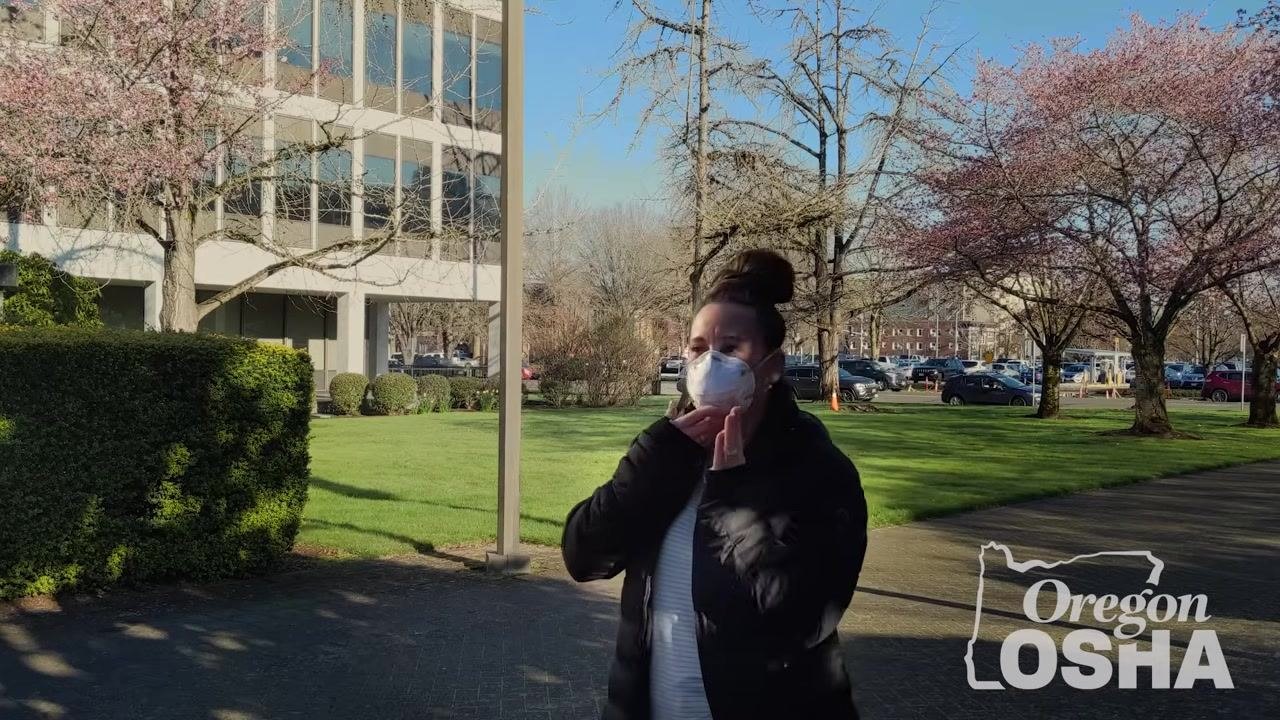
Perform a seal check
Each time you put on the respirator, check that it is properly positioned by confirming there is no air leaking between your face and the mask.
- Place both hands over the mask and exhale sharply.
- Check for air leaks around the edges of the mask.
- If you feel air leaking, adjust the mask and straps for a better fit and repeat the seal check.
Perform positive and negative pressure seal checks
Positive pressure check: - Cover the entire surface of the respirator with both hands to prevent air from passing through the filtering facepiece. - Gently exhale. - Confirm that the facepiece bulges slightly, which indicates a good seal.
Negative pressure check: - With your hands still covering the respirator, take a quick, deep breath in. - Confirm that the facepiece collapses slightly, which also indicates a good seal.
Safety note: If you feel air blowing through the seal on your face or around your eyes during either check, the respirator may not fit properly. Readjust the mask and straps and repeat the seal checks until you achieve a proper seal.

Remove the respirator
- Cup the respirator in your hand to maintain its position on your face.
- Pull the bottom strap over your head first.
- While still holding the respirator in place, pull the top strap over your head.
- Remove the respirator from your face.
Store or dispose of the respirator
- If you plan to reuse the respirator, store it away from contaminated areas.
- Before reusing it, inspect the respirator for any damage or missing parts.
- Dispose of the respirator immediately if it is damaged, has missing parts, is contaminated, or if you sense restriction to your breathing.
Verification and summary
Before each reuse of the respirator, confirm the following:
- No signs of damage or missing components are present.
- The respirator has not been contaminated.
- Breathing through the respirator feels normal, with no restriction.
Dispose of the respirator if any of these conditions are not met. By following this procedure each time you wear an N95 mask, you ensure it is put on correctly, forms a proper seal, and is handled safely before, during, and after use. Always refer to the specific instructions provided with your respirator and your workplace safety guidelines for additional information.

Generation details: cost, quality tiers
Docsie billed 1,500 credits ($1.05) to analyze this 3-minute video at standard quality. The rewrite, template fill and Word/PDF exports were included. The same video at each quality tier:
| Quality | Frames sampled | Credits | Approx. cost |
|---|---|---|---|
| Draft | every 16-30 s | 750 | $0.52 |
| Standard (this guide) | every 8-15 s | 1,500 | $1.05 |
| Detailed | every 4-7 s | 3,000 | $2.10 |
| Ultra | every 1-3 s | 6,000 | $4.20 |
Credits priced at $0.70 per 1,000; plans include a monthly allowance. Enterprise customers on on-premise or bring-your-own-model deployments run this on their own inference and pay no per-video credits.
Generated by Docsie Video-to-Docs on 2026-09-28 from a 2-minute video. Screenshots are frames from the source video and belong to their creator, Oregon Occupational Safety & Health (Oregon OSHA), whose original is embedded above. If you own this video and want the guide removed or credited differently, contact us and we will act within one business day.