
How to 5s Audit Checklist
A 5S audit checklist is the primary tool used to evaluate and sustain the fifth pillar of the 5S methodology, "Sustain." This document explains how to build, apply, and maintain a 5S audit checklist so that workplace organization standards are verified consistently, objectively, and with minimal disruption to daily operations. Use this checklist framework whenever you plan, schedule, or conduct a 5S (or extended 6S) audit in your area.
Video: 5S Audit - Overview of the Audit Form 📋 | Opexity by Opexity (2024). All credit for the demonstration goes to the creator; watch the original on YouTube. The written guide below was generated from this video by Docsie. Creator? Request a change or removal.
A 5S audit checklist is the primary tool used to evaluate and sustain the fifth pillar of the 5S methodology, "Sustain." This document explains how to build, apply, and maintain a 5S audit checklist so that workplace organization standards are verified consistently, objectively, and with minimal disruption to daily operations. Use this checklist framework whenever you plan, schedule, or conduct a 5S (or extended 6S) audit in your area.
Scope & Purpose
This checklist applies to any area covered by an implemented 5S system and is used to verify ongoing compliance with 5S standards, not to assign blame.
Key principles that define the scope of a 5S audit:
- An audit is not the same as control. An audit is carried out based on a plan, and its aim is to ensure compliance with the implemented system.
- The purpose of an audit is to maintain implemented standards and drive continuous improvement.
- The purpose of control, by contrast, is to find irregularities and punish those responsible — this is not the intent of a 5S audit.
- The audit is connected with the area being reviewed, not with specific people or processes.
- The most important feature of a 5S audit is independence, which comes from the auditor's objectivity.
Use this checklist on a regular, recurring basis rather than as a one-time event, since audits only achieve their desired results when performed consistently across every area covered by the 5S system.
Reference Documents
Before conducting an audit, confirm the following reference materials are current and available:
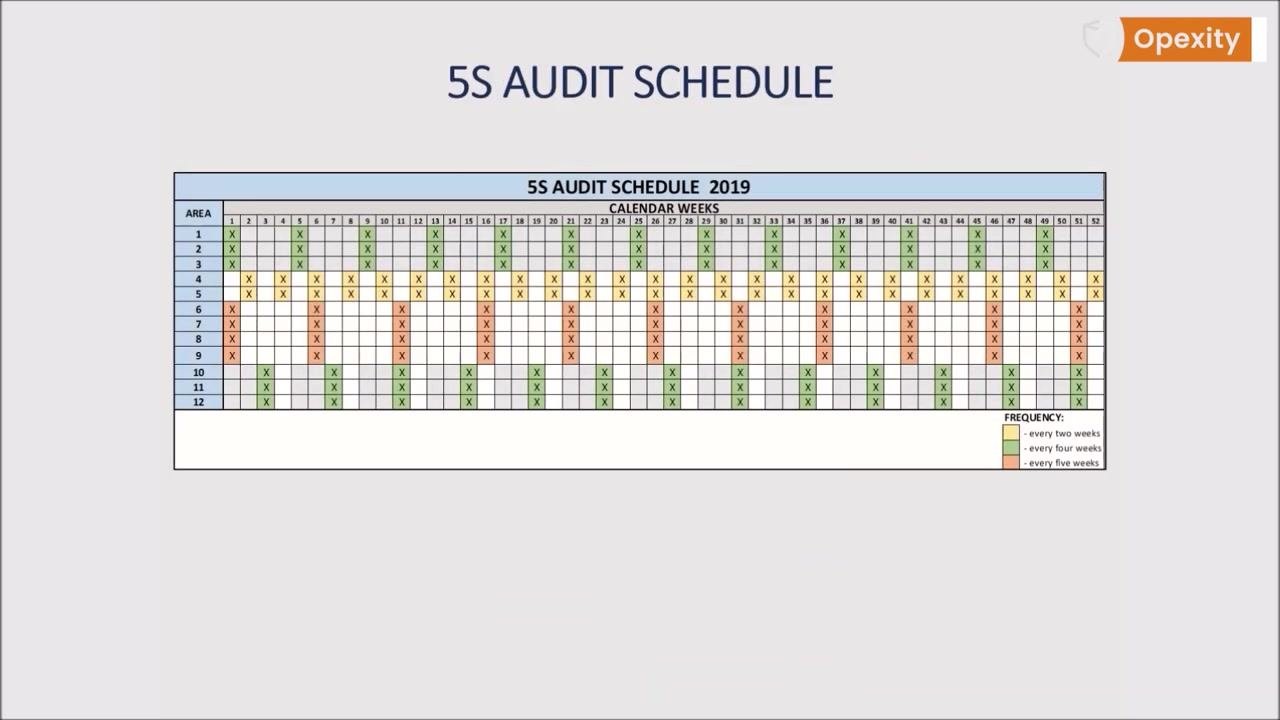
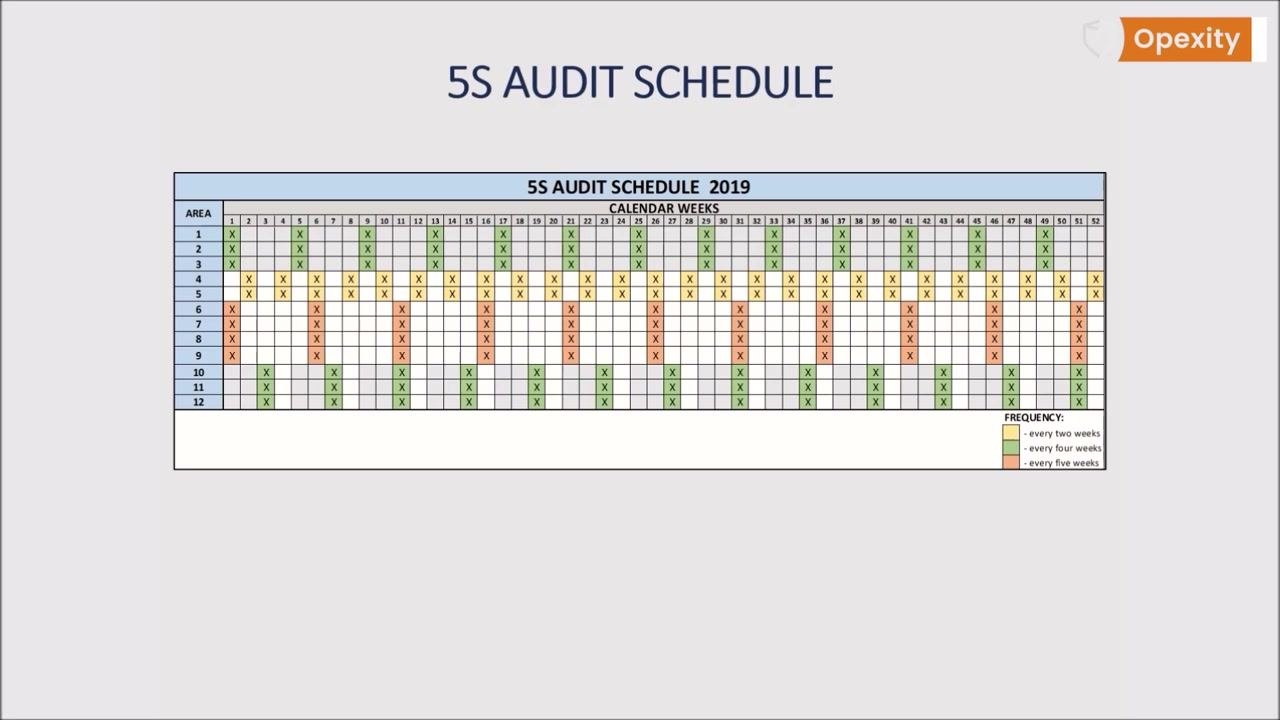
- 5S Audit Schedule — a plan indicating a general time frame (week number or month) for auditing each area. Avoid overly precise dates so the schedule remains flexible and supports daily, organization-wide improvement rather than improvement limited to scheduled events.
- Current 5S standards for each audited area — auditors must have knowledge of these standards and understand the principles of the 5S system.
- 5S Audit Form — the checklist document used during the audit itself (detailed below).
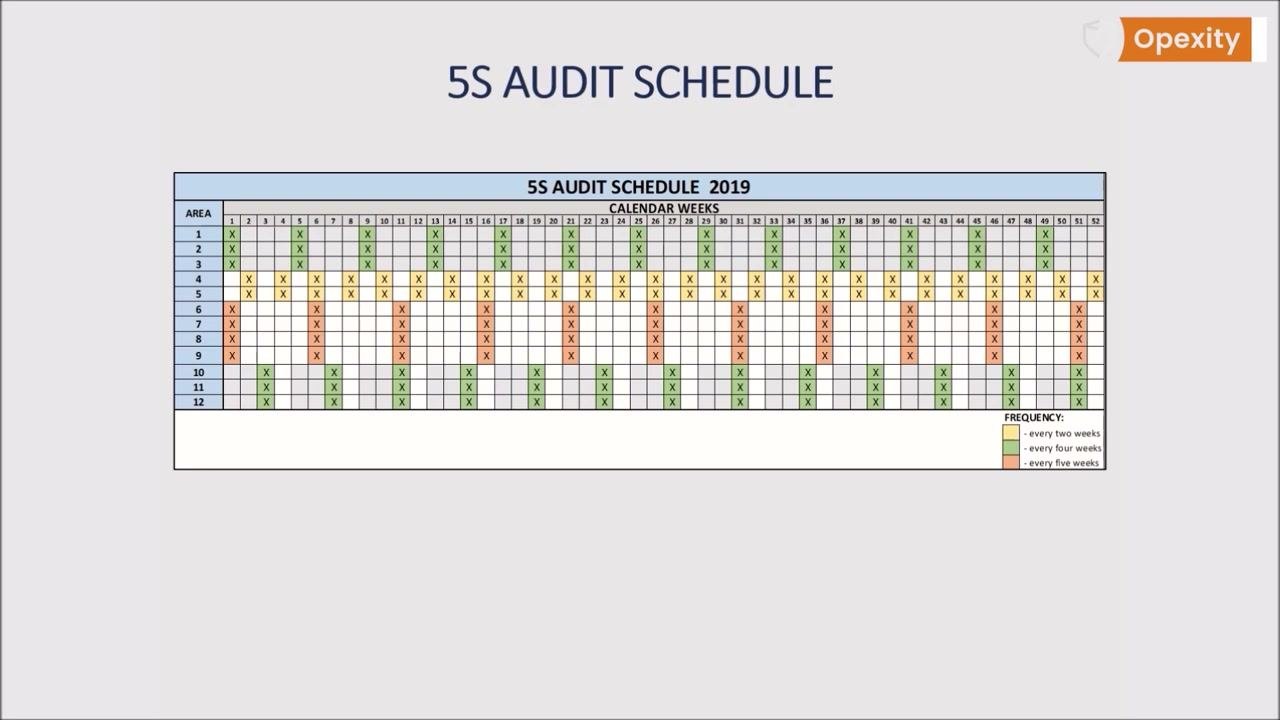
Color coding on the schedule communicates frequency at a glance:
- Green: audit every two weeks
- Yellow: audit every four weeks
- Orange: audit every five weeks
Share the schedule with all relevant personnel so everyone understands when audits may occur, while emphasizing that it is a guideline rather than a strict timetable.
Equipment Required
No specialized measuring instruments are needed to conduct a 5S audit. The essential tools are documentation-based:
- 5S Audit Form — prepared in advance, simple and not overly complicated, to maximize effectiveness.
- Scoring key — a defined key stating the number of points assigned to each desired state (for example, 0 = standard does not exist, 5 = standard observed everywhere).
- Sufficient time allotted per area: the audit should be designed to be completed in several minutes to several dozen minutes, depending on the size of the area.
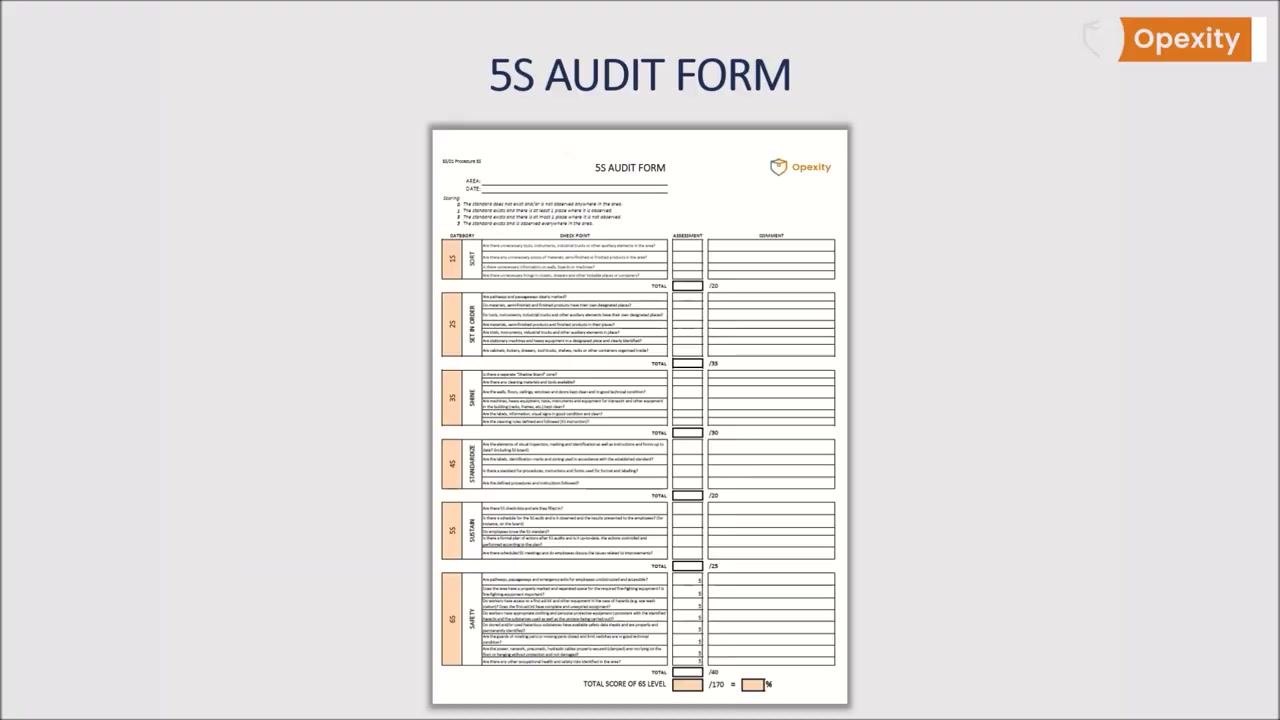
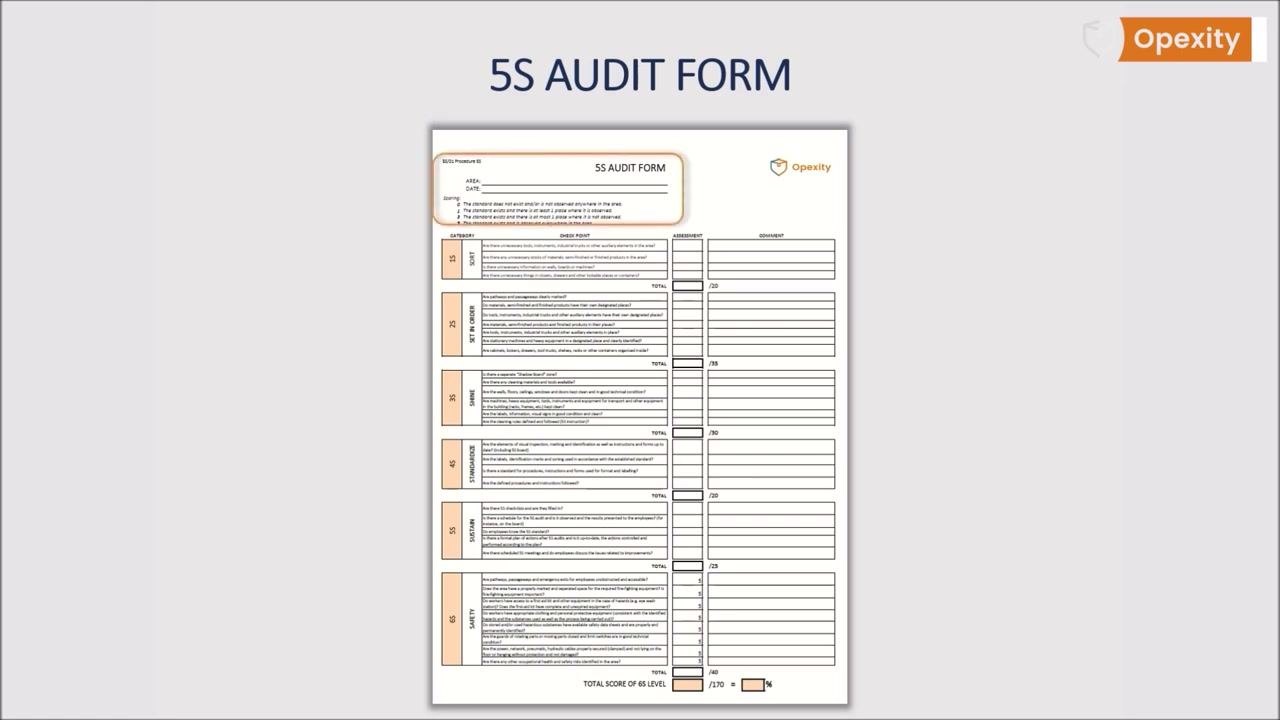
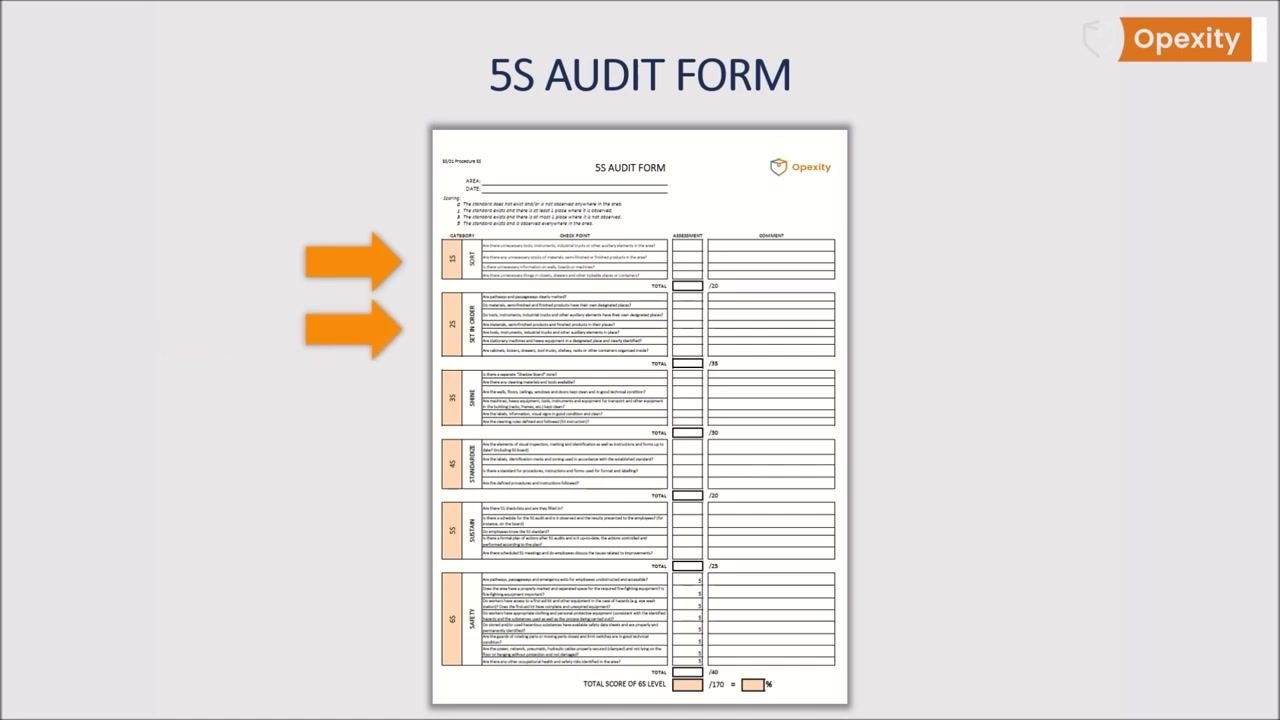
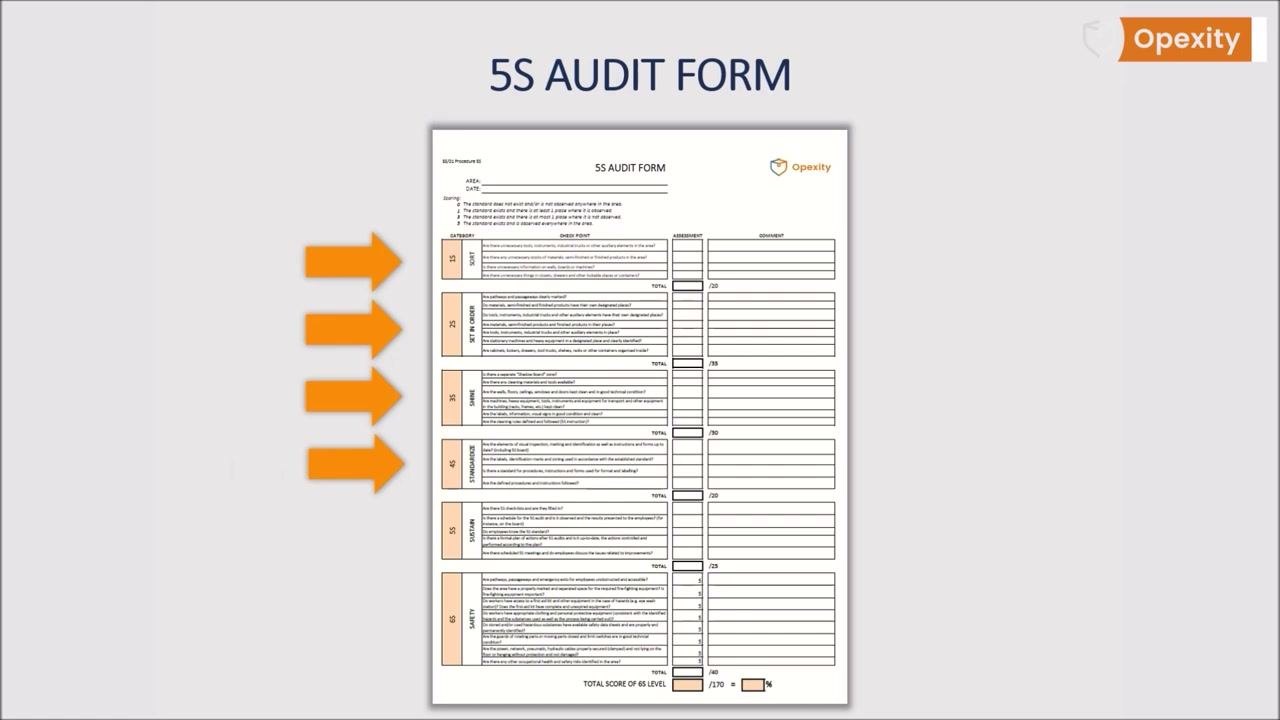
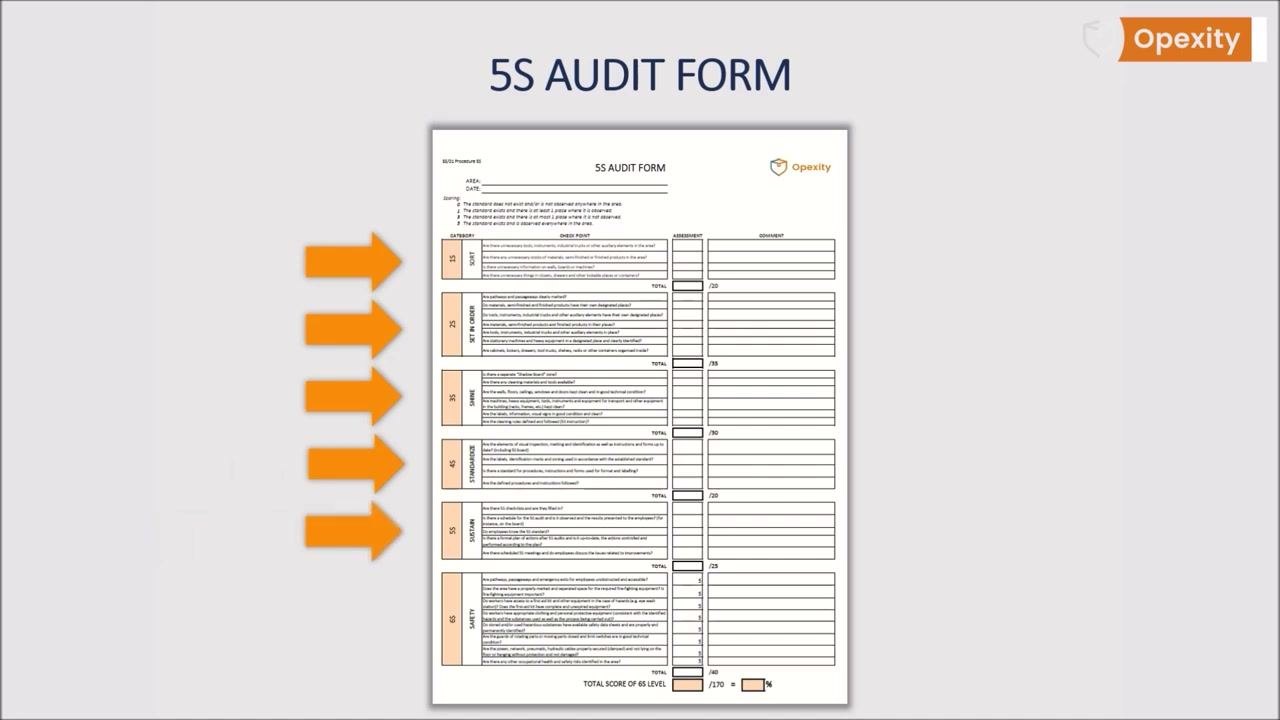
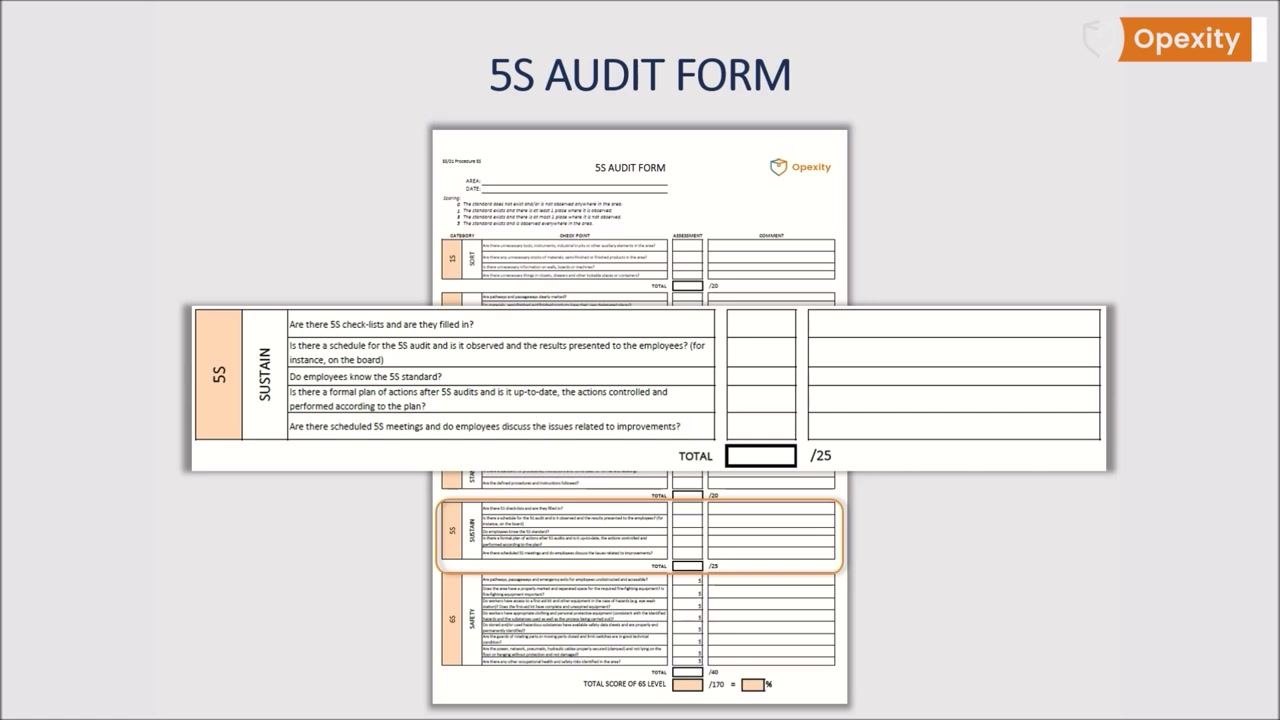
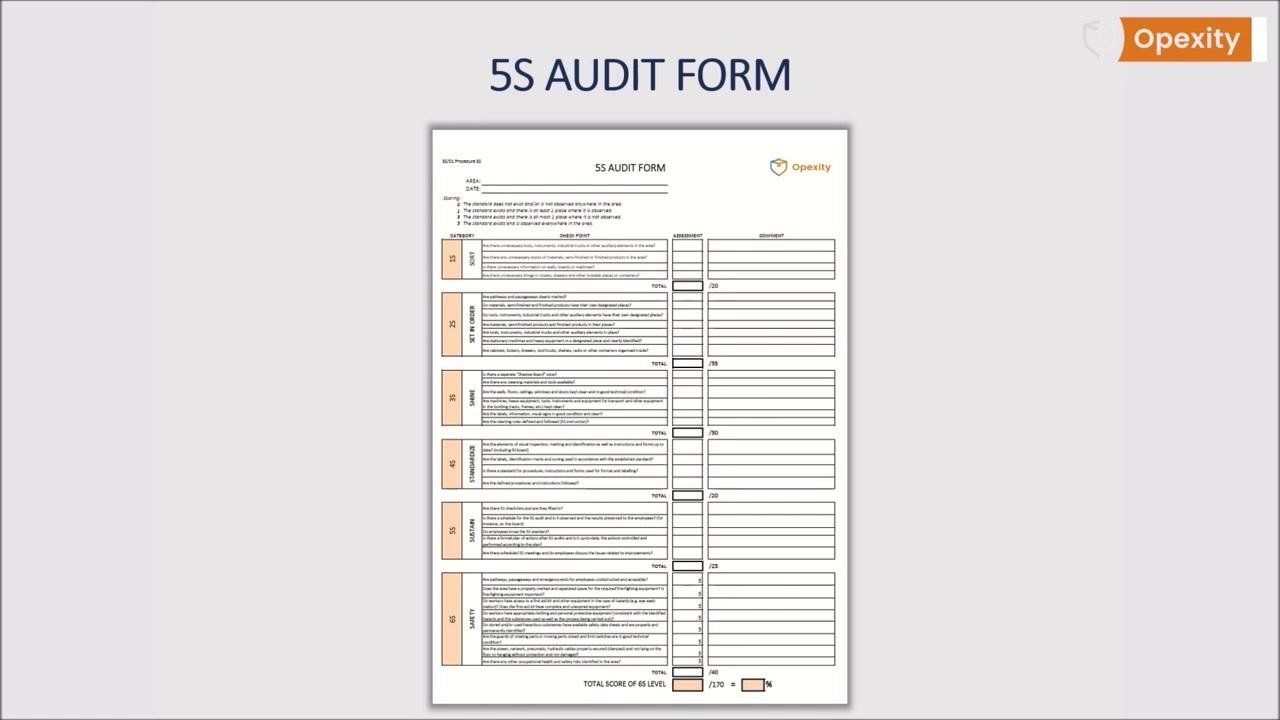
The form should contain all elements needed for a self-contained audit: area and date fields, clear scoring criteria, checklist questions for each 5S category, assessment and comment sections, and a total score calculation for the overall 5S level.
Inspection Points
Divide the 5S audit checklist into five thematic sections corresponding to the 5S methodology, each with targeted questions used to objectively assess compliance.
1S – Sort
| Characteristic | Specification | Method (example question) | Sample scope |
|---|---|---|---|
| Sort | No unnecessary tools, instruments, industrial trucks, or auxiliary elements present | Are there unnecessary tools, instruments, industrial trucks, or other auxiliary elements in the area? | Whole audited area |
| Sort | No unnecessary stock | Are there any unnecessary stocks of materials, semi-finished, or finished products in the area? | Whole audited area |
| Sort | No unnecessary information displayed | Is there unnecessary information on walls, boards, or machines? | Walls, boards, machines |
| Sort | No unnecessary items stored | Are there unnecessary things in closets, drawers, and other lockable places or containers? | Closets, drawers, containers |
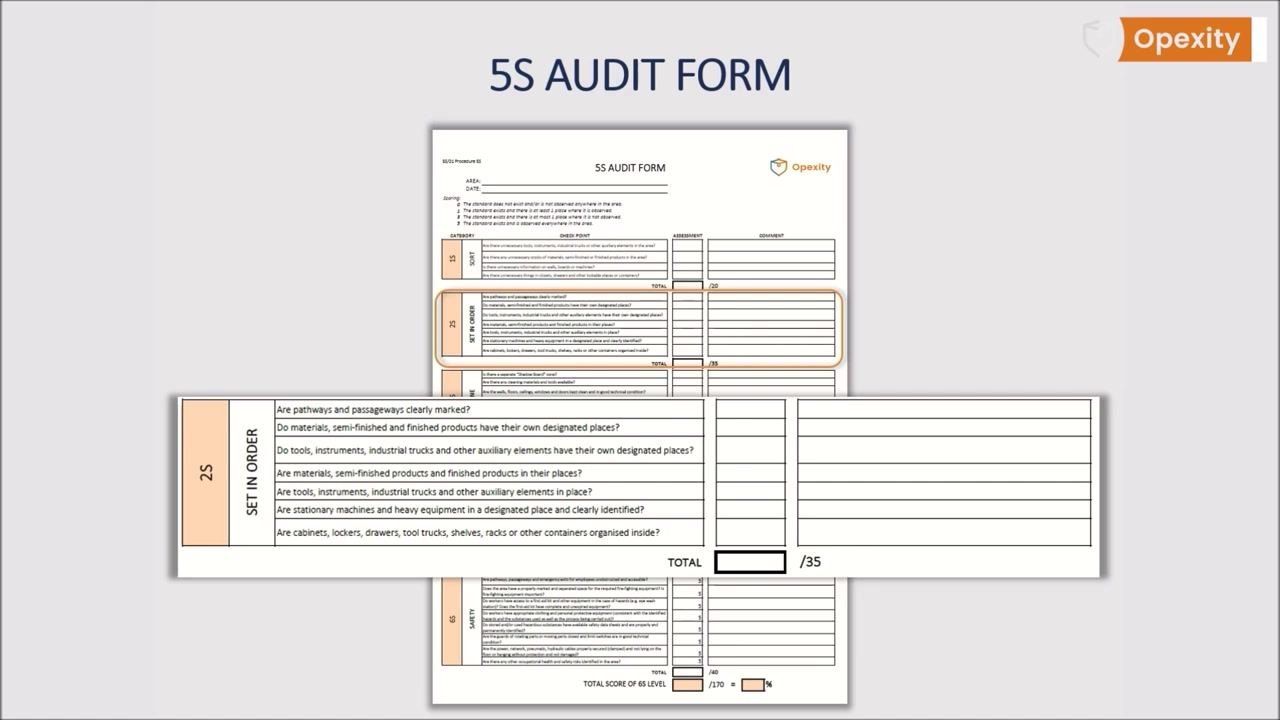
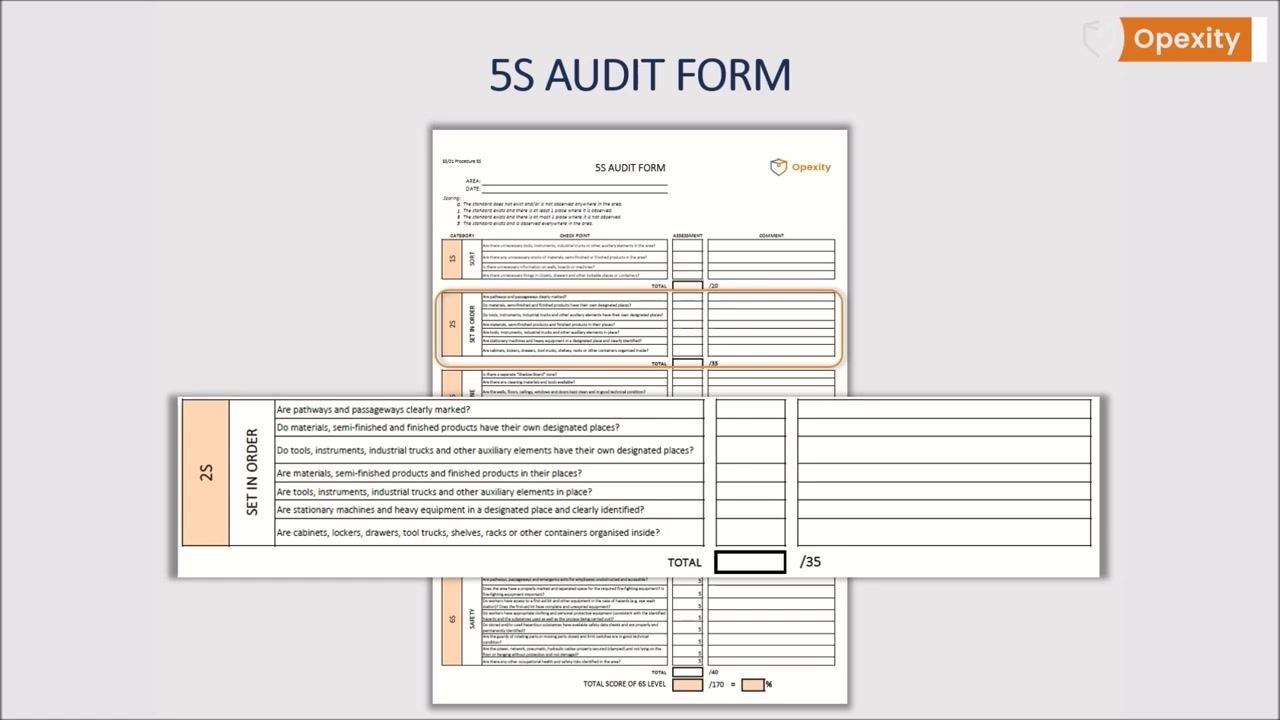
2S – Set in Order
| Characteristic | Specification | Method (example question) | Sample scope |
|---|---|---|---|
| Set in Order | Pathways clearly marked | Are pathways and passageways clearly marked? | Floor markings |
| Set in Order | Designated storage locations exist | Do materials, semi-finished, and finished products have their own designated places? | Storage areas |
| Set in Order | Tools and equipment have assigned places | Do tools, instruments, industrial trucks, and other auxiliary elements have their own designated places? | Tool storage |
| Set in Order | Items located correctly | Are materials, semi-finished products, and finished products in their places? | Storage areas |
| Set in Order | Machines and equipment identified | Are stationary machines and heavy equipment in a designated place and clearly identified? | Machine locations |
| Set in Order | Organized containers | Are cabinets, lockers, drawers, tool trucks, shelves, racks, or other containers organized inside? | Storage furniture |
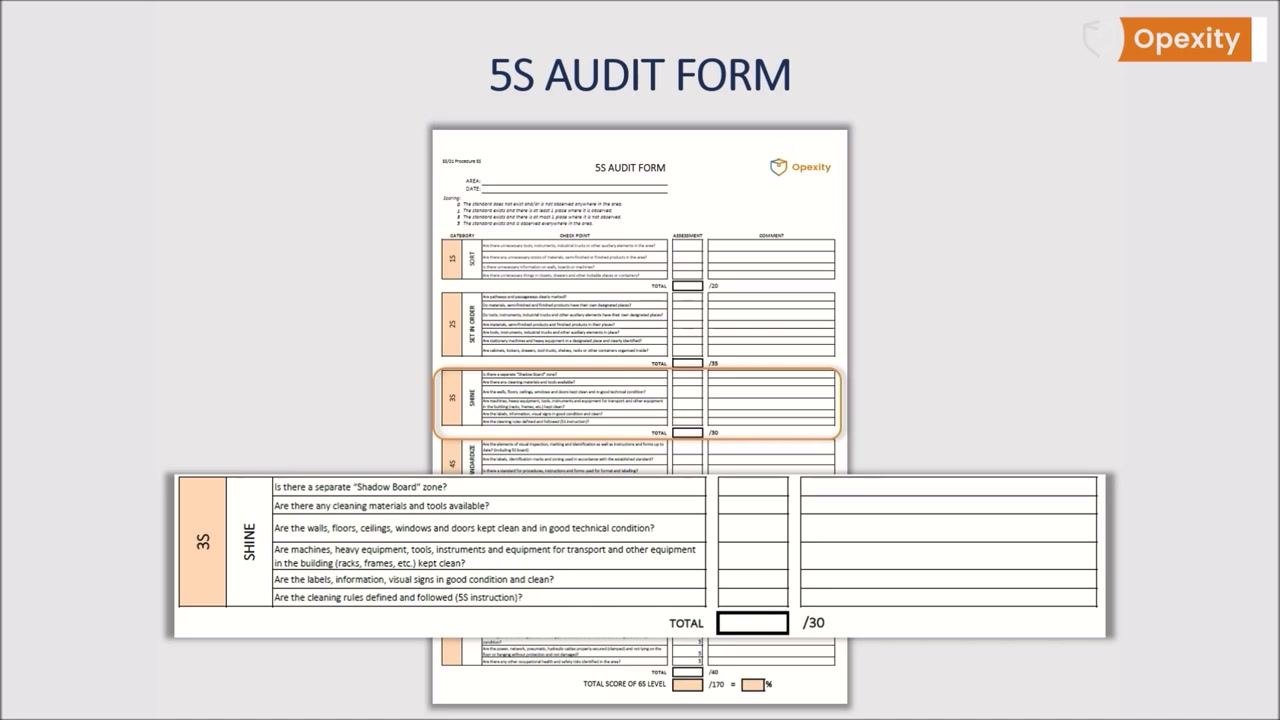
3S – Shine
| Characteristic | Specification | Method (example question) | Sample scope |
|---|---|---|---|
| Shine | Shadow board zone exists | Is there a separate "Shadow Board" zone? | Tool area |
| Shine | Cleaning supplies available | Are there any cleaning materials and tools available? | Cleaning stations |
| Shine | Facility in clean, good condition | Are the walls, floors, ceilings, windows, and doors kept clean and in good technical condition? | Whole area |
| Shine | Equipment kept clean | Are machines, heavy equipment, tools, instruments, and equipment for transport kept clean? | Machines and equipment |
| Shine | Signage clean and legible | Are the labels, information, and visual signs in good condition and clean? | Signage |
| Shine | Cleaning rules followed | Are the cleaning rules defined and followed (5S instruction)? | Cleaning procedure |
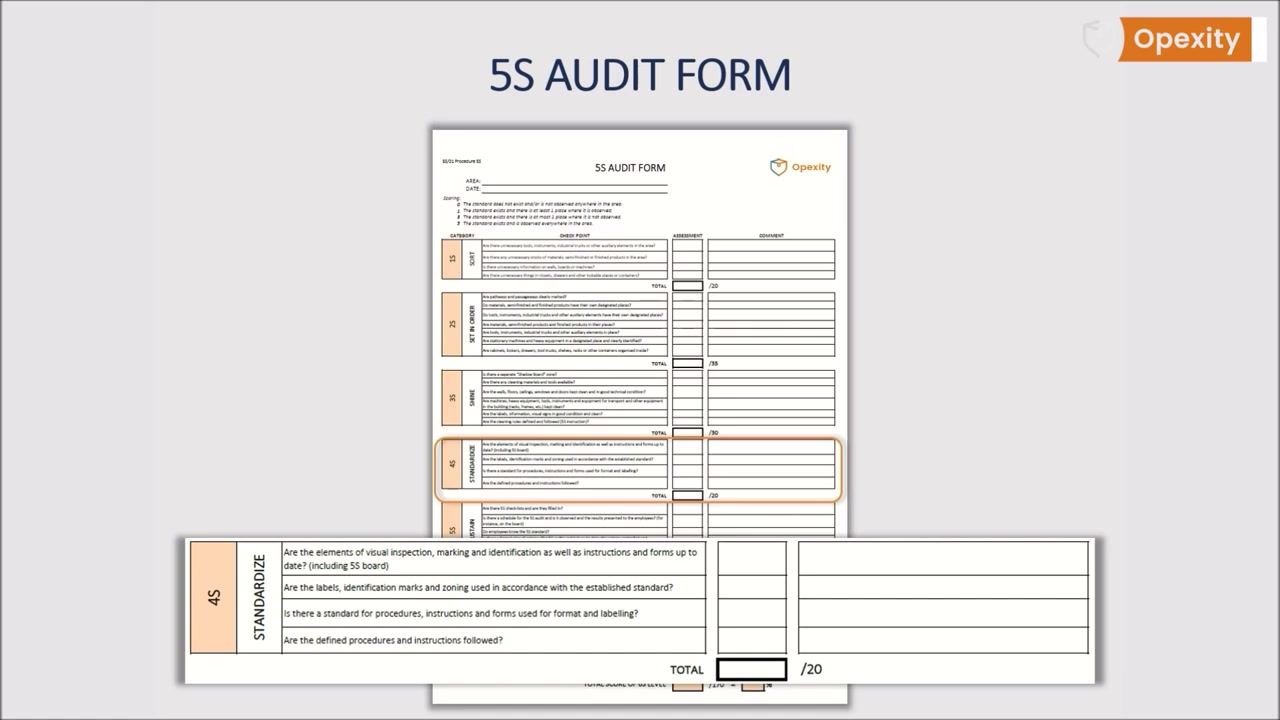
4S – Standardize
| Characteristic | Specification | Method (example question) | Sample scope |
|---|---|---|---|
| Standardize | Visual controls up to date | Are the elements of visual inspection, marking, and identification, as well as instructions and forms, up to date (including the 5S board)? | 5S board, instructions |
| Standardize | Labeling matches standard | Are the labels, identification marks, and zoning used in accordance with the established standard? | Labels and zoning |
| Standardize | Standard exists for forms/labels | Is there a standard for procedures, instructions, and forms used for format and labeling? | Documentation |
| Standardize | Procedures followed | Are the defined procedures and instructions followed? | Work practice |
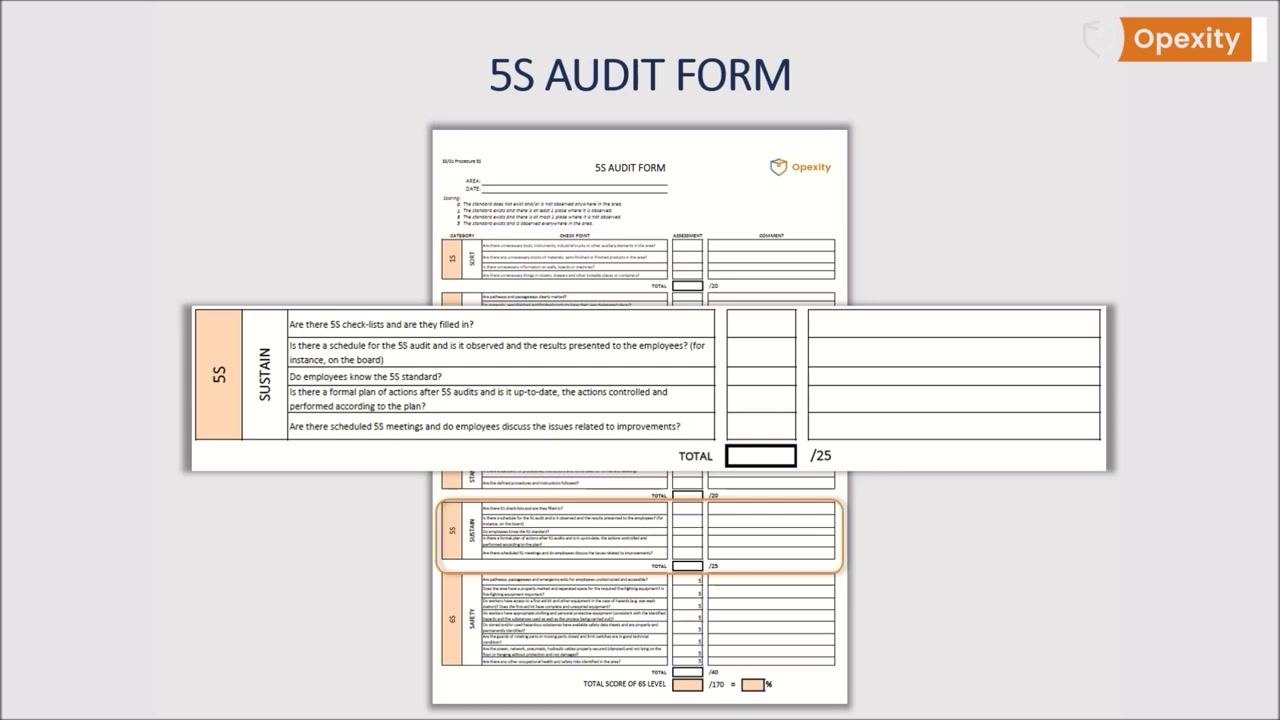
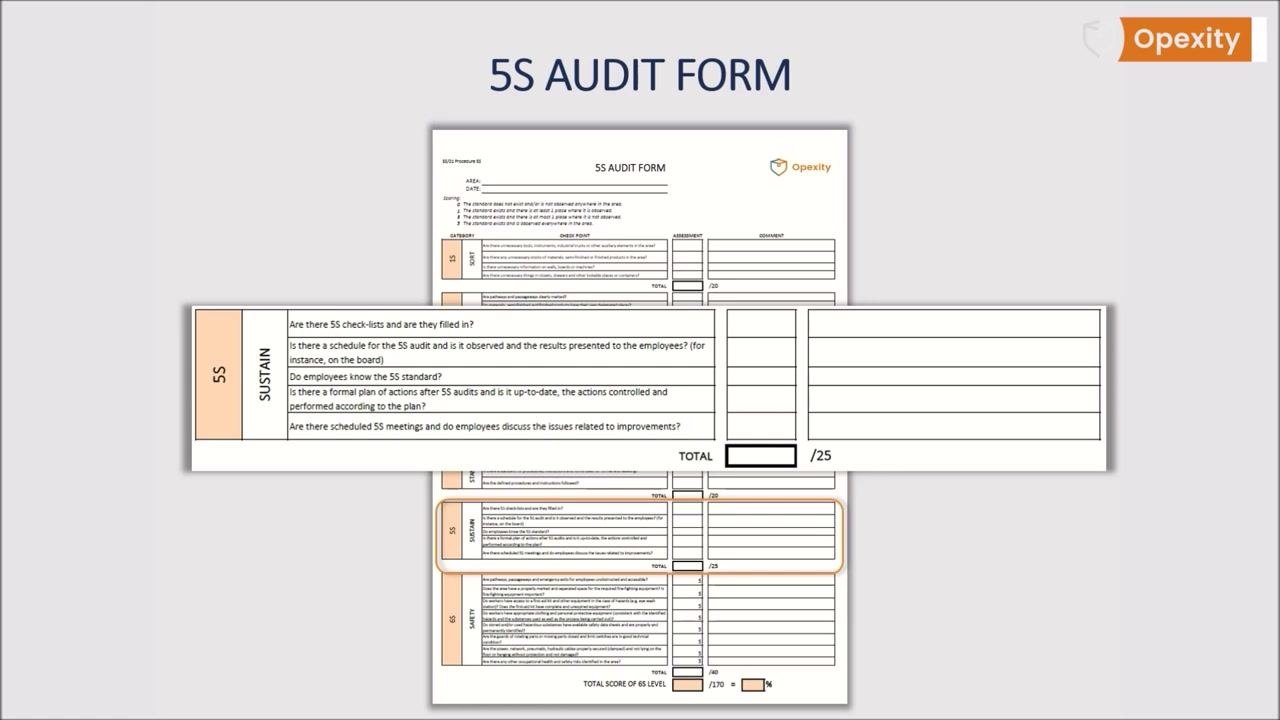
5S – Sustain
| Characteristic | Specification | Method (example question) | Sample scope |
|---|---|---|---|
| Sustain | Checklists filled in | Are there 5S check-lists and are they filled in? | Audit records |
| Sustain | Audit schedule observed | Is there a schedule for the 5S audit and is it observed and the results presented to the employees (e.g., on the board)? | Audit schedule |
| Sustain | Standards known | Do employees know the 5S standard? | Employee interviews |
| Sustain | Action plan maintained | Is there a formal plan of actions after 5S audits, and is it up-to-date, with actions controlled and performed according to the plan? | Action plan |
| Sustain | Meetings held | Are scheduled 5S meetings held and do employees discuss issues related to improvements? | Meeting records |
Set in Order / Safety – Fire and emergency marking
| Characteristic | Specification | Method (example question) | Sample scope |
|---|---|---|---|
| Set in Order | Emergency equipment correctly marked | Are fire extinguishers, hydrants, and emergency exits correctly marked and accessible? | Emergency equipment locations |
Ergonomics
| Characteristic | Specification | Method (example question) | Sample scope |
|---|---|---|---|
| Safety/Ergonomics | Workstation ergonomics addressed | Are ergonomic practices and workstation setup evaluated as part of the audit? | Individual workstations |
Safety
| Characteristic | Specification | Method (example question) | Sample scope |
|---|---|---|---|
| Safety | No new security risks | Have no additional security risks been identified? | Whole area, reviewed each cycle |
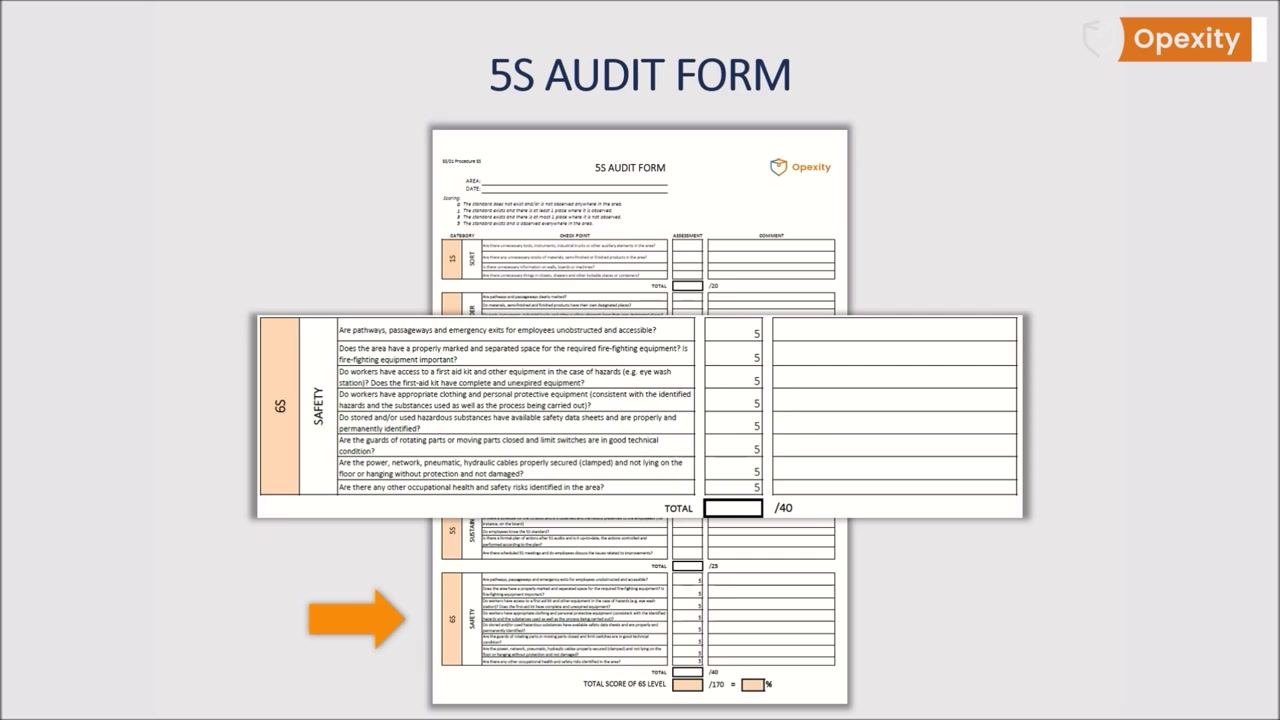
6S Safety (extended audit)
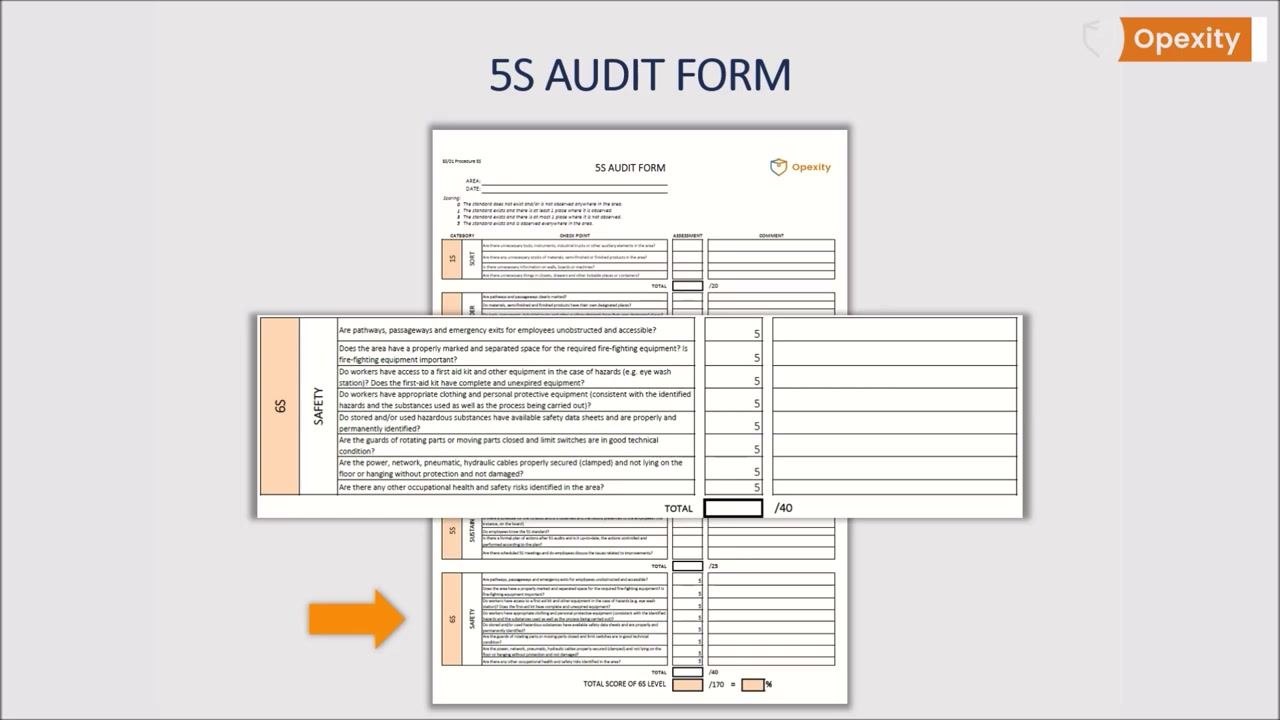
When your organization extends the 5S audit checklist to include a dedicated Safety category, add a 6S SAFETY section, clearly separated and highlighted like the other categories, with its own scoring column and comment area.
| Characteristic | Specification | Method (example question) | Sample scope |
|---|---|---|---|
| 6S Safety | Pathways and exits unobstructed | Are pathways, passageways, and emergency exits for employees unobstructed and accessible? | Emergency routes |
| 6S Safety | Fire-fighting equipment marked | Does the area have a properly marked and separated space for the required fire-fighting equipment? Is fire-fighting equipment present? | Fire safety points |
| 6S Safety | First aid equipment complete | Do workers have access to a first aid kit and other hazard equipment (e.g., eye wash station)? Does the first aid kit have complete, unexpired equipment? | First aid stations |
| 6S Safety | PPE appropriate | Do workers have appropriate clothing and personal protective equipment consistent with identified hazards, substances used, and the process carried out? | Workers on site |
| 6S Safety | Safety data sheets available | Do stored and/or used hazardous substances have available safety data sheets, properly and permanently identified? | Chemical storage |
| 6S Safety | Machine guards intact | Are the guards of rotating or moving parts closed, and are limit switches in good technical condition? | Machinery |
| 6S Safety | Cables secured | Are power, network, pneumatic, and hydraulic cables properly secured (clamped), not lying on the floor, not hanging unprotected, and undamaged? | Cabling and lines |
| 6S Safety | Other OHS risks | Are there any other occupational health and safety risks identified in the area? | Whole area |
Acceptance Criteria
Score each checklist item according to the defined scoring key, where 0 indicates the standard does not exist and 5 indicates the standard is observed everywhere. Assign a scoring value (for example, 5 points) to each question.
- Calculate a total score for each of the five (or six) categories.
- Sum category scores into a total score representing the overall 5S (or 6S) level of the area.
- For the 6S Safety section specifically, calculate its own subtotal (for example, out of 40 points) and add it to the overall audit score for a comprehensive 6S evaluation.
Non-Conformance Handling
When a checklist item is scored below the desired state, follow these steps:
- Record the assessment and comments for the specific question in the comment section of the audit form.
- Present the audit findings to the team after each audit rather than holding them back.
- Use the comment section to note feedback or discussion points raised during that review.
- Maintain a formal, up-to-date plan of actions following each 5S audit.
- Ensure actions identified in the plan are controlled and performed according to schedule.
- Track whether suggestions and improvements identified during the audit are actually put into practice.
- Hold scheduled 5S meetings so employees can discuss issues related to improvements and non-conformances.
- Regularly review and update the Safety section to address any newly identified risks, making this part of every audit cycle.
Record Keeping
Keep the audit form concise — ideally limited to one A4 page — for clarity and ease of use.
Make the form simple, transparent, and understandable for all employees, using clear language and a logical structure so it is accessible to everyone in the company.
Traceability requirements for the completed form:
- AREA field identifying the location audited.
- DATE field recording when the audit took place.
- Scoring key referenced on the form for consistent interpretation of results.
- Comment fields documenting observations, safety concerns, corrective actions, or follow-up requirements for each category.
- Total score section for each category and a final total score at the bottom of the form.
For additional templates or guidance on building out a 5S or 6S audit form, refer to the resource materials provided by your audit form creator.
What's Next
Once your 5S audit checklist and schedule are established, apply them consistently across every area, present findings to employees after each cycle, and track corrective actions through to completion. Where safety is a priority, extend the form with a dedicated 6S Safety section so that occupational health and safety risks are evaluated alongside standard workplace organization criteria.
Generation details: cost, quality tiers, downloads
Docsie billed 4,000 credits ($2.80) to analyze this 8-minute video at standard quality. The rewrite, template fill and Word/PDF exports were included. The same video at each quality tier:
| Quality | Frames sampled | Credits | Approx. cost |
|---|---|---|---|
| Draft | every 16-30 s | 2,000 | $1.40 |
| Standard (this guide) | every 8-15 s | 4,000 | $2.80 |
| Detailed | every 4-7 s | 8,000 | $5.60 |
| Ultra | every 1-3 s | 16,000 | $11.20 |
Credits priced at $0.70 per 1,000; plans include a monthly allowance. Enterprise customers on on-premise or bring-your-own-model deployments run this on their own inference and pay no per-video credits.
Same video, other quality tiers
We ran this exact video through Docsie again at different frame-sampling rates. Compare the guides side by side:
Generated by Docsie Video-to-Docs on 2026-09-10 from a 7-minute video. It was generated straight into Docsie's Quality Control Checklist template, so every section of that template is filled from the video. Screenshots are frames from the source video and belong to their creator, Opexity, whose original is embedded above. If you own this video and want the guide removed or credited differently, contact us and we will act within one business day.