
4.8
on G2
Trace requirements to implementation evidence across specs, test plans, and design docs. Every finding backed by exact citations, scored consistently, with exceptions highlighted automatically.

Join forward-thinking teams using Docsie





_Leader_Small-Business_Leader.svg)


Manual RTM maintenance becomes impossible as requirements grow. You need proof of coverage, but you're drowning in document versions.
Real output
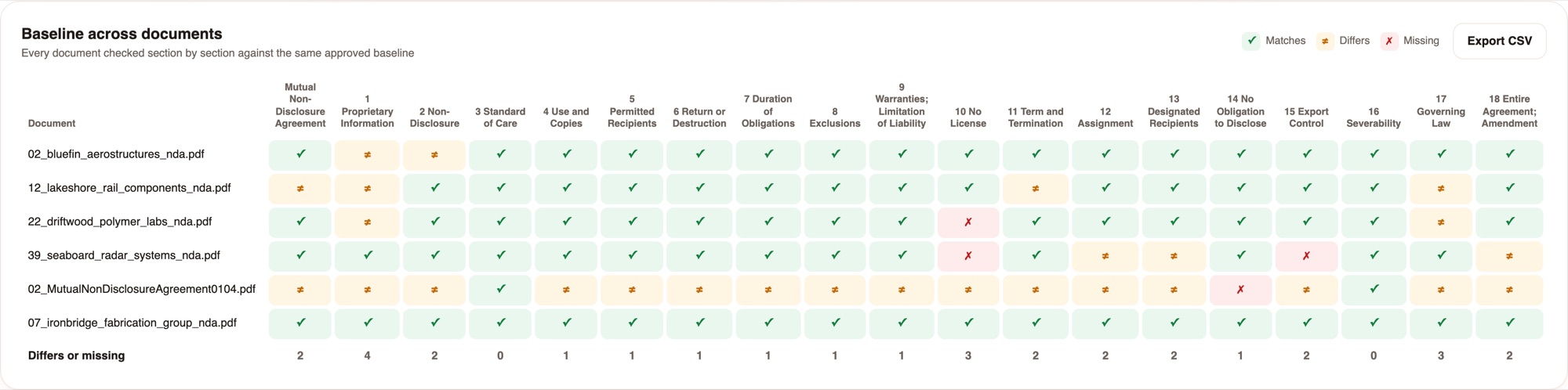
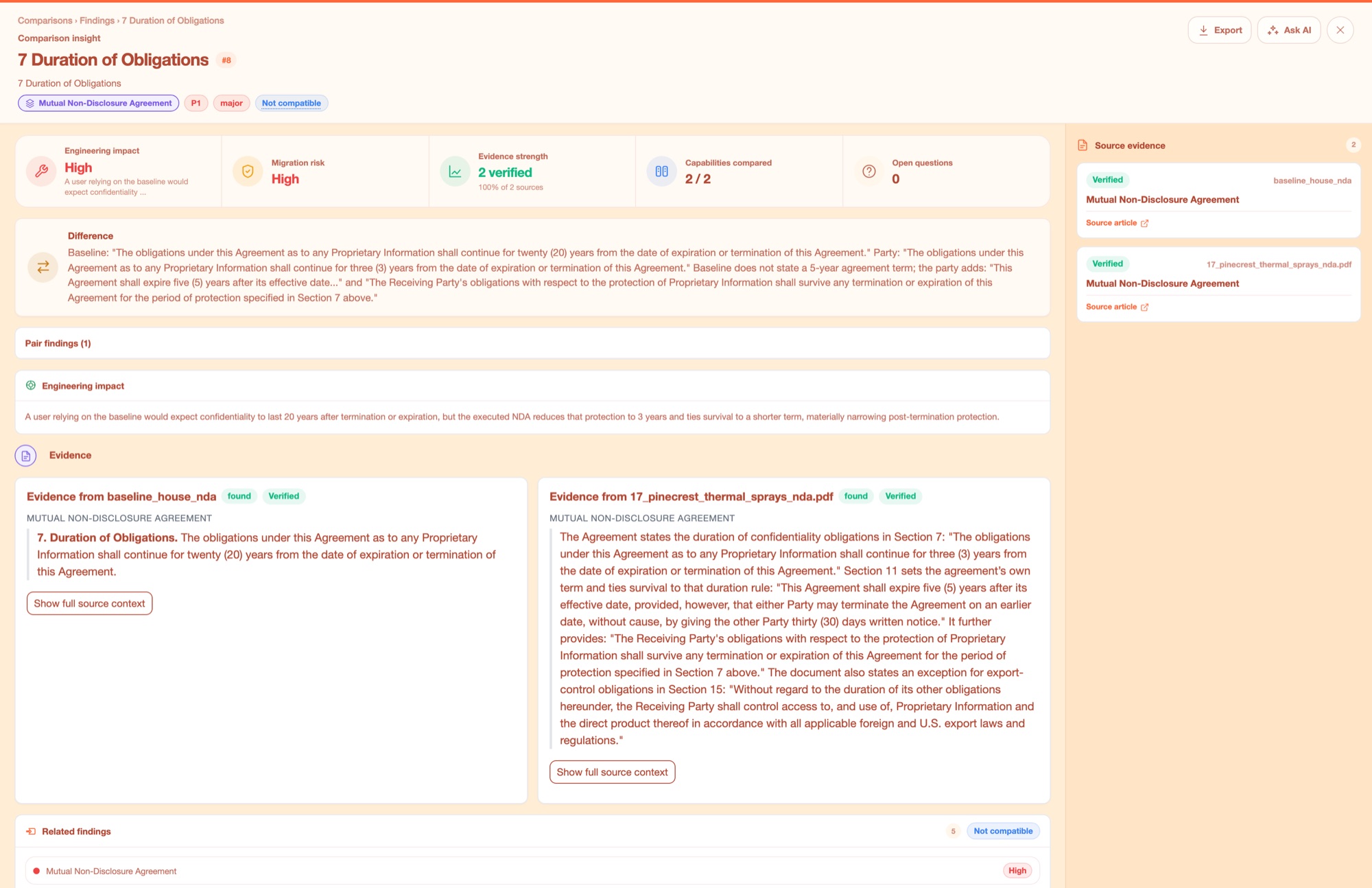
Six NDAs checked against one approved baseline. Every verdict resolves to the exact source text on both sides.
19 baseline sections across the whole intake. The totals row shows where the drift is concentrated - section 1 differs in 4 of 6 documents.
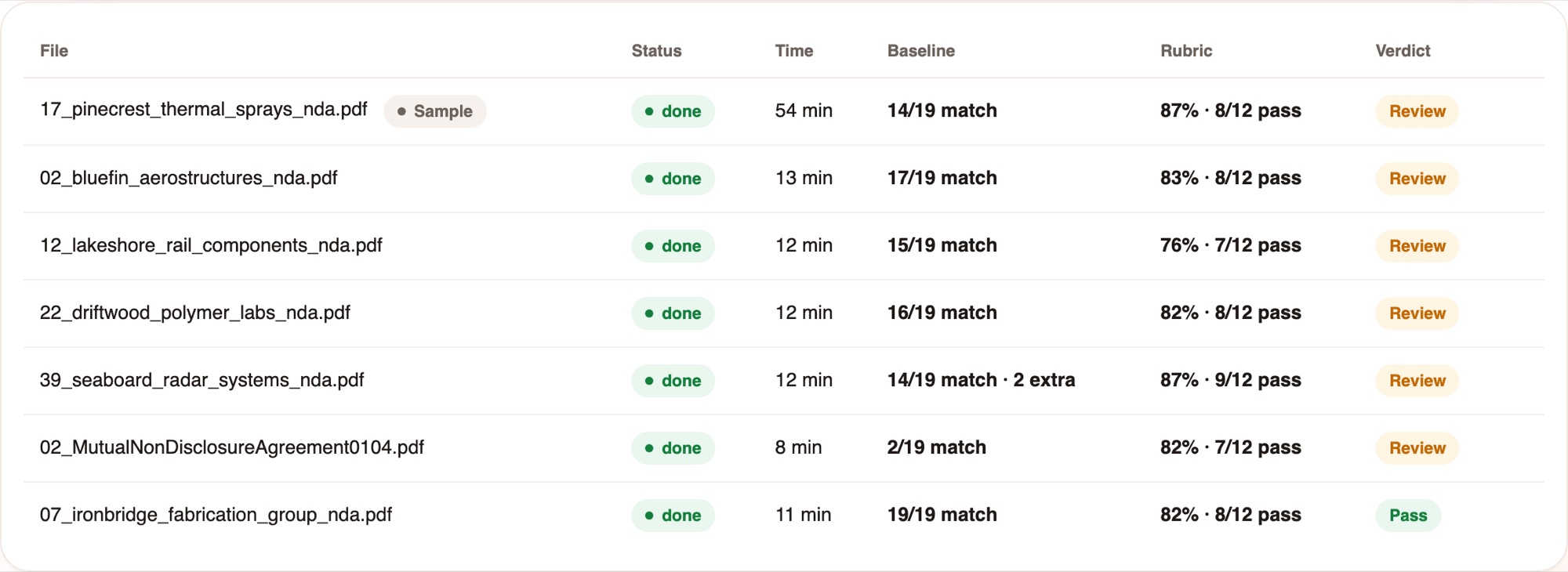
Baseline result, rubric score and the verdict in one line, so reviewers open only the exceptions.
Each criterion scores the share of its expectations met. Scores roll up by weight. Critical and high-severity failures are counted separately.
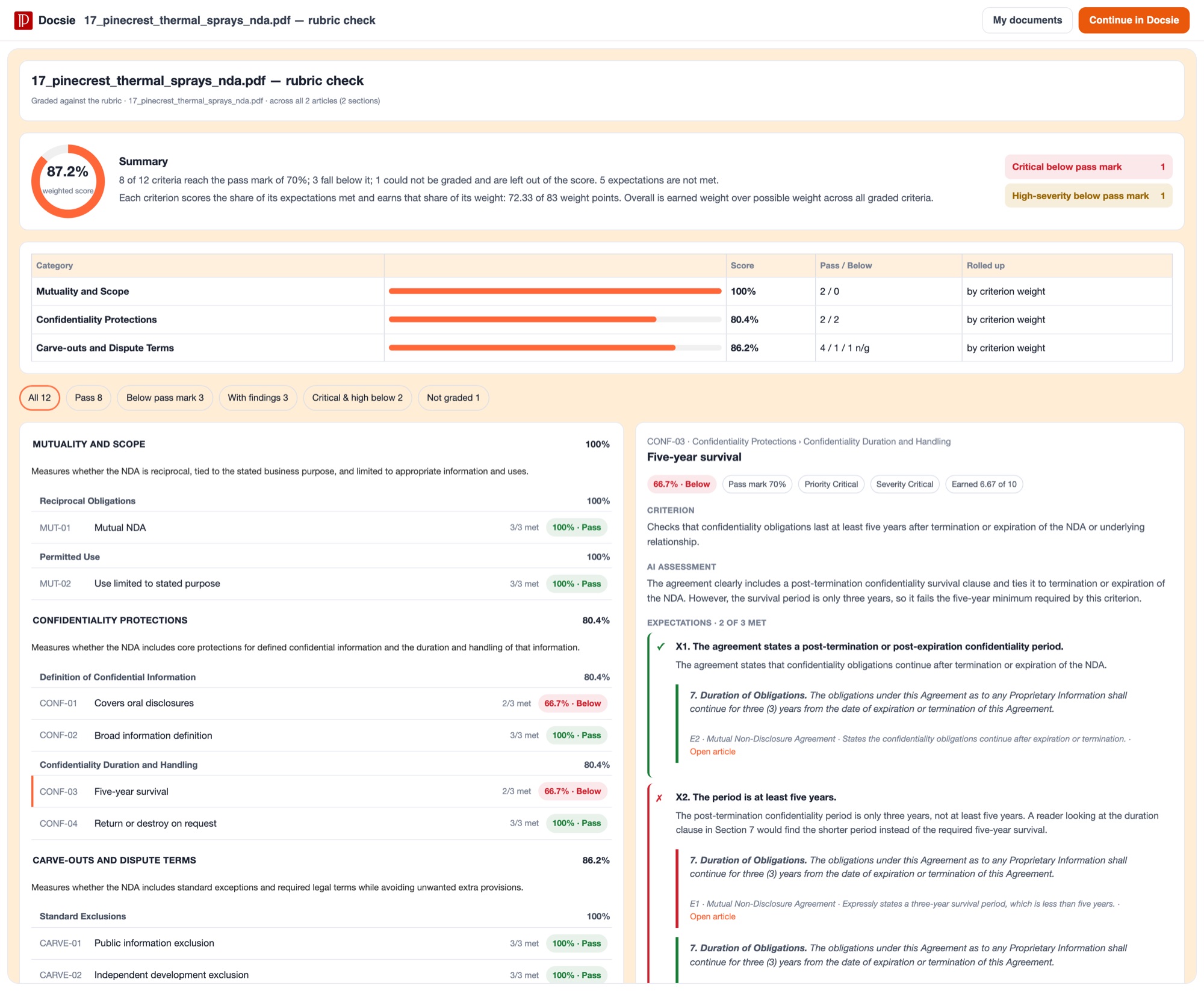
Both sides quoted in full, each marked Verified. This is the difference between a score you can act on and a number you have to re-check by hand.
Why Docsie
Stop maintaining spreadsheets. Start proving compliance with evidence you can defend in any audit.
Every requirement traced to implementation evidence and back again. No orphaned requirements, no untraced design elements. Every link resolves to exact source text you can cite in reviews and audits, not fuzzy matches or AI hallucinations.
Define your weighted rubric once—partial coverage, full satisfaction, implementation depth. Scoring runs in code, not subjective reviewer judgment. Same requirements get the same grade across all documents, eliminating reviewer bias and audit inconsistencies.
Approve one sample RTM, freeze the baseline and rubric, then run it over hundreds of documents. Docsie flags only the exceptions—missing traces, weak evidence, requirement gaps. Your team reviews what matters, not what's already compliant.
Systems engineers across aerospace, medical devices, and defense use Docsie for requirements traceability.

Trace safety requirements through design specifications, verification procedures, and test reports. Prove bidirectional traceability for certification audits with cited evidence for every requirement link, passing FAA and customer reviews on first submission.

Maintain design history files with automated traceability from user needs through risk analysis, software requirements, design specs, and verification protocols. Survive FDA audits with matrices you can regenerate and defend with cited source text.

Manage traceability across customer requirements, system specs, subsystem designs, and interface control documents. Run factories over hundreds of subsystem documents to find coverage gaps before integration, not after delivery.
Everything you need to automate requirements traceability with cited evidence.
Finds requirement satisfaction across different wording and document structures, not just keyword matches.
Every trace link resolves to exact source text—no summaries, no hallucinations, just quoted evidence.
Define coverage thresholds, implementation depth, and evidence quality—scored consistently in code, not by model interpretation.
Trace requirements across specs, designs, test plans, and verification reports in a single matrix.
Approve one baseline, then only review documents that fail your rubric—ignore everything that passes.
Requirements changed? Re-generate traceability in minutes with highlighted differences from your baseline.
Common Questions
What systems engineers ask about automated requirements traceability.
Q: How does Docsie handle different requirement formats and numbering schemes?
A: The concept engine extracts requirements regardless of format—numbered lists, tables, SHALL statements, or narrative text. You define what constitutes a requirement in your rubric, and Docsie traces based on semantic content, not just requirement IDs.
Q: Can I trace requirements across document versions and baselines?
A: Yes. Compare any revision against your approved baseline to see exactly which requirements lost traceability, gained coverage, or changed implementation. Every difference is cited with exact source text from both versions.
Q: What if a requirement is partially satisfied across multiple documents?
A: Docsie's weighted rubric lets you score partial coverage. You define thresholds—like 'design intent' in one doc plus 'verification evidence' in another equals full satisfaction. The scoring runs consistently across all requirements.
Q: How do I prove traceability in an audit with cited evidence?
A: Every trace link in Docsie resolves to exact quoted text from source documents. Export your RTM with inline citations showing precisely where each requirement is addressed, satisfying DO-178C, IEC 62304, and ISO 26262 traceability requirements.
Q: Can I freeze a baseline for validated or certified systems?
A: Yes. Once you approve an RTM, freeze the baseline and rubric. Any new document checked against that baseline will highlight only deviations, ensuring your validated traceability remains intact while flagging what needs change control review.
Still have questions?
Book a DemoSee how Docsie can help your team today.
No credit card required.


