
4.8
on G2
 Screen Studio
 Cap
Cap
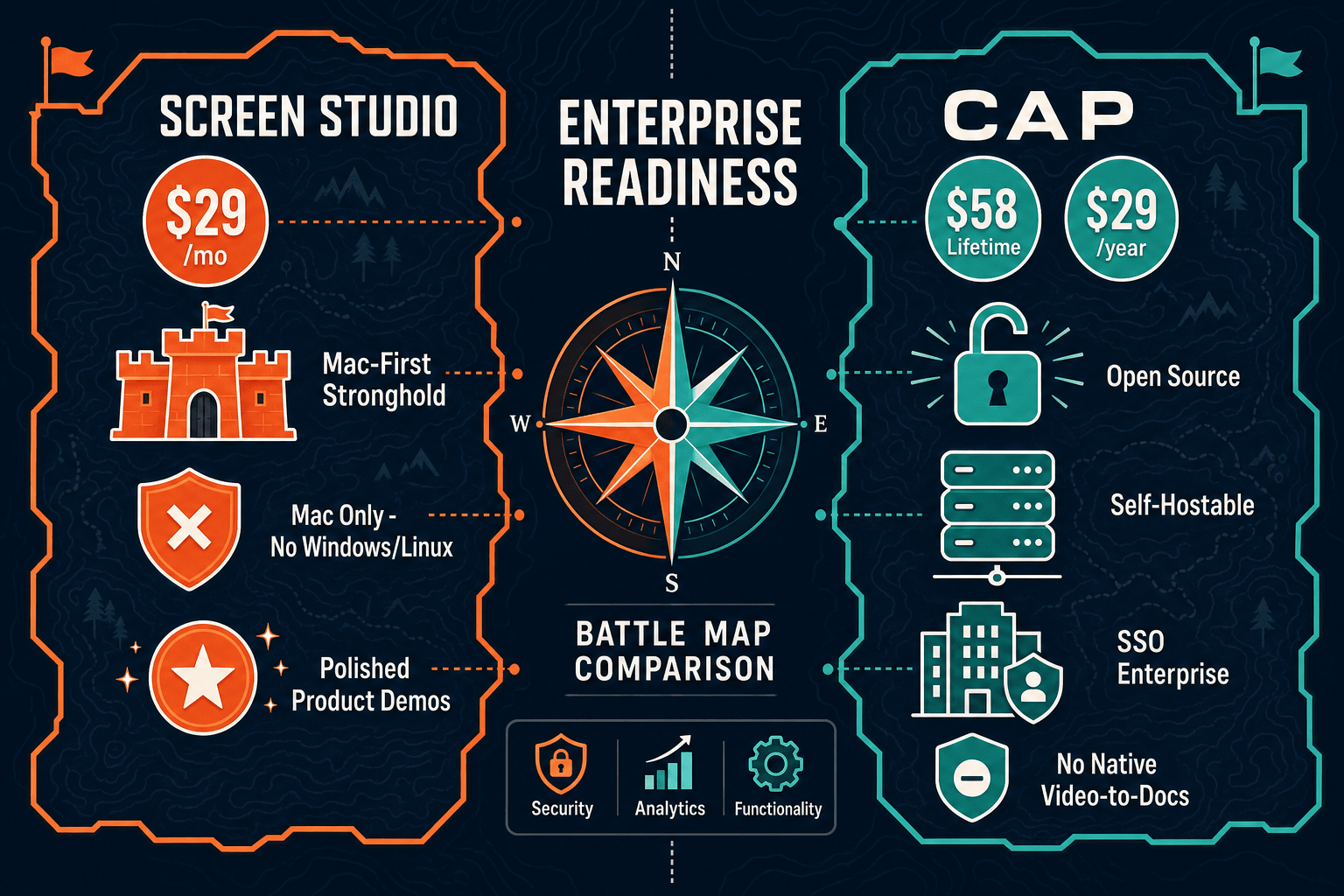
Screen Studio and Cap both record polished screen videos, but neither was built with enterprise IT requirements in mind. This comparison examines their security controls, compliance posture, admin capabilities, and support tiers so enterprise buyers can make an informed decision—and understand why Docsie Recorder is the stronger enterprise-ready alternative.
Screen Studio is a polished Mac recorder built for individual creators, not enterprise IT environments.
Enterprise Feature Matrix
A detailed head-to-head comparison of enterprise features including security, compliance, administration, scalability, and support across Screen Studio and Cap.
| Enterprise Capability |
Screen Studio
|
Cap
|
|---|---|---|
| Free Plan Available | ||
| Windows Support | ||
| Linux Support | Verify current status | |
| Open-Source Codebase | ||
| Self-Hosting Option | ||
| SSO (SAML / OAuth) | Enterprise plan; verify | |
| Role-Based Access Control | ||
| Audit Logs | ||
| Data Residency Controls | Partial via self-hosting | |
| SOC 2 Compliance | Not documented | Verify |
| GDPR Compliance | Not documented | Verify |
| Uptime SLA | N/A (local app) | Verify |
| Dedicated Support | Enterprise plan | |
| Team / Multi-User Administration | ||
| Enterprise Pricing Tier | ||
| API Access | ||
| Analytics & Usage Reporting | ||
| Knowledge Base / Doc Publishing | ||
| Video-to-Docs Conversion | ||
| Custom Domain Support |
Data as of May 2026. Features are based on publicly available information and vendor documentation. Enterprise-tier features for Cap should be verified directly with their sales team before procurement decisions.
Strengths & Weaknesses
Deep Dive Analysis
An in-depth look at four enterprise dimensions—security and compliance, scalability and performance, administration and control, and support and SLA—to help enterprise buyers assess both tools honestly.
Screen Studio's local-first Mac architecture means recordings stay on device by default, which is a passive security advantage rather than an active compliance posture. There are no documented SOC 2, GDPR, or HIPAA certifications, no SSO integration, and no audit trail. Cap's open-source codebase lets security teams inspect the code directly, and its self-hosting path allows organizations to keep data entirely within their own infrastructure. However, Cap's formal compliance certifications remain unverified, and audit logs are not confirmed. Neither tool meets the baseline security requirements most enterprise procurement teams expect from vendor software.
Screen Studio is a single-user Mac desktop application with no multi-user infrastructure layer, making it fundamentally unscalable for enterprise rollouts beyond individual power users. There is no centralized management, no usage analytics, and no team provisioning. Cap scales more meaningfully with team collaboration features, cloud sharing infrastructure, and a self-hosting path that can be sized to organizational needs. Its Pro plan supports multiple users, and the Enterprise tier offers custom deployment. However, Cap is a younger platform and its performance at large enterprise scale has not been widely documented or independently validated.
Screen Studio offers essentially no enterprise administration capabilities. There is no user management, no centralized policy enforcement, no role-based permissions, and no way for IT administrators to manage licenses or monitor usage across a team. Cap provides meaningful administrative controls by comparison, including role-based access control, team management, and analytics. Its Enterprise tier adds custom deployment options and a security review process. That said, Cap's admin controls are still maturing, and features like SSO and audit logging—standard requirements for enterprise IT—require verification before relying on them in procurement decisions.
Screen Studio does not offer dedicated enterprise support or a documented uptime SLA. As a local desktop application, uptime for the recording function itself is not cloud-dependent, but the shareable links infrastructure has no published SLA. Support appears to be standard self-service. Cap's Enterprise plan includes dedicated support, and a security review process is part of the onboarding. However, specific SLA terms, response time guarantees, and escalation paths are not publicly documented and need to be confirmed with Cap's sales team before enterprise procurement decisions are made.
Our Recommendation
Screen Studio is a polished Mac recorder built for individual creators, not enterprise IT environments. It lacks every major enterprise control—SSO, audit logs, RBAC, compliance certifications, and cross-platform support—making it unsuitable for standardized enterprise deployment. Cap is a meaningfully more enterprise-aware product with open-source auditability, self-hosting, cross-platform support, role-based access control, and an Enterprise tier, but its compliance certifications and advanced admin controls are still maturing for a product founded in 2023.
Choose Screen Studio if you need. .
Choose Cap if you need. .
Choose Docsie Recorder if you need. .
Winner: Docsie Recorder
Docsie Recorder is the enterprise-ready choice because it combines a free, open-source, MIT-licensed recorder core with the full downstream Docsie platform—delivering SSO, audit logs, role-based access control, versioned documentation management, multi-tenant portal delivery, and API access that neither Screen Studio nor Cap can match. Where Screen Studio stops at a polished video file and Cap stops at a share link with basic team controls, Docsie Recorder routes each recording into a structured documentation pipeline (CONVERT → MANAGE → DELIVER) that enterprise IT, legal, and compliance teams can actually govern and audit.
Decision Helper
A direct framework for picking between Screen Studio, Cap, and Docsie based on your specific needs.
Polished Mac-only product demos with cinematic zoom and motion.
Open-source screen recorder with cloud sharing.

Convert real video into searchable docs, then deploy multi-tenant portals.
Common Questions
Q: Does Screen Studio support SSO or SAML for enterprise authentication?
A: No. Screen Studio does not offer any SSO, SAML, or OAuth integration. It is a standalone Mac desktop application with no centralized identity management. Enterprises that require SSO as a standard security control will need to look elsewhere.
Q: Can Cap be self-hosted to meet data residency requirements?
A: Yes, Cap offers a self-hosting path that allows organizations to run the platform within their own infrastructure, which can satisfy data residency requirements for regulated industries. However, self-hosting requires DevOps expertise to deploy and maintain, and the operational overhead should be factored into total cost of ownership before committing to this approach.
Q: Does either Screen Studio or Cap have documented SOC 2 or GDPR compliance certifications?
A: Neither Screen Studio nor Cap has publicly documented SOC 2 Type II or GDPR compliance certifications at the time of this comparison. Cap's self-hosting option provides a path to controlling data handling, but formal compliance attestations should be verified directly with each vendor before making procurement decisions for regulated industries.
Q: Is there a better alternative to both Screen Studio and Cap for enterprise teams that need recording plus documentation governance?
A: Yes—Docsie Recorder addresses the enterprise gaps that both tools leave open. It is a free, open-source, cross-platform recorder (Mac, Windows, Linux) that connects directly to the Docsie platform, which provides SSO, audit logs, role-based access control, versioned knowledge base management, multi-tenant portal delivery, and API access. Unlike Screen Studio or Cap, Docsie Recorder turns recordings into governed, searchable documentation rather than stopping at a video file or share link—giving enterprise IT and compliance teams the controls they actually need.
Q: Can Screen Studio be deployed enterprise-wide across a mixed Mac and Windows organization?
A: No. Screen Studio is Mac-only and has no Windows or Linux support, making enterprise-wide standardization impossible for organizations with mixed device fleets. Teams that need a single recording standard across operating systems should evaluate Cap or Docsie Recorder, both of which support multiple platforms.
Q: What enterprise administration features does Cap offer compared to Screen Studio?
A: Cap meaningfully outpaces Screen Studio on administration with role-based access control, team management, usage analytics, and an Enterprise tier that includes a dedicated security review and custom deployment. Screen Studio offers none of these controls. That said, Cap's enterprise features are still maturing—SSO availability and audit log support should be confirmed with Cap's sales team before finalizing procurement decisions.
Both Screen Studio and Cap stop at the video layer—leaving enterprise teams without SSO, audit logs, versioned documentation management, or governed knowledge base publishing. Docsie Recorder is a free, open-source, cross-platform recorder that feeds directly into Docsie's enterprise documentation platform, giving you the recording quality of Screen Studio, the open-source auditability of Cap, and the full enterprise controls neither tool provides.
Free recorder download.