
4.8
on G2
 Archbee
 Notion
Archbee and Notion both serve documentation and knowledge management, but neither was built from the ground up for enterprise demands. This comparison evaluates their real enterprise readiness across security, compliance, administration, and support — then shows why Docsie is the stronger enterprise alternative.
Archbee is enterprise-ready for developer documentation and Notion for team knowledge bases, but neither offers multi-tenant customer portals or video-to-docs conversion the way Docsie does.
Enterprise Feature Matrix
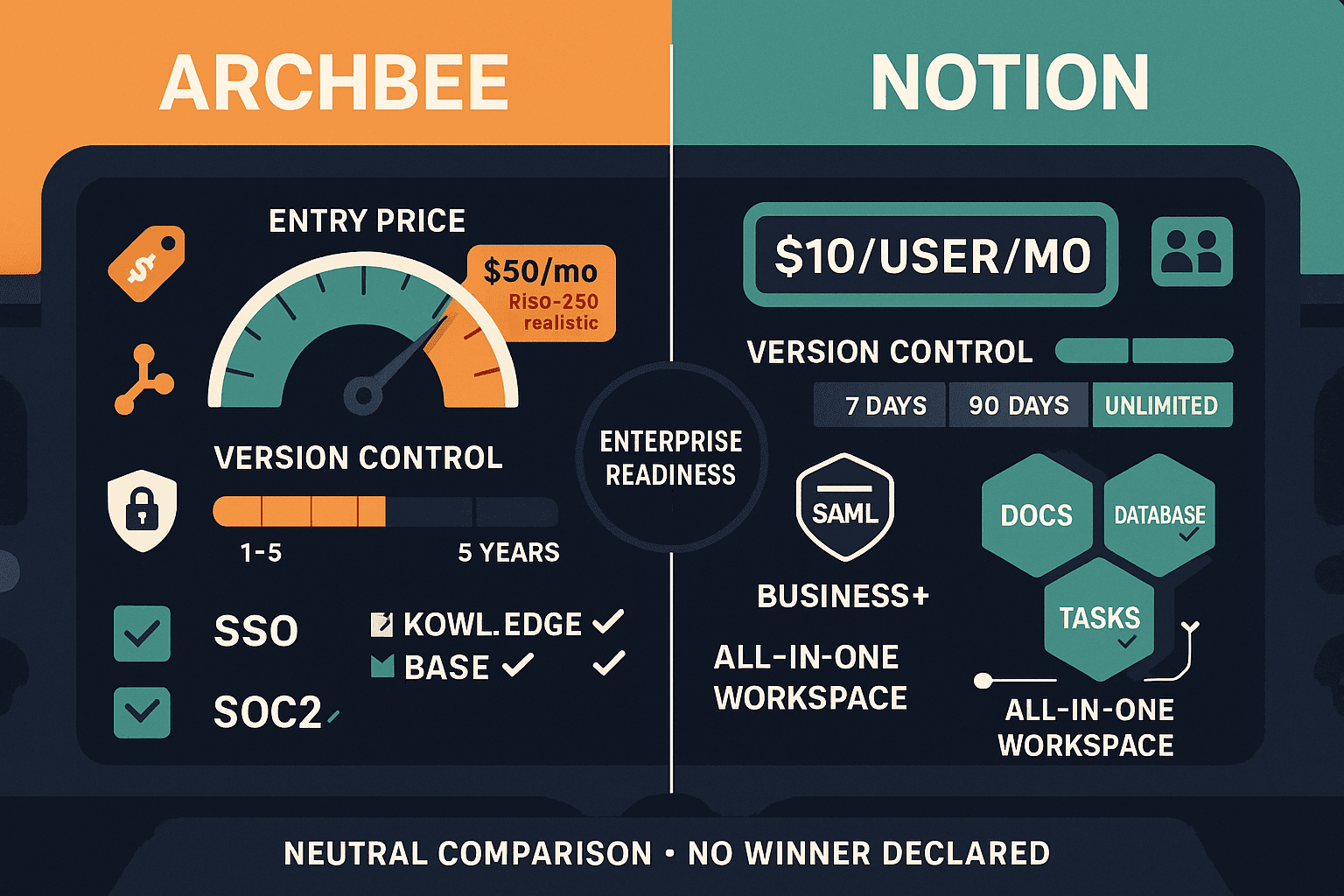
A detailed comparison of enterprise-critical features including security controls, compliance certifications, access management, scalability, and vendor support.
| Enterprise Feature |
Archbee
|
Notion
|
|---|---|---|
| SOC 2 Type II Compliance | ||
| GDPR Compliance | ||
| HIPAA Readiness | ||
| SSO (SAML) | Enterprise only | Business+ (SAML) |
| SCIM Provisioning | Enterprise only | |
| Audit Logs | Enterprise only | |
| Role-Based Access Control | ||
| Granular Permissions | ||
| Version History | 1–5 years (tier-dependent) | 7 days (Plus) / 90 days (Business) / Unlimited (Enterprise) |
| Custom Domain Support | ||
| Multi-Tenant Portals | ||
| Analytics & Reporting | Add-on ($80/month) | Business+ |
| API Access | Add-on ($80/month) | |
| Dedicated Support / CSM | Enterprise only | Enterprise only |
| Uptime SLA | Enterprise only | Enterprise only |
| Data Residency Options | ||
| Air-Gap / Private Infrastructure | ||
| Compliance Monitoring | ||
| Multi-Language / Auto-Translation | ||
| Embeddable Widget | Add-on ($80/month) |
Data as of February 2026. Features based on publicly available vendor documentation and pricing pages. Archbee SSO and SLA require Enterprise tier. Notion audit logs and SCIM require Enterprise tier.
Strengths & Weaknesses
Deep Dive Analysis
An in-depth evaluation of enterprise readiness across security and compliance, scalability, administration, and vendor support — with honest assessments of where each tool delivers and where each falls short.
Both Archbee and Notion hold SOC 2 and GDPR certifications, meeting baseline enterprise security requirements. However, neither offers HIPAA readiness, data residency options, or air-gap deployment — critical requirements for regulated industries like healthcare, finance, and defense. Archbee's SSO is gated behind its Enterprise tier, while Notion includes SAML SSO from Business tier onwards. Neither platform offers real-time compliance monitoring or frame-by-frame content scanning for regulatory violations. For organizations operating under HIPAA, SOX, or ITAR, both tools present meaningful compliance gaps that require workarounds or additional tooling.
Archbee is built for technical documentation teams but lacks native multi-tenant architecture — enterprises managing documentation for multiple clients or departments must create separate workspaces. Notion scales reasonably well for internal wikis but is known to become difficult to govern at large scale without rigid naming conventions and permission structures. Neither tool offers the ability to spin up thousands of branded documentation portals from a single content source. For enterprises delivering documentation to multiple business units, partners, or clients simultaneously, both tools require significant manual overhead to simulate what purpose-built multi-tenant platforms handle natively.
Notion edges ahead on administration with SCIM provisioning and audit logs available at Enterprise tier, enabling automated user lifecycle management and compliance reporting. Archbee lacks SCIM entirely and does not offer audit logs on any standard tier. Both tools offer role-based access control, but Notion's granular permission model is more mature for large teams. Notably, Archbee's API access — essential for integrating documentation workflows into enterprise systems — requires an $80/month add-on. Notion includes API access across paid tiers. Neither platform provides automated compliance monitoring, broken link detection, or content drift alerts that enterprise documentation at scale requires.
Both Archbee and Notion reserve dedicated support, Customer Success Managers, and formal SLA guarantees exclusively for their Enterprise tier customers — meaning Growth or Business plan users receive standard support with no uptime commitments. Archbee's Enterprise tier includes SLA and dedicated support but the company was founded in 2020 and has a smaller support organization than established players. Notion's Enterprise tier includes a dedicated success manager but has faced criticism for response times at scale. Neither vendor offers the procurement-friendly custom SLA, custom security documentation, and migration support that enterprise buyers typically need when standardizing on a documentation platform organization-wide.
Our Recommendation
Archbee is a competent technical documentation platform that meets baseline enterprise security standards but hides critical features like analytics, API access, and SSO behind add-on fees or Enterprise tier gating. Notion is a flexible all-in-one workspace with stronger administration controls at Enterprise tier, but it was designed for internal use and fundamentally lacks the external delivery infrastructure — custom domains, multi-tenant portals, white-labeling — that enterprise documentation programs require. Both are reasonable choices within their core use cases, but neither is a complete enterprise documentation platform.
Choose Archbee if you need...
Choose Notion if you need...
Choose Docsie if you need...
Winner: Docsie
Both Archbee and Notion share critical enterprise gaps — no HIPAA readiness, no data residency, no multi-tenant portal delivery, no real-time compliance monitoring, and no video-to-docs conversion. Docsie addresses all of these with a purpose-built enterprise knowledge orchestration platform that converts any content into structured documentation, delivers it through unlimited branded portals, trains teams with a built-in LMS, monitors compliance in real-time, and runs entirely on private infrastructure — at transparent pricing that doesn't require stacking add-ons to unlock core enterprise functionality.
Decision Helper
A direct framework for picking between Archbee, Notion, and Docsie based on your specific needs.
Developer documentation with OpenAPI support and add-on pricing.
Flexible all-in-one workspace for notes, docs, and databases.

Combine product docs, API references, and customer portals in one platform.
Common Questions
Q: Does Archbee or Notion support HIPAA compliance for regulated industries?
A: Neither Archbee nor Notion is HIPAA-ready out of the box. Both hold SOC 2 and GDPR certifications, which satisfy many enterprise security requirements, but organizations in healthcare or life sciences that need HIPAA Business Associate Agreements and HIPAA-aligned data handling will find both platforms insufficient. Docsie is HIPAA-ready and supports compliance monitoring for HIPAA, SOX, ITAR, and GDPR in real time.
Q: Which tool has better SSO and user provisioning for enterprise IT?
A: Notion offers more complete enterprise identity management — SAML SSO from Business tier and SCIM provisioning at Enterprise tier for automated user lifecycle management. Archbee provides SAML SSO only at Enterprise tier and does not offer SCIM provisioning on any plan. For IT teams that need to automate onboarding and offboarding at scale, Notion's Enterprise tier is the stronger option between the two, though Docsie supports SAML, OAuth, OIDC, Azure AD, Okta, and Google SSO across its tiers.
Q: Can either Archbee or Notion deliver documentation to multiple clients or tenants?
A: No. Neither Archbee nor Notion supports multi-tenant portal architecture. Enterprises needing to deliver separate branded documentation portals to different clients, departments, or partner organizations must manually create and manage isolated workspaces in both tools — a significant administrative overhead. Docsie's multi-tenant delivery layer allows one knowledge base to power unlimited branded portals, each with custom domains, access controls, and white-labeling.
Q: How does version history compare for audit and compliance purposes?
A: Archbee offers the stronger version history story with up to 5 years of history on its top tiers, which is valuable for compliance audits requiring historical documentation trails. Notion's version history is only 7 days on the Plus plan and 90 days on Business — organizations on those tiers face real limitations for compliance use cases. Notion only offers unlimited version history at Enterprise tier. For teams that need long-term version audit capability without paying Enterprise pricing, Archbee has an advantage.
Q: Is there a better alternative to both Archbee and Notion for enterprise documentation?
A: Yes — Docsie was purpose-built for enterprise documentation delivery at scale. Where Archbee is a developer documentation tool with add-on-heavy pricing and where Notion is an internal workspace without external delivery capabilities, Docsie provides a complete six-pillar platform covering content conversion, management, multi-tenant delivery, built-in LMS training, autonomous agents, and real-time compliance monitoring. It supports SOC 2, GDPR, HIPAA, SOX, and ITAR, runs on private infrastructure, and delivers through unlimited branded portals — all at transparent, workspace-based pricing starting at $170/month for 15 users.
Q: What are the real enterprise costs for Archbee vs Notion at 50 users?
A: At 50 users, Notion Business costs $1,000/month (50 × $20/user annually) with full AI and SAML SSO included. Archbee's Growth or Enterprise pricing is custom, but reaching enterprise-grade features requires adding SSO and the full add-on stack (AI, analytics, API access), which Archbee estimates total to $150–$230/month even at small scale — costs that grow significantly at 50 users. Docsie's Organization plan covers 90 users at $750/month with all core features included, offering better per-user economics and no add-on surprises.
Docsie delivers what neither Archbee nor Notion can — multi-tenant documentation portals, HIPAA-ready compliance monitoring, video-to-docs conversion, built-in LMS with certifications, and autonomous agents — all on private infrastructure with transparent pricing. No add-ons required to unlock enterprise capabilities.
No credit card required. Free AI credits to convert a 10-minute training video included on signup.