
How to Operate a Manual Pallet Jack
This SOP provides step-by-step guidance for safely operating a manual pallet jack, covering the basics of lifting, moving, and lowering pallets in a warehouse or store environment. Following these procedures helps prevent injuries and ensures safe pallet handling practices.
Video: How to use a manual pallet jack by WORKFORCE COACH (2021). All credit for the demonstration goes to the creator; watch the original on YouTube. The written guide below was generated from this video by Docsie. Creator? Request a change or removal.
Purpose
This SOP provides step-by-step guidance for safely operating a manual pallet jack, covering the basics of lifting, moving, and lowering pallets in a warehouse or store environment. Following these procedures helps prevent injuries and ensures safe pallet handling practices.
Scope
This procedure applies to team members who need to operate a manual pallet jack for in-store or warehouse pallet movement tasks.
Equipment
- Manual pallet jack (with two fixed front wheels, a large swiveling rear wheel, and a handle with a lift/lower lever)
- Pallets to be moved
Familiarize yourself with the equipment
Before operating the pallet jack, take time to understand its components. A manual pallet jack has two fixed wheels at the front and a large swiveling wheel at the back. The handle includes a lever used for lifting and lowering pallets.
Observe the equipment layout and your surroundings, including the location of pallets, vending machines, and open floor space in the work area.
Position the pallet jack under the pallet
Position the pallet jack so the forks are aligned with the open slots at the bottom of the pallet. Insert the forks fully into the pallet before attempting to lift.
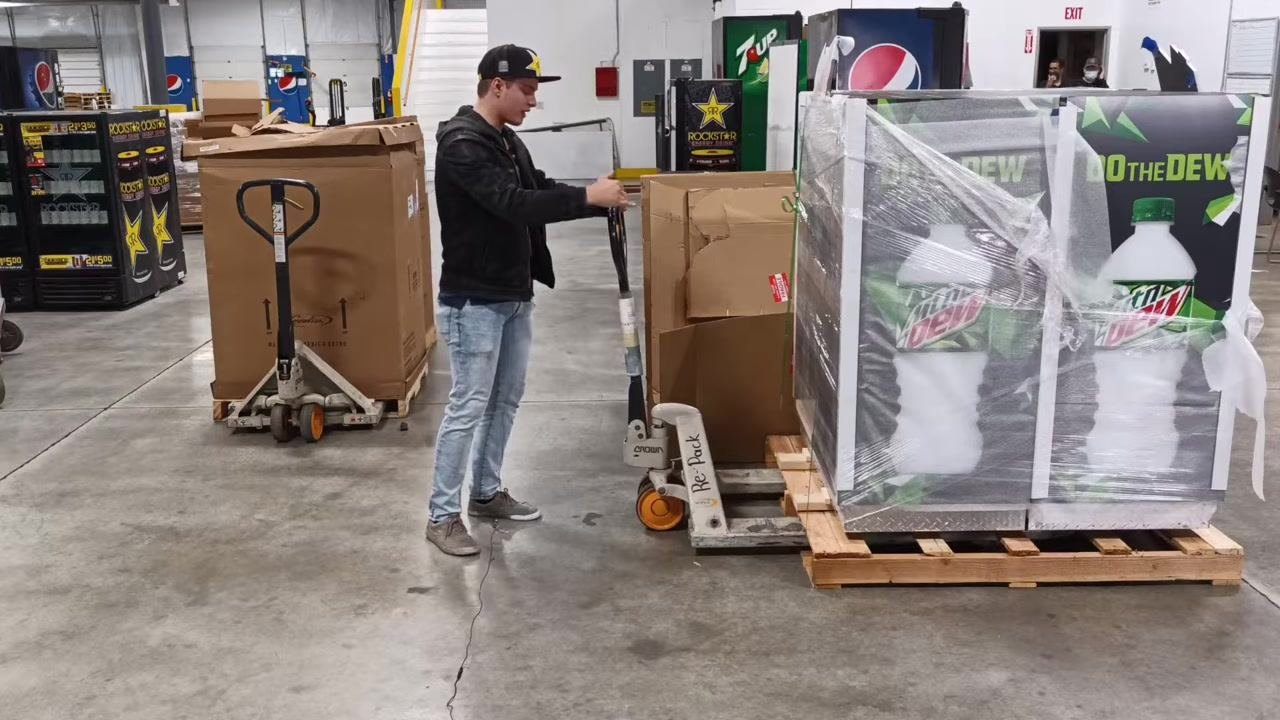
Lift the pallet
Push the handle lever all the way down until it stops. Pump (crank) the handle up and down to raise the pallet off the ground.
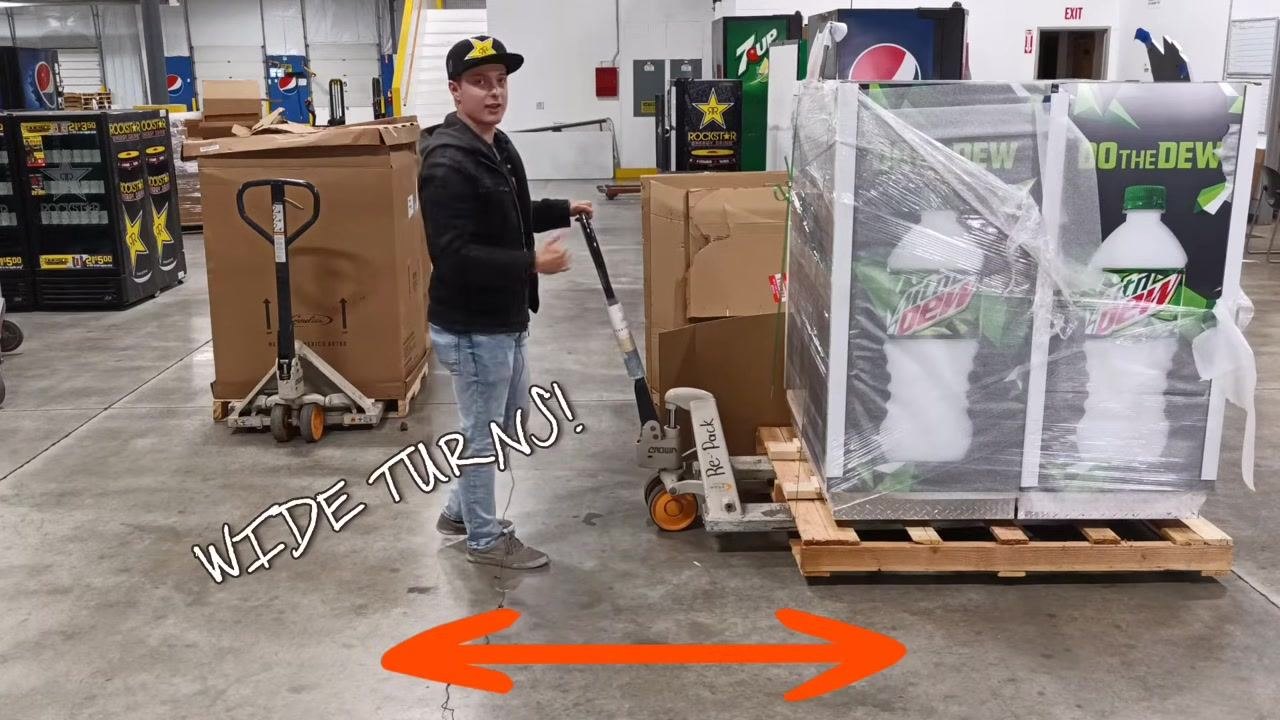
Move the pallet
Once the pallet is lifted, move it by pulling or pushing the handle.
Safety Note: The rear wheels do not swivel. Make wide turns, similar to maneuvering a semi-truck, to avoid obstacles and ensure the back wheels clear corners.
Lower the pallet safely
To lower the pallet, pull the handle lever up and hold it. The pallet will gently drop to the ground.
Safety Note: Always lower the pallet when stopped to ensure safety.
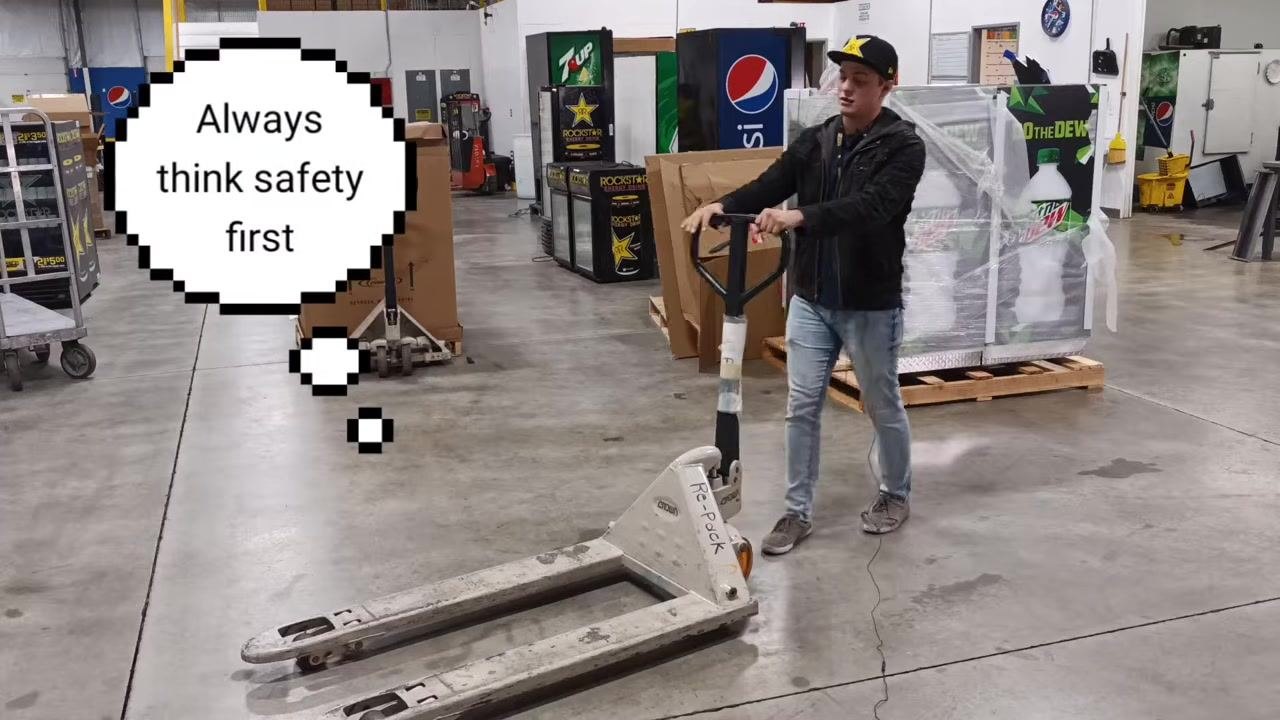
Safety guidelines: avoiding injuries and best practices
Front wheel hazard awareness
The front wheel of a manual pallet jack is extremely solid. When loaded, the pallet jack can carry thousands of pounds, making the front wheel especially dangerous if it rolls over your foot.
Safety Note: Never attempt to stop a moving pallet jack by placing your foot in front of the wheel. This instinctive action can result in serious injury, such as a broken foot.
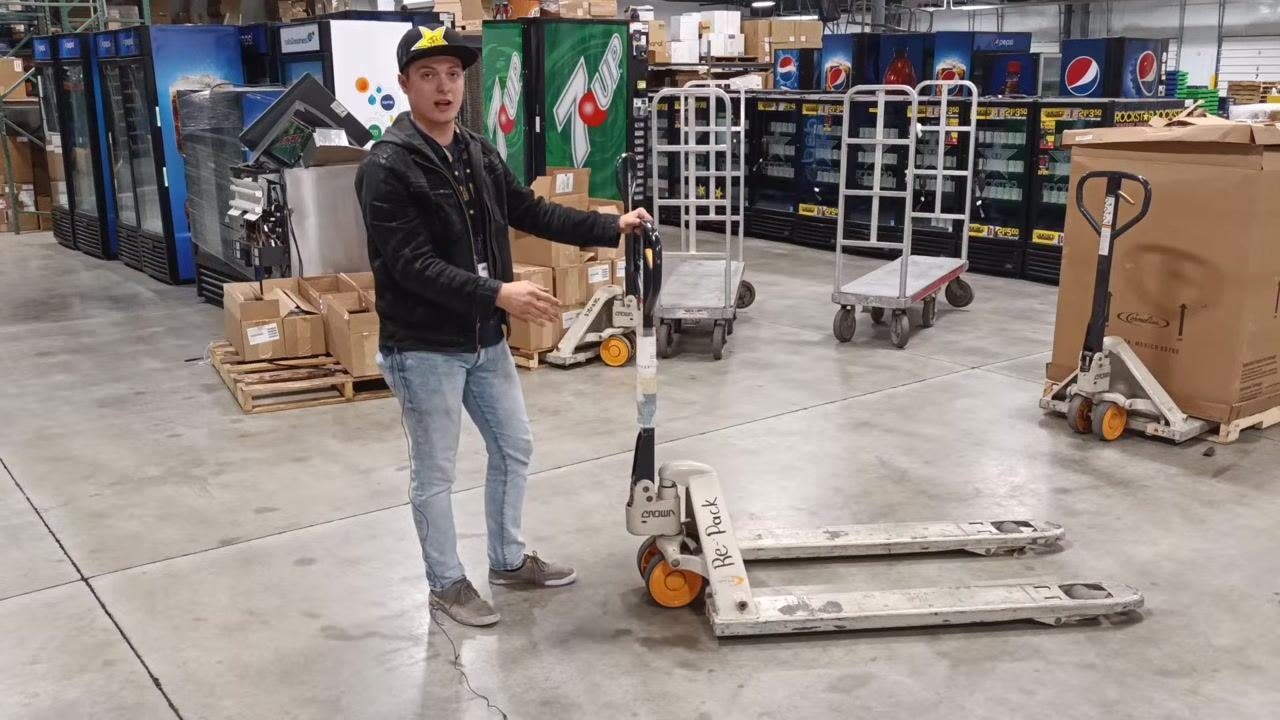
How to stop a moving pallet jack safely
If the pallet jack is moving too fast and you need to stop it suddenly, do not use your foot. Instead, quickly turn the handle sharply to one side or the other. This rapid movement will stop the pallet jack immediately.
Safety Note: If you turn the handle slowly, the pallet will simply pivot and continue moving, which can be dangerous. Practice this maneuver to ensure you can perform it quickly and safely in an emergency.
Keep your feet clear of the wheels
Always keep your feet on both sides of the pallet jack's wheel, never in front of it. This positioning helps prevent the wheel from running over your toes if you need to stop suddenly or if the jack moves unexpectedly.
Communicate when dropping a pallet
Before lowering a pallet in an aisle, always alert those around you. Clearly announce, "Hey, I'm dropping the pallet, watch your feet," to ensure no one's feet are under the pallet. Lower the pallet slowly, giving people time to move their feet out of the way.
Practice good safety habits
Always prioritize the safety of your coworkers. Practice good habits, such as clear communication and proper foot placement, to prevent injuries.
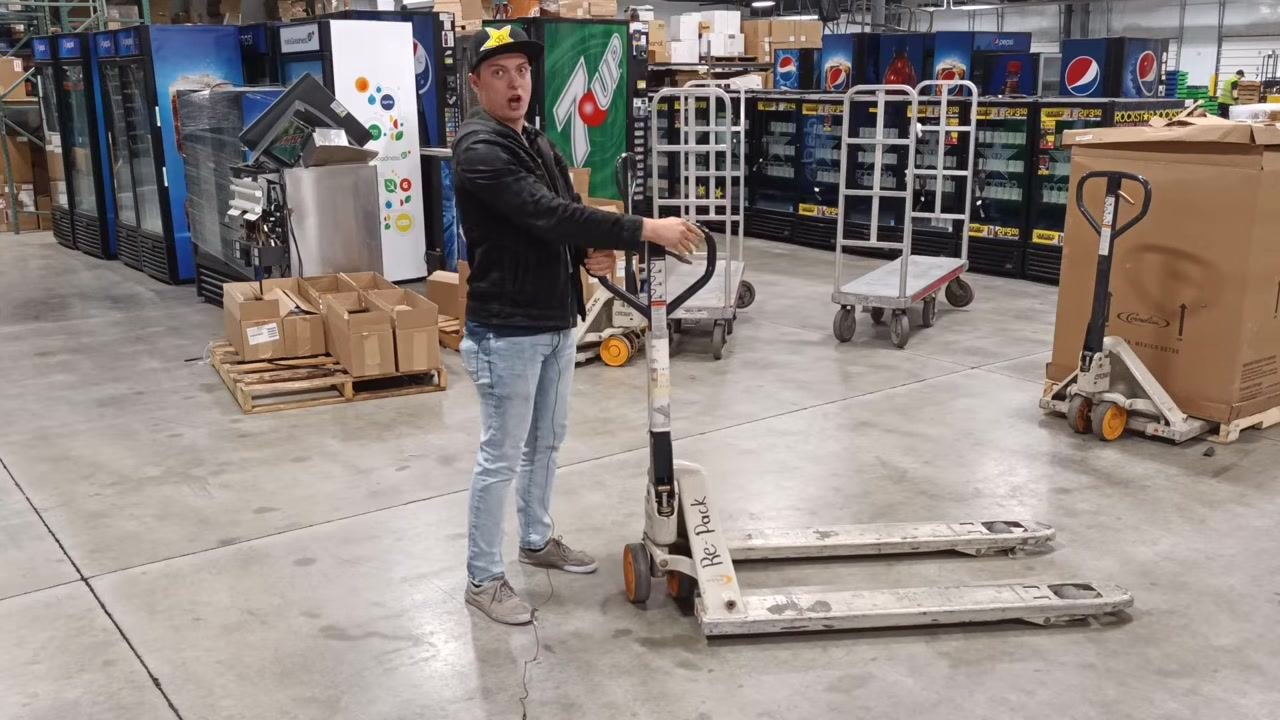
Verification and summary
Confirm the following before considering the procedure complete:
- The pallet was lifted and moved without the forks slipping or the load shifting.
- Wide turns were used throughout to account for the non-swiveling rear wheels.
- The pallet was lowered gently and only while stopped.
- No feet were placed in front of the wheels at any point.
- Verbal warnings were given before lowering pallets near others.
Key Safety Reminders: - Always think safety first when operating a pallet jack. - Lower the pallet when stopped to prevent accidents. - Use wide turns to avoid collisions, as the rear wheels do not swivel. - Never use your foot to stop a pallet jack. - Use the handle to stop the jack quickly and safely. - Keep feet clear of wheels at all times. - Communicate clearly before lowering pallets. - Always think of your coworkers' safety and practice good habits.
By following these steps, you can safely and effectively use a manual pallet jack to move pallets in a warehouse or store environment, helping prevent injuries and ensure a safer workplace.
What's next
If you found this training helpful, consider liking and subscribing to receive more safety and equipment operation tips in the future. Leave comments to let the trainers know what topics you are interested in for future content.

This training is provided by Workforce Coach.
Generation details: cost, quality tiers
Docsie billed 2,000 credits ($1.40) to analyze this 4-minute video at standard quality. The rewrite, template fill and Word/PDF exports were included. The same video at each quality tier:
| Quality | Frames sampled | Credits | Approx. cost |
|---|---|---|---|
| Draft | every 16-30 s | 1,000 | $0.70 |
| Standard (this guide) | every 8-15 s | 2,000 | $1.40 |
| Detailed | every 4-7 s | 4,000 | $2.80 |
| Ultra | every 1-3 s | 8,000 | $5.60 |
Credits priced at $0.70 per 1,000; plans include a monthly allowance. Enterprise customers on on-premise or bring-your-own-model deployments run this on their own inference and pay no per-video credits.
Generated by Docsie Video-to-Docs on 2026-09-08 from a 3-minute video. Screenshots are frames from the source video and belong to their creator, WORKFORCE COACH, whose original is embedded above. If you own this video and want the guide removed or credited differently, contact us and we will act within one business day.