
How to Use a Fire Extinguisher
This document provides standard operating guidance for safely and effectively using a fire extinguisher during a house fire emergency. It is based on expert demonstrations and observed common mistakes, and it is intended to help homeowners respond quickly and correctly when a fire occurs.
Video: Fire Safety:How to Use a Fire Extinguisher by ABC News (2012). All credit for the demonstration goes to the creator; watch the original on YouTube. The written guide below was generated from this video by Docsie. Creator? Request a change or removal.
Purpose
This document provides standard operating guidance for safely and effectively using a fire extinguisher during a house fire emergency. It is based on expert demonstrations and observed common mistakes, and it is intended to help homeowners respond quickly and correctly when a fire occurs.
Scope
This procedure applies to any resident or occupant who may need to respond to a small, contained house fire using a portable fire extinguisher. It covers fire awareness, common mistakes to avoid, proper extinguisher technique, and decision-making about when to fight a fire versus when to evacuate.
Background and Risk Awareness
Before outlining the procedure, it is important to understand the context of fire risk:
- Approximately 1,000 house fires occur in the country every day.
- Fires can be caused by lightning, summer grills, and other common sources.
- FEMA warns that most people who believe they know how to use a fire extinguisher actually do not.
- Fire doubles in size every 60 seconds, so any delay in response significantly increases danger and damage.
Required equipment
- A portable fire extinguisher, in working condition and accessible
- A phone to call 911
- A clear, unobstructed escape route
Common mistakes to avoid
Real-life demonstrations, including tests where homeowners believed they were participating in a family fire drill but were actually being evaluated on extinguisher use, revealed the following common errors:
- Taking too long to pull the pin, which delays the response.
- Standing too far from the flames, which renders the extinguisher ineffective.
- Taking your eyes off the fire while operating the extinguisher.
Safety Note: If you are unable to operate the extinguisher effectively, prioritize evacuating the area immediately rather than continuing to attempt extinguishment.
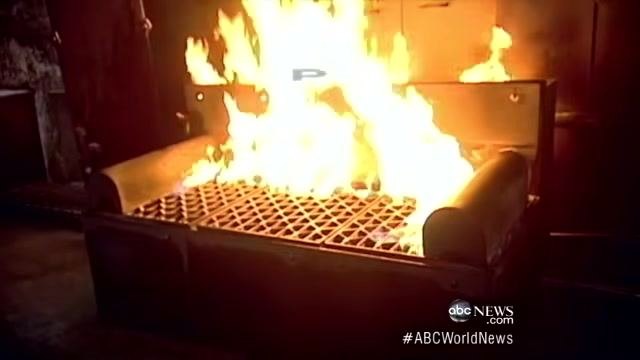
The image below illustrates the difficulty of this situation: a homeowner attempting to control a rapidly growing fire.

Procedure
Step 1: Assign roles immediately upon discovering a fire
- Designate one person to call 911 immediately to alert emergency services.
- Designate a second person to operate the fire extinguisher only if it is safe to do so.
Safety Note: Always call 911 as soon as a fire is discovered, regardless of whether you plan to fight it yourself.
Step 2: Assess whether the fire is safe to fight
- Confirm the fire is small, contained, and still in its very early stages.
- Confirm you have a clear, unobstructed escape route before attempting to use the extinguisher.
- If the fire is no longer in its early stages, is growing rapidly, or you are unsure, do not attempt to fight it. Evacuate immediately.
Step 3: Apply the PASS method to operate the extinguisher
Follow the PASS method in sequence:
- P – Pull the pin to unlock the extinguisher.
- A – Aim the nozzle directly at the base of the flames, not at the top of the fire.
- S – Squeeze the trigger/handle to release the extinguishing agent.
- S – Sweep the nozzle from side to side to cover the entire area of the fire.
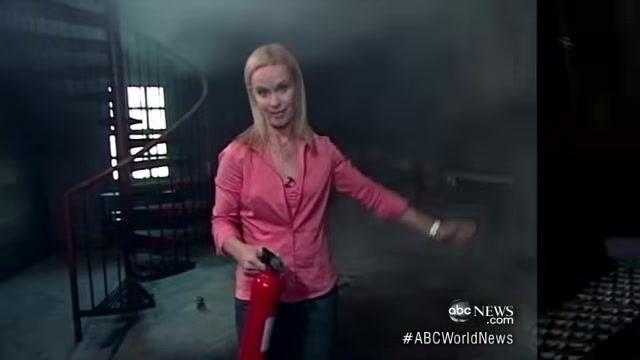
The image below demonstrates a fire safety instructor correctly performing the PASS method.
Verification: When the PASS method is performed correctly, the fire can be successfully extinguished. Confirm the flames are fully out before leaving the area.
Step 4: Evacuate if the fire cannot be controlled
- If the fire is too large, spreading quickly, or beyond your ability to control, stop attempting to extinguish it.
- Leave the area immediately and move toward a clear, illuminated exit.
- Wait outside for professional firefighters to arrive.
The image below shows the correct evacuation response when a fire is beyond control.
Safety Note: Fire safety professionals, including those from the Bergen County Fire Academy, emphasize the importance of learning how to use a fire extinguisher before an emergency occurs, not during one.
Summary of key actions
- Familiarize yourself with your fire extinguisher's operation before an emergency happens.
- Assign one person to call 911 and another to operate the extinguisher, if safe.
- Use the PASS method: Pull, Aim, Squeeze, Sweep.
- Only attempt to extinguish very small, contained fires with a clear escape route available.
- Evacuate immediately if the fire grows, spreads rapidly, or you feel unsafe.
- Never take your eyes off the fire while operating the extinguisher, and do not stand too far from the flames.
- Always prioritize personal safety over property, and call for professional help without delay.
Generation details: cost, quality tiers
Docsie billed 1,500 credits ($1.05) to analyze this 3-minute video at standard quality. The rewrite, template fill and Word/PDF exports were included. The same video at each quality tier:
| Quality | Frames sampled | Credits | Approx. cost |
|---|---|---|---|
| Draft | every 16-30 s | 750 | $0.52 |
| Standard (this guide) | every 8-15 s | 1,500 | $1.05 |
| Detailed | every 4-7 s | 3,000 | $2.10 |
| Ultra | every 1-3 s | 6,000 | $4.20 |
Credits priced at $0.70 per 1,000; plans include a monthly allowance. Enterprise customers on on-premise or bring-your-own-model deployments run this on their own inference and pay no per-video credits.
Generated by Docsie Video-to-Docs on 2026-09-08 from a 2-minute video. Screenshots are frames from the source video and belong to their creator, ABC News, whose original is embedded above. If you own this video and want the guide removed or credited differently, contact us and we will act within one business day.