
4.8
on G2
 Archbee
 Guru
Guru
Archbee is a developer documentation platform with add-on-heavy pricing, while Guru is an internal knowledge management tool with AI-powered verification workflows. This head-to-head comparison evaluates both tools on enterprise security, scalability, administration, and support — so you can choose the right platform for your organization.
Archbee and Guru serve fundamentally different enterprise documentation needs.
Enterprise Feature Matrix
A detailed side-by-side comparison of enterprise-grade features across security, compliance, administration, scalability, and support for Archbee and Guru.
| Enterprise Feature |
Archbee
|
Guru
|
|---|---|---|
| SOC 2 Compliance | ||
| GDPR Compliance | ||
| HIPAA Readiness | ||
| SSO (SAML) | Enterprise only | Enterprise only |
| Role-Based Access Control | ||
| Granular Permissions | ||
| Audit Logs | ||
| Multi-Tenant Portals | ||
| Custom Domain Support | ||
| Custom Branding | ||
| API Access | Add-on ($80/month) | |
| Analytics & Reporting | Add-on ($80/month) | |
| 50+ Language Support | ||
| Dedicated Customer Success Manager | Enterprise only | Enterprise only |
| SLA Guarantee | Enterprise only | Enterprise only |
| Uptime SLA | Enterprise only | Enterprise only |
| Priority Support | Enterprise only | Builder+ tiers |
| Version Control | 1–5 years by tier | Via verification cycles |
| Review & Approval Workflows | ||
| Helpdesk Integrations |
Data as of February 2026. Features based on publicly available vendor documentation and pricing pages.
Strengths & Weaknesses
Deep Dive Analysis
An in-depth analysis across four enterprise readiness dimensions — security and compliance, scalability and performance, administration and control, and support and SLA.
Both Archbee and Guru hold SOC 2 and GDPR certifications, covering baseline enterprise security requirements. Archbee offers SSO exclusively at the Enterprise tier, while Guru provides SAML SSO also at Enterprise level. Neither platform confirms HIPAA readiness, which limits suitability for healthcare organizations. Critically, neither tool provides published audit logs — a significant gap for regulated industries requiring traceable access records. Guru's broader integration footprint (Salesforce, Zendesk, Teams) introduces more potential data exposure surface. Neither platform offers air-gap or private infrastructure deployment, leaving compliance-heavy enterprises without the isolation they need.
Guru's architecture is built for large internal teams, with its verification workflow system designed to scale knowledge accuracy across thousands of employees. Its Knowledge Agents (Chat, Research, MCP Server) launched in 2025 signal investment in enterprise-scale AI. Archbee is designed for smaller technical teams and product documentation — its add-on model reveals infrastructure limitations, with API access and analytics gated behind additional payments rather than included as core capabilities. Neither platform documents uptime SLAs at lower pricing tiers. Guru's 10-seat minimum implies it targets mid-to-large organizations; Archbee's $50 base price suggests startup focus despite Enterprise tier availability.
Guru offers stronger administrative controls for enterprise buyers, with granular permissions, expert assignment for verification cycles, and deeper integrations with CRM and support platforms like Salesforce and Zendesk. Its browser extension provides contextual knowledge delivery that admins can configure. Archbee's administration is more lightweight — suitable for smaller technical teams but lacking the governance depth enterprises need. Neither tool offers multi-tenant architecture, meaning organizations serving multiple clients must manage entirely separate instances. Custom domain support is exclusive to Archbee — Guru does not allow custom domains, which constrains external knowledge delivery and branding for client-facing portals.
Both platforms gate dedicated support, SLA guarantees, and Customer Success Managers behind their Enterprise tiers, requiring custom pricing conversations before accessing meaningful support commitments. Guru offers Priority Support starting at the Builder tier — one step below Enterprise — giving mid-tier buyers some assurance. Archbee's dedicated support and SLA are strictly Enterprise-only, with no intermediate escalation path. Neither platform publishes specific uptime percentages or response-time SLAs at lower tiers. For enterprise procurement teams requiring contractual support commitments before signing, both tools require engagement with sales teams — a friction point that full enterprise platforms typically resolve with transparent SLA documentation.
Our Recommendation
Archbee and Guru serve fundamentally different enterprise documentation needs. Archbee targets developer and API documentation teams with a low-entry price that quickly escalates through add-ons, while Guru focuses on internal knowledge management with AI-powered verification workflows designed for large enterprise teams. Neither platform is purpose-built for enterprise-scale external documentation delivery, multi-tenant client portals, or regulated compliance environments requiring audit logs and private infrastructure.
Choose Archbee if you need...
Choose Guru if you need...
Choose Docsie if you need...
Winner: Docsie
Both Archbee and Guru share critical enterprise gaps — no audit logs, no multi-tenant client portals, no HIPAA readiness, and no private infrastructure deployment. Docsie addresses all of these with SOC 2 Type II, GDPR, HIPAA-ready, SOX, and ITAR compliance, full audit logs, multi-tenant architecture scaling to 10,000+ documentation sites, air-gap capable private infrastructure, and a six-pillar knowledge orchestration platform that converts any content into structured docs, delivers through branded portals, trains with built-in LMS, automates with autonomous agents, and monitors compliance in real time.
Decision Helper
A direct framework for picking between Archbee, Guru, and Docsie based on your specific needs.
Developer documentation platform with native OpenAPI/Swagger support.
AI-enabled enterprise knowledge management with verification workflows.

Convert real video into searchable docs, then deploy multi-tenant portals.
Common Questions
Q: Do both Archbee and Guru offer SOC 2 compliance?
A: Yes, both Archbee and Guru are SOC 2 compliant and GDPR-compliant. However, neither platform confirms HIPAA readiness or provides published audit logs — two requirements that are common in regulated industries like healthcare, financial services, and defense. Enterprise buyers in these verticals will need to verify compliance posture directly with each vendor before committing.
Q: Does Archbee or Guru support multi-tenant client portals?
A: Neither Archbee nor Guru supports multi-tenant client portals. Archbee supports custom domains and branding for a single external documentation site, while Guru is focused entirely on internal knowledge management with no external delivery architecture. Organizations needing to deliver separate branded documentation portals to multiple clients simultaneously will find both platforms inadequate for that use case.
Q: Which platform has better enterprise administration controls?
A: Guru has stronger enterprise administration capabilities overall, including granular permissions, expert assignment for verification workflows, and deeper integrations with enterprise systems like Salesforce, Zendesk, and Microsoft Teams. Archbee offers role-based access and approval workflows but is designed for smaller technical teams rather than enterprise governance at scale. Both reserve SSO (SAML) for their Enterprise tiers.
Q: Is there a better alternative to both Archbee and Guru for enterprise documentation?
A: Yes — Docsie is purpose-built for enterprise knowledge orchestration at a scale neither Archbee nor Guru reaches. Docsie offers SOC 2 Type II, GDPR, HIPAA-ready, SOX, and ITAR compliance with real-time compliance monitoring, full audit logs, multi-tenant portals for unlimited clients, air-gap capable private infrastructure, and a six-pillar platform covering content conversion, management, delivery, training, automation, and compliance monitoring. For enterprises evaluating both Archbee and Guru and finding gaps, Docsie is the logical next step.
Q: How does Archbee's true cost compare to Guru for enterprise teams?
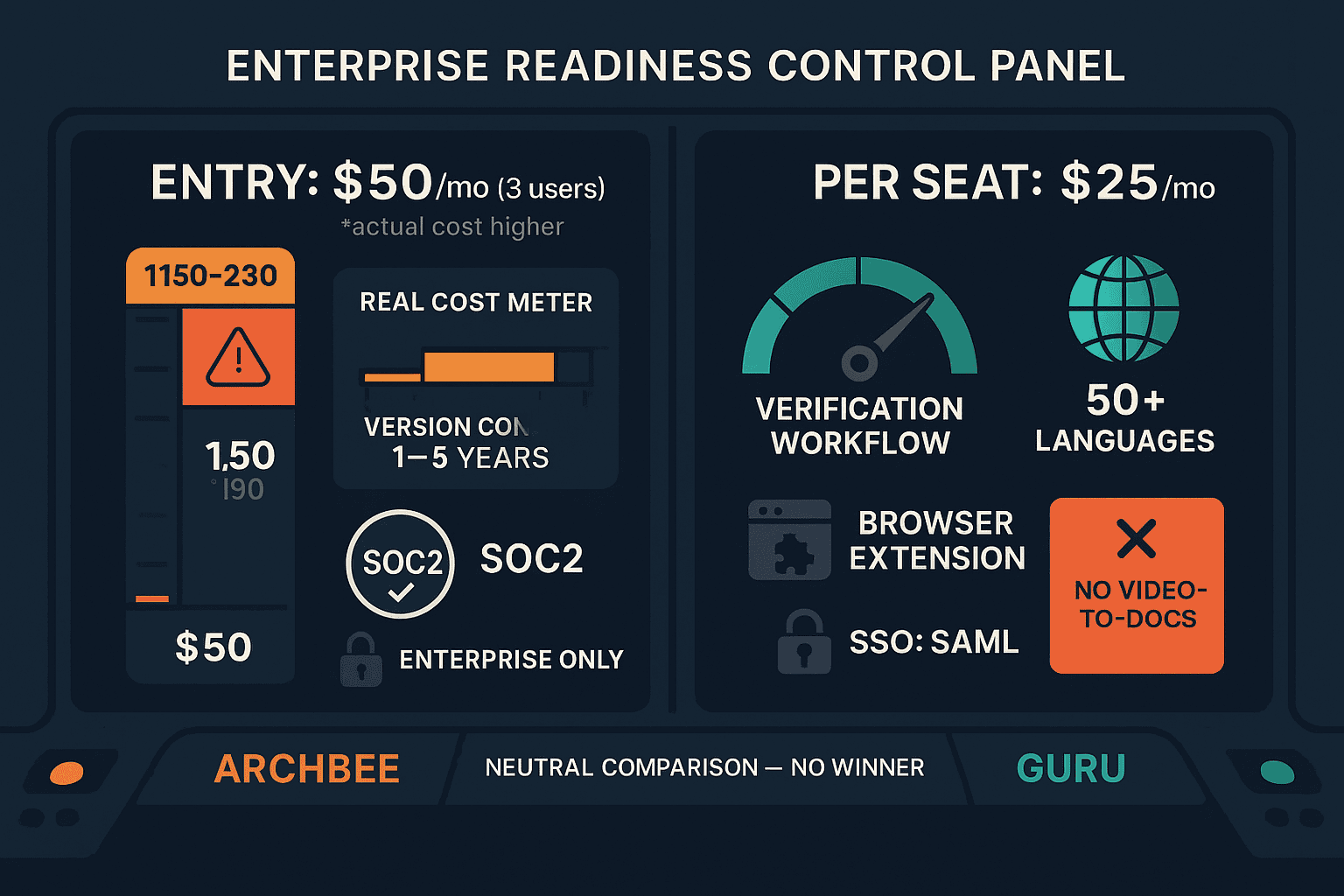
A: Archbee's advertised $50/month base price is misleading — a fully-featured deployment with AI ($20/month), analytics ($80/month), API access ($80/month), and app widget embedding ($80/month) costs $150–$230/month before reaching Enterprise. Guru's $25/seat/month with a 10-seat minimum creates a $250/month floor that scales linearly with headcount. For teams over 20 people, Guru's per-seat model typically becomes significantly more expensive than Archbee's add-on structure, though both require Enterprise pricing conversations for full capabilities.
Q: Which tool is better suited for regulated industries like healthcare or finance?
A: Neither Archbee nor Guru is fully optimized for heavily regulated industries. Both lack HIPAA readiness confirmation, published audit logs, and private infrastructure deployment options — all common requirements in healthcare, financial services, and government sectors. Docsie addresses these gaps with HIPAA-ready compliance, SOX and ITAR-compatible on-prem deployment, real-time frame-by-frame compliance monitoring, and air-gap deployment capability on private infrastructure.
Docsie delivers what both Archbee and Guru cannot — multi-tenant documentation portals, SOC 2 Type II and HIPAA-ready compliance with real-time monitoring, full audit logs, air-gap capable private infrastructure, and a complete CONVERT → MANAGE → DELIVER → LEARN → AUTOMATE → MONITOR platform. One system. Unlimited clients. Enterprise-grade security from day one.
No credit card required. Free AI credits included to convert a 10-minute training video.