
How to Write an 8d Report
An 8D report is the standard tool for addressing and resolving quality issues that arise in a product or process. Learning how to write an 8D report means working through eight structured disciplines, typically labeled D0 through D8, that take a team from problem definition all the way to closure and prevention. This guide walks through each discipline using a real corrosion-defect example, showing exactly what information belongs in each field of the report.
Video: How to complete an 8D report? [8D template walkthrough] by Quality Inspection (2020). All credit for the demonstration goes to the creator; watch the original on YouTube. The written guide below was generated from this video by Docsie. Creator? Request a change or removal.
An 8D report is the standard tool for addressing and resolving quality issues that arise in a product or process. Learning how to write an 8D report means working through eight structured disciplines, typically labeled D0 through D8, that take a team from problem definition all the way to closure and prevention. This guide walks through each discipline using a real corrosion-defect example, showing exactly what information belongs in each field of the report.
Prerequisites
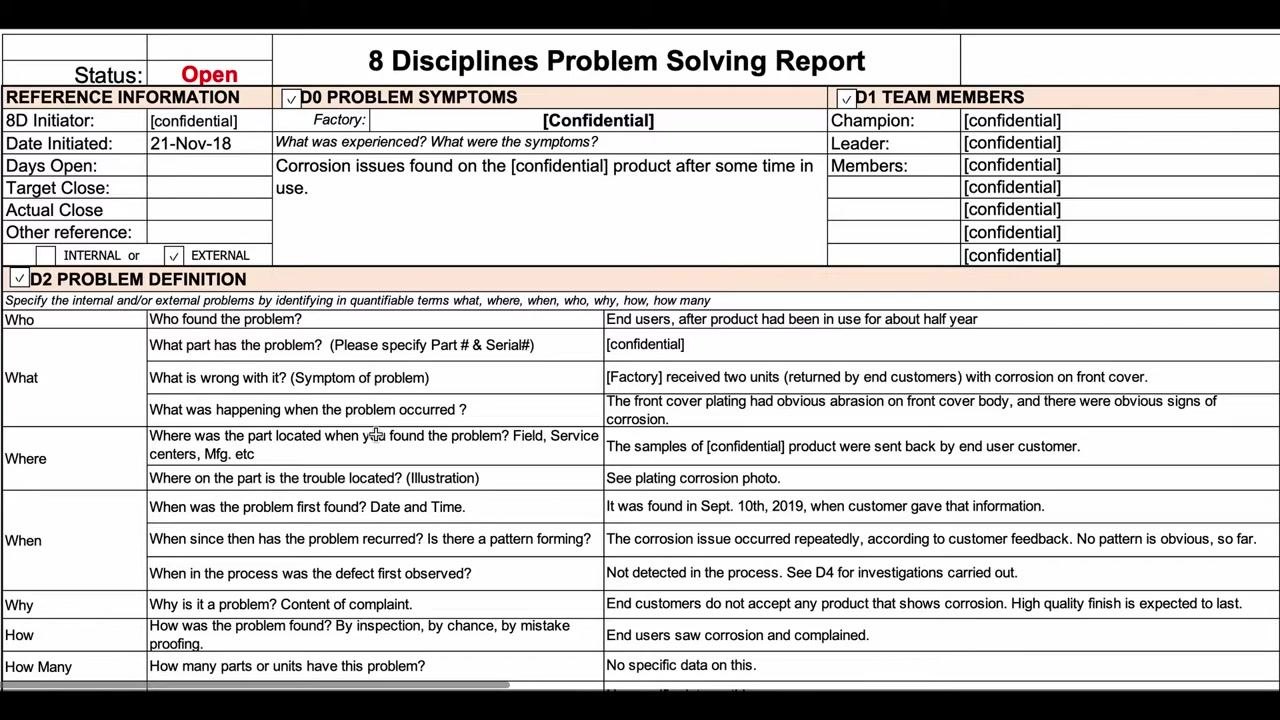
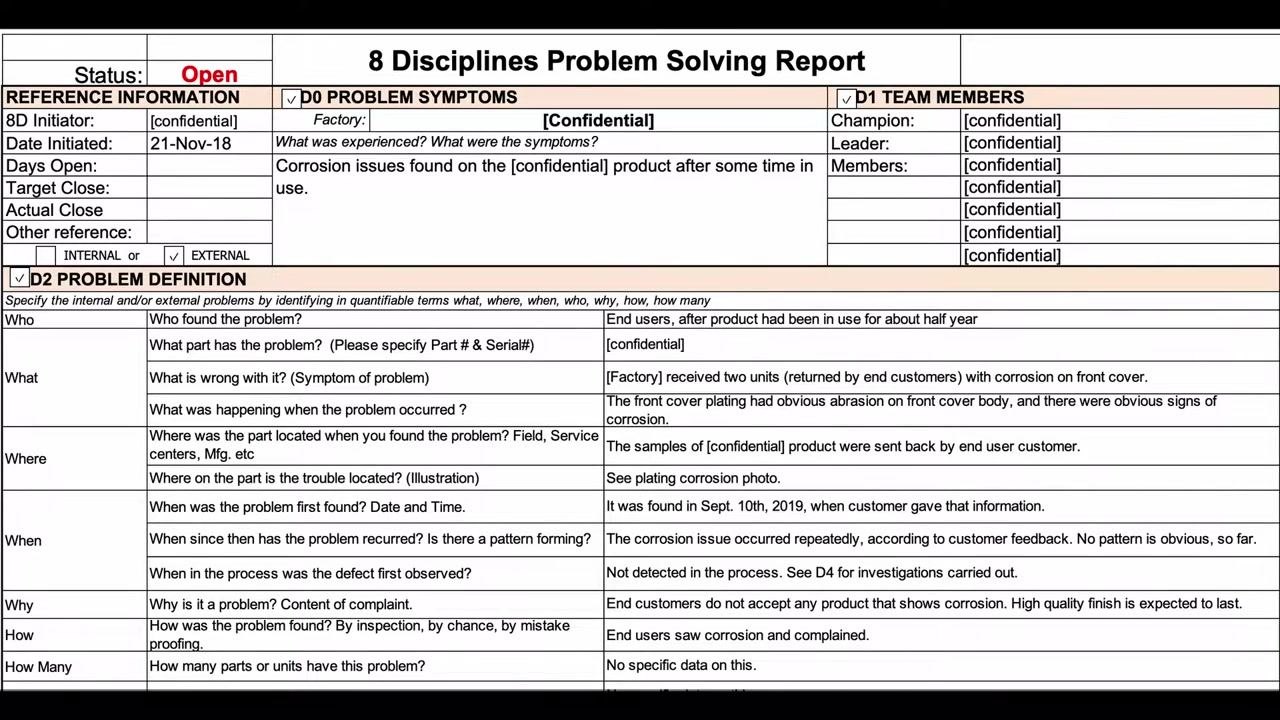
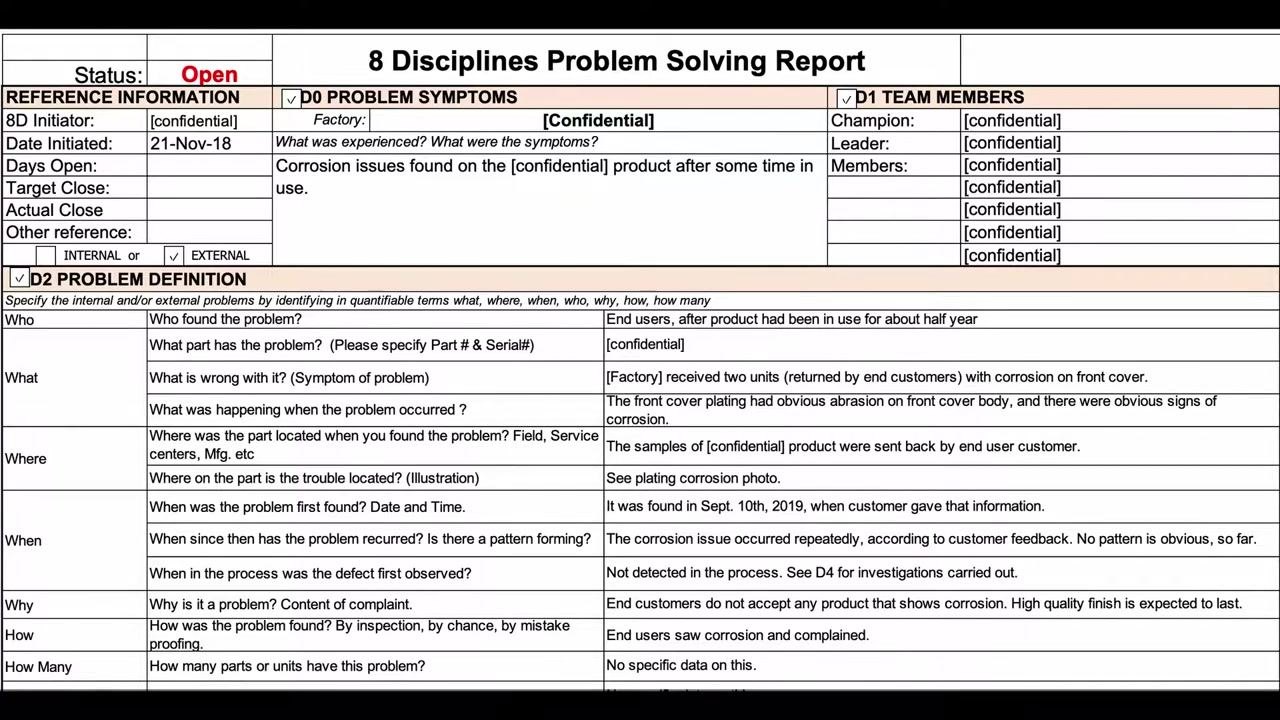
Before starting the disciplines themselves, set up the report's basic reference information. This ensures accountability and gives everyone a shared reference point for tracking progress.
- Status – mark the report as Open until the issue is fully closed.
- 8D Initiator – the person responsible for starting the report.
- Date Initiated – the date the report was opened (e.g., 21-Nov-18).
- Days Open – a running count of how long the report has been active.
- Target Close – a deadline for closing the report, which is especially important when working with suppliers or internal teams.
- Actual Close – left blank until the issue is resolved.
- Other Reference – any additional identifiers needed.
- Internal/External – whether the issue originates internally or externally.
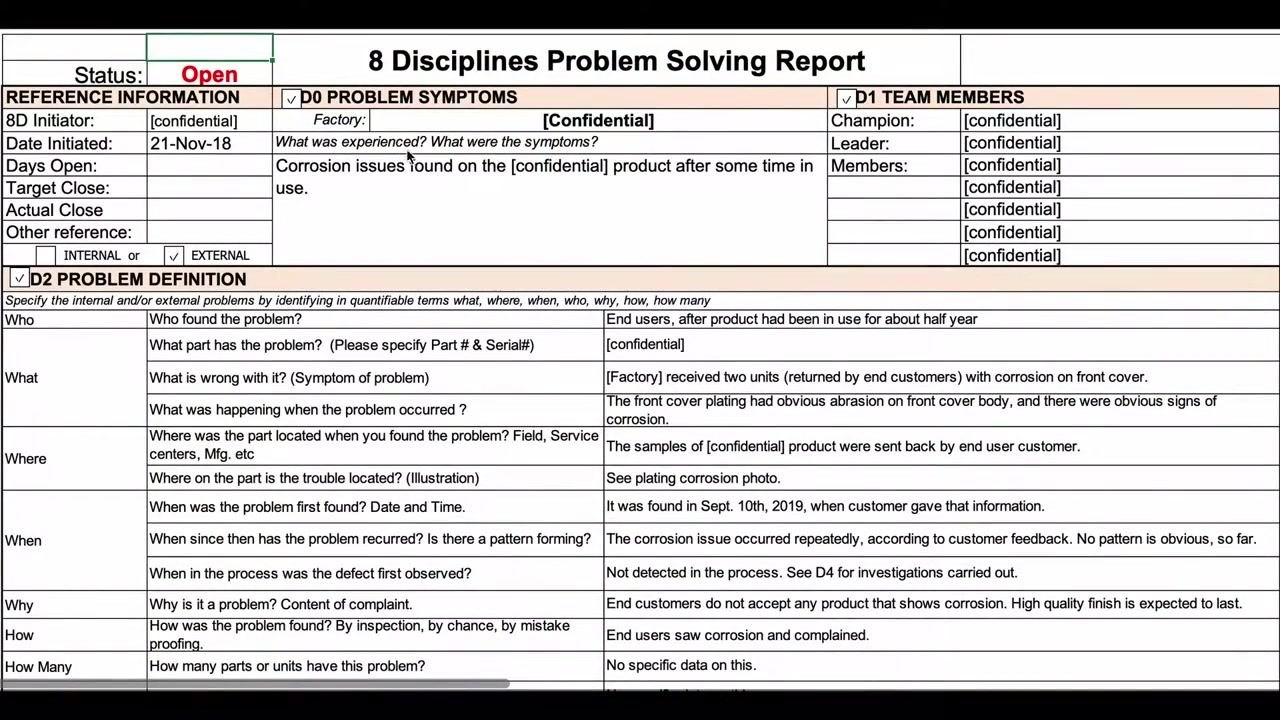
Use a dashboard to track all open and closed 8D reports so that relevant parties can see that progress is being actively monitored.
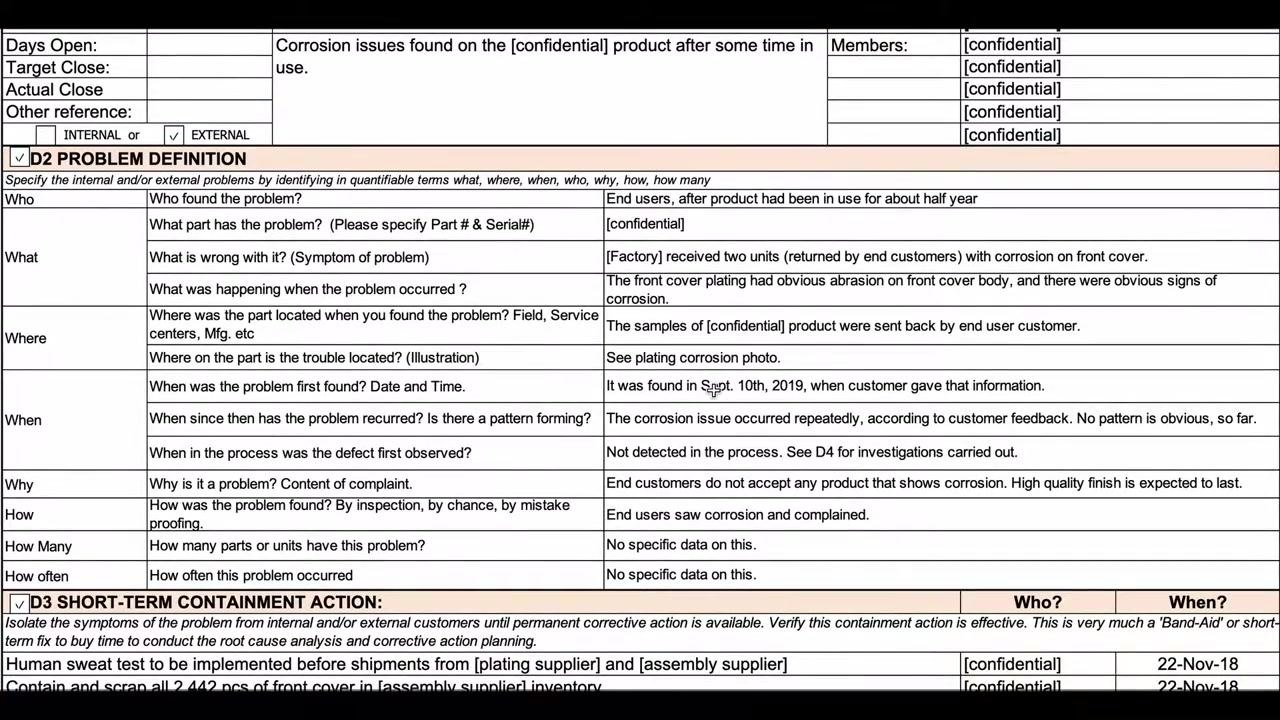
Once the basic information is in place, describe the problem in the problem symptoms field using simple, clear language — for example, "Corrosion issues found on the [confidential] product after some time in use" — and specify the product using its SKU number or another identifier.
D1 team
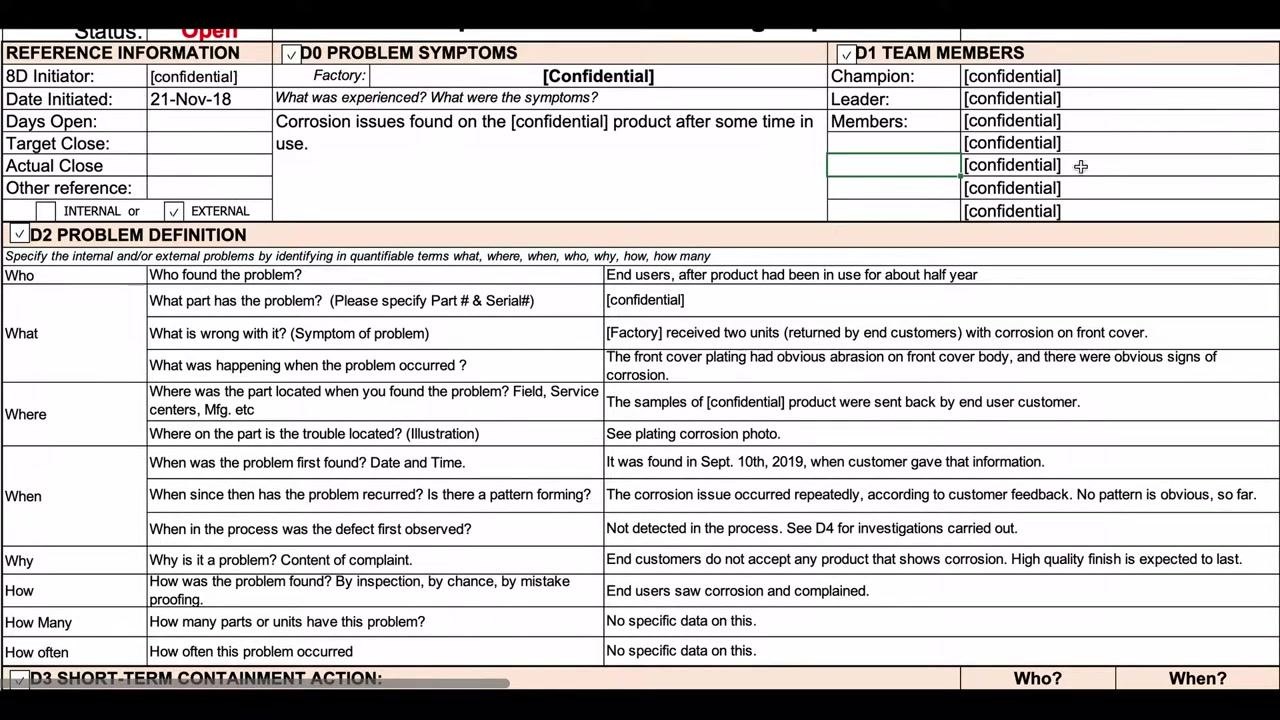
Assemble a team that is highly knowledgeable about the process involved. Aim for diversity of expertise and specialties so the analysis benefits from multiple perspectives.
- Champion – oversees the report and provides sponsorship.
- Leader – manages the day-to-day 8D process.
- Members – typically include the quality manager, production manager, process engineer, and supplier representatives when the issue involves an external supplier.
Assigning these roles up front ensures the right people are contributing to each discipline as the report progresses.
D2 problem description
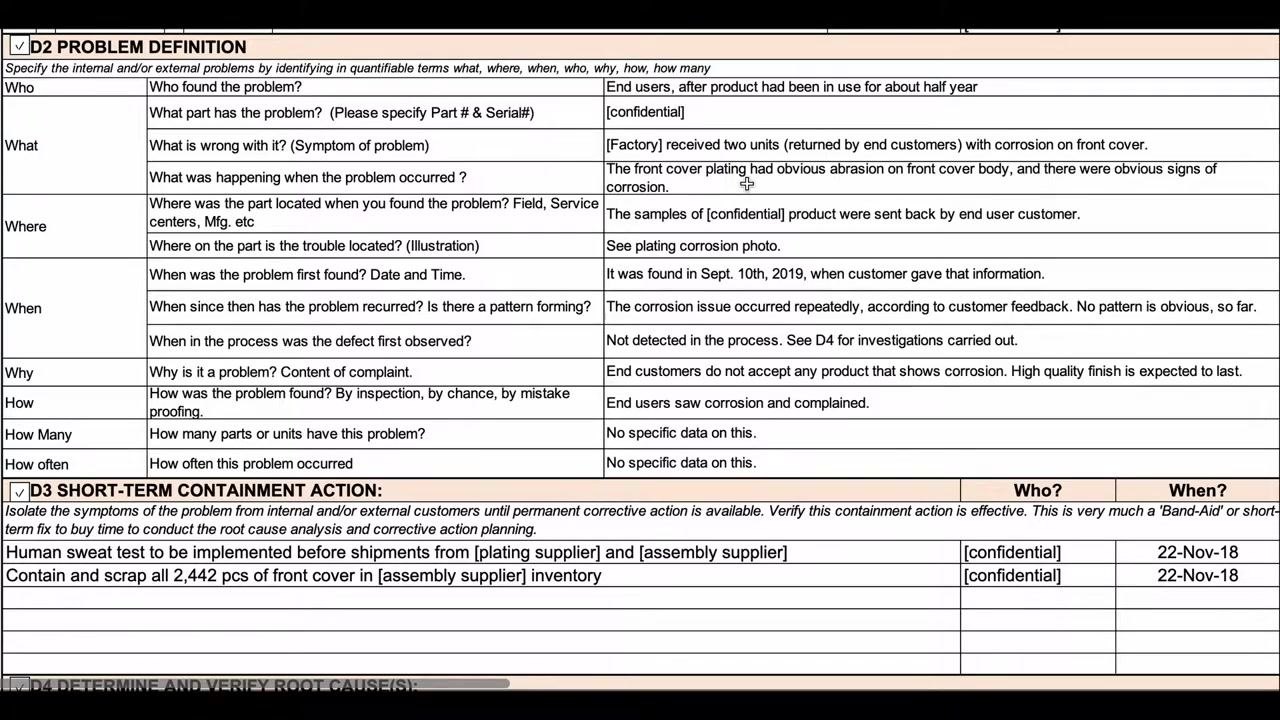
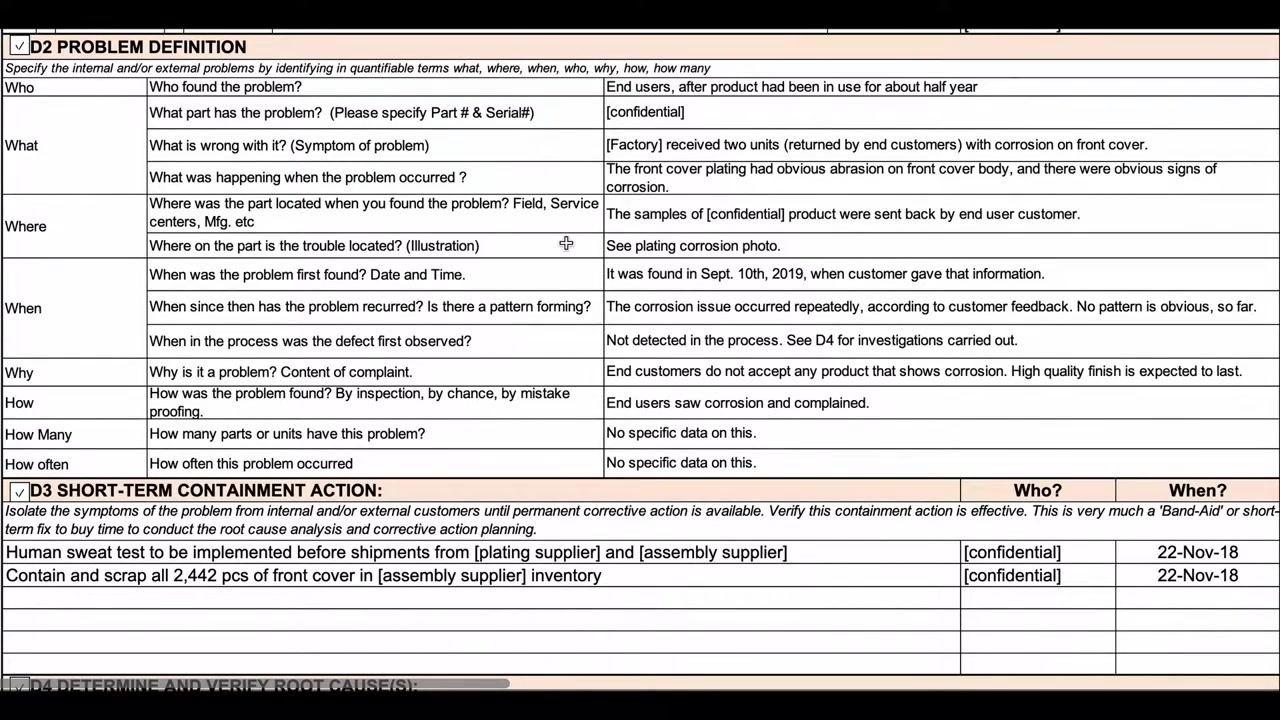
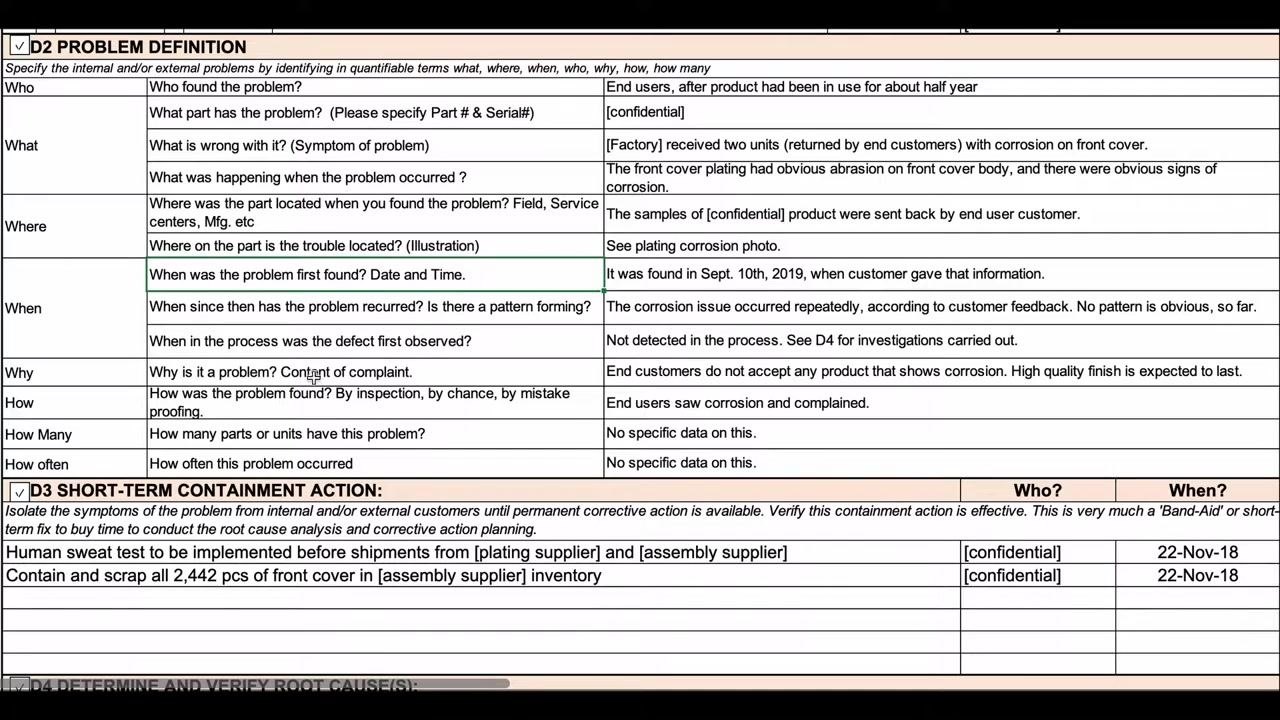
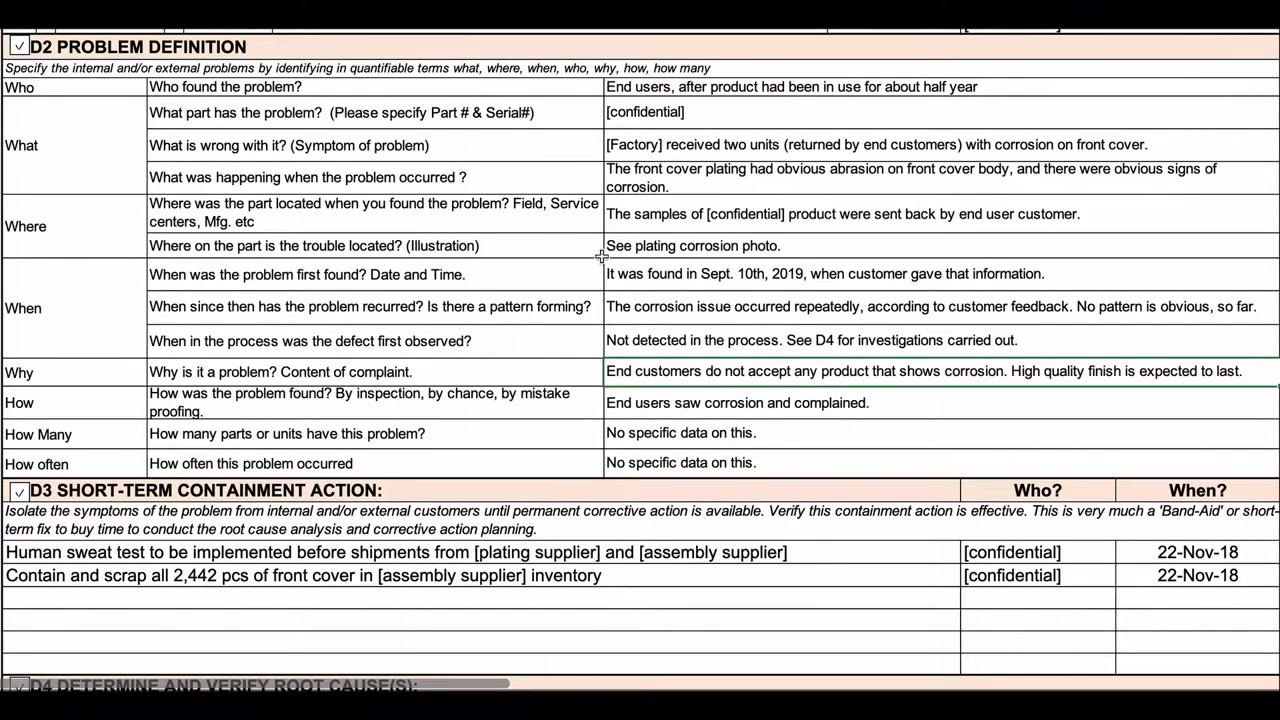
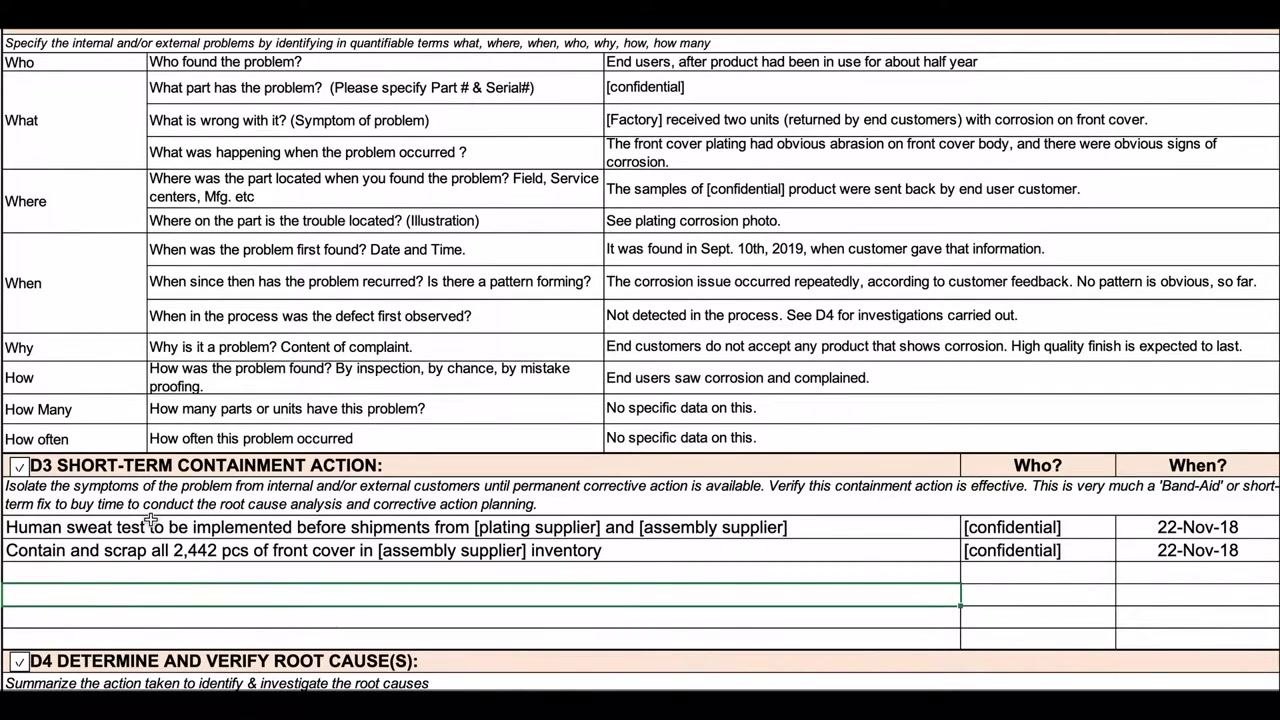
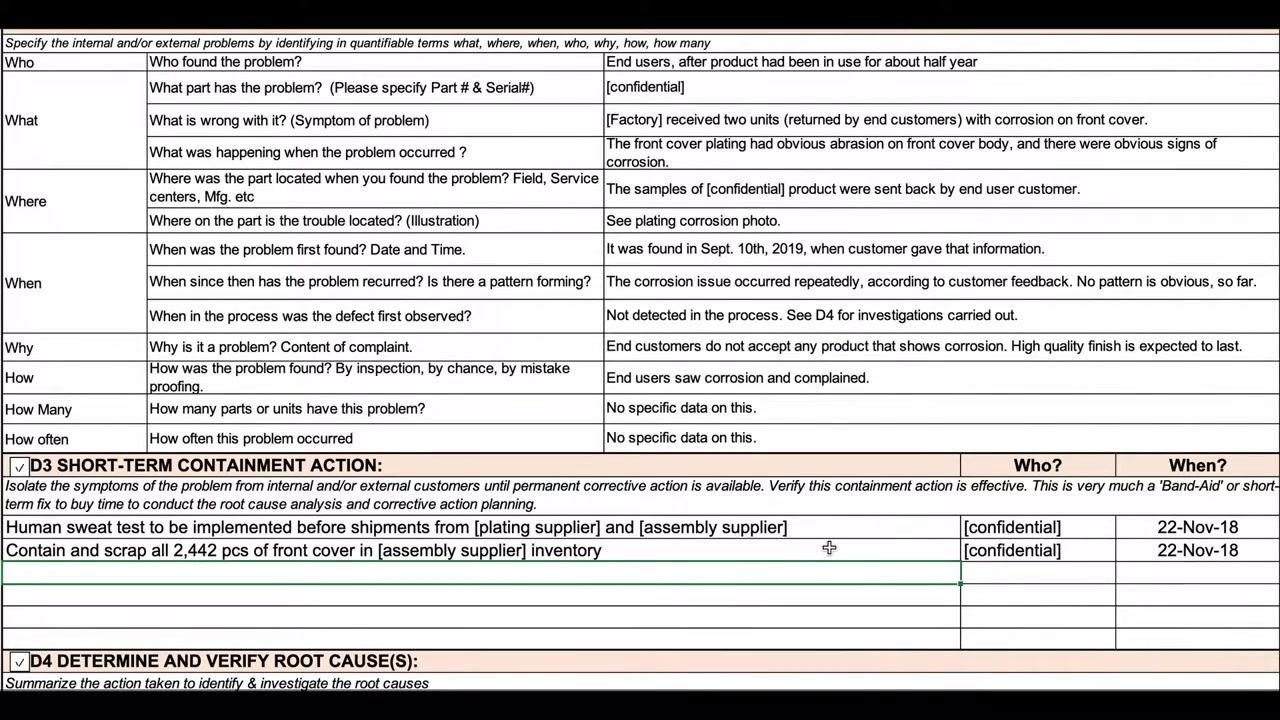
Complete the D2 Problem Definition table by answering the Five Ws and the Two or Three Hs in specific, quantifiable, and factual terms. Avoid assumptions — document facts and observations explicitly, even if some points seem obvious.
Fill out each field as follows:
- Who found the problem? End users, after the product had been in use for about half a year.
- What part has the problem? The specific part number and serial number (confidential in this example).
- What is wrong with it? Factory received two units, returned by end customers, with corrosion on the front cover.
- What was happening when the problem occurred? The front cover plating had obvious abrasion on the front cover body, along with obvious signs of corrosion.
- Where was the part located when found? Samples of the product were sent back by the end user customer.
- Where on the part is the trouble located? See the plating corrosion photo for illustration.
- When was the problem first found? September 10th, 2019, when the customer provided that information.
- When has the problem recurred? The corrosion issue occurred repeatedly according to customer feedback; no obvious pattern has emerged so far.
- When in the process was the defect first observed? Not detected in the process — see D4 for the related investigations.
- Why is it a problem? End customers do not accept any product that shows corrosion; a high-quality finish is expected to last.
- How was the problem found? End users saw the corrosion and complained.
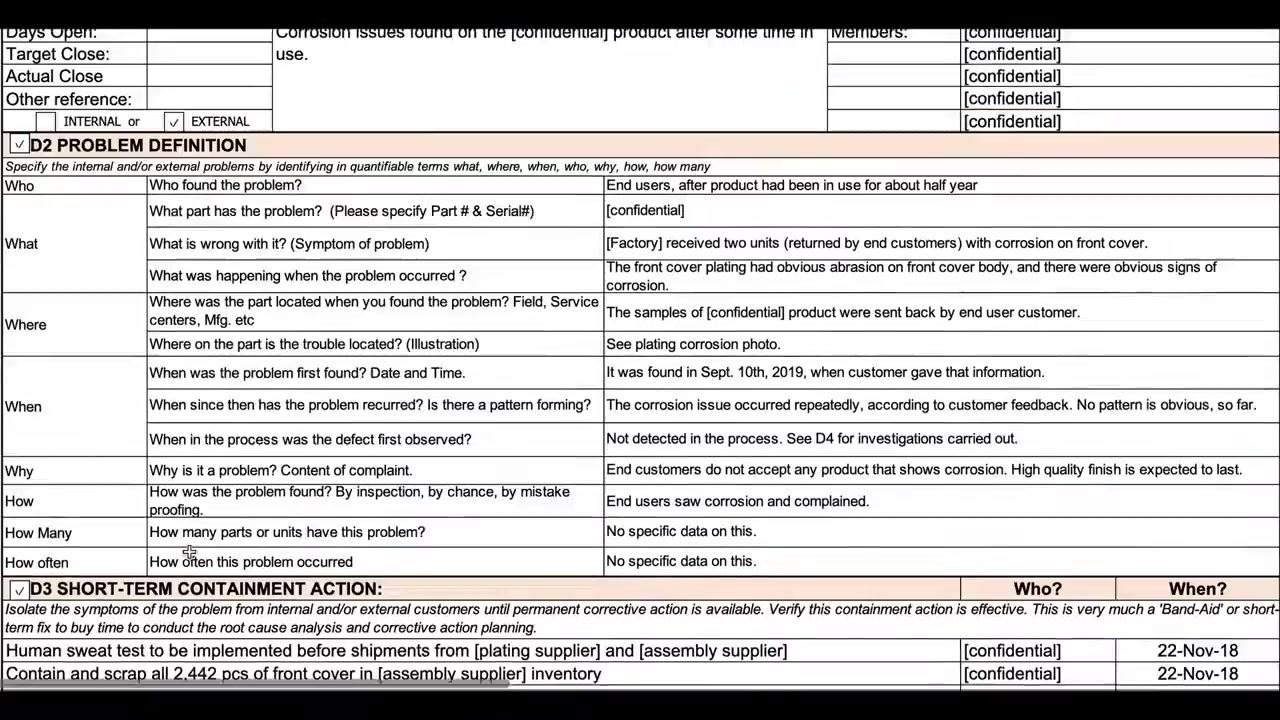
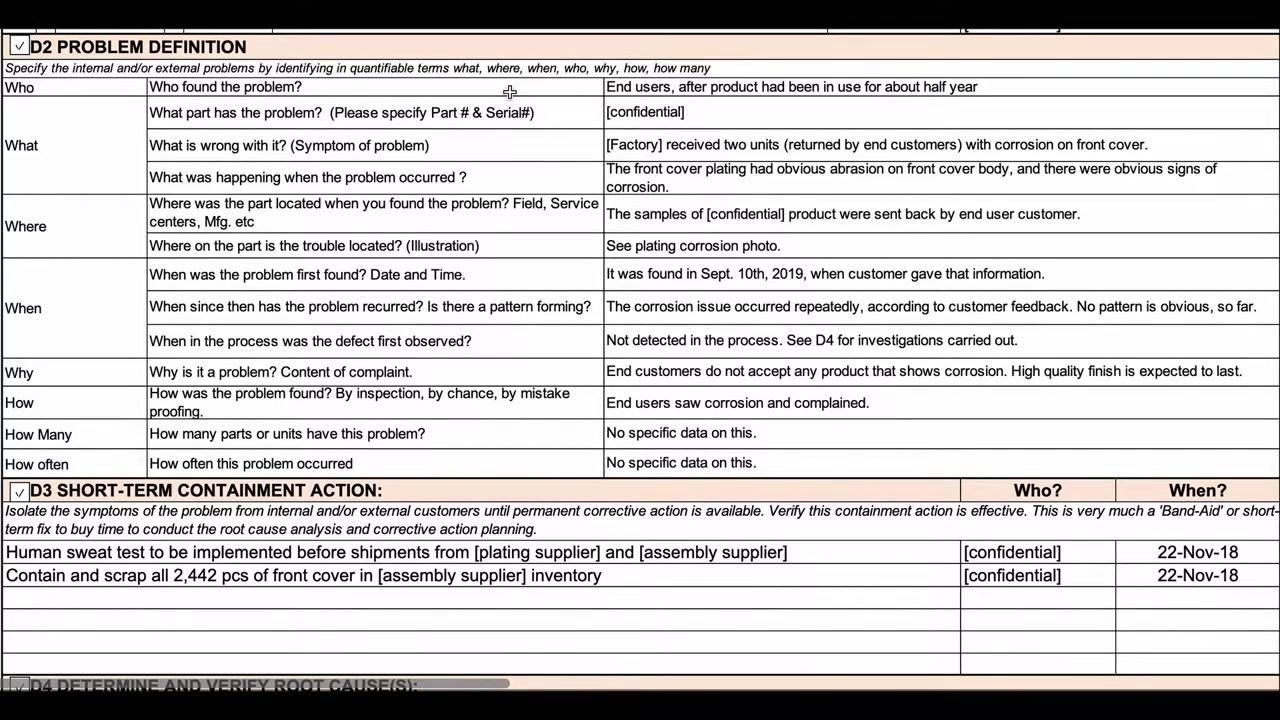
- How many parts or units have this problem? No specific data available.
- How often did this problem occur? No specific data available.
Attach or reference supporting evidence, such as photos of the defect, to give all stakeholders visual context. Once every field is complete, review the section for clarity and completeness so that someone not directly involved in the process can still understand the problem.
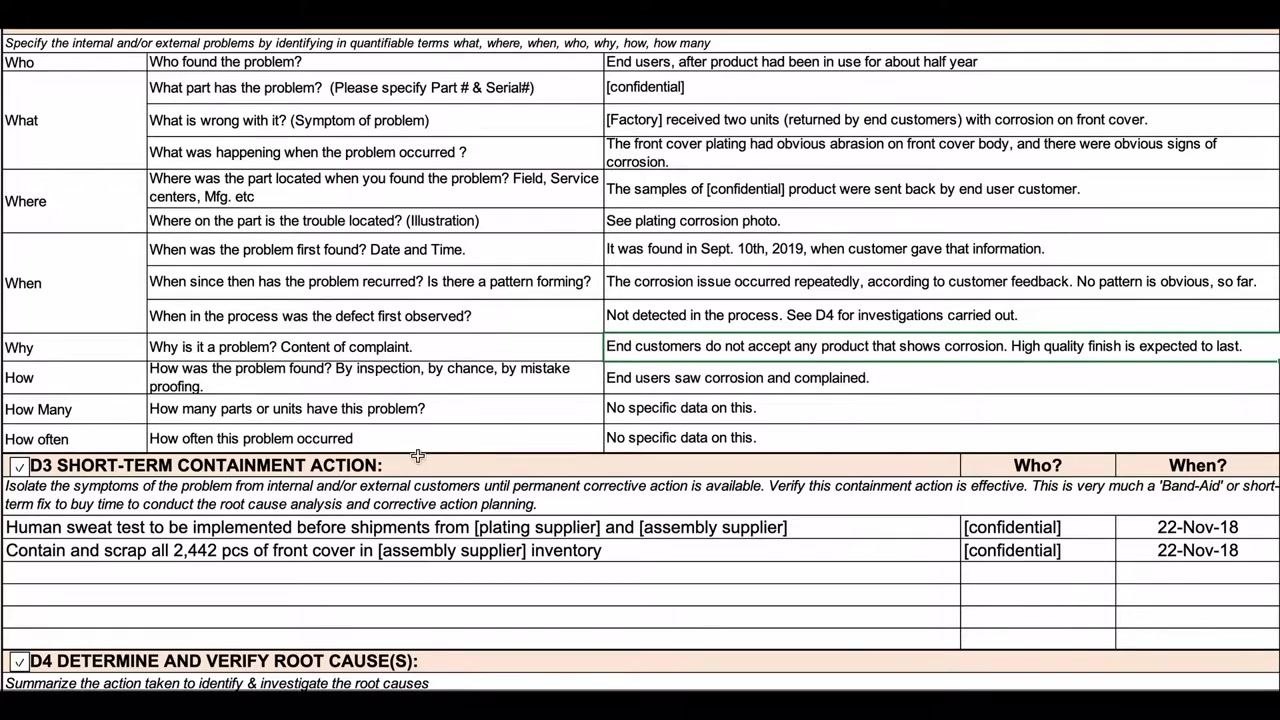
For a final recap, the completed problem-definition table reads: Who — end users after roughly half a year of use; What — corrosion on the front cover of the confidential part; Where — samples returned by the end user; When — first found September 10th, 2019, recurring without a clear pattern, not detected during the process; Why — end customers reject any corrosion; How — found through end-user complaints; How Many / How Often — no specific data available on either.
D3 containment
Before root cause work is complete, take immediate action to isolate the symptoms of the problem from internal and/or external customers. First, revisit how the problem was found, how many parts are affected, and how often it occurs; if quantitative data is available, plot it to look for patterns.
Spend at least 10–20 minutes reviewing and visualizing the data, investing more time if additional data collection is needed. While analyzing, decide what immediate steps can contain the problem — for example, halting shipments if products are still being manufactured and more information is still needed.
Document the specific containment actions taken, along with the responsible party and date:
| Containment action | Responsible | Date |
|---|---|---|
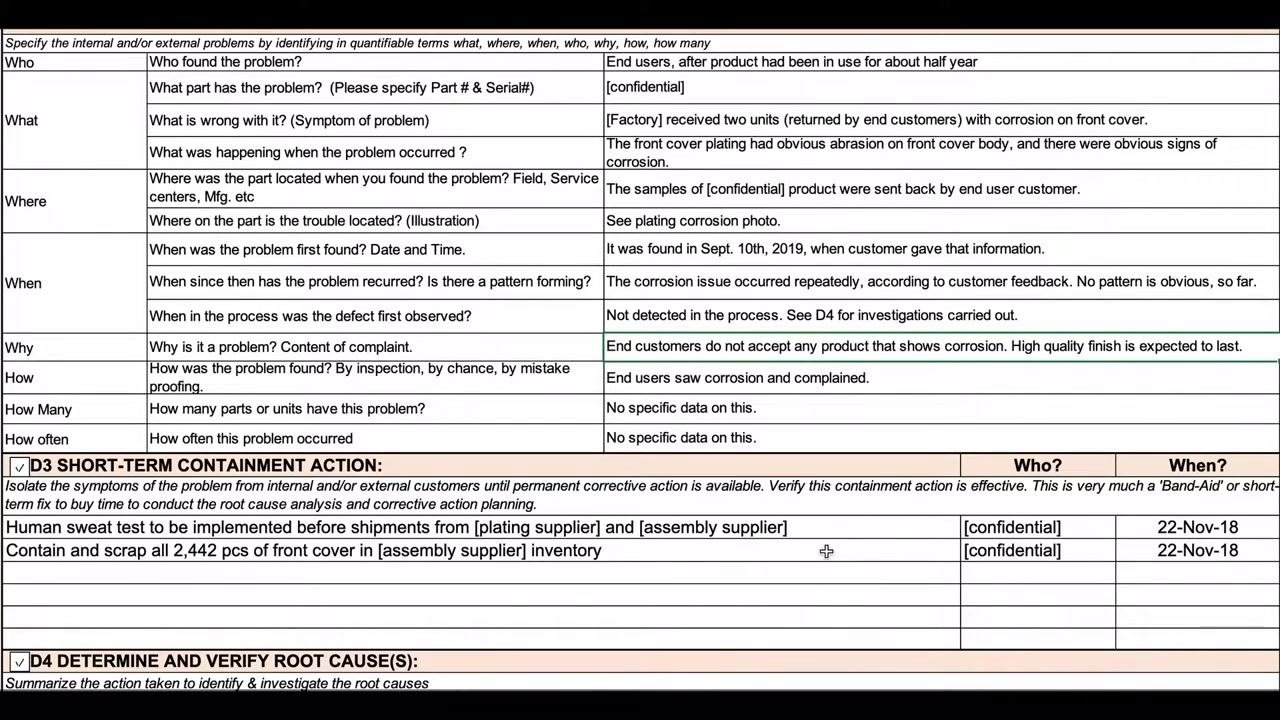
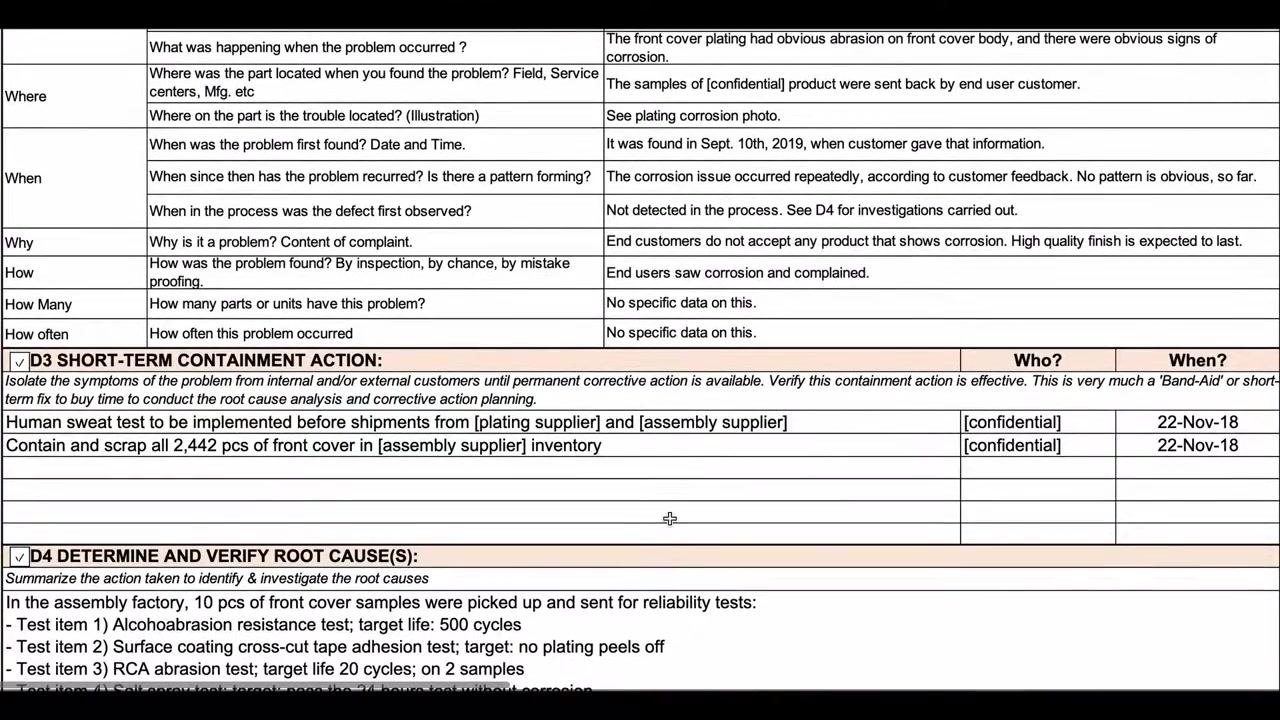
| Implement a human sweat test before shipments from the plating supplier and the assembly supplier | [confidential] | 22-Nov-18 |
| Contain and scrap all 2,442 pieces of front cover in the assembly supplier's inventory | [confidential] | 22-Nov-18 |
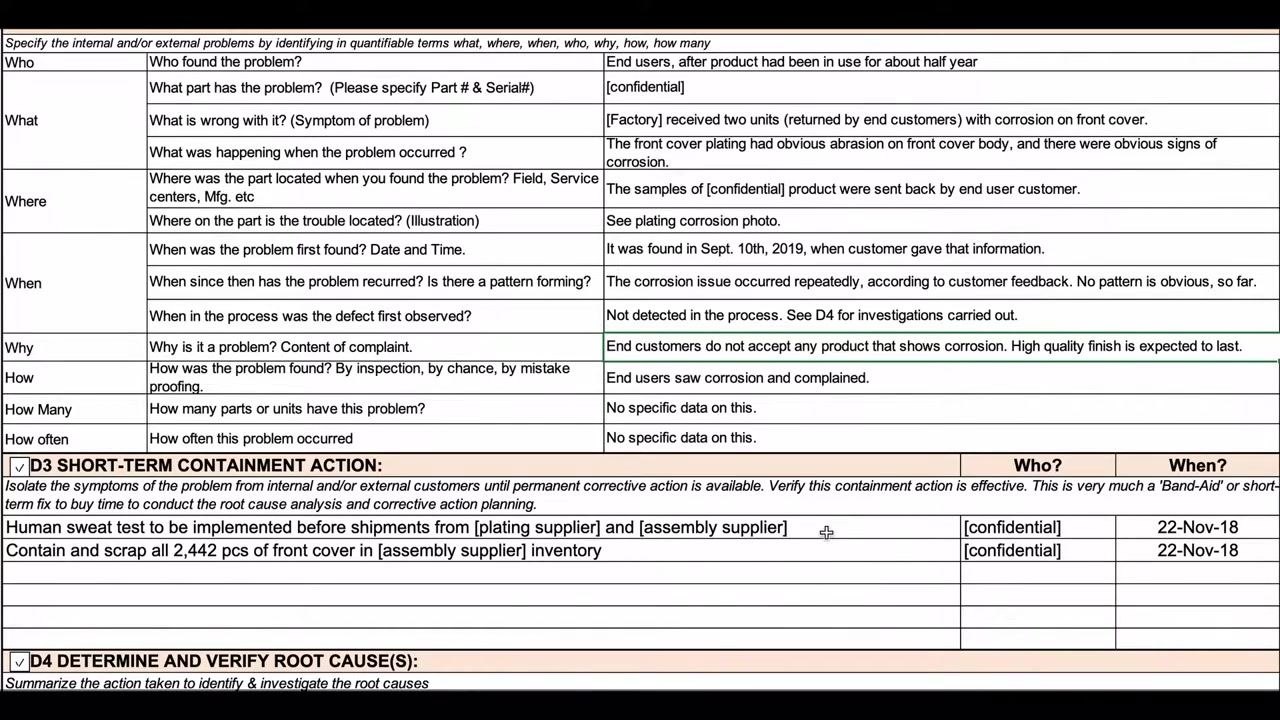
Treat these actions as temporary measures until a permanent corrective action is identified. Continue collecting data and add extra tests, such as the human sweat test, to replicate the failure mode as containment continues.
D4 root cause
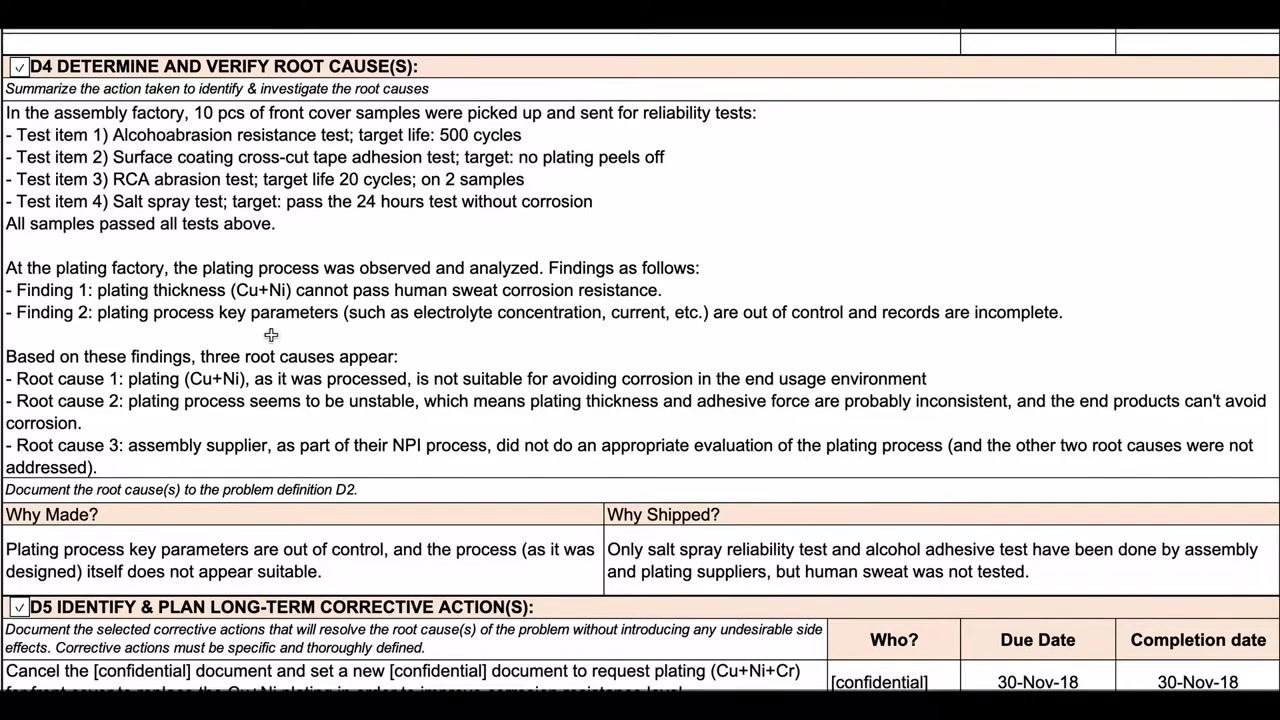
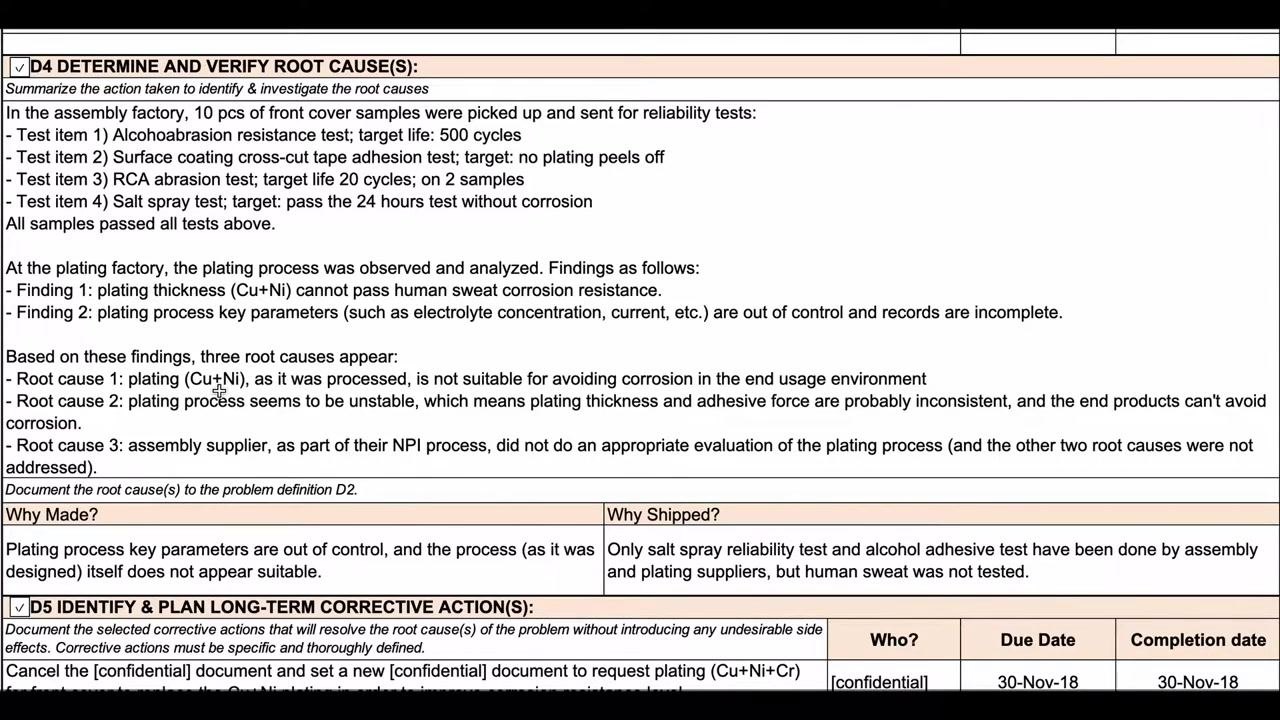
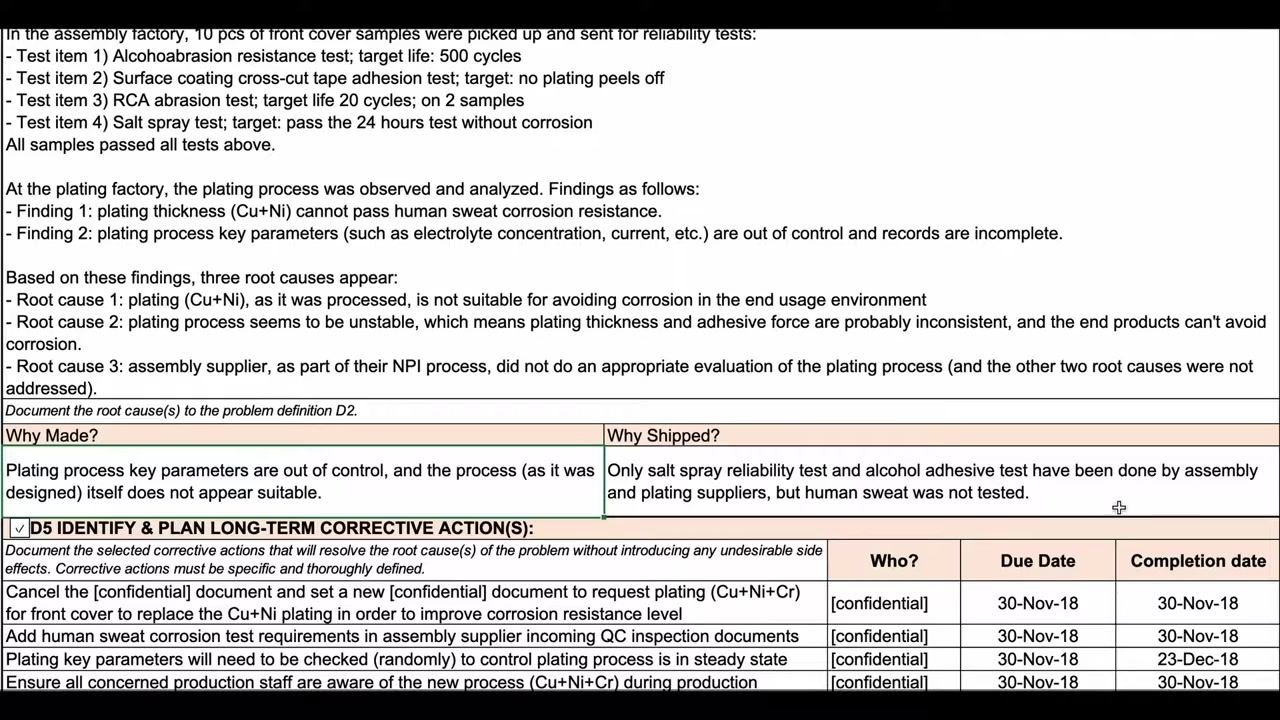
Investigate the root cause by combining reliability testing with a review of the supplier's process. In the assembly factory, ten front cover samples were pulled and sent for the following reliability tests:
| Test | Target | Result |
|---|---|---|
| Alcohol abrasion resistance test | Target life 500 cycles | Passed |
| Surface coating cross-cut tape adhesion test | No plating peels off | Passed |
| RCA abrasion test (2 samples) | Target life 20 cycles | Passed |
| Salt spray test | Pass 24 hours without corrosion | Passed |
At the plating factory, the investigation produced two key findings:
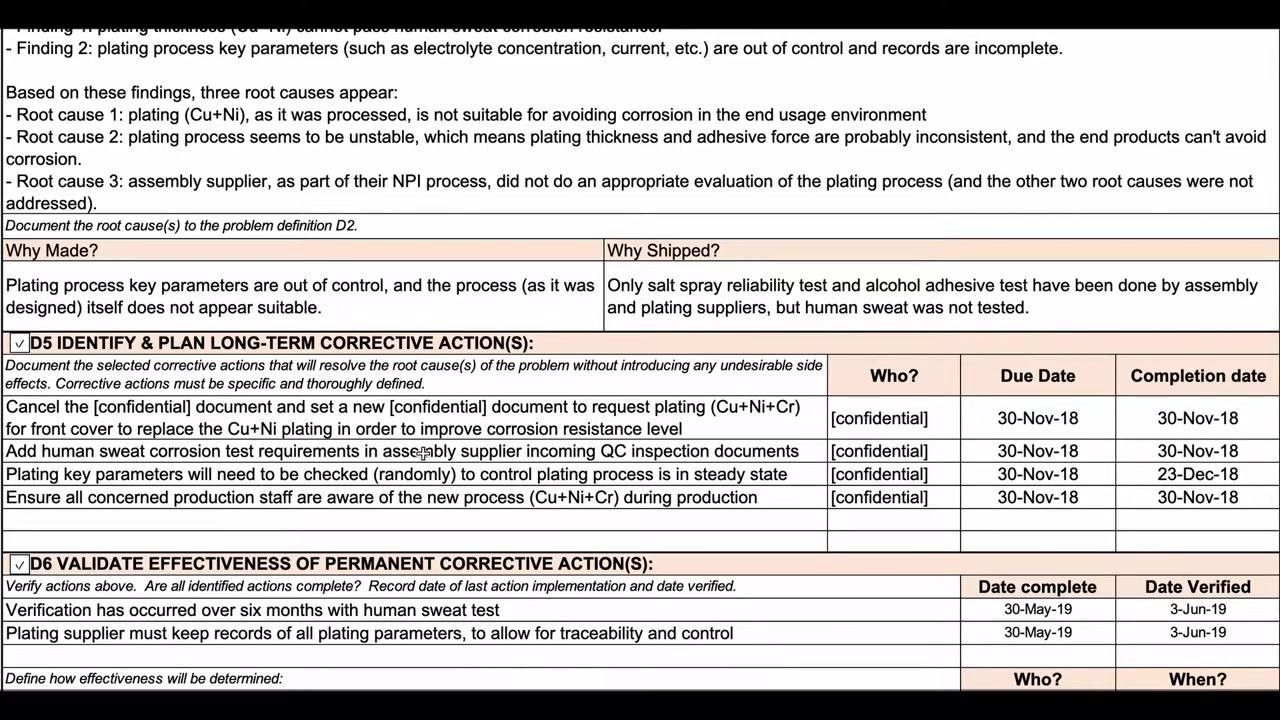
- Finding 1: Plating thickness (Cu+Ni) cannot pass the human sweat corrosion resistance requirement.
- Finding 2: Plating process key parameters — electrolyte concentration, current, and others — are out of control, and records are incomplete.
From these findings, three root causes were identified:
| Root cause | Description |
|---|---|
| Root cause 1 | Plating (Cu+Ni), as processed, is not suitable for avoiding corrosion in the end-use environment |
| Root cause 2 | Plating process is unstable; plating thickness and adhesive force are inconsistent, leading to unavoidable corrosion |
| Root cause 3 | The assembly supplier did not perform an appropriate evaluation of the plating process during NPI (New Product Introduction) |
The report also captures the escape point through two dedicated questions:
- Why made? Plating process key parameters are out of control, and the process as designed is not suitable.
- Why shipped? Only the salt spray and alcohol adhesive tests were performed by the assembly and plating suppliers; human sweat corrosion was never tested, so the gap was not caught before shipment.
Recognize that thinner plating with lower adhesive force accelerates corrosion, underscoring the need for proper plating evaluation during NPI. The problem spans two levels: the plating factory's process control and plating suitability, and the assembly supplier's lack of evaluation during product introduction.
D5 corrective action
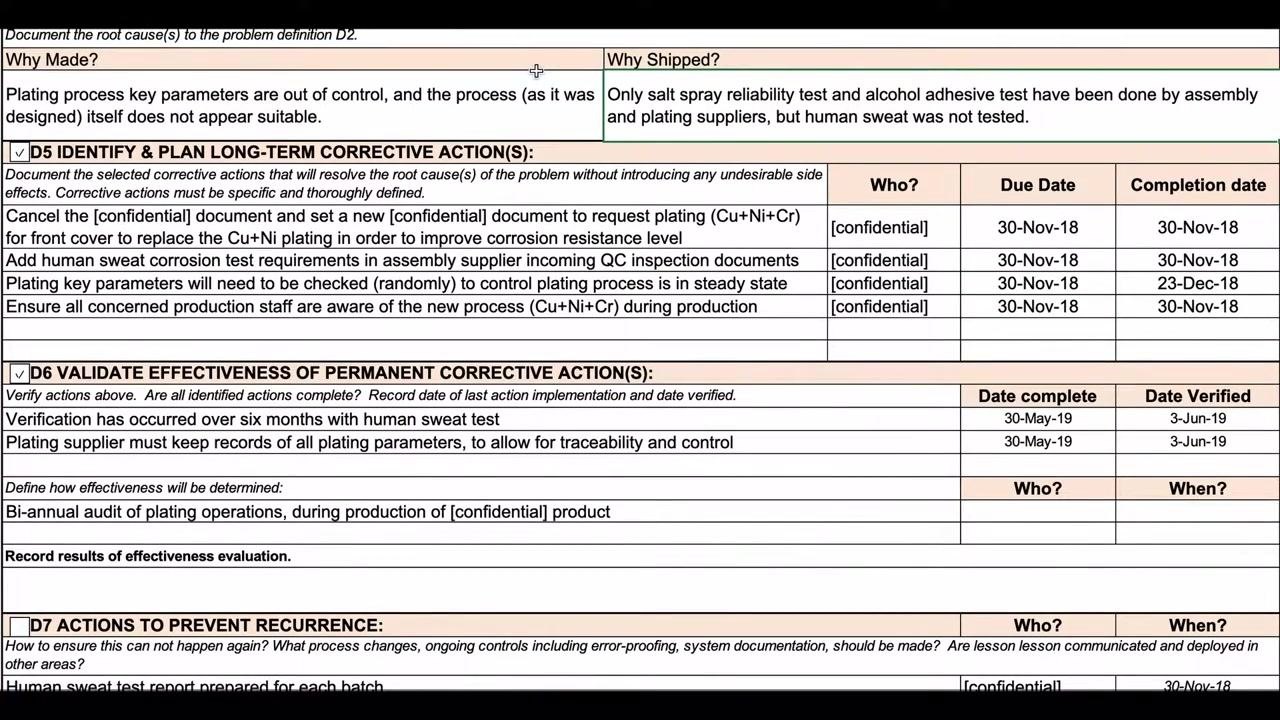
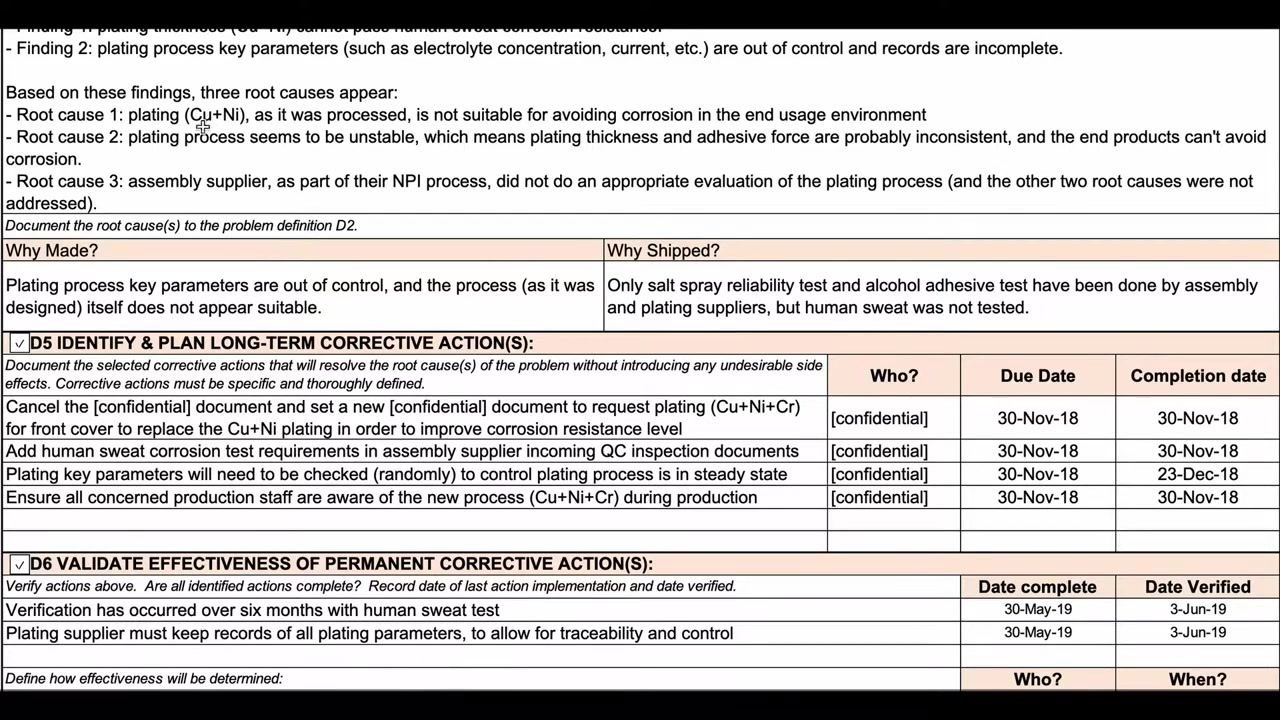
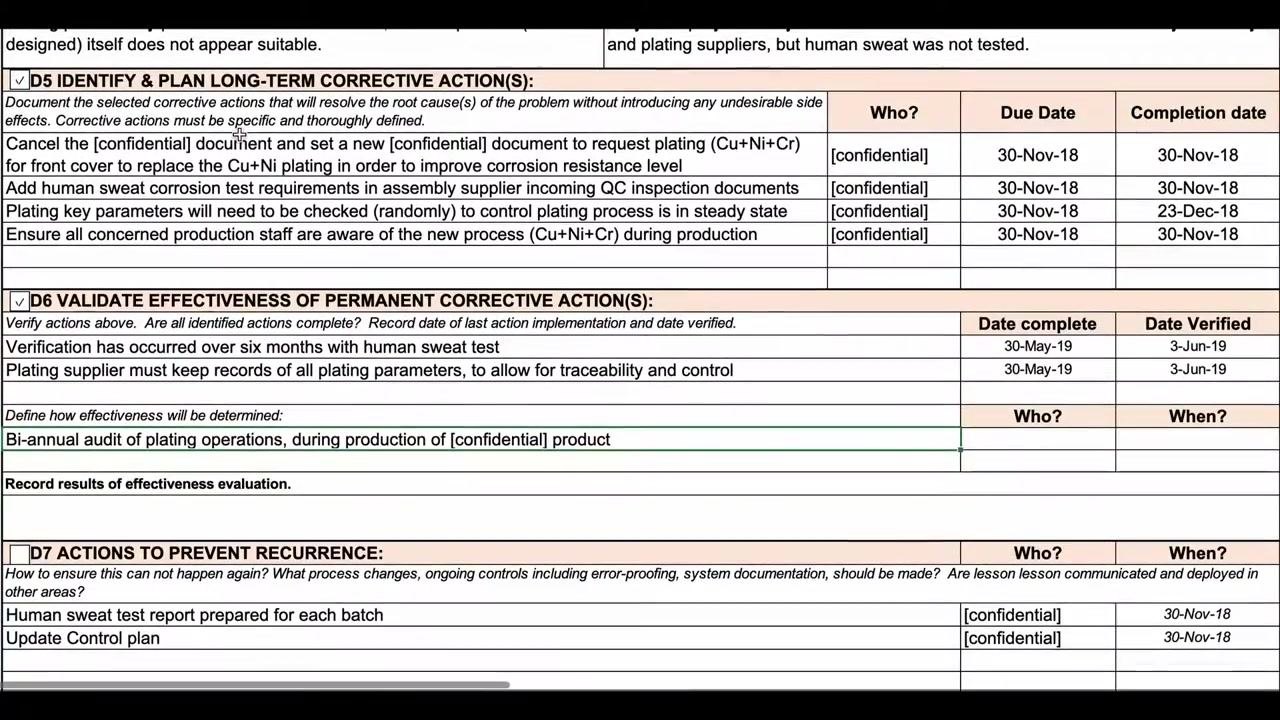
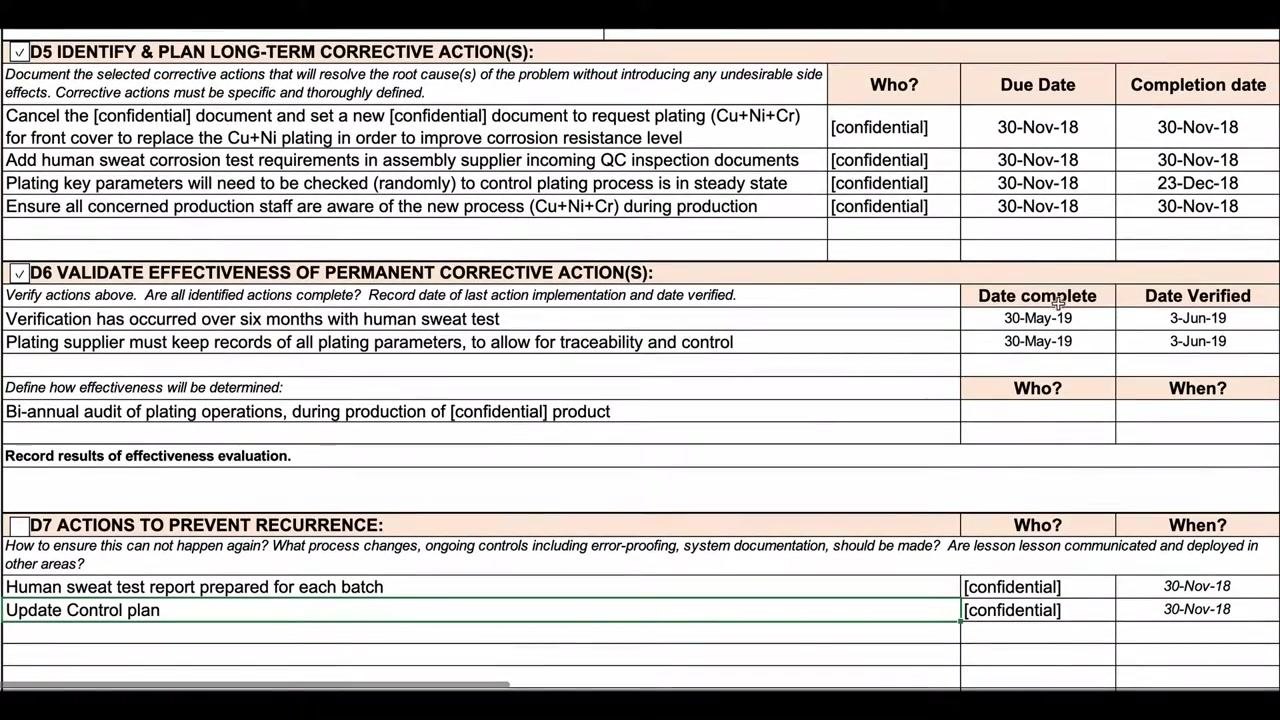
Based on the confirmed root causes, define permanent corrective actions that resolve the issue without introducing undesirable side effects. Each action should be specific and thoroughly defined.
| Corrective action | Responsible | Due date | Completion date |
|---|---|---|---|
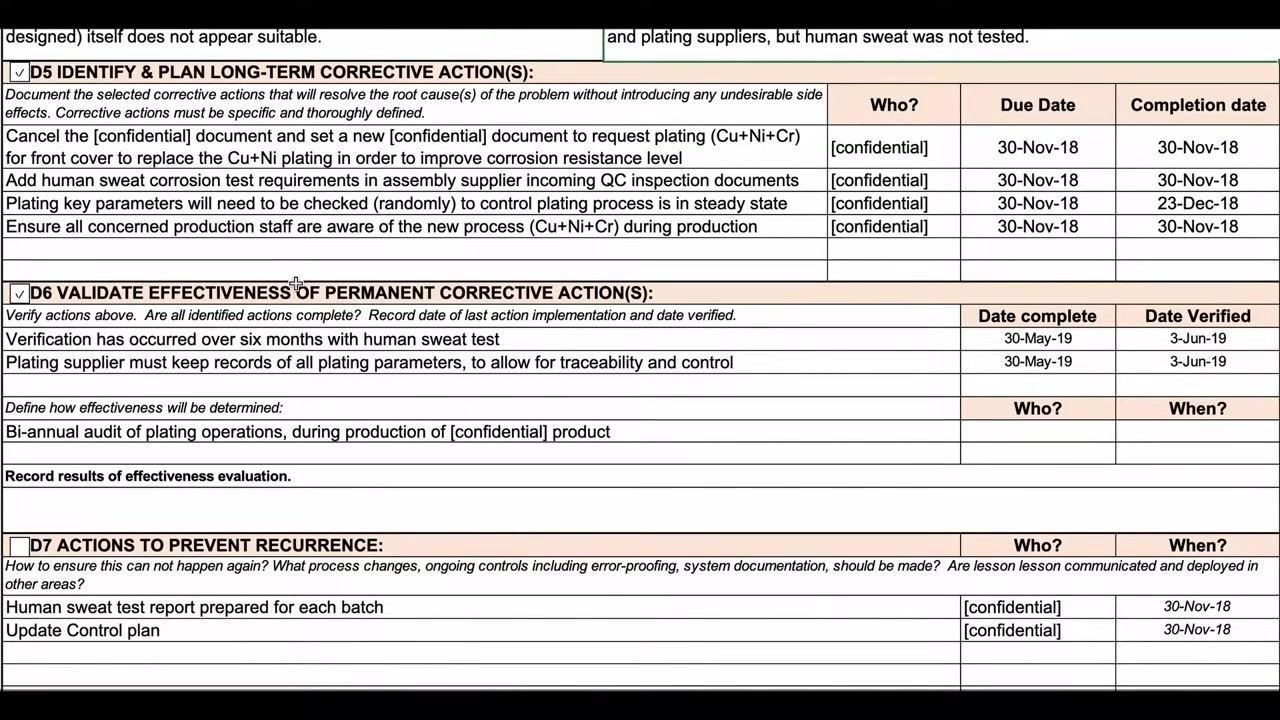
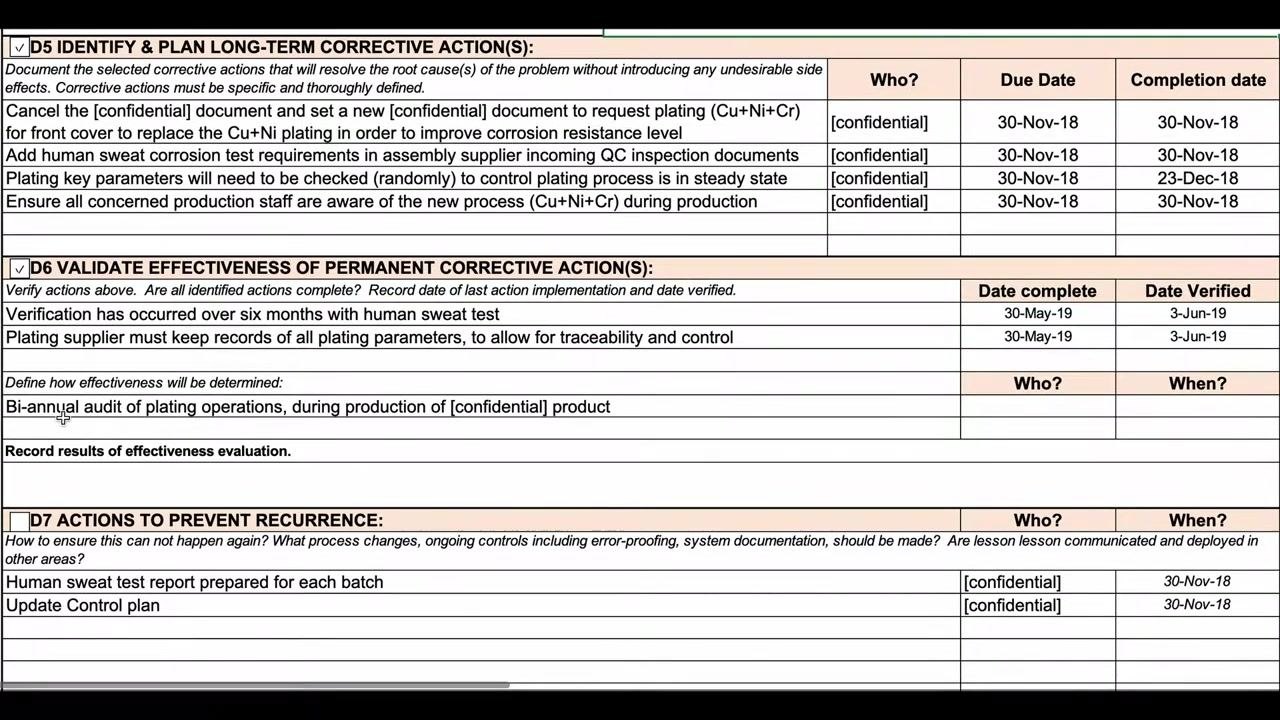
| Cancel the existing plating specification document and issue a new one requesting Cu+Ni+Cr plating for the front cover to improve corrosion resistance | [confidential] | 30-Nov-18 | — |
| Add human sweat corrosion test requirements to the assembly supplier's incoming QC inspection documents | [confidential] | 30-Nov-18 | — |
| Check plating key parameters randomly to confirm the plating process remains in a steady state | [confidential] | 23-Dec-18 | — |
| Ensure all concerned production staff are aware of the new Cu+Ni+Cr process during production | [confidential] | 30-Nov-18 | — |
For complex reports, it can help to duplicate the corrective action file for each discipline — creating separate, clearly named files for D5, D6, D7, and D8 — so every team member can follow the process without confusion.
D6 validation
Verify that all corrective actions listed in D5 are complete and effective before considering the issue resolved.
| Validation check | Detail | Date |
|---|---|---|
| Human sweat test verification | Conducted over six months to confirm the new plating resists corrosion | Complete: 30-May-19; Verified: 3-Jun-19 |
| Plating parameter record-keeping | Plating supplier must keep records of all plating parameters for traceability and control | Ongoing |
| Bi-annual audit | Audit of plating operations during production of the confidential product, used to define ongoing effectiveness | Ongoing |
Keep the documentation simple and clear so it remains easy to review even as the report grows in complexity; separate files per discipline can help when multiple corrective actions are tracked simultaneously.
The source material does not describe an explicit customer sign-off step within D6; when your team reaches this point, record any customer confirmation of the fix alongside the audit and test results above.
D7 prevention
Define ongoing controls so the issue does not recur, and update the relevant documents to reflect the new process.
| Preventive action | Responsible | Due date | Document updated |
|---|---|---|---|
| Prepare a human sweat test report for each batch | [confidential] | 30-Nov-18 | Control plan |
| Update the control plan | [confidential] | 30-Nov-18 | Control plan, process/work instruction |
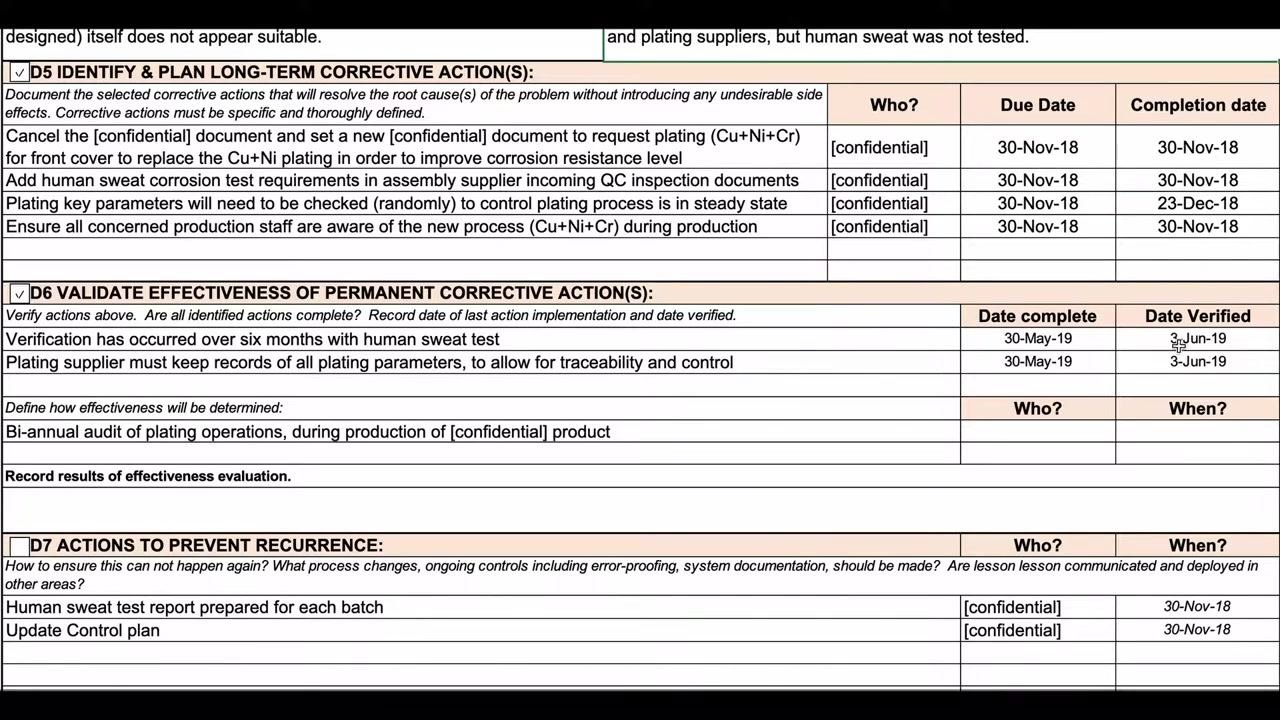
Mark whether the Control Plan and Process or Work Instruction documents require updates, and check the corresponding boxes in the report.
Consider adding an extra audit layer so suppliers do not overlook or forget implemented changes, and assign a dedicated person experienced in root cause analysis to oversee follow-up and documentation. This helps maintain high standards and prevents the issue from recurring.
D8 closure
Once D5 through D7 are validated, use the D8 section to recognize the collective efforts of the team for their contributions to the corrective action process.
The material reviewed here does not capture an explicit customer acceptance record or a final closure date field; when your report reaches this stage, record the customer's formal acceptance and the date the report is officially closed alongside the team recognition notes.
What's next
With the report complete, continue to monitor the bi-annual audits and batch-level human sweat test reports defined in D6 and D7 to confirm the corrective actions hold over time. If you have questions about applying this process to an issue in your own supply chain, reach out to your quality team for guidance, and consult QualityInspection.org for further practical advice on quality inspection and supply chain management.
Generation details: cost, quality tiers, downloads
Docsie billed 7,000 credits ($4.90) to analyze this 14-minute video at standard quality. The rewrite, template fill and Word/PDF exports were included. The same video at each quality tier:
| Quality | Frames sampled | Credits | Approx. cost |
|---|---|---|---|
| Draft | every 16-30 s | 3,500 | $2.45 |
| Standard (this guide) | every 8-15 s | 7,000 | $4.90 |
| Detailed | every 4-7 s | 14,000 | $9.80 |
| Ultra | every 1-3 s | 28,000 | $19.60 |
Credits priced at $0.70 per 1,000; plans include a monthly allowance. Enterprise customers on on-premise or bring-your-own-model deployments run this on their own inference and pay no per-video credits.
Generated by Docsie Video-to-Docs on 2026-09-10 from a 13-minute video. It was generated straight into Docsie's 8D Report template, so every section of that template is filled from the video. Screenshots are frames from the source video and belong to their creator, Quality Inspection, whose original is embedded above. If you own this video and want the guide removed or credited differently, contact us and we will act within one business day.