
4.8
on G2
 Scribe
 Tango
Tango
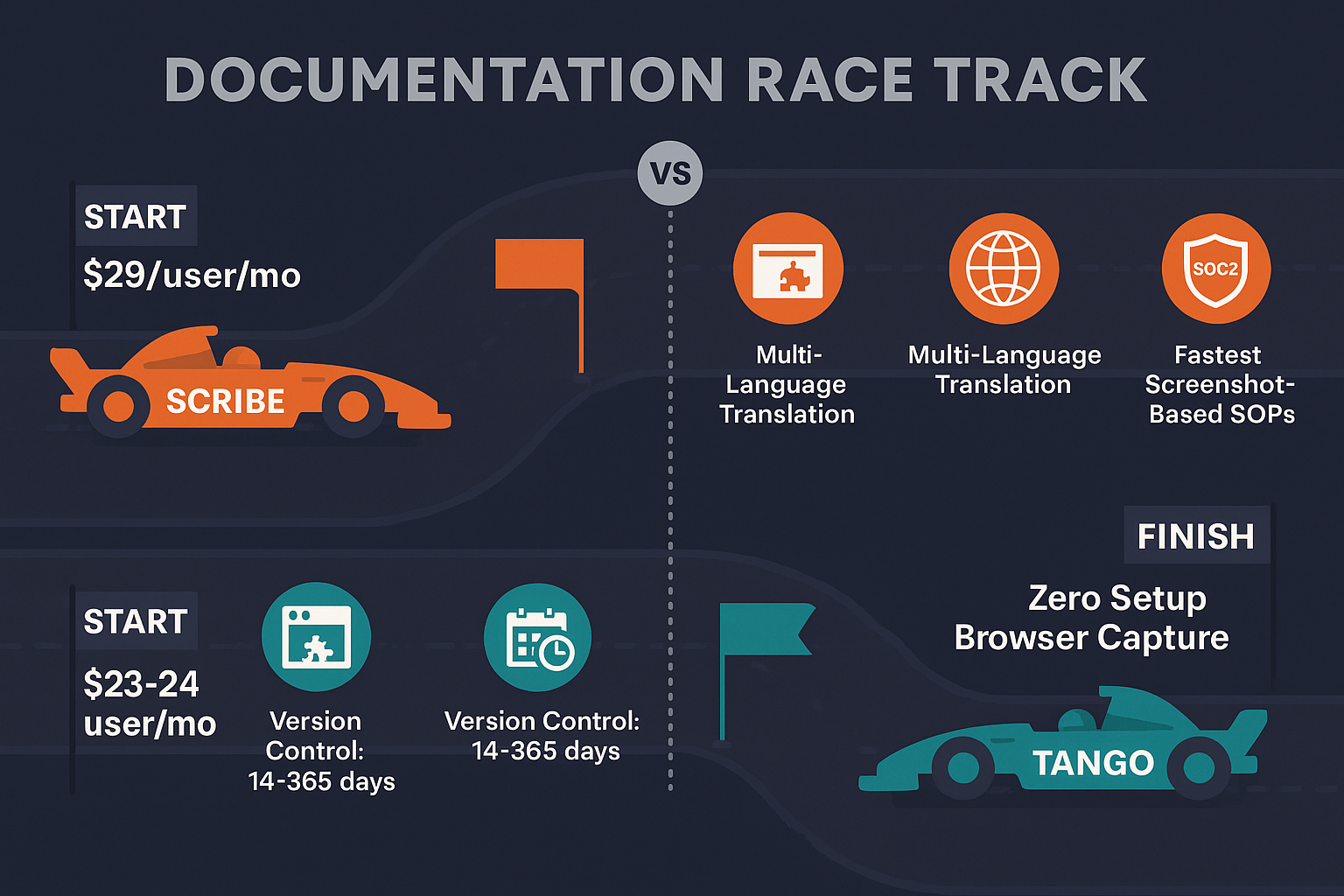
Scribe and Tango both auto-capture browser workflows as annotated screenshot guides, but they differ in pricing, enterprise features, and strategic direction. Scribe focuses on SOPs and internal process documentation; Tango is pivoting toward CRM automation. Neither converts existing video libraries or delivers multi-tenant customer portals — gaps that matter at enterprise scale.

Scribe and Tango are closely matched tools that solve the same narrow problem — capturing browser workflows as screenshot guides.
Feature Matrix
A comprehensive side-by-side comparison of capture methods, AI capabilities, content management, enterprise security, and delivery features across Scribe and Tango.
| Feature |
Scribe
|
Tango
|
|---|---|---|
| Browser Extension Capture | ||
| Desktop App Capture | Pro+ only | Pro+ only |
| Screenshot-Based Step Guides | ||
| Screen Recording (Video Output) | ||
| Video-to-Documentation Conversion | ||
| Real-World Video Support | ||
| Audio Transcription | ||
| AI Content Generation | ||
| In-App Guided Walkthroughs | Enterprise only (Nuggets) | |
| Multi-Language / Translation | Translation feature available | |
| Auto-Translation | ||
| Version Control | 14 days (Pro) / 365 days (Enterprise) | |
| Knowledge Base Platform | ||
| Multi-Tenant Portals | ||
| Custom Domain Support | ||
| Custom Branding | Pro+ (remove watermark, add brand) | Partial (branded exports) |
| Embeddable Widget | ||
| AI PII / PHI Redaction | Enterprise only | Enterprise only (auto PII blur) |
| SSO (SAML / SCIM) | Enterprise only | Enterprise only |
| SOC 2 Compliance | ||
| GDPR Compliance | ||
| HIPAA Support | Enterprise (PHI redaction) | |
| Audit Logs | ||
| Role-Based Access Control | ||
| Analytics & Reporting | Advanced (Pro+) | |
| Collaboration & Comments | ||
| Approval Workflows | Pro Team+ | |
| API Access | ||
| Free Plan | Yes (browser capture, watermark) | Yes (15 workflows, 10 users) |
| Starting Paid Price | $15/seat/month (5-seat min) | $23–24/user/month |
Data as of February 2026. Features based on publicly available information and vendor documentation. Pricing reflects publicly listed rates.
Strengths & Weaknesses
Deep Dive
An in-depth analysis of where Scribe and Tango differ across capture capabilities, content management, enterprise readiness, and strategic direction — helping you choose the right tool for your team's specific needs.
Both Scribe and Tango use a Chrome extension to auto-capture browser workflows as annotated screenshot guides — the core experience is nearly identical. The key difference is that Scribe also produces a screen recording video alongside the screenshot guide, giving teams a richer output. Tango is screenshots-only. Neither tool can process video that already exists — they only capture new workflows in real time. Teams with libraries of training videos, Loom recordings, or real-world footage get zero value from either tool's capture engine.
Both tools lock SSO (SAML/SCIM) and automatic PII blurring behind Enterprise plans. Scribe has an edge with HIPAA support via PHI redaction — relevant for healthcare and finance teams. Scribe also includes approval workflows on its Pro Team plan ($15/seat/month, 5-seat minimum), which Tango lacks entirely. Tango counters with in-app guided walkthroughs (Nuggets) at Enterprise — a feature Scribe doesn't offer. Neither tool provides API access, audit logs, multi-tenant portals, custom domains, or a knowledge base platform, limiting both to internal SOP use cases rather than enterprise knowledge orchestration.
Scribe remains firmly focused on process documentation and SOPs — its roadmap centers on making screenshot-guide creation faster and more integrated with tools like Confluence, Notion, and SharePoint. Tango has made a significant strategic pivot toward CRM automation, particularly Salesforce and HubSpot workflow automation. This means documentation features are increasingly secondary in Tango's product roadmap. Teams choosing Tango today should expect the documentation toolset to remain relatively static as engineering resources shift to automation. Scribe is the safer long-term bet if documentation is your primary use case.
Scribe's Pro Team plan starts at $15/seat/month with a 5-seat minimum ($75/month floor), making it more affordable for mid-sized teams. However, Enterprise pricing has been reported at $18,000+ per year — a significant jump. Tango's Pro plan runs $23–24/user/month with no minimum seat requirement, making it marginally easier to start but more expensive per user. Both tools charge per user, meaning costs scale linearly with headcount. Neither offers workspace-based or AI-credit pricing. For large teams or organizations needing multi-client delivery, per-seat pricing from either tool becomes a significant budget line item with no corresponding increase in capability.
Our Recommendation
Scribe and Tango are closely matched tools that solve the same narrow problem — capturing browser workflows as screenshot guides. Scribe is the stronger documentation-focused choice with screen recording output, approval workflows, HIPAA support, and a stable product roadmap. Tango offers frictionless setup and a generous free plan, but its pivot to CRM automation means its documentation capabilities are unlikely to evolve meaningfully. Neither tool addresses the broader documentation challenges of converting existing video libraries, delivering content to multiple clients, or managing enterprise knowledge at scale.
Choose Scribe if you need...
Choose Tango if you need...
Choose Docsie if you need...
Winner: Docsie
Both Scribe and Tango are single-purpose capture tools with no ability to process existing video content, no multi-tenant delivery, no version control worth mentioning, and no API access. For teams that have outgrown basic SOP capture and need a complete CONVERT → MANAGE → DELIVER → LEARN → AUTOMATE → MONITOR knowledge platform — with support for any video type, 100+ languages, unlimited branded client portals, built-in LMS, and SOC 2 Type II compliance — Docsie addresses every gap both competitors share.
Decision Helper
A direct framework for picking between Scribe, Tango, and Docsie based on your specific needs.
Browser process capture that auto-generates step-by-step guides.
Workflow capture tool turning clicks into screenshot how-tos.

Convert real video into searchable docs, then deploy multi-tenant portals.
Common Questions
Q: What is the main difference between Scribe and Tango?
A: Both tools auto-capture browser workflows as annotated screenshot guides using a Chrome extension. The key differences are that Scribe also generates a screen recording video alongside the screenshots, includes approval workflows on its Pro Team plan, and has HIPAA support at Enterprise. Tango's differentiator is in-app guided walkthroughs (Nuggets) overlaid on web apps, a more generous free plan, and a CRM automation pivot toward Salesforce and HubSpot. For pure documentation use cases, Scribe is the more feature-complete choice.
Q: Can either Scribe or Tango convert existing training videos into documentation?
A: No — neither tool can process pre-existing video content. Both Scribe and Tango are capture-only tools that require you to perform the workflow live while their browser extension records it. If you have a library of training recordings, Loom videos, onboarding walkthroughs, or any pre-recorded content, neither tool can extract documentation from that footage. Docsie is specifically designed to convert any existing video (including screen recordings, real-world footage, and silent physical-process videos) into structured documentation.
Q: Do Scribe or Tango support multi-tenant client portals?
A: Neither Scribe nor Tango supports multi-tenant portals. Both tools are built exclusively for internal documentation — guides are stored in each tool's own interface and shared via link or embedded widget. There is no way to deliver branded, client-specific documentation portals through either platform. Organizations serving multiple clients or needing white-labeled knowledge bases must look elsewhere. Docsie's multi-tenant architecture lets a single knowledge base power unlimited branded portals per client, each with custom domains and access controls.
Q: Which tool has better version control?
A: Tango technically offers version history — 14 days on Pro and 365 days on Enterprise — but this is history tracking, not true version control with branching, rollback, or diff comparison. Scribe has no version control at all for published content. Neither tool supports content versioning workflows appropriate for enterprise documentation management, where multiple product versions, localized variants, or client-specific content need to coexist and be maintained simultaneously.
Q: Is there a better alternative to both Scribe and Tango?
A: Yes — Docsie addresses the core limitations shared by both tools. While Scribe and Tango only capture new browser workflows as screenshots, Docsie converts any existing video (training recordings, screen captures, real-world footage), manages documentation with full version control and 100+ language auto-translation, and delivers content through multi-tenant branded portals to multiple clients simultaneously. Docsie also includes a built-in LMS with certifications, autonomous documentation agents, and real-time compliance monitoring — capabilities neither Scribe nor Tango comes close to offering.
Q: How does pricing compare between Scribe and Tango at scale?
A: Scribe's Pro Team plan starts at $15/seat/month with a 5-seat minimum ($75/month floor), making it more accessible for mid-sized teams, though Enterprise pricing has been reported at $18,000+ per year. Tango Pro runs $23–24/user/month with no seat minimum, making it easier to start small but more expensive per user. Both tools use per-seat pricing that scales linearly with headcount and provides no additional capability per dollar spent at higher user counts. For large teams, Docsie's workspace-based pricing ($199–$750/month for teams of 15–90 users) typically offers substantially better economics.
Scribe and Tango are great at one thing — capturing new browser workflows as screenshots. But if you need to convert existing training videos, deliver documentation to multiple clients through branded portals, manage content in 100+ languages, or run autonomous documentation workflows, Docsie is the platform built for that. One system to convert, manage, deliver, train, automate, and monitor — without per-seat pricing that punishes growth.
No credit card required. Free AI credits to convert a 10-minute training video included.