
4.8
on G2
 Docsie
 Scribe
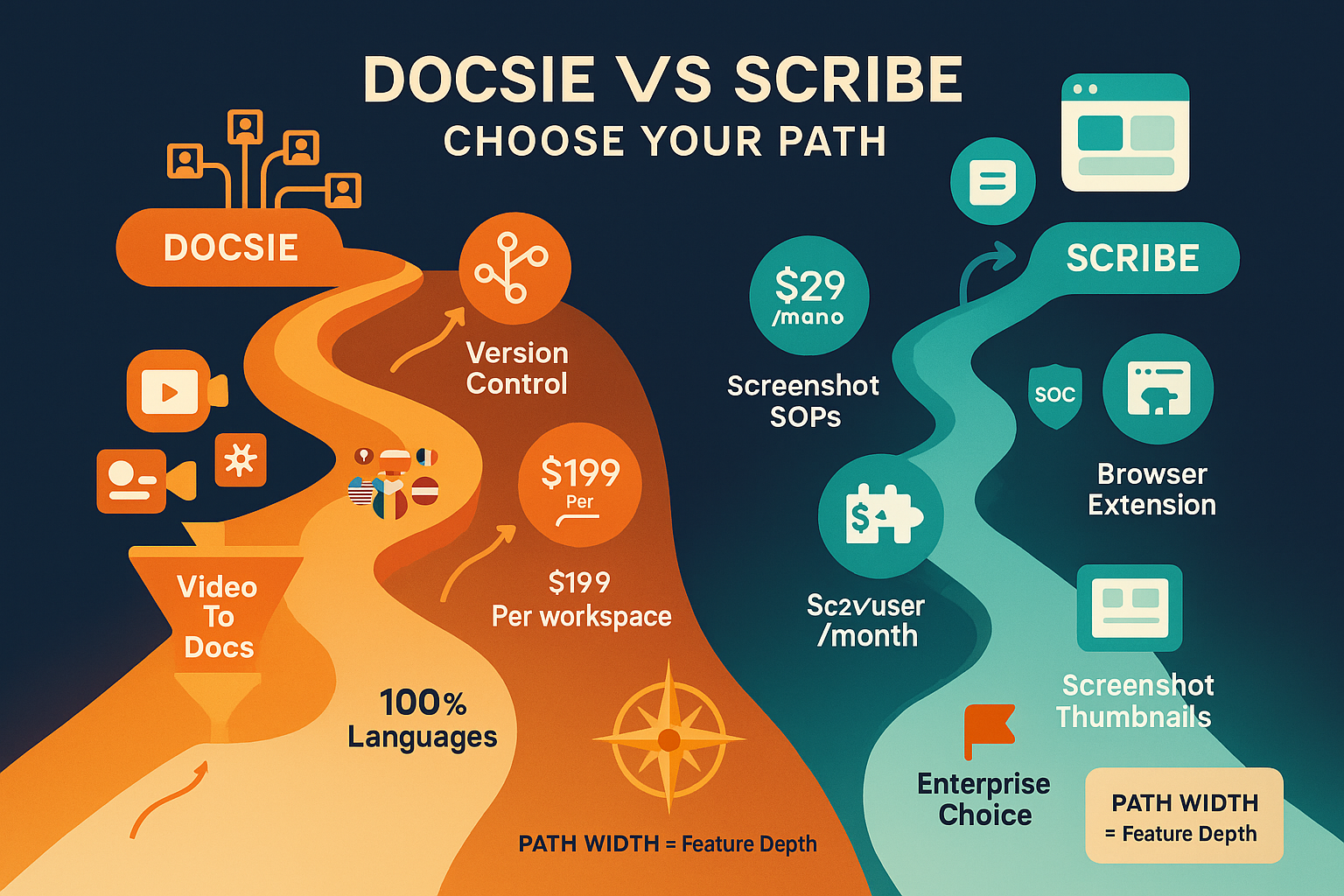
Docsie and Scribe both help teams create documentation, but serve fundamentally different purposes. Docsie converts any video into structured knowledge bases with multi-tenant portals and enterprise delivery, while Scribe captures screen workflows as annotated screenshot guides for internal process documentation.

Docsie runs video-to-docs plus multi-tenant portals, Scribe captures workflows into quick guides, while Docsie fits when you also need video → structured docs → multi-tenant portals end-to-end.
Feature Matrix
A comprehensive comparison of documentation capabilities, AI automation, enterprise functionality, and content delivery between Docsie and Scribe.
| Feature |
Docsie
Our Pick
|
Scribe
|
|---|---|---|
| Video to Documentation Conversion | ||
| Real-World Video Processing | ||
| Screen Recording Capture | Upload any recording | Chrome extension |
| PDF Import & Conversion | ||
| Website Ingestion | ||
| Computer Vision & OCR | ||
| Audio Transcription | ||
| Multi-Language Support | 100+ | Translation available |
| Auto-Translation | ||
| Version Control | ||
| Multi-Tenant Portals | ||
| Custom Domain Support | ||
| Knowledge Base Platform | ||
| Built-in LMS & Certification | ||
| Autonomous Agents | ||
| Compliance Monitoring | HIPAA/SOX/ITAR/GDPR | PHI redaction only |
| AI Chatbot | ||
| Browser Extension | ||
| API Access | ||
| SSO (SAML/OAuth) | Enterprise only | |
| SOC 2 Type II Compliance | ||
| Air-Gap Capable | ||
| Content Reuse & Templates | ||
| Analytics & Reporting | Pro Team+ | |
| Private Infrastructure |
Data as of February 2026. Features are based on publicly available information and vendor documentation.
Strengths & Weaknesses
Deep Dive
An in-depth analysis of the critical differences in documentation capabilities, AI automation, enterprise readiness, and content delivery ecosystems.
Docsie functions as a complete knowledge orchestration platform with hierarchical content structure (Shelves → Books → Articles), unlimited version control with inheritance across language variants, content reuse blocks, templates, and multi-step approval workflows. It converts videos, PDFs, websites, and documents into searchable structured knowledge bases. Scribe creates annotated screenshot guides from browser workflows with basic editing and sharing capabilities, but lacks version control, content management, or documentation platform features. For teams needing comprehensive knowledge bases with content governance, Docsie provides enterprise-grade structure; Scribe is optimized for quick internal SOP creation rather than systematic knowledge management or external delivery.
Docsie employs multimodal AI combining computer vision, OCR, audio transcription, and speaker diarization to understand and convert any video type into structured documentation. Its autonomous agents execute scheduled or triggered workflows for touchless content pipelines on private infrastructure. The agentic AI chatbot uses tool calls (not traditional RAG) for accurate responses without hallucination. Docsie supports 100+ languages with Ghost Translator for terminology-preserving auto-translation. Scribe uses AI for automatic step detection during screen capture and basic content generation from captured workflows, plus PII/PHI redaction at Enterprise tier. Docsie's AI handles diverse inputs and automates entire knowledge workflows; Scribe's AI optimizes screenshot annotation and internal process capture.
Docsie delivers comprehensive enterprise capabilities including SOC 2 Type II compliance, multiple SSO methods (SAML, OAuth, OIDC, Azure AD, Google, Okta), JWT authentication, EU data residency, audit logs, granular permissions, 99.9% uptime SLA, and air-gap capable deployment on private infrastructure. Multi-tenant architecture enables one knowledge base to power unlimited branded customer portals with custom domains. Real-time compliance monitoring scans video, audio, and text for HIPAA, SOX, ITAR, GDPR violations. Scribe offers SOC 2 compliance, SAML SSO and SCIM on Enterprise plans, plus PII/PHI redaction, but lacks audit logs, data residency options, multi-tenant capabilities, and air-gap deployment. For regulated industries, client-facing delivery, and autonomous operations, Docsie provides significantly deeper enterprise functionality.
Docsie provides comprehensive API access, webhooks, custom JavaScript/CSS, embeddable AI-powered widgets with chatbot, helpdesk integrations, product tours, custom domain support with SSL, and MCP-ready architecture for AI agent integration. Its open ecosystem enables embedding documentation portals anywhere, building custom workflows, and orchestrating knowledge operations at scale. Built-in LMS allows courses to reference live documentation so training stays automatically updated. Scribe integrates with ClickUp, Notion, SharePoint, Airtable, Confluence, and 360Learning for sharing screenshot guides, plus offers embeddable widgets. However, it lacks API access for programmatic control or automation. Docsie's ecosystem is built for knowledge orchestration across the entire CONVERT → MONITOR workflow; Scribe's integrations focus on distributing internal SOPs to collaboration tools.
Our Recommendation
Docsie and Scribe serve fundamentally different use cases despite both creating documentation. Docsie is a six-pillar knowledge orchestration platform that converts any content (video, PDF, web) into structured knowledge bases, delivers them through multi-tenant portals, trains users with built-in LMS, automates with autonomous agents, and monitors compliance—all on private infrastructure. Scribe is a browser extension that captures screen workflows and generates annotated screenshot guides for internal process documentation. The choice depends on whether you need comprehensive knowledge orchestration or simple internal SOP capture.
Choose Docsie if you need...
Choose Scribe if you need...
Winner: Docsie
For teams needing comprehensive knowledge orchestration with video conversion, multi-tenant delivery, enterprise compliance, autonomous automation, and built-in training capabilities. Docsie provides the complete CONVERT → MANAGE → DELIVER → LEARN → AUTOMATE → MONITOR workflow on private infrastructure, while Scribe excels specifically at internal screenshot-based SOP creation but lacks the platform features required for customer-facing knowledge delivery, video processing, version control, LMS capabilities, or autonomous knowledge operations.
Decision Helper
A direct framework for picking between Docsie, Scribe based on your specific needs.
Knowledge orchestration platform with video-to-docs, multi-tenant portals, and grounded AI chatbot.
Browser extension that auto-captures clicks into step-by-step guides.
Common Questions
Q: Can Scribe convert existing training videos into documentation like Docsie?
A: No. Scribe only works with live screen captures through its browser extension—it cannot accept uploaded videos, training recordings, or any pre-existing video content. Docsie accepts any video format (MP4, MOV, AVI, WebM, Loom links) plus real-world footage and converts them into structured documentation using multimodal AI with computer vision, OCR, and audio transcription.
Q: Does Docsie have a browser extension for screen capture like Scribe?
A: No, Docsie does not offer a browser extension for live screen capture. However, you can use any screen recording tool (Loom, OBS, QuickTime) and upload the video to Docsie for conversion into structured documentation. Docsie's advantage is processing any video type—not just screen recordings—including real-world footage, training videos, and physical processes that Scribe cannot handle.
Q: Which tool supports multi-tenant customer portals?
A: Only Docsie offers multi-tenant architecture where one knowledge base powers unlimited branded documentation portals for different clients, each with custom domains, white-label branding, SSO, and granular access controls. Scribe is purely internal—it has no customer-facing portal capabilities, making it unsuitable for consultancies, implementation partners, or any team delivering documentation to external clients.
Q: How does pricing compare for large teams?
A: Scribe charges per user ($15/seat minimum 5 seats on Pro Team, forcing expensive Enterprise pricing for larger teams—reported at $18,000-$39/user/year). Docsie uses workspace-based pricing ($199-$750/month for teams of 15-90 users) with AI credits instead of per-seat fees. For teams larger than 10 people, Docsie typically offers better economics and avoids per-seat pricing inflation.
Q: Can I use both Docsie and Scribe together?
A: There's limited practical synergy. Scribe creates screenshot guides from live browser captures, while Docsie converts any video into structured knowledge bases with version control and multi-tenant delivery. If you need internal SOPs and external customer documentation, you could theoretically use both—but Docsie's ability to process any video type (including screen recordings) makes Scribe redundant for most teams that need both internal and external documentation.
Q: Which tool is better for documenting physical or real-world processes?
A: Only Docsie can handle real-world video documentation. Scribe is limited to browser screen captures and cannot process videos of physical processes, equipment operation, field training, manufacturing workflows, medical procedures, or any non-screen activity. If you need to document factory floors, lab procedures, field operations, or hands-on training, Docsie's computer vision and multimodal AI can convert that footage into structured documentation with auto-generated screenshots and step-by-step instructions.
Convert your training videos, PDFs, and websites into structured knowledge bases delivered through branded portals—with built-in LMS, autonomous agents, and compliance monitoring on private infrastructure.
No credit card required. Free AI credits to convert a 10-minute video included.