
4.8
on G2
 Guru
Guru
 Slab
Slab
Guru offers AI-powered knowledge management with enterprise verification workflows and SOC 2 compliance, while Slab delivers a clean, minimal internal wiki with a generous free tier but limited enterprise controls. Neither tool is built for external delivery, multi-tenant portals, or the full governance stack enterprise teams increasingly require.
Guru and Slab cover different enterprise needs but share gaps in SSO depth, multi-tenancy, and audit-grade compliance—where Docsie was built from the ground up.
Enterprise Feature Matrix
A detailed comparison of enterprise-grade capabilities across security, compliance, administration, scalability, and support for Guru and Slab.
| Enterprise Capability |
Guru
|
Slab
|
|---|---|---|
| SOC 2 Compliance | ||
| GDPR Compliance | ||
| HIPAA Readiness | ||
| SSO (SAML) | Enterprise only | Business only |
| Role-Based Access Control | ||
| Audit Logs | Enterprise only | |
| Advanced Analytics | Builder+ | Startup+ |
| API Access | ||
| Custom Domain Support | ||
| Multi-Tenant Portals | ||
| AI Content Generation | ||
| Auto-Translation (50+ languages) | ||
| Verification / Approval Workflows | ||
| Version Control | Via verification cycles | 90-day (Free), unlimited (Startup+) |
| Real-Time Collaboration | ||
| Embeddable Widget | ||
| Browser Extension | ||
| Dedicated Customer Success Manager | Enterprise only | |
| Priority Support | Builder+ | Startup+ |
| Custom Branding / White Label |
Data as of February 2026. Features based on publicly available vendor documentation and pricing pages. Enterprise features require the highest-tier plan for both tools.
Strengths & Weaknesses
Deep Dive
An in-depth analysis of the four critical enterprise readiness dimensions — security, scalability, administration, and support — as they apply to Guru and Slab.
Guru holds SOC 2 Type II certification and is GDPR compliant, giving it a meaningful security baseline for enterprise procurement. SAML SSO is available on the Enterprise plan, enabling identity provider integration. However, Guru lacks HIPAA readiness, making it unsuitable for healthcare organizations without additional controls. Slab meets GDPR requirements but has no SOC 2 certification, which will fail most enterprise security questionnaires outright. Neither tool offers audit logs outside of Guru's Enterprise tier, and neither provides data residency options or air-gap deployment — both significant gaps for regulated industries.
Guru is designed for large organizations and has demonstrated scale with enterprise customers. Its browser extension, Knowledge Agents, and MCP Server support provide scalable knowledge delivery across tools. However, the AI credit model means heavy usage at scale can incur additional costs. Slab is architecturally simple and performs well for teams under 200 users but offers no published SLAs, no scalability guarantees, and no enterprise infrastructure commitments. With no API access, Slab cannot participate in automated enterprise workflows, making true organizational scale a significant challenge for any team with complex documentation needs.
Guru provides meaningful administrative controls including role-based access, verification workflows, expert assignment, and analytics dashboards. Admins can enforce knowledge review cycles, track content health, and monitor engagement — critical for enterprise knowledge governance. Slab's administrative controls are minimal by design; its simplicity-first philosophy limits granular permissions, workflow enforcement, and content governance tooling. Neither platform supports multi-tenant administration — the ability to manage separate content environments for different clients or business units from a single admin console — a capability increasingly required by enterprise and consulting organizations.
Guru offers tiered support with priority support on Builder plans and a dedicated Customer Success Manager on Enterprise. Formal SLAs are available at the Enterprise level, making it a viable option for organizations requiring contractual support commitments. Slab offers priority support on its Startup plan and dedicated support on Business, but no published uptime SLAs and no formal CSM program. For enterprise procurement teams that require documented SLAs, escalation paths, and dedicated technical contacts as part of vendor evaluation, Guru has a clear advantage — though both tools fall short of the full enterprise support stack that compliance-heavy organizations demand.
Our Recommendation
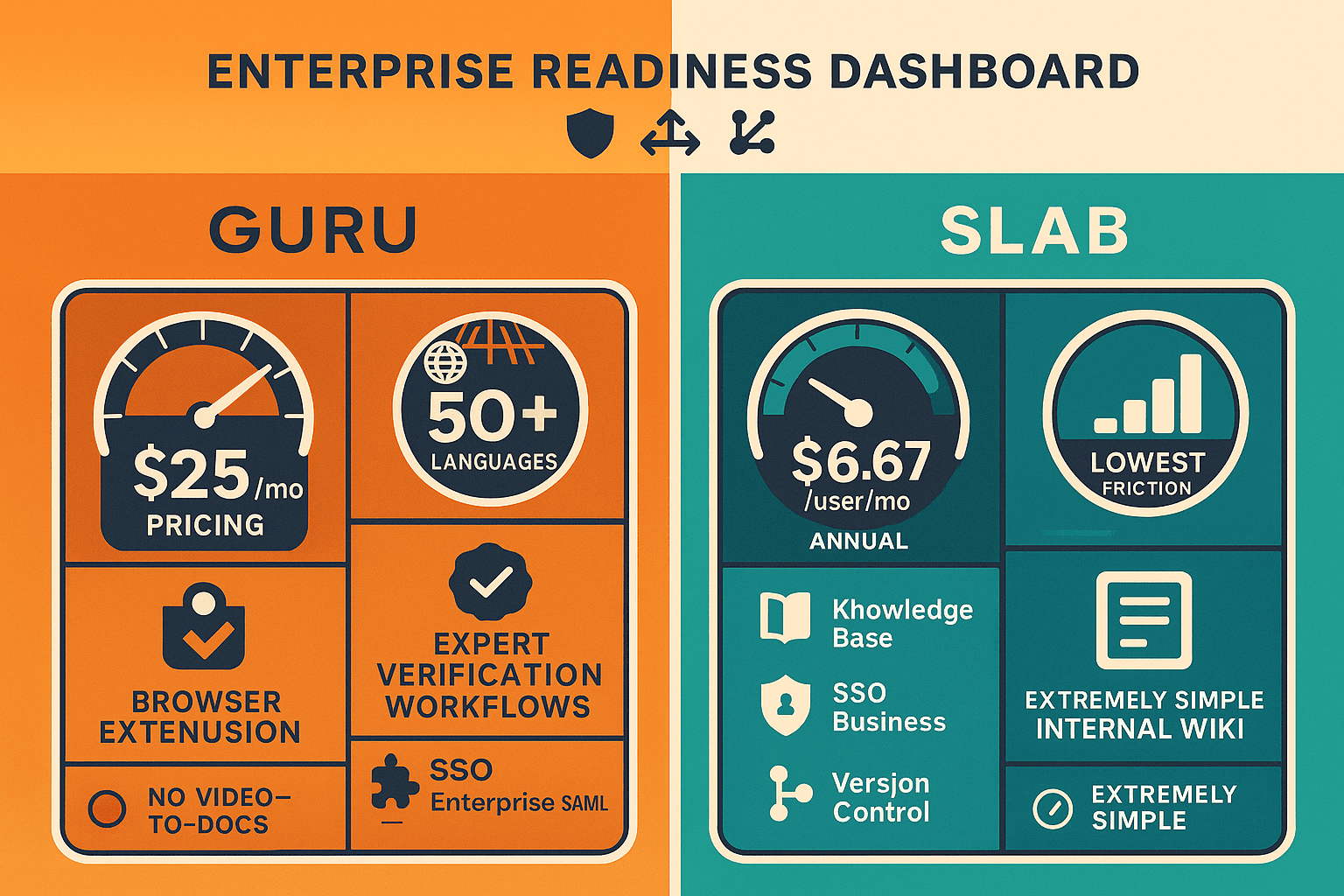
Guru is the stronger enterprise platform of the two — it offers SOC 2 compliance, SAML SSO, AI-powered Knowledge Agents, expert verification workflows, and formal enterprise support. Slab wins on simplicity and affordability for small-to-mid teams but lacks the security certifications, AI capabilities, and administrative controls that enterprise buyers require. For any organization running a genuine enterprise evaluation, Guru is the more credible option — but both tools share fundamental gaps that limit their suitability for modern enterprise documentation needs.
Choose Guru if you need...
Choose Slab if you need...
Choose Docsie if you need...
Winner: Docsie
Docsie addresses the core enterprise gaps shared by both Guru and Slab — no multi-tenant portals, no external delivery, no HIPAA readiness, no air-gap capability, and no built-in LMS or compliance monitoring. With SOC 2 Type II certification, SAML/OAuth/OIDC/Azure AD SSO, granular permissions, audit logs, 99.9% uptime SLA, and the ability to scale to 10,000+ documentation sites across unlimited client portals, Docsie delivers genuine enterprise readiness that neither competitor can match.
Decision Helper
A direct framework for picking between Guru, Slab, and Docsie based on your specific needs.
AI-powered enterprise wiki with verification workflows.
Beautifully designed team wiki with integrations across the stack.

Multi-tenant knowledge portals with AI chatbot and video-to-docs.
Common Questions
Q: Is Guru SOC 2 compliant?
A: Yes. Guru holds SOC 2 Type II certification, which satisfies the baseline security requirements for most enterprise procurement processes. Slab does not have SOC 2 certification, which will cause it to fail many enterprise security questionnaires. If SOC 2 compliance is a hard requirement for your vendor evaluation, Guru is the only option between the two.
Q: Does either Guru or Slab support HIPAA compliance for healthcare enterprises?
A: Neither Guru nor Slab is HIPAA-ready. Both lack the technical safeguards, BAA agreements, and audit trail capabilities required for HIPAA-covered entities. Healthcare organizations or any company handling protected health information should evaluate platforms purpose-built for regulated industries rather than either of these tools.
Q: Which tool offers better SSO and identity management?
A: Guru supports SAML SSO on its Enterprise plan, enabling integration with major identity providers. Slab offers SSO on its Business plan (custom pricing). Both gate SSO behind their highest-tier plans. Neither offers the breadth of SSO options (SAML, OAuth, OIDC, Azure AD, Okta, Google) that enterprise identity teams typically require from a primary knowledge platform.
Q: Can Guru or Slab support external client documentation delivery?
A: No. Both Guru and Slab are internal-only platforms. Neither supports custom domains for external portals, multi-tenant delivery to different client organizations, or white-label branding for customer-facing documentation. If you need to deliver documentation to external clients, customers, or partners, you will need a different platform entirely.
Q: How do Guru and Slab compare for a large enterprise with multiple departments?
A: Guru handles enterprise scale more effectively — it offers role-based access, verification workflows, content health tracking, and a dedicated CSM at the Enterprise level. Slab's simplicity-first design limits administrative granularity, making it harder to enforce governance across a large multi-department organization. That said, neither platform supports true multi-tenant isolation between departments or business units, which is a limitation for complex enterprise org structures.
Q: Is there a better alternative to both Guru and Slab for enterprise documentation?
A: Yes — Docsie is purpose-built for enterprise knowledge orchestration at a scale neither Guru nor Slab can match. Docsie offers SOC 2 Type II compliance, HIPAA readiness, air-gap deployment, multi-tenant portals for client or department isolation, a built-in LMS with certifications, autonomous agents, and real-time compliance monitoring across HIPAA, SOX, ITAR, and GDPR frameworks. Where Guru focuses on internal knowledge verification and Slab prioritizes simplicity, Docsie delivers the full enterprise stack — convert, manage, deliver, learn, automate, and monitor — on private infrastructure with 100+ language support and a 99.9% uptime SLA.
Docsie delivers what both Guru and Slab can't — SOC 2 Type II compliance, multi-tenant portals for client and department isolation, built-in LMS with certifications, autonomous agents, real-time compliance monitoring, and 100+ language support. All on private infrastructure with a 99.9% uptime SLA and full enterprise support.
No credit card required. Free AI credits included. Enterprise plans with custom SLAs available.