
4.8
on G2
 Guidde
 Scribe
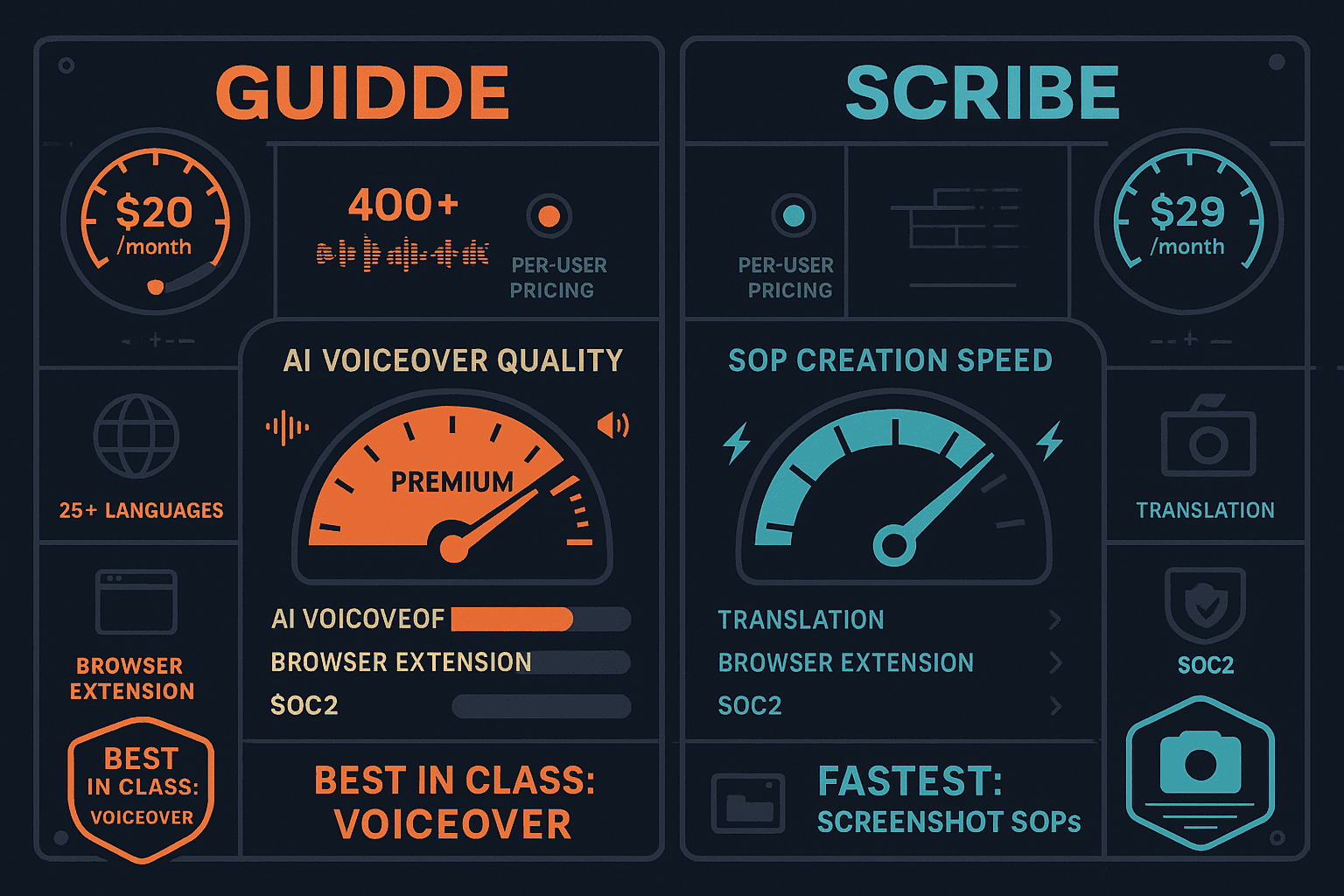
Guidde and Scribe both offer Enterprise tiers, but how do they actually stack up for large organizations? This head-to-head comparison covers security, compliance, SSO, scalability, admin controls, and support SLAs — and reveals which platform is truly ready for enterprise-grade documentation at scale.
Guidde and Scribe cover different enterprise needs but share gaps in SSO depth, multi-tenancy, and audit-grade compliance—where Docsie was built from the ground up.
Enterprise Feature Matrix
A comprehensive side-by-side breakdown of enterprise-grade features including security, compliance, identity management, scalability, and administrative controls.
| Enterprise Capability |
Guidde
|
Scribe
|
|---|---|---|
| SSO Support | SAML (Enterprise only) | SAML + SCIM (Enterprise only) |
| SCIM User Provisioning | ||
| IP Whitelisting | ||
| SOC 2 Type II | ||
| GDPR Compliance | ||
| HIPAA / PHI Redaction | Enterprise (PHI redaction) | |
| PII Redaction | Enterprise only | Enterprise (AI-powered) |
| Audit Logs | ||
| Role-Based Access Control | ||
| Data Residency | ||
| Uptime SLA | Enterprise SLA | |
| Dedicated Support | ||
| Custom Branding / White-Label | Pro+ only | |
| Multi-Tenant Portals | ||
| API Access | ||
| Version Control | ||
| Approval / Review Workflows | Pro Team+ | |
| Analytics & Reporting | Enterprise only | |
| Auto-Translation | Enterprise only | |
| Custom Domain Support |
Data as of February 2026. Features based on publicly available documentation and vendor-published pricing pages. Enterprise tier pricing for both tools requires custom quotes.
Strengths & Weaknesses
Deep Dive Analysis
An in-depth analysis across the four pillars of enterprise readiness — Security & Compliance, Scalability & Performance, Administration & Control, and Support & SLA.
Both Guidde and Scribe achieve SOC 2 Type II and GDPR compliance, establishing a credible baseline. Scribe pulls ahead with HIPAA-oriented PHI redaction, SCIM provisioning, and IP whitelisting — controls that regulated industries (healthcare, finance, government) treat as non-negotiable. Guidde offers PII redaction on Enterprise but lacks SCIM, IP controls, and any HIPAA coverage. Critically, neither platform provides audit logs, data residency options, or air-gap deployment — gaps that make both tools risky choices for heavily regulated enterprises managing sensitive documentation at scale.
Neither Guidde nor Scribe publishes an uptime SLA on standard tiers — Scribe offers a custom Enterprise SLA, while Guidde provides no published SLA at all. Guidde's Business plan is hard-capped at 5 creators, forcing an Enterprise upgrade for teams of any meaningful size. Scribe's per-seat pricing ($15/seat with a 5-seat minimum) scales poorly for large organizations, and the reported $18,000+ annual Enterprise floor creates a high cost of entry. Neither tool offers multi-tenant architecture, meaning organizations serving multiple clients or business units must duplicate their documentation infrastructure entirely.
Scribe has a meaningful advantage in administrative controls, offering SAML SSO, SCIM provisioning, IP whitelisting, approval workflows, and role-based access control. These give IT and security teams standard levers for user lifecycle management and content governance. Guidde provides SAML SSO and RBAC at Enterprise, but lacks SCIM, IP whitelisting, and approval workflows entirely. Both tools are missing audit logs — a critical control for demonstrating compliance during audits. Neither provides API access for integrating with enterprise ITSM, identity providers, or content management systems beyond their published integrations.
Both Guidde and Scribe include dedicated support on Enterprise plans, but the maturity of their SLA commitments differs. Scribe explicitly offers an Enterprise SLA, giving customers a contractual uptime commitment. Guidde provides dedicated support but does not publish SLA terms, leaving enterprises without a formal uptime guarantee. Neither tool offers the full enterprise support package that large organizations expect — including custom onboarding, migration assistance, dedicated success managers, and annual procurement workflow support. Both platforms are mid-market products being stretched to serve enterprise buyers rather than platforms built enterprise-first.
Our Recommendation
Scribe edges out Guidde on pure enterprise security controls — offering SCIM provisioning, IP whitelisting, PHI redaction, and a formal Enterprise SLA that Guidde cannot match. However, both platforms share fundamental enterprise gaps that matter most at scale — no audit logs, no data residency, no API access, no multi-tenant portals, no version control, and no ability to serve documentation to multiple clients from a single system. Neither tool was architected as an enterprise documentation platform; both are point solutions being pushed beyond their original scope.
Choose Guidde if you need...
Choose Scribe if you need...
Choose Docsie if you need...
Winner: Docsie
Docsie is the only platform in this comparison built enterprise-first across the full documentation lifecycle. It closes every gap both Guidde and Scribe share — delivering audit logs, data residency, air-gap capable private infrastructure, multi-tenant portals, version control, API access, 100+ language auto-translation, and real-time compliance monitoring in a single system. Where Guidde and Scribe are point solutions with enterprise tiers bolted on, Docsie's six-pillar CONVERT → MANAGE → DELIVER → LEARN → AUTOMATE → MONITOR architecture was designed from the ground up for organizations that need to manage and deliver documentation at enterprise scale — to multiple clients simultaneously, in multiple languages, under strict regulatory requirements.
Decision Helper
A direct framework for picking between Guidde, Scribe, and Docsie based on your specific needs.
AI-narrated video tutorials from browser screen captures.
Auto-generate step-by-step process guides from screen recordings.

Convert real video (not just screen captures) into SOPs and deploy them at scale.
Common Questions
Q: Do Guidde and Scribe both have SOC 2 Type II certification?
A: Yes, both Guidde and Scribe are SOC 2 Type II certified, which provides a baseline security assurance for enterprise procurement. However, SOC 2 alone does not cover HIPAA, ITAR, or SOX requirements. Scribe adds HIPAA-oriented PHI redaction at Enterprise, while Guidde does not offer any HIPAA coverage. Neither platform provides audit logs or data residency — both of which are commonly required during enterprise security reviews.
Q: Which tool is better for HIPAA compliance — Guidde or Scribe?
A: Scribe has a stronger HIPAA posture than Guidde, offering AI-powered PHI redaction to automatically obscure protected health information in captured screenshots on its Enterprise plan. Guidde offers PII redaction but does not specifically address HIPAA PHI requirements. Neither platform is fully HIPAA-ready in the way a dedicated healthcare documentation solution would be — both lack the audit logging and data residency controls typically required for a comprehensive HIPAA compliance program.
Q: Does either tool provide audit logs for enterprise compliance audits?
A: Neither Guidde nor Scribe provides audit logs as of 2026. This is a significant enterprise gap — regulated organizations in finance, healthcare, and government typically require audit trails documenting who accessed, created, or modified content and when. The absence of audit logs in both platforms makes it difficult to demonstrate compliance during internal or external audits, and should be a key consideration for enterprise buyers in regulated industries.
Q: Is Scribe's SCIM provisioning a significant enterprise advantage over Guidde?
A: Yes, SCIM provisioning is a meaningful advantage for large organizations. SCIM allows IT teams to automatically sync user creation, deactivation, and role changes from an identity provider like Okta or Azure AD directly into the documentation platform — eliminating manual user management at scale. Guidde only offers SAML SSO without SCIM, meaning user lifecycle management must be handled manually. For organizations with hundreds of users, this operational overhead is a real cost.
Q: Can either Guidde or Scribe deliver documentation to multiple enterprise clients simultaneously?
A: Neither Guidde nor Scribe supports multi-tenant portal delivery. Both are designed for a single organization's internal or customer-facing use within one workspace. If you need to deliver separate, branded documentation portals to multiple clients — each with their own domain, branding, and access controls — from a single knowledge base, neither tool can support that architecture. This is a fundamental gap for implementation partners, consultancies, and SaaS companies serving multiple enterprise clients.
Q: Is there a better alternative to both Guidde and Scribe for enterprise documentation?
A: Docsie is the strongest enterprise alternative to both platforms. Unlike Guidde and Scribe, Docsie provides audit logs, data residency, air-gap capable private infrastructure, SAML/OAuth/OIDC/Azure AD/Okta SSO, multi-tenant portals for unlimited clients, version control with rollback, API access, 100+ language auto-translation, and real-time compliance monitoring for HIPAA, SOX, ITAR, and GDPR. It also includes a built-in LMS with certifications and autonomous agents for touchless documentation workflows — all in one platform. For enterprises that have outgrown what Guidde or Scribe can offer, Docsie's six-pillar knowledge orchestration platform addresses every gap both competitors leave behind.
Docsie delivers what both Guidde and Scribe can't — audit logs, data residency, multi-tenant portals, version control, API access, SCIM provisioning, real-time compliance monitoring for HIPAA/SOX/ITAR/GDPR, and a built-in LMS with certifications. One platform. Every enterprise documentation requirement. No per-creator pricing traps.
No credit card required. Free AI credits to convert a 10-minute training video included.