
4.8
on G2
 Document360
 ReadMe
Document360 is a purpose-built external knowledge base with strong AI writing and helpdesk integrations. ReadMe is a premium API documentation platform with interactive API explorers and versioned developer hubs. Both serve distinct audiences — but neither covers multi-tenant portals, video-to-docs conversion, or enterprise knowledge orchestration at scale.
Document360 and ReadMe serve fundamentally different audiences.
Feature Matrix
A comprehensive feature-by-feature comparison of Document360 and ReadMe across AI capabilities, content management, developer tools, enterprise security, and delivery options.
| Feature |
Document360
|
ReadMe
|
|---|---|---|
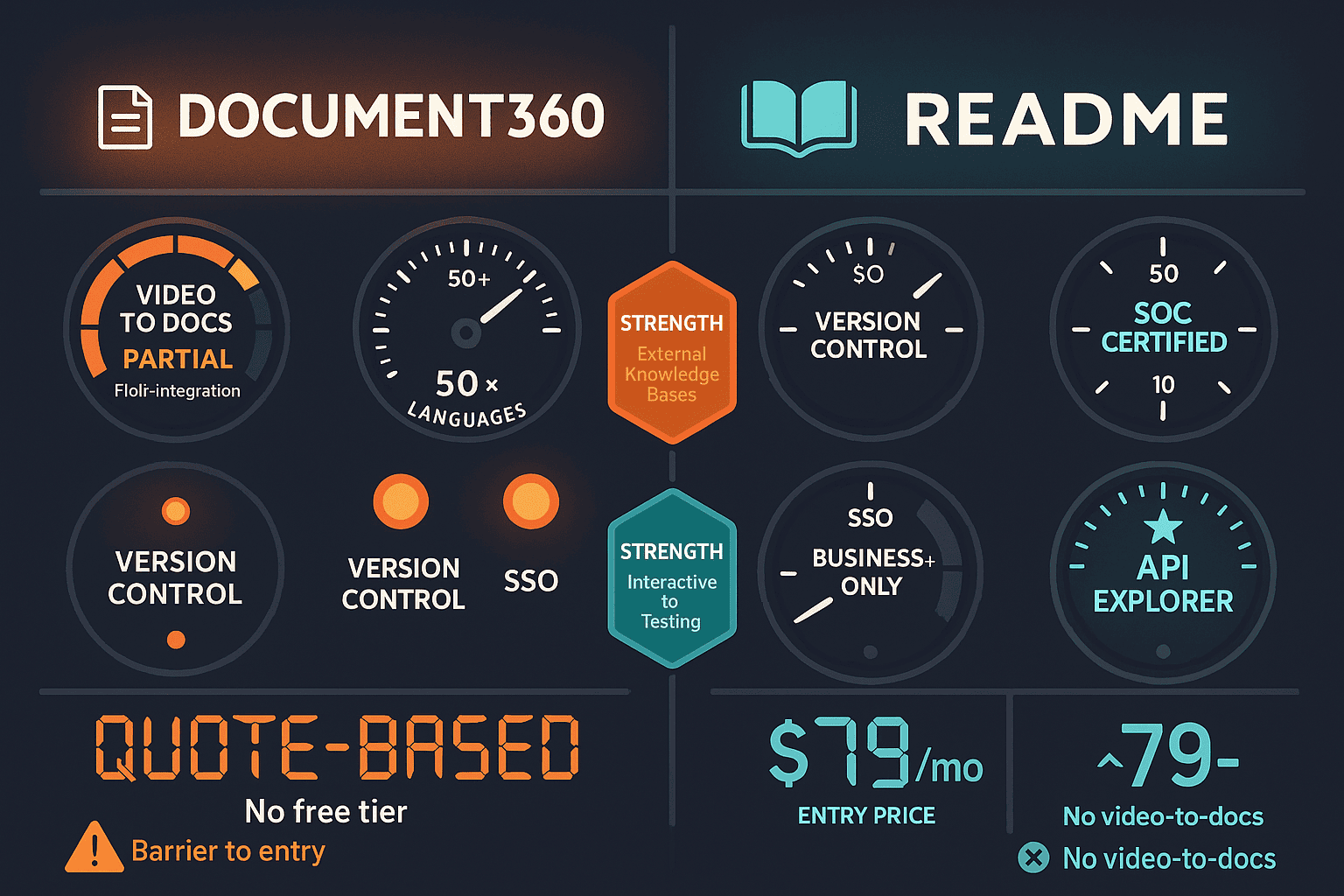
| Primary Use Case | External knowledge base | API / developer documentation |
| Free Plan | ||
| Transparent Pricing | ||
| Starting Price | Quote-based (contact sales) | $79/month (Startup) |
| AI Content Generation | ||
| AI Suite Name | Eddy AI | Agent Owlbert |
| Interactive API Explorer | ||
| OpenAPI / Swagger Support | ||
| Video to Documentation | ||
| Screen Recording Support | ||
| Multi-Language Support | 50+ languages | |
| Auto-Translation | ||
| Version Control | ||
| Changelog Management | ||
| Multi-Tenant Portals | ||
| Custom Domain | ||
| Embeddable Widget | ||
| AI Chatbot / Ask AI | ||
| Review / Approval Workflows | Business+ only | |
| Helpdesk Integrations | ||
| SSO (SAML) | Business+ only | |
| SOC 2 Compliance | ||
| GDPR Compliance | ||
| Audit Logs | ||
| Role-Based Access Control | ||
| Content Reuse / Snippets | ||
| Analytics & Reporting | ||
| Built-in LMS / Certifications | ||
| Autonomous Agents | ||
| Real-Time Compliance Monitoring |
Data as of February 2026. Features based on publicly available information and vendor documentation. Document360 discontinued its free tier in November 2024; new users require sales contact for access.
Strengths & Weaknesses
Deep Dive
Document360 is purpose-built for external knowledge bases with hierarchical content structure, approval workflows, content snippets, and reusable blocks — making it well-suited for teams managing large volumes of customer-facing documentation. ReadMe focuses on developer hubs with versioned API references, changelogs, and interactive guides rather than general knowledge management. Document360's Eddy AI adds 50+ language auto-translation and FAQ generation. ReadMe's Agent Owlbert enforces style consistency and audits docs for quality. For general knowledge base needs, Document360 has a clear structural advantage, while ReadMe's content tools are developer-documentation-specific.
ReadMe is the clear winner for API documentation. Its interactive API explorer lets developers make live API calls directly within documentation — a capability Document360 does not offer. ReadMe supports OpenAPI and Swagger specifications natively, generates versioned developer hubs for multi-version APIs, and manages changelogs for release communication. Document360 has no API explorer, no OpenAPI support, and is not designed for developer-facing portals. For SaaS companies building developer ecosystems, ReadMe's interactive tooling significantly reduces developer onboarding friction and is purpose-built for the technical documentation workflow that developer relations teams require.
Both platforms include AI writing tools, but with different strengths. Document360's Eddy AI covers video/audio-to-content conversion (via screen recording), FAQ generation, and 50+ language auto-translation — useful for multilingual customer support teams. ReadMe's Agent Owlbert (launched October 2025) focuses on doc linting, style enforcement, and docs auditing to maintain consistent API documentation quality. ReadMe's Ask AI chatbot answers developer questions by searching documentation. Neither platform offers autonomous agents, touchless ingestion pipelines, or real-time compliance monitoring. Document360's translation capabilities give it an edge for global content teams; ReadMe's quality enforcement tools benefit developer documentation workflows.
Both tools are SOC 2 and GDPR compliant with role-based access controls. Document360 adds audit logs, SAML SSO on all plans, and dedicated enterprise support. ReadMe gates SSO and review workflows behind its $349/month Business tier. Neither tool offers multi-tenant portals for delivering documentation to multiple clients from a single system — a significant gap for implementation partners, consulting firms, and agencies. Document360's embeddable widget supports in-app documentation delivery; ReadMe lacks this. For regulated industries or organizations delivering documentation to multiple client organizations simultaneously, both platforms require custom workarounds that significantly increase operational complexity.
Our Recommendation
Document360 and ReadMe serve fundamentally different audiences. Document360 is built for customer-facing knowledge bases with strong helpdesk integrations, multilingual support, and content governance — best suited for mid-market support and product teams. ReadMe is built for developer portals with interactive API explorers and versioned hubs — best suited for SaaS companies with developer-facing APIs. They rarely compete directly, but both share critical limitations for enterprise teams needing multi-client delivery, video-to-docs conversion, and knowledge orchestration at scale.
Choose Document360 if you need...
Choose ReadMe if you need...
Choose Docsie if you need...
Winner: Docsie
Both Document360 and ReadMe are strong single-purpose tools — but neither supports multi-tenant documentation delivery, real-world video-to-docs conversion, built-in LMS with certifications, or autonomous knowledge workflows. Docsie closes all these gaps in one platform with transparent pricing, a genuine free plan, 100+ language auto-translation, and enterprise-grade compliance monitoring — making it the superior choice for teams that need more than a single-use knowledge base or developer portal.
Decision Helper
A direct framework for picking between Document360, ReadMe, and Docsie based on your specific needs.
Purpose-built external KB with strong AI writing tools.
Developer hub specialised in interactive API documentation.

Convert real video into searchable docs, then deploy multi-tenant portals.
Common Questions
Q: Is Document360 or ReadMe better for API documentation?
A: ReadMe is significantly better for API documentation. It offers a best-in-class interactive API explorer with live API testing, native OpenAPI/Swagger support, versioned developer hubs, and changelog management. Document360 has no API explorer or OpenAPI support and is not designed for developer-facing portals. If your primary need is API documentation, ReadMe is the clear choice between the two.
Q: Does Document360 still have a free plan?
A: No. Document360 discontinued its free tier in November 2024. Existing users were grandfathered, but new users cannot access any free tier and must contact sales for pricing. A 14-day free trial is available, but all plans are now quote-based with no published pricing. This is a significant barrier for teams that prefer self-serve evaluation and purchase.
Q: Can either Document360 or ReadMe convert training videos into documentation?
A: Neither platform offers true video-to-documentation conversion. Document360 acquired Floik, which adds screen-recording-to-interactive-demo capability, but this only works with new screen captures — not uploaded training videos or real-world footage. ReadMe has no video capabilities at all. Teams needing to convert existing training videos, field recordings, or real-world footage into structured documentation will need a different platform entirely.
Q: Which platform supports multiple languages better?
A: Document360 is far superior for multilingual documentation. Its Eddy AI suite supports 50+ languages with auto-translation built into the platform. ReadMe has no multi-language support or auto-translation capabilities whatsoever, making it unsuitable for global documentation teams or companies serving non-English-speaking markets.
Q: Is there a better alternative to both Document360 and ReadMe?
A: Yes — Docsie addresses the key limitations of both platforms. Unlike Document360, Docsie offers transparent pricing, a genuine free plan, real-world video-to-docs conversion, and multi-tenant portals for delivering documentation to multiple clients simultaneously. Unlike ReadMe, Docsie supports general knowledge bases, 100+ language auto-translation, helpdesk integrations, and a built-in LMS with certifications. Docsie's six-pillar framework — CONVERT, MANAGE, DELIVER, LEARN, AUTOMATE, MONITOR — covers capabilities that neither Document360 nor ReadMe can match individually or combined.
Q: Can Document360 and ReadMe be used together?
A: Technically yes, but there is minimal overlap in their feature sets. Document360 handles customer-facing knowledge bases and help centers, while ReadMe manages developer portals and API references. Organizations with both a customer support knowledge base and a developer portal might use both tools, but this creates content silos, separate workflows, and doubled costs. A unified platform like Docsie can serve both audiences from a single system with multi-tenant delivery.
Q: Which tool is more cost-effective for growing teams?
A: ReadMe offers a free plan and transparent published pricing starting at $79/month, making it easier to evaluate and budget. Document360 requires sales contact for all pricing, with no self-serve option and no free plan since November 2024. At enterprise scale, ReadMe's pricing reaches $3,000+/month. Document360's costs are opaque. For teams wanting predictable, published pricing with a genuine free starting point, ReadMe is more accessible — though Docsie's published plans ($199–$750/month) offer broader capabilities at competitive price points.
Docsie delivers what both tools lack — multi-tenant portals for delivering branded documentation to multiple clients, real-world video-to-docs conversion (not just screen recordings), 100+ language auto-translation, a built-in LMS with certifications, autonomous agents for touchless knowledge workflows, and real-time compliance monitoring. All on one platform with transparent pricing and a genuine free plan.
Free plan includes AI credits to convert a 10-minute training video. No credit card required.