
4.8
on G2
 Confluence
 Tango
Tango
Confluence is the heavyweight enterprise wiki built for Atlassian-centric organizations, scaling to 150,000 users with full SSO, audit logs, and ISO 27001 compliance. Tango is a lightweight workflow capture tool pivoting toward CRM automation, with limited enterprise controls and no uptime SLA. This comparison cuts through the noise for enterprise buyers evaluating both platforms.
For enterprise buyers, Confluence and Tango cover narrow slices (scales to 150 and soc 2 compliant and gdpr-ready) while Docsie adds SSO, audit trails, multi-tenant portals, and compliance monitoring in one platform.
Enterprise Feature Matrix
A head-to-head comparison of enterprise-grade capabilities across security, compliance, administration, scalability, and support for Confluence and Tango.
| Feature |
Confluence
|
Tango
|
|---|---|---|
| SSO (SAML / OAuth) | Enterprise only | |
| SCIM Provisioning | Enterprise only | |
| Multiple Identity Providers | Enterprise plan | |
| Role-Based Access Control | ||
| Granular Permissions | Advanced (Premium+) | Basic |
| Audit Logs | ||
| SOC 2 Compliance | ||
| GDPR Compliance | ||
| ISO 27001 Certification | ||
| Data Residency Options | Enterprise plan | |
| Automatic PII Blurring | Enterprise only | |
| Uptime SLA | 99.9% (Premium+) | None published |
| User Scalability | Up to 150,000 users | Not disclosed |
| Version History | Unlimited | 14 days (Pro) / 365 days (Enterprise) |
| API Access | ||
| Dedicated Support | 24/7 (Premium+) | Enterprise only |
| Admin Analytics & Reporting | Pro+ | |
| Multi-Tenant / Client Portals | ||
| Custom Domain | ||
| Air-Gap / Private Infrastructure |
Data as of February 2026. Features are based on publicly available information and vendor documentation. Tango's enterprise tier requires custom pricing; some features may vary by contract.
Strengths & Weaknesses
Deep Dive
An in-depth analysis of the critical enterprise dimensions where Confluence and Tango differ most — and where both fall short for modern enterprise documentation needs.
Confluence leads decisively on security credentials. It holds ISO 27001 certification alongside SOC 2 and GDPR, supports data residency on its Enterprise plan, and offers SCIM provisioning with multiple identity providers. Tango achieves SOC 2 and GDPR compliance and adds useful automatic PII blurring for screenshots on Enterprise, but lacks ISO 27001, has no data residency, and publishes no audit logs. For regulated industries — financial services, healthcare, government — Confluence's compliance posture is substantially stronger. Tango's compliance gaps make it unsuitable as a primary enterprise knowledge platform in audit-heavy environments.
Confluence is purpose-built for enterprise scale, supporting up to 150,000 users per site with a documented 99.9% uptime SLA on Premium and above. It has been battle-tested in organizations with thousands of concurrent users across global teams. Tango publishes no uptime SLA and does not disclose maximum user capacity — a significant red flag for enterprise procurement teams requiring contractual performance guarantees. Tango's architecture is designed around individual workflow capture sessions, not high-volume concurrent documentation operations. For organizations that need platform reliability guarantees, Confluence's track record and published SLAs provide meaningful assurance that Tango cannot match.
Confluence offers a mature administrative control suite — full audit logs, space-level and page-level permissions, advanced role-based access control, SCIM user provisioning, and multi-IDP support for complex enterprise identity stacks. Admins can govern content at granular levels across large, distributed teams. Tango provides role-based access and SAML SSO but restricts them to its Enterprise tier, and critically offers no audit logs on any plan. For organizations requiring full visibility into who accessed, edited, or shared sensitive documentation, Tango's admin toolset is insufficient. Confluence gives IT and security teams the administrative levers they need to maintain governance at scale.
Confluence's Premium and Enterprise plans include 24/7 dedicated support with defined response SLAs, backed by Atlassian's global support infrastructure. Enterprise customers also receive dedicated technical account management and access to Atlassian's professional services network. Tango offers dedicated support on its Enterprise plan, but no published response time SLAs and no uptime commitment are available publicly. For enterprise buyers where downtime directly impacts productivity or customer commitments, the absence of contractual SLAs from Tango is a material procurement risk. Confluence's transparent SLA structure is a meaningful differentiator for organizations with formal vendor risk management requirements.
Our Recommendation
Confluence is the clear winner on enterprise readiness between these two tools. It offers proven scalability to 150,000 users, ISO 27001 certification, audit logs, SCIM provisioning, multiple IDP support, and a published uptime SLA — the table stakes for serious enterprise deployments. Tango, while capable as a lightweight workflow capture tool for browser-based SOPs, lacks the compliance certifications, audit infrastructure, API access, and contractual SLAs that enterprise procurement teams require. However, both tools share critical gaps that matter for modern enterprise knowledge operations: neither supports multi-tenant client portals, custom domain delivery, video-to-documentation conversion, or air-gap private infrastructure deployment.
Choose Confluence if you need...
Choose Tango if you need...
Choose Docsie if you need...
Winner: Docsie
For enterprise teams that need more than an internal wiki or a screenshot capture tool, Docsie delivers a complete six-pillar knowledge orchestration platform — CONVERT, MANAGE, DELIVER, LEARN, AUTOMATE, MONITOR — on private infrastructure. It closes the gaps both Confluence and Tango leave open: multi-tenant client portals, video-to-docs conversion from any source, built-in LMS with certifications, autonomous documentation agents, real-time compliance monitoring for HIPAA/SOX/ITAR/GDPR, and air-gap deployment. With SOC 2 Type II compliance, 99.9% uptime SLA, full audit logs, and transparent workspace-based pricing that avoids per-seat inflation, Docsie is the more complete enterprise-ready platform for organizations managing knowledge at scale.
Decision Helper
A direct framework for picking between Confluence, Tango, and Docsie based on your specific needs.
Atlassian's team wiki, deeply tied to Jira and the Atlassian suite.
Free browser-based capture for quick how-tos with screenshot annotation.

Convert real video into searchable docs, then deploy via multi-tenant portals.
Common Questions
Q: Does Tango have an uptime SLA for enterprise customers?
A: Tango does not publish an uptime SLA on any plan, including its Enterprise tier. This is a significant gap for enterprise procurement teams that require contractual performance guarantees. Confluence, by contrast, offers a documented 99.9% uptime SLA from its Premium plan onward. Organizations in regulated industries or with vendor risk management requirements should treat Tango's absence of a published SLA as a material procurement consideration.
Q: Which tool provides better compliance certifications for regulated industries?
A: Confluence holds ISO 27001 certification in addition to SOC 2 and GDPR, and offers data residency options on its Enterprise plan. Tango achieves SOC 2 and GDPR compliance with useful PII blurring on Enterprise, but has no ISO 27001, no data residency, and no audit logs. For healthcare, financial services, or government use cases, Confluence's compliance credentials are substantially stronger — though neither tool offers HIPAA-ready or ITAR compliance coverage.
Q: Can either Confluence or Tango deliver documentation to external clients through branded portals?
A: Neither Confluence nor Tango supports multi-tenant client portals. Confluence is designed for internal enterprise wikis and does not offer custom domains or client-facing delivery. Tango's output is an internal workflow library without external portal capabilities. If your organization needs to deliver branded documentation to multiple external clients or customer organizations from a single knowledge base, both tools are fundamentally unsuitable for that use case.
Q: Is Confluence worth the cost for teams not already using Jira?
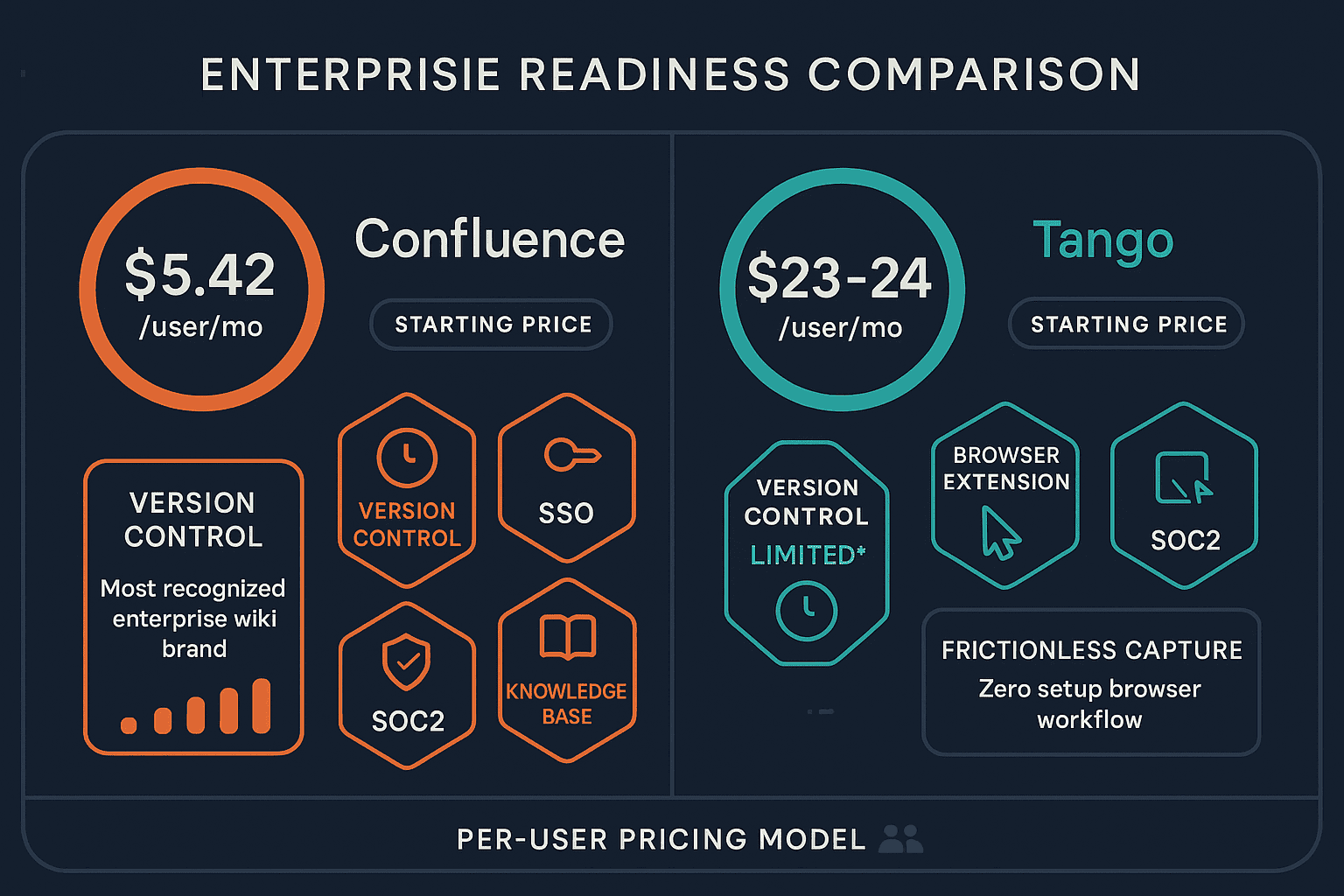
A: Confluence delivers its best value when teams are already embedded in the Atlassian ecosystem — Jira, Bitbucket, Trello. For teams outside that stack, Confluence's per-user pricing ($5.42–$10.44/user/month plus Enterprise custom pricing) and complexity may not be justified by the documentation functionality alone. Teams without Atlassian dependencies often find the platform's administrative overhead and cost structure disproportionate to their needs.
Q: What happens to Tango's enterprise roadmap given its pivot to CRM automation?
A: Tango has publicly pivoted its product direction toward CRM automation (Salesforce, HubSpot) with documentation increasingly becoming a secondary use case. Enterprise buyers evaluating Tango as a long-term documentation platform should factor in roadmap risk — feature investment in enterprise documentation controls may be deprioritized as the company focuses on its automation pivot. This makes Tango a riskier long-term enterprise documentation investment compared to platforms with documentation as their core focus.
Q: Is there a better alternative to both Confluence and Tango for enterprise documentation?
A: Docsie is purpose-built to address the gaps both tools leave open. Unlike Confluence, Docsie supports multi-tenant client portals, custom domain delivery, video-to-documentation conversion, a built-in LMS, autonomous agents, and real-time compliance monitoring for HIPAA, SOX, ITAR, and GDPR — all on private infrastructure. Unlike Tango, Docsie offers full audit logs, SOC 2 Type II compliance, API access, 100+ language auto-translation, and a published 99.9% uptime SLA. For enterprise teams managing knowledge at scale across internal teams and external clients, Docsie's six-pillar CONVERT → MANAGE → DELIVER → LEARN → AUTOMATE → MONITOR platform provides a more complete enterprise-ready foundation.
Docsie delivers what both Confluence and Tango cannot — multi-tenant branded portals, video-to-documentation conversion, a built-in LMS with certifications, autonomous agents, real-time compliance monitoring for HIPAA/SOX/ITAR/GDPR, and air-gap private infrastructure deployment. All with SOC 2 Type II compliance, full audit logs, and transparent workspace-based pricing that scales without per-seat inflation.
No credit card required. Free AI credits to convert a 10-minute training video included.