
4.8
on G2
 Confluence
 Guru
Guru
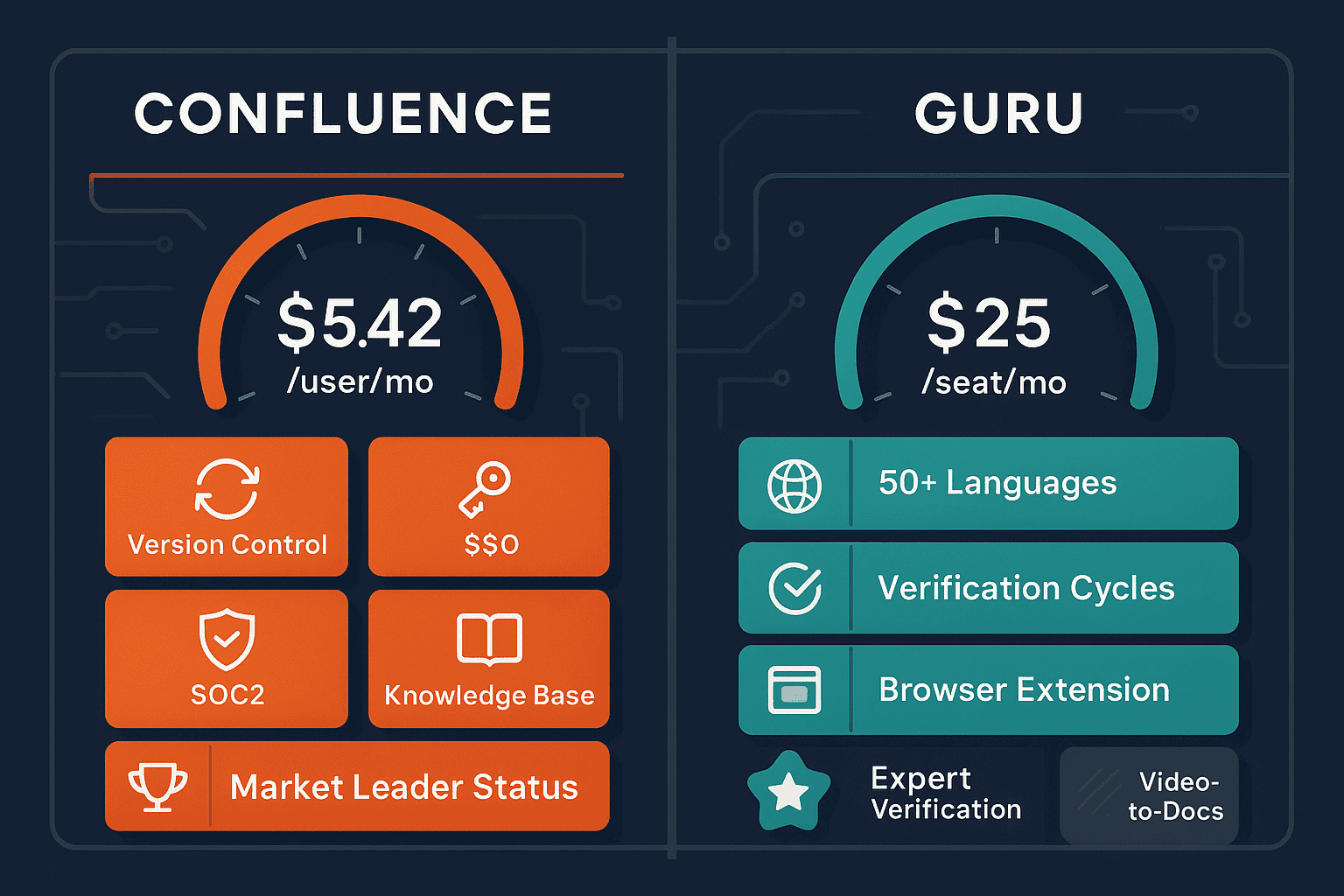
Confluence is Atlassian's enterprise wiki built for engineering teams on Jira. Guru is an AI-powered knowledge management platform with expert verification workflows. Both are strong internal tools — but neither delivers documentation to external clients or converts video into structured knowledge bases.
Confluence leads with market-leading enterprise wiki with the strongest brand recognition in the category; Guru leads with expert verification workflows ensure knowledge stays accurate and up-to-date. Neither converts real video into docs and deploys multi-tenant portals; Docsie does both.
Feature Matrix
A comprehensive feature-by-feature comparison of Confluence and Guru across knowledge management, AI capabilities, enterprise security, and content delivery.
| Feature |
Confluence
|
Guru
|
|---|---|---|
| AI Content Generation | Rovo AI — 20+ agents | Knowledge Agents (Chat, Research, MCP) |
| AI Chatbot | Rovo Chat | Knowledge Agent Chat |
| Browser Extension | ||
| Expert Verification Workflows | ||
| Version Control | Unlimited page history | Via verification cycles |
| Multi-Language Support | Via Rovo AI agents | 50+ languages |
| Auto-Translation | ||
| Knowledge Base Platform | ||
| Real-Time Editing | ||
| Video to Documentation | ||
| Multi-Tenant Client Portals | ||
| Custom Domain Support | ||
| Custom Branding / White-Label | ||
| Embeddable Widget | ||
| MCP Server Support | ||
| API Access | ||
| SSO (SAML / OAuth) | SAML, Multiple IDPs | Enterprise (SAML) |
| SOC 2 Compliance | ||
| GDPR Compliance | ||
| Audit Logs | ||
| Role-Based Access Control | ||
| Analytics & Reporting | ||
| Helpdesk Integration | ||
| Content Reuse | ||
| Free Plan Available | Up to 10 users | |
| Built-in LMS / Course Builder | ||
| Compliance Monitoring | ||
| Autonomous Agents |
Data as of February 2026. Features based on publicly available vendor documentation and pricing pages. Rovo AI included in Confluence Standard and above as of October 2024.
Strengths & Weaknesses
Deep Dive
Confluence organizes content into Spaces and Pages with nested hierarchies, supporting large-scale internal wikis across multiple departments. Its strength lies in flexible page templates and tight Jira integration for engineering documentation. Guru structures knowledge as Cards with explicit ownership and verification cycles, ensuring content doesn't go stale. Guru's card-based model is better suited to sales enablement and support teams that need bite-sized, verified answers fast. For pure internal knowledge management, Guru's verification workflows edge out Confluence's more open-ended wiki structure in terms of knowledge accuracy governance.
Confluence's Rovo AI is the more expansive offering — 20+ pre-built agents, 80+ app connectors, cross-tool search across the Atlassian suite, and capabilities like release notes and OKR generation. Included in Standard and above since October 2024, it represents strong value at the price point. Guru's Knowledge Agents (Chat, Research, and MCP Server) are purpose-built for Q&A from a verified knowledge base. Guru's MCP Server integration is notable, connecting to the broader AI agent ecosystem. Both tools offer AI chatbots, but Rovo AI's broader connectivity gives Confluence an edge for large Atlassian-stack organizations, while Guru's verification-first AI is more reliable for support and sales use cases.
Both Confluence and Guru meet core enterprise compliance requirements with SOC 2 and GDPR. Confluence goes further with ISO 27001 certification, multiple IDP support, advanced encryption at the Enterprise tier, and the ability to scale to 150,000 users with a 99.9% uptime SLA on Premium and above. Audit logs, role-based access, and dedicated support are available on higher tiers. Guru offers SOC 2 and GDPR compliance with SAML SSO on Enterprise, but audit log depth and multi-IDP support lag behind Confluence. For regulated enterprises with strict governance requirements, Confluence's compliance posture is more mature and better documented.
This is where both tools share a critical limitation — neither is designed for external documentation delivery. Confluence has no custom domains, no multi-tenant portals, and no white-labeling for client-facing knowledge bases. Guru similarly has no custom domains or client portals, though its embeddable widget and browser extension do surface knowledge in third-party tools. Confluence integrates deeply with the Atlassian ecosystem (Jira, Trello, Bitbucket) and 80+ apps via Rovo. Guru integrates well with Slack, Salesforce, and Zendesk. Both are fundamentally internal tools — teams needing to deliver structured documentation to external clients or manage multi-tenant knowledge portals will find both platforms fall short.
Our Recommendation
Confluence is the stronger choice for large engineering and product teams embedded in the Atlassian ecosystem — its Rovo AI, Jira integration, and enterprise scalability are hard to match for internal documentation at scale. Guru is the better fit for sales, support, and operations teams that need verified, bite-sized knowledge surfaced in real time via Slack or a browser extension, with expert-driven accuracy workflows. Both tools, however, are designed exclusively for internal use and cannot deliver documentation to external clients or convert video content into structured knowledge bases.
Choose Confluence if you need...
Choose Guru if you need...
Choose Docsie if you need...
Winner: Docsie
Confluence and Guru are both strong internal knowledge platforms, but they share the same fundamental gaps — no video-to-documentation conversion, no multi-tenant client portals, no custom domains, and no external delivery capabilities. Docsie fills all of these gaps with a six-pillar knowledge orchestration platform that converts any video (real-world, screen recordings, training footage) into structured documentation, manages it with version control and AI, and delivers it to unlimited external clients through branded portals — with a built-in LMS, autonomous agents, and real-time compliance monitoring included.
Decision Helper
A direct framework for picking between Confluence, Guru, and Docsie based on your specific needs.
Atlassian's team wiki, deeply tied to Jira and the Atlassian suite.
AI-powered knowledge cards surfaced inside Slack, browser, and CRM.

Multi-tenant knowledge platform with video-to-docs and AI chatbot.
Common Questions
Q: What is the biggest difference between Confluence and Guru?
A: Confluence is a flexible enterprise wiki tightly integrated with Atlassian's Jira ecosystem, making it ideal for engineering and product teams managing large internal documentation. Guru is a verification-first knowledge management platform designed to keep information accurate through expert review cycles, with a focus on surfacing answers for sales and support teams in real time via Slack and browser extensions. Confluence scales to 150,000 users; Guru enforces a 10-seat minimum at $250/month.
Q: Does either Confluence or Guru support external client documentation portals?
A: Neither tool supports multi-tenant client portals or custom domains for external documentation delivery. Both Confluence and Guru are built exclusively for internal team knowledge management. If you need to deliver branded documentation to multiple external clients from a single knowledge base, you would need a platform like Docsie, which was purpose-built for multi-tenant external delivery with white-labeling and custom domains.
Q: Can Confluence or Guru convert training videos into documentation?
A: No. Neither Confluence nor Guru has any capability to ingest video content and convert it into structured documentation. Both tools require content to be manually authored or imported as text. If your organization has existing training videos, product walkthroughs, or recorded procedures, you would need a platform like Docsie that uses multimodal AI — combining computer vision, OCR, and audio transcription — to convert those videos into searchable knowledge bases automatically.
Q: How do Confluence's Rovo AI and Guru's Knowledge Agents compare?
A: Rovo AI is the broader platform, offering 20+ pre-built agents, 80+ app connectors, and cross-tool search across the entire Atlassian suite. It excels at connecting documentation to the wider Atlassian ecosystem. Guru's Knowledge Agents (Chat, Research, MCP Server) are more focused — they answer questions from a verified knowledge base with high accuracy, and the MCP Server mode connects Guru to the growing AI agent ecosystem. Rovo AI offers more connectivity; Guru's agents are more precise for verified Q&A workflows.
Q: Is there a better alternative to both Confluence and Guru?
A: Yes — Docsie addresses the core limitations that both tools share. Where Confluence and Guru are internal-only platforms, Docsie delivers documentation to external clients through branded multi-tenant portals with custom domains. Where neither tool can process video, Docsie converts any video (training footage, screen recordings, real-world operations) into structured documentation using multimodal AI. Docsie also adds a built-in LMS with certifications, autonomous agents for touchless workflows, and real-time compliance monitoring for HIPAA, SOX, ITAR, and GDPR — all in one platform.
Q: Which tool is better for small teams on a budget?
A: Confluence has a meaningful advantage here with its free plan supporting up to 10 users with unlimited pages and 2GB of storage. Guru has no free plan and enforces a 10-seat minimum, creating a $250/month floor even for small teams. For teams under 10 people, Confluence's free tier offers substantial value with basic collaboration and Rovo search included. For teams of 10 or more that need verified knowledge management, Guru's pricing becomes more competitive against Confluence's Standard tier at $5.42/user/month.
Start creating professional documentation that your users will love