
How to Write an SBAR Report
This procedure explains how to write an SBAR report and deliver it clearly when contacting a physician, nurse practitioner, physician assistant, or another member of the healthcare team. SBAR stands for Situation, Background, Assessment, and Recommendation. It is a structured communication method designed to simplify and organize the process of sharing patient information, so you communicate the patient's situation, relevant background, your assessment findings, and your recommendations in a clear, focused, and systematic way.
Video: SBAR Nursing Example: Nurse-to-Physician Communication Report NCLEX by RegisteredNurseRN (2021). All credit for the demonstration goes to the creator; watch the original on YouTube. The written guide below was generated from this video by Docsie. Creator? Request a change or removal.
Purpose
This procedure explains how to write an SBAR report and deliver it clearly when contacting a physician, nurse practitioner, physician assistant, or another member of the healthcare team. SBAR stands for Situation, Background, Assessment, and Recommendation. It is a structured communication method designed to simplify and organize the process of sharing patient information, so you communicate the patient's situation, relevant background, your assessment findings, and your recommendations in a clear, focused, and systematic way.
Using SBAR helps you stay organized, eliminate unnecessary details that can waste time or confuse the listener, and avoid situations where you are unable to answer a provider's follow-up questions.
Scope
Use this procedure whenever you need to:
- Report a patient's deteriorating condition to a physician, nurse practitioner, or physician assistant.
- Request something specific for a patient from a healthcare provider.
- Hand off a patient to another nurse.
- Transfer a patient to a different unit.
- Communicate with other healthcare team members, such as speech therapy, occupational therapy, and physical therapy.
SBAR guides you in providing the essential information other team members need to understand your patient's situation, regardless of the audience.
Prerequisites and required materials
Before you begin an SBAR communication, make sure you have:
- An SBAR template or layout (many units provide one) to fill in before calling or speaking with another provider.
- Access to the patient's chart, ideally open on your computer for quick reference.
- Notes and papers organized and within reach so you can answer questions efficiently.
- Current vital signs and physical assessment findings for the patient.
- A stethoscope and any equipment needed to complete a physical assessment.
Procedure
Step 1: Review the SBAR framework and its purpose
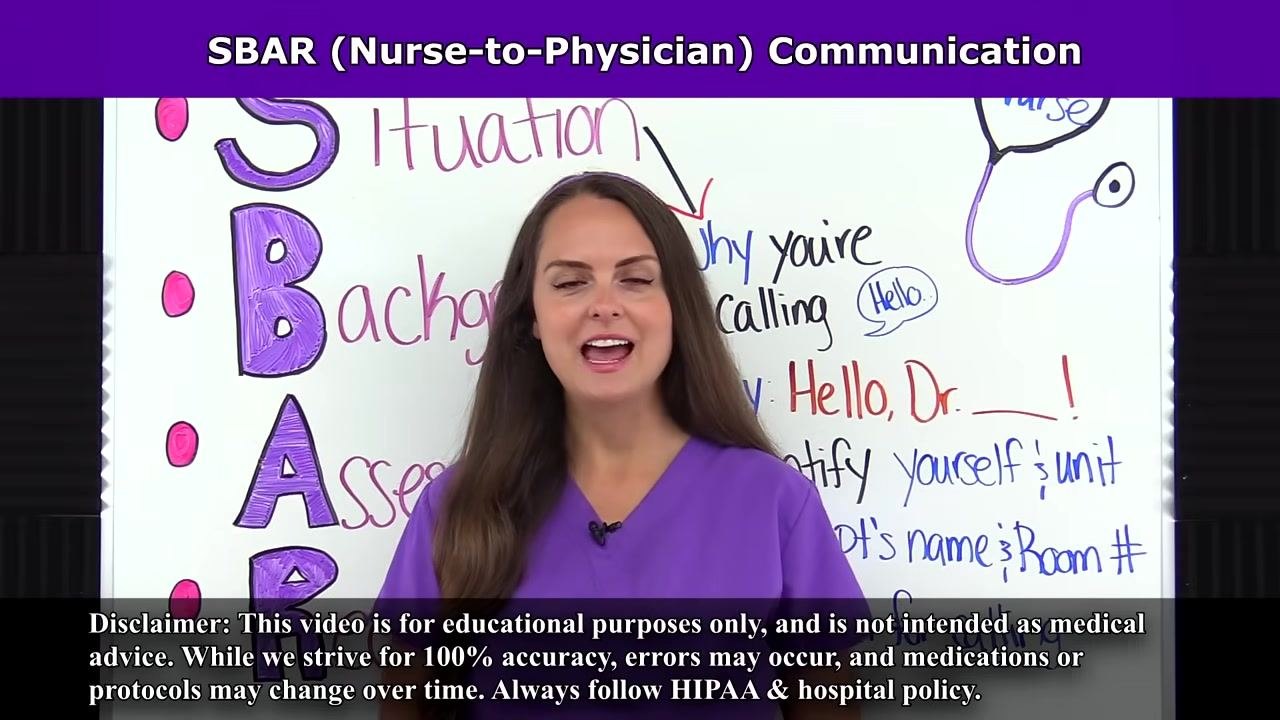
Before your first call, understand what each letter of SBAR represents and why the structure matters: Situation (why you're calling), Background (identify yourself and your unit, and state the patient's name and room number), Assessment (share your assessment findings), and Recommendation (clearly state what you recommend or need from the provider).
Step 2: Gather an SBAR template and prepare documentation
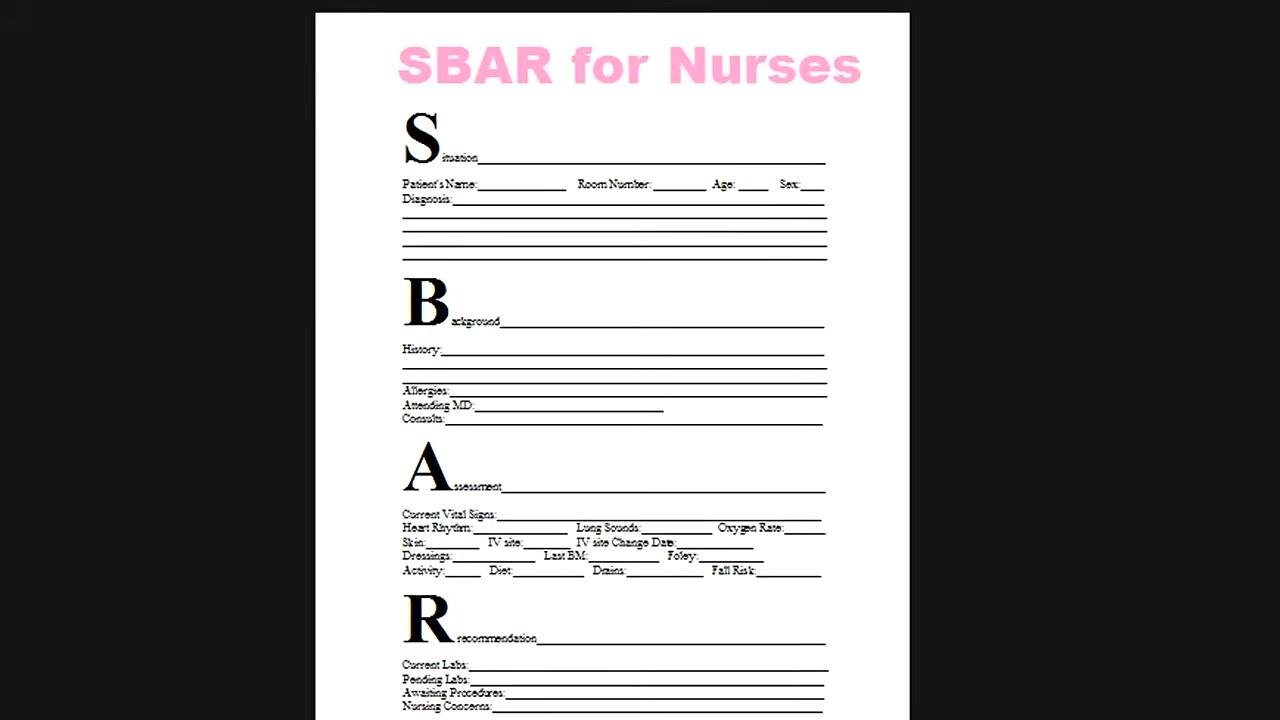
Obtain an SBAR template or layout, since many units already provide one. Fill in the template before you call or speak with another provider so all required details are ready. A typical template includes: Situation (Patient Name, Room Number, Age, Sex, Diagnosis), Background (History, Allergies, Attending MD, Consults), Assessment (Current Vital Signs, Heart Rhythm, Lung Sounds, Oxygen Rate, Skin, IV Site, Dressings, Activity, Diet, Drains, Fall Risk, etc.), and Recommendation (Current Labs, Pending Labs, Awaiting Procedures, Nursing Concerns).
If you are new to SBAR, develop a personal system for compiling this information. With practice, this process becomes quicker and more intuitive, and you will be able to do much of it mentally or with brief notes.
Step 3: Perform a physical assessment of the patient
Before communicating, thoroughly review the patient's chart to understand their current status and history. Then physically assess the patient and collect their vital signs so you have all relevant information at hand before you call.
Safety note: Complete this assessment and chart review before initiating the call so you can answer follow-up questions without delay.
Step 4: Prepare your introduction for the situation section
Before calling, review the latest progress notes to understand the current care plan and which providers are involved, check the most recent lab results for significant changes, and confirm the patient's current medications. Open the patient's chart on your computer and keep your notes organized within reach.
The Situation section is where you state, in a short sentence, the reason you are calling. Keep this section focused and avoid unnecessary detail.

Step 5: State the situation on the call
Deliver the Situation section in four parts: greet the provider (for example, "Hello, Dr. [Name]"), identify yourself and your unit (for example, "This is [Your Name] from the Cardiac PCU"), state the patient's full name and room number, and clearly state the reason for your call.
Example script: "Hello, Dr. Smith, this is Jane Doe from the Cardiac PCU. I'm calling about Mr. John Brown in room 402. The reason for my call is that he has developed new shortness of breath."
Step 6: Outline the background details to report
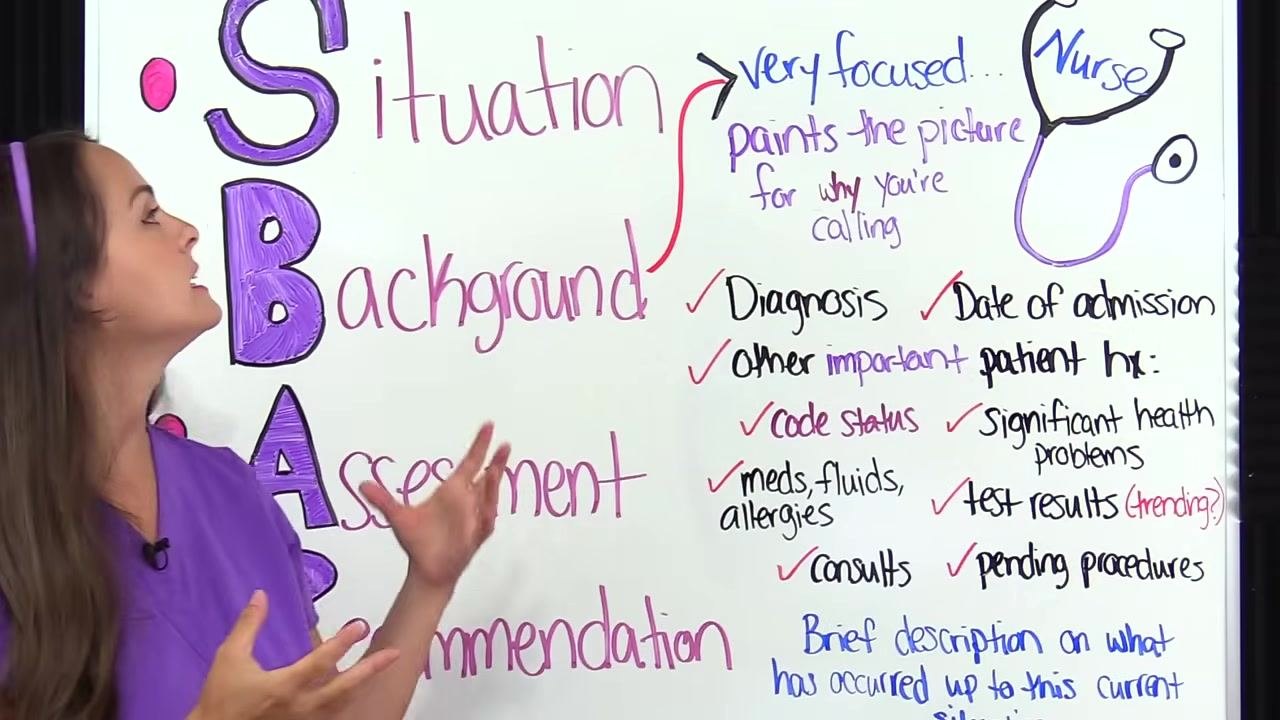
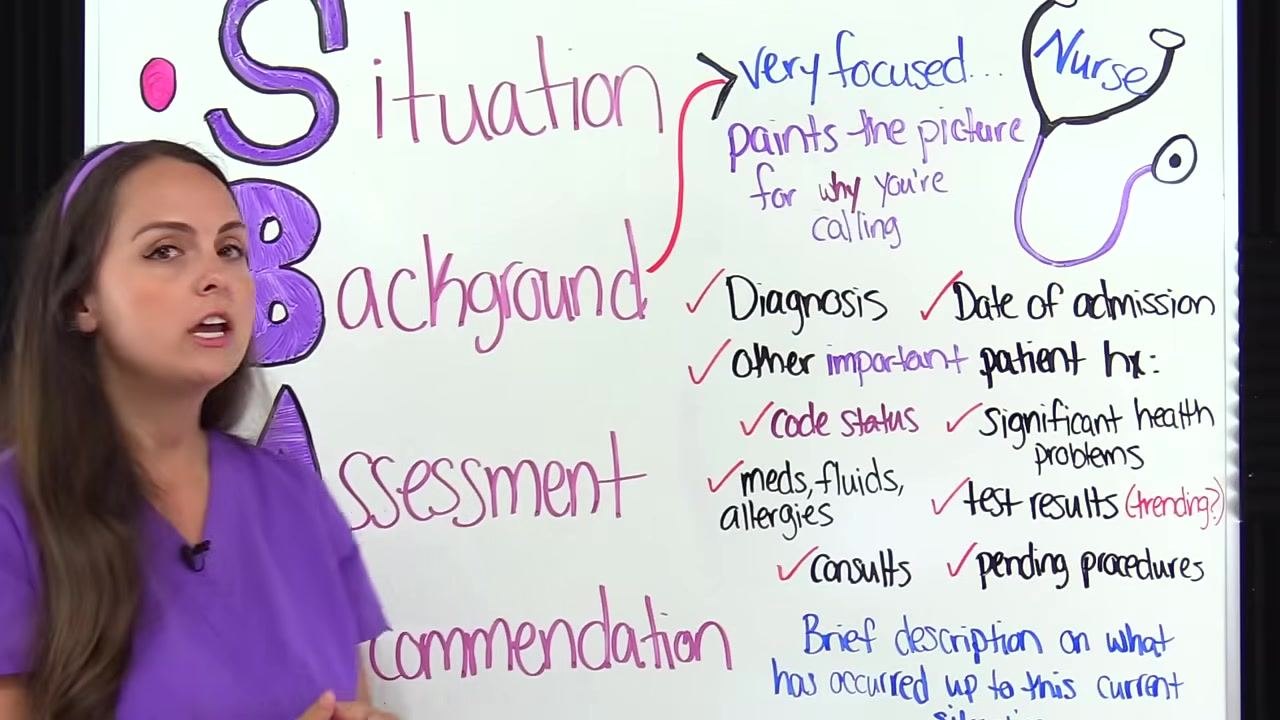
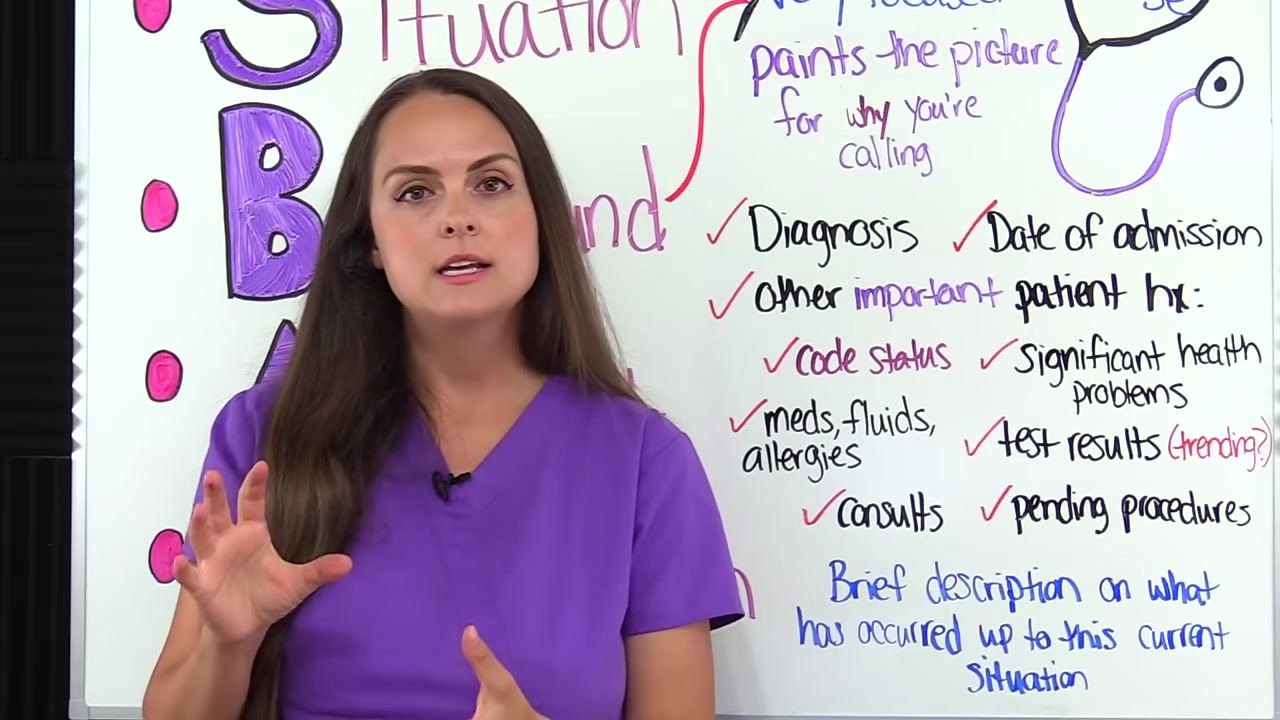
Keep the Background section very focused; its goal is to paint a clear picture of why you are calling. Prepare to cover: diagnosis, date of admission, other important patient history, code status, significant health problems, medications/fluids/allergies, test results (especially if trending), consults, pending procedures, and a brief description of what has occurred up to the current situation.
Step 7: Report the diagnosis and admission date
State the patient's diagnosis clearly, include the date of admission, and mention any other important aspects of the patient's history relevant to the current situation.
Step 8: Report code status and significant health problems
State the patient's code status (for example, full code or DNR) and mention any significant health problems that may impact care or decision-making.

Step 9: Report medications, fluids, allergies, and consults
Provide information about the patient's current medications and fluids, state any known allergies, and mention any consults that have been requested or completed.
Step 10: Report test results and pending procedures
Give relevant test results, especially those that are trending or changing, and mention any pending procedures that may affect the patient's care.

Step 11: Compare current results with previous results
When discussing test results, compare current values to previous ones (for example, previous H&H values) to identify trends or changes worth flagging to the provider.

Step 12: Communicate your assessment findings
In the Assessment section, clearly state what you have assessed and what you think is going on with the patient. Provide supporting assessment findings and current vital signs, and specify if you suspect a particular system is involved, such as respiratory, cardiac, neuro, or GI. If you are unsure of the exact issue, describe your concern using phrases such as "I am worried," "the patient is deteriorating," "they are unstable," or "their condition has changed."
Step 13: State your recommendation
In the Recommendation section, be very specific about what you want from the person you are calling. Clearly state your request: additional orders (for example, labs or tests), clarification on medications or other orders, a request for the provider to see the patient (for example, for transfer or urgent review), or a request for their recommendations if you are unsure what to do next. Close by reiterating why you are calling and what you need.

Step 14: Be specific about what you are requesting
Use direct language when stating your request, for example: "I am requesting more orders, such as labs or tests," "I need clarification on the patient's medications," "I am requesting that you see the patient for possible transfer or urgent review," or, if you are unsure what to request, ask the provider for their recommendations based on everything you have told them.

Step 15: Apply SBAR to a sample scenario
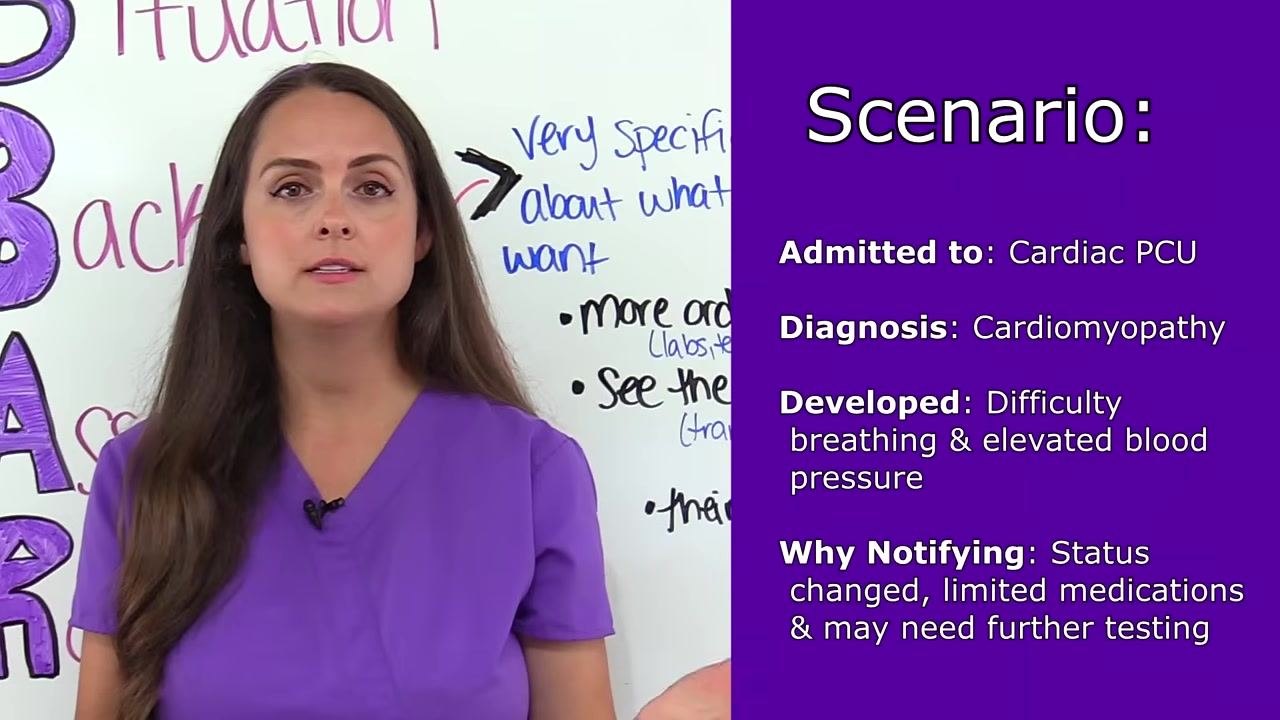
Practice the full sequence using a scenario before you place a real call. For example: patient admitted to the Cardiac PCU with a diagnosis of cardiomyopathy, who developed difficulty breathing and elevated blood pressure around noon, prompting notification because the patient's status has changed, medications available are limited, and further testing may be needed.
Step 16: State the situation using the example script
Open the call by identifying yourself, your location, and the patient, then state your concern. Example script: "Hello, Dr. Ross. This is Sarah from 1800, the Cardiac PCU floor. I'm taking care of Mr. Morris in Room 1802. I'm concerned about the patient's recent development of dyspnea and hypertension."
Step 17: Provide background using the example script
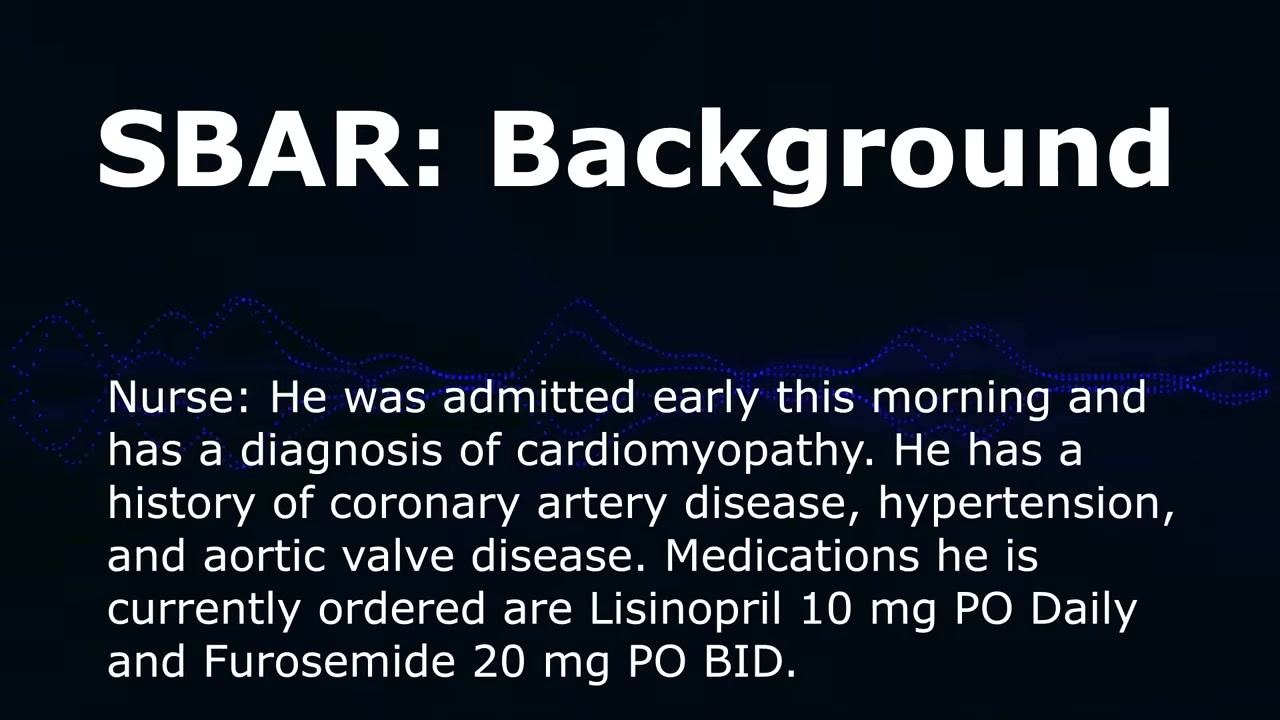
Summarize admission details, diagnosis, and relevant history, then list current medications and dosages. Example script: "He was admitted early this morning and has a diagnosis of cardiomyopathy. He has a history of coronary artery disease, hypertension, and aortic valve disease. Medications he is currently ordered are Lisinopril 10 mg PO Daily and Furosemide 20 mg PO BID."
Step 18: Present assessment findings (respiratory)
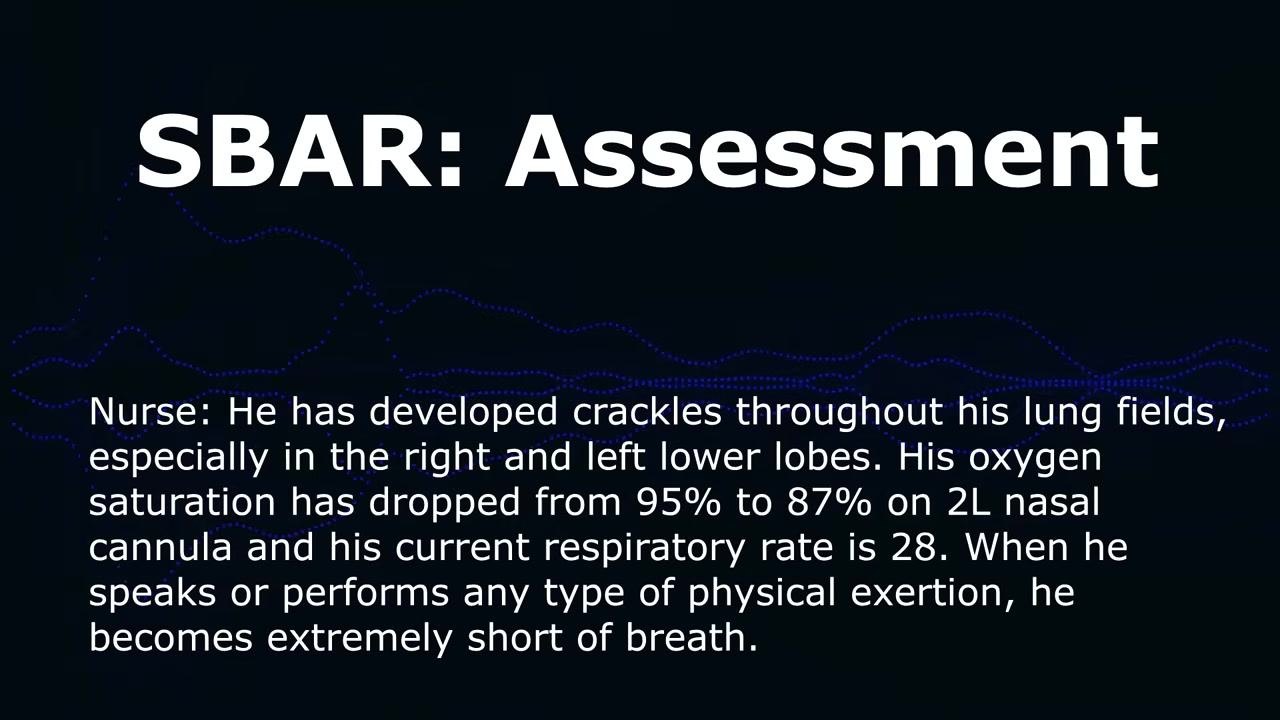
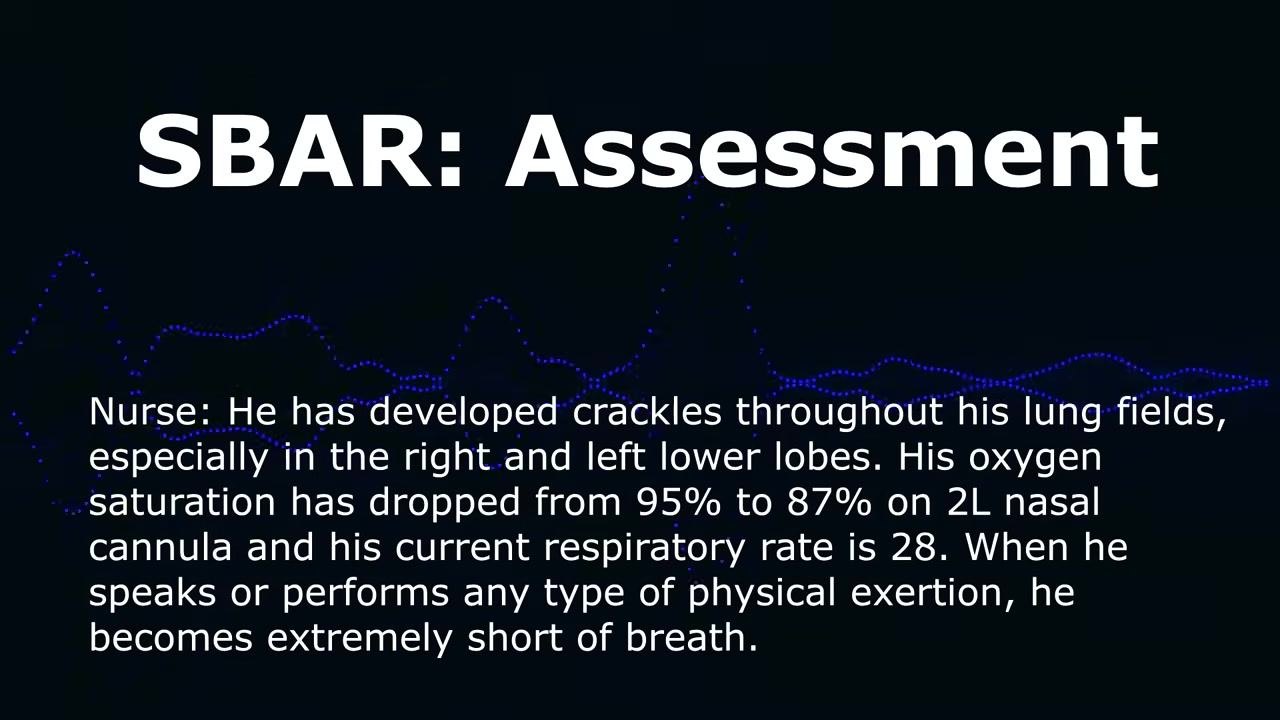
Share your clinical findings and observations, including vital sign changes and the patient's response to activity. Example script: "He has developed crackles throughout his lung fields, especially in the right and left lower lobes. His oxygen saturation has dropped from 95% to 87% on 2L nasal cannula, and his current respiratory rate is 28. When he speaks or performs any type of physical exertion, he becomes extremely short of breath."
Step 19: Present assessment findings (cardiovascular)
Continue the assessment with additional findings and your clinical impression. Example script: "He has 3+ pitting edema in the lower extremities. Current blood pressure is 200/120 and heart rate is 102 (regular sinus tachycardia). I think he is experiencing fluid volume overload, which may be contributing to the patient's respiratory status and current cardiac issues."
Step 20: Make your recommendation
Clearly state your recommendation or request for the next steps in the patient's care. Example script: "I think the patient may need an adjustment in medications and further diagnostic testing. How would you like me to proceed with this patient?"
Step 21: Offer specific options for the physician
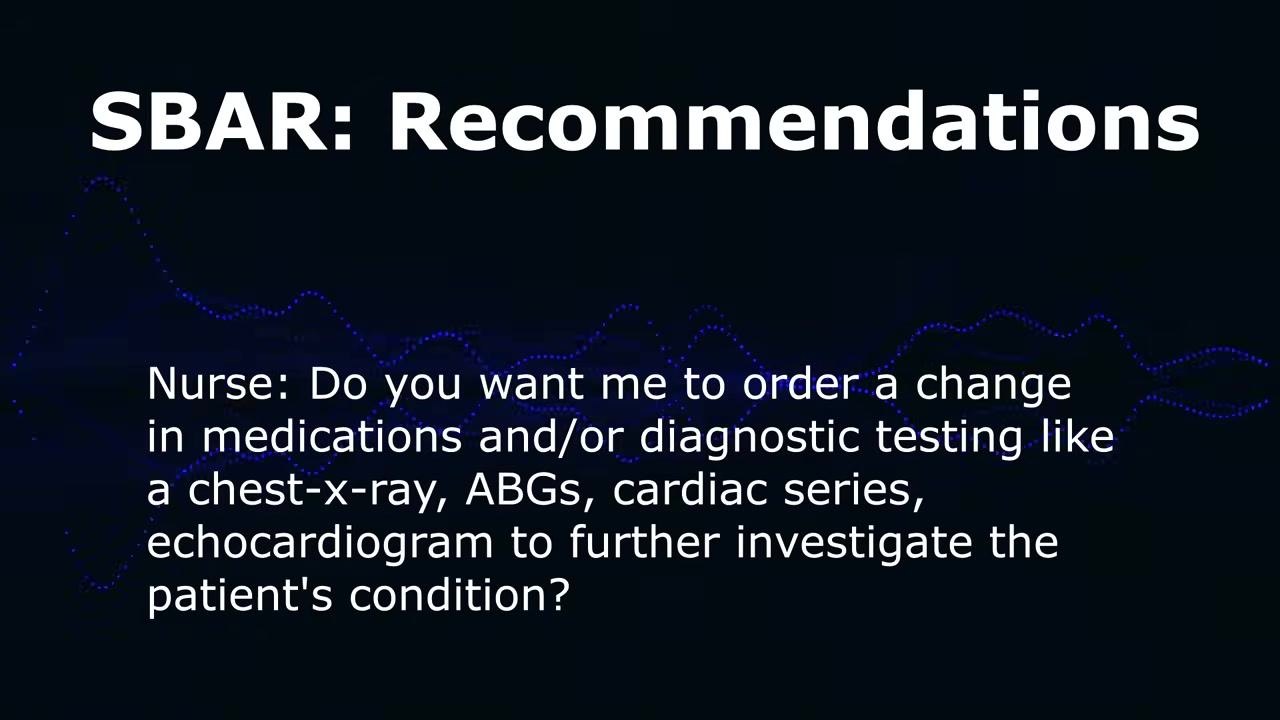
Give the provider concrete options to consider, such as changes in medications or specific diagnostic tests. Example script: "Do you want me to order a change in medications and/or diagnostic testing like a chest x-ray, ABGs, cardiac series, echocardiogram to further investigate the patient's condition?"
Step 22: Confirm, complete, and document orders
After the physician responds, read back the orders to confirm accuracy, complete all orders as instructed, and document the conversation and actions taken in the patient's medical record.
Safety note: Always read back orders before ending the call and before carrying them out, to prevent errors in patient care.
Verification and summary
Before ending any SBAR communication, confirm you have covered:
- Situation: Your name, unit, and patient details (name and room number), plus the main reason for your call.
- Background: Diagnosis, date of admission, relevant history, code status, significant health problems, medications/fluids/allergies, test results and trends, consults, and pending procedures.
- Assessment: Your clinical findings, current vital signs, and your impression of what system may be involved.
- Recommendation: A specific, actionable request or question for the provider.
- Orders read back, completed, and documented in the patient's record.
What's next
Apply this same SBAR structure beyond nurse-to-physician calls, including patient hand-offs to other nurses, transfers to different units, and communication with other healthcare team members such as speech therapy, occupational therapy, and physical therapy. Continue to refine your personal system for compiling SBAR information so the process becomes faster and more intuitive with practice.
Generation details: cost, quality tiers
Docsie billed 6,500 credits ($4.55) to analyze this 13-minute video at standard quality. The rewrite, template fill and Word/PDF exports were included. The same video at each quality tier:
| Quality | Frames sampled | Credits | Approx. cost |
|---|---|---|---|
| Draft | every 16-30 s | 3,250 | $2.27 |
| Standard (this guide) | every 8-15 s | 6,500 | $4.55 |
| Detailed | every 4-7 s | 13,000 | $9.10 |
| Ultra | every 1-3 s | 26,000 | $18.20 |
Credits priced at $0.70 per 1,000; plans include a monthly allowance. Enterprise customers on on-premise or bring-your-own-model deployments run this on their own inference and pay no per-video credits.
Generated by Docsie Video-to-Docs on 2026-09-09 from a 12-minute video. Screenshots are frames from the source video and belong to their creator, RegisteredNurseRN, whose original is embedded above. If you own this video and want the guide removed or credited differently, contact us and we will act within one business day.