
4.8
on G2
 Scribe
 Tango
Tango
Both Scribe and Tango capture browser workflows as screenshot-based documentation, but their enterprise capabilities differ significantly. This comparison evaluates security compliance, scalability architecture, administrative controls, and support commitments to help enterprise buyers make informed decisions.
Enterprise Feature Matrix
A comprehensive breakdown of security, compliance, scalability, administration, and support features critical for enterprise documentation platforms.
| Enterprise Feature |
Scribe
|
Tango
|
|---|---|---|
| SOC 2 Type II Compliance | ||
| GDPR Compliance | ||
| HIPAA Support | PHI redaction (Enterprise) | |
| SSO (SAML) | Enterprise only | Enterprise only |
| SCIM Provisioning | Enterprise only | Enterprise only |
| IP Whitelisting | Enterprise only | |
| Audit Logs | ||
| Data Residency Options | ||
| Uptime SLA | Enterprise SLA | |
| Version Control | 14 days (Pro), 365 days (Enterprise) | |
| Role-Based Access Control | ||
| Multi-Tenant Portals | ||
| API Access | ||
| Custom Domain Support | ||
| White-Label Branding | Remove logo (Pro+) | Branded exports |
| Dedicated Support | Enterprise only | Enterprise only |
| AI PII/PHI Redaction | Enterprise only | Auto PII blurring (Enterprise) |
| Multi-Language Support | Translation feature | |
| Knowledge Base Platform | ||
| Maximum Team Size | Unlimited (Enterprise) | Unlimited (Enterprise) |
Data as of February 2026. Enterprise features require custom pricing for both platforms. Neither tool provides audit logs or data residency options.
Strengths & Weaknesses
Deep Dive Analysis
Both Scribe and Tango achieve SOC 2 Type II and GDPR compliance, meeting baseline enterprise security requirements. Scribe adds HIPAA-ready PHI redaction and IP whitelisting on Enterprise plans, making it stronger for healthcare and finance. Tango offers automatic PII blurring but lacks HIPAA certification. Critically, neither platform provides audit logs—a major gap for enterprises requiring security event monitoring, compliance reporting, or forensic investigation capabilities. Neither offers data residency options, problematic for EU organizations with strict data sovereignty requirements under GDPR or companies operating in regulated jurisdictions requiring in-country data storage. Both require Enterprise tier upgrades to access SAML SSO and SCIM provisioning.
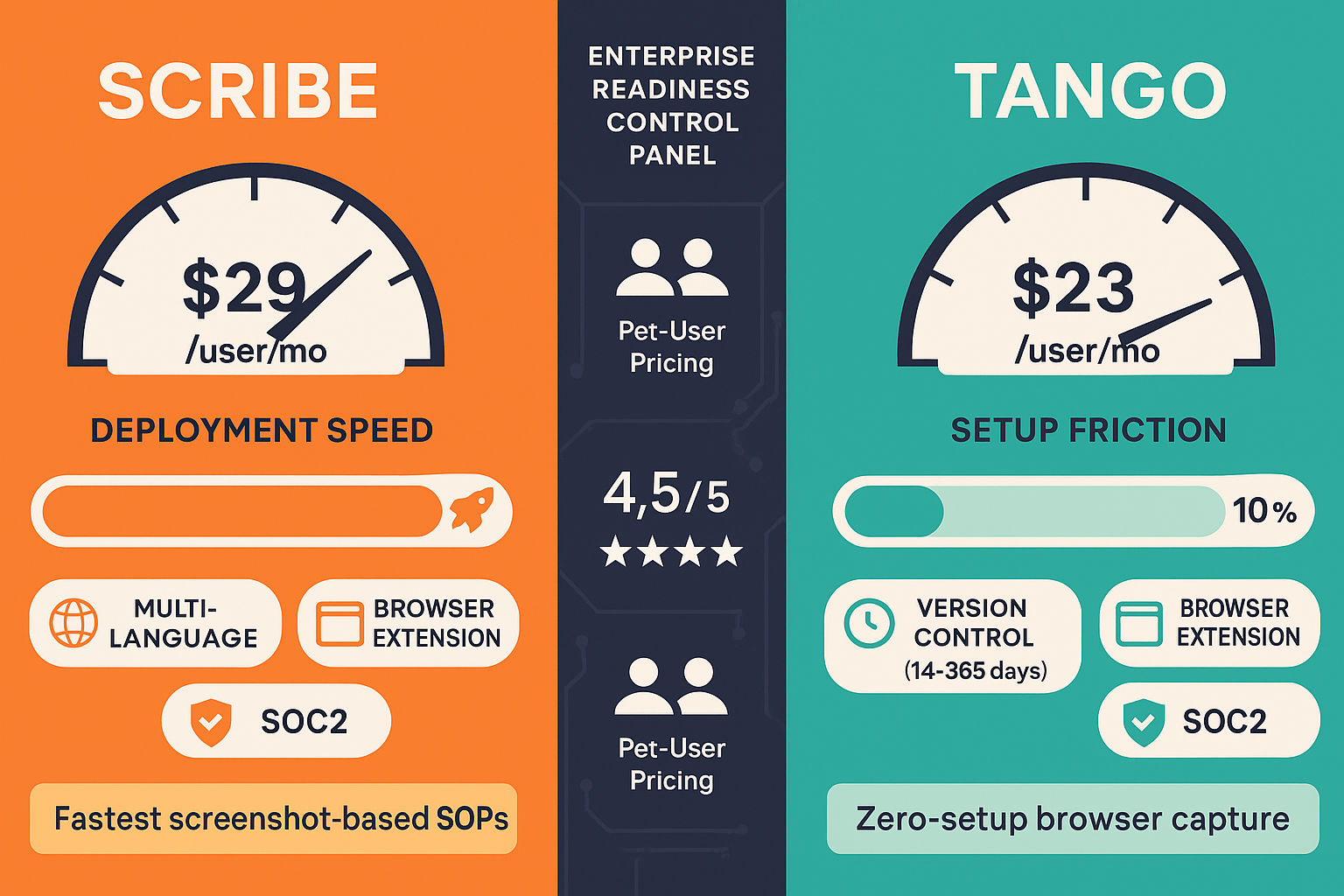
Both platforms use per-user pricing models that become expensive at enterprise scale. Scribe charges $15/user/month minimum (5 seats required), with Enterprise pricing reportedly $18,000+ annually. Tango charges $23-24/user/month on Pro plans with custom Enterprise pricing. Neither publishes uptime guarantees publicly—only Scribe mentions an Enterprise SLA without specific uptime percentages. Both platforms lack scalability features critical for large deployments including multi-tenant architecture for serving multiple clients or business units, API access for automation at scale, or custom domain support for branded delivery. The screenshot-only capture model limits both tools to browser-based documentation, creating scalability constraints when enterprises need to document physical processes, real-world training, or video content libraries.
Both platforms offer role-based access control for managing team permissions, but administrative capabilities remain limited compared to enterprise knowledge management platforms. Scribe provides no version control for published content, making content governance impossible. Tango offers minimal version history (14 days on Pro, 365 days on Enterprise), insufficient for regulated industries requiring indefinite audit trails. Neither platform provides granular permission controls beyond basic roles, audit logs for tracking administrative actions, or workflow automation capabilities. The lack of API access on both platforms prevents integration with enterprise SSO beyond SAML, custom provisioning workflows, or automated content publishing pipelines. For enterprises managing documentation across departments, regions, or client organizations, these administrative limitations create significant operational friction and compliance risks.
Both Scribe and Tango reserve dedicated support for Enterprise tier customers, leaving Pro and Team plan users with standard support channels. Scribe commits to an uptime SLA on Enterprise plans but doesn't publish specific percentages (industry standard is 99.9%). Tango provides no public SLA commitments at any tier, creating uncertainty for mission-critical documentation deployments. Neither platform offers 24/7 support, custom onboarding programs, or dedicated customer success managers as standard Enterprise features—these require negotiation during Enterprise sales cycles. The lack of API access and webhooks on both platforms means enterprises cannot build monitoring, alerting, or failover mechanisms for documentation systems. For organizations requiring guaranteed uptime, rapid incident response, or proactive support relationships, both platforms fall short of enterprise-grade service commitments without significant Enterprise contract investments.
Our Recommendation
Scribe and Tango both offer baseline enterprise security (SOC 2, GDPR, SSO) but lack critical capabilities for true enterprise readiness. Scribe edges ahead with HIPAA PHI redaction, IP whitelisting, and uptime SLA commitments. Tango offers longer version history (365 days vs. none) but provides no SLA guarantees. Both share fundamental limitations that restrict enterprise deployment.
Choose Scribe if you need...
Choose Tango if you need...
Choose Docsie if you need...
Winner: Docsie
For enterprises requiring true knowledge management capabilities beyond screenshot capture. Both Scribe and Tango are limited to internal browser workflow documentation with no video conversion, no multi-tenant delivery, no audit logs, no API access, and no data residency options. Docsie provides complete CONVERT → MANAGE → DELIVER infrastructure with enterprise-grade security, scalability to 10,000+ documentation sites, and the ability to serve multiple clients from one platform—addressing the critical gaps both competitors share while delivering superior enterprise readiness.
Common Questions
Q: Do Scribe and Tango provide audit logs for compliance?
A: No, neither Scribe nor Tango provides audit logs at any tier, including Enterprise plans. This is a critical gap for enterprises requiring security event monitoring, compliance reporting (SOC 2, ISO 27001), or forensic investigation capabilities. Audit logs are table-stakes for regulated industries and enterprise security teams.
Q: Can I host documentation for multiple clients with Scribe or Tango?
A: No. Neither platform supports multi-tenant architecture. Both are designed exclusively for internal team documentation, not customer-facing or multi-client delivery. You cannot create separate branded portals with custom domains for different clients, making both unsuitable for consultancies, implementation partners, or SaaS companies serving multiple customers.
Q: Do these tools offer data residency options for EU compliance?
A: No, neither Scribe nor Tango provides data residency options or EU-based data centers. For organizations with strict data sovereignty requirements under GDPR, HIPAA, or industry regulations requiring in-country data storage, this is a significant compliance barrier requiring legal review before deployment.
Q: Can Scribe or Tango convert existing training videos into documentation?
A: No. Both tools only capture new screen workflows through browser extensions—they cannot accept uploaded videos, training recordings, or any pre-existing video content. If you have libraries of training videos, product demos, or recorded sessions, neither platform can help convert that content into documentation.
Q: Is there a better alternative to both Scribe and Tango for enterprises?
A: Yes. Docsie addresses the fundamental limitations both tools share while providing superior enterprise readiness. Docsie converts any video (existing training libraries, screen recordings, real-world footage) into structured knowledge bases using multimodal AI, delivers them through multi-tenant branded portals, provides audit logs and EU data residency, offers API access for automation, and supports 100+ languages with auto-translation—all with SOC 2 Type II compliance and 99.9% uptime SLA.
Q: How does per-user pricing affect enterprise TCO compared to alternatives?
A: Both Scribe ($15/user minimum 5 seats) and Tango ($23-24/user) use per-seat pricing that scales linearly with team size. For a 100-person enterprise, annual costs reach $18,000-$28,800 before Enterprise tier premiums. Docsie uses workspace-based pricing ($199-$750/month for 15-90 users) with AI credits instead of per-seat fees, typically providing 40-60% lower TCO at enterprise scale while avoiding per-user inflation as teams grow.
Docsie delivers true enterprise knowledge orchestration with audit logs, multi-tenant portals, video-to-docs conversion, API access, EU data residency, and 99.9% uptime SLA—addressing the critical gaps both Scribe and Tango share while providing comprehensive documentation management for global enterprises.
No credit card required. Free AI credits to convert a 10-minute training video included. SOC 2 Type II and GDPR compliant.
Start creating professional documentation that your users will love