
4.8
on G2
 Screen Studio
 Zight
Zight
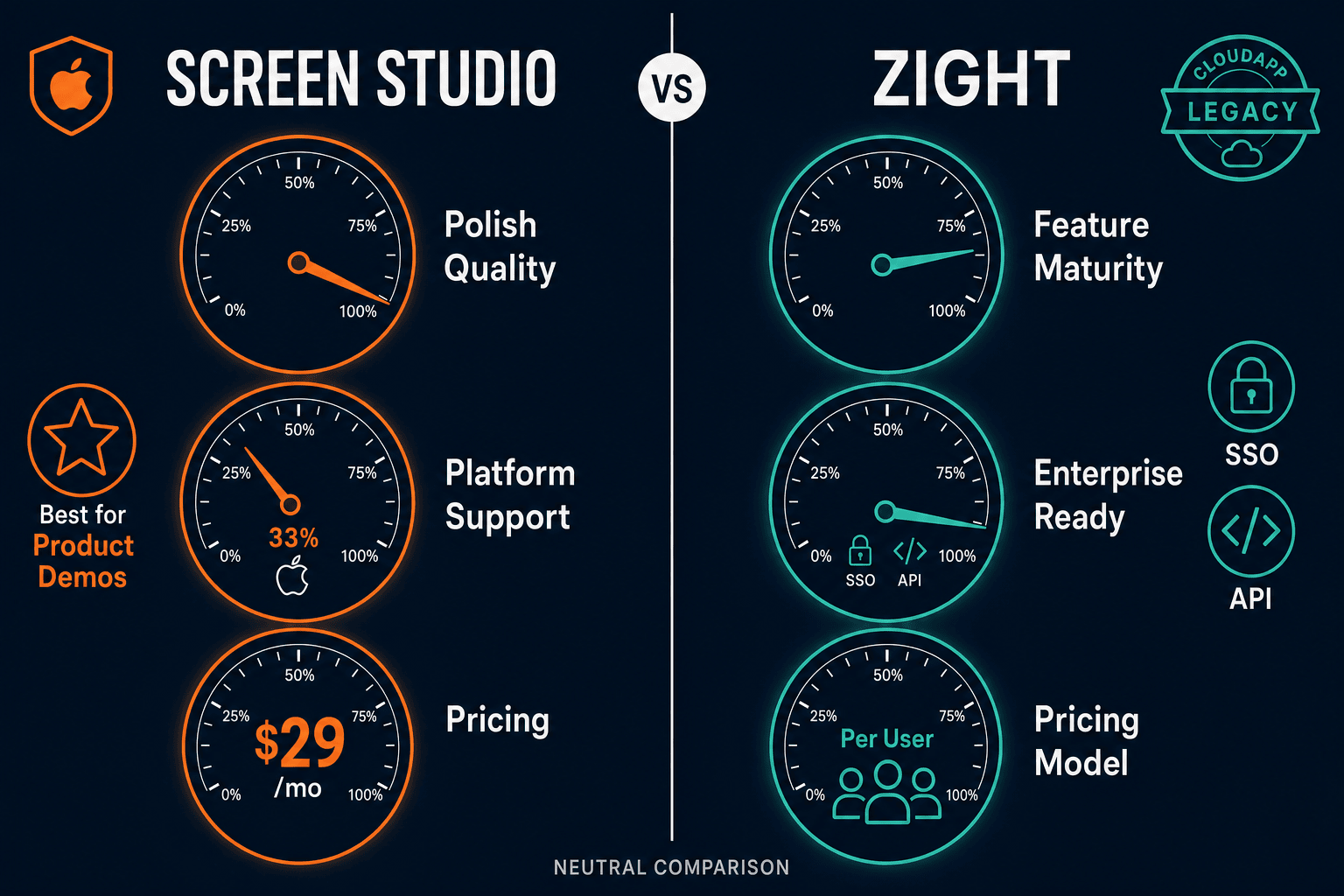
Screen Studio charges a flat subscription for a polished Mac-only recorder, while Zight uses per-user pricing across a free-to-enterprise tier stack. This page breaks down every plan, what you actually get at each price point, and whether either tool is worth the spend for your team.
Screen Studio wins on simplicity and visual quality for Mac users willing to commit annually, but it offers nothing for Windows teams and no path to documentation.
Feature Matrix
A side-by-side breakdown of features across pricing tiers to show exactly what each dollar buys you in Screen Studio and Zight.
| Feature / Plan Capability |
Screen Studio
|
Zight
|
|---|---|---|
| Free Plan Available | ||
| Starting Price (paid) | $9/month (billed yearly) | Per-user paid tier; verify on zight.com |
| Mac Support | ||
| Windows Support | ||
| Linux Support | ||
| Browser Extension | ||
| Screen Recording | ||
| Screenshot Capture | ||
| GIF Export | ||
| Webcam Overlay | ||
| Automatic Zoom & Cursor Polish | ||
| Annotations & Blur | ||
| AI Transcription | ||
| Team Workspace & Admin | Team plan and above | |
| Analytics & Reporting | Team plan and above | |
| SSO / SAML | Enterprise only | |
| Audit Logs | Enterprise only | |
| API Access | ||
| Integrations (Slack, Salesforce, Zendesk) | ||
| Video-to-Docs Conversion | ||
| Knowledge Base Publishing |
Pricing and features verified from public sources as of May 2026. Screen Studio pricing confirmed at $29/month or $9/month billed yearly. Zight Pro and Team exact per-user prices should be verified at zight.com before purchase. Neither tool converts recordings into structured documentation.
Strengths & Weaknesses
Deep Dive
A deeper look at the three pricing dimensions that matter most when choosing between these two tools.
Screen Studio's yearly plan at $9/month is genuinely competitive for a solo Mac user who records polished product demos frequently. The flat model means every feature is unlocked from day one with no upgrade friction. Zight's free tier provides real value for teams that only need lightweight screenshot and short recording sharing. However, once you move past free, Zight's per-user pricing multiplies costs quickly for teams of five or more, while Screen Studio's flat fee stays constant regardless of how many people share one account. For individual creators, Screen Studio's yearly plan wins on pure value. For growing teams already in a cross-platform environment, Zight's tiers offer more collaborative features at scale.
Screen Studio's pricing model does not scale with team size — it is a per-device Mac app with a single flat subscription. This is an advantage for solo users but a limitation for teams, since there are no shared workspaces, team libraries, or admin dashboards at any price point. Zight scales explicitly through its Free, Pro, Team, and Enterprise tiers, adding shared workspaces, analytics, and admin controls as you move up. The trade-off is that per-user fees compound: a ten-person team paying Zight's Pro rate spends significantly more than the same team paying Screen Studio's yearly flat fee. Enterprises requiring SSO and audit logs must move to Zight's custom Enterprise tier, where pricing is negotiated rather than published.
Screen Studio's biggest hidden cost is platform lock-in. If any team member uses Windows or Linux, they cannot participate in the workflow — forcing organizations to either standardize on Mac or pay for a second tool. There is no team account, so collaboration requires workarounds. Zight's hidden costs emerge at the enterprise tier: SSO, SAML, advanced security, and audit logs are all gated behind custom pricing. Teams that assume they can get enterprise compliance on a published plan will hit a paywall. Neither tool converts recordings into written documentation, meaning teams that need support articles, knowledge base content, or onboarding guides must pay separately for a documentation platform on top of either subscription.
Pricing Breakdown
Every published plan for both tools, side by side, with an honest look at what each tier actually delivers.
Screen Studio offers a simpler, flatter pricing model that rewards individual Mac creators who commit annually — $9/month with every feature unlocked is genuinely good value for that use case. Zight offers more pricing flexibility with a real free tier and a team-oriented tier stack, but per-user costs escalate quickly and enterprise security features require a custom contract. Neither tool publishes a team collaboration model that stays affordable at ten or more seats without trade-offs. Both tools also share a fundamental gap — neither converts recordings into written documentation, meaning any team that needs knowledge base content will pay for a second platform regardless of which recorder they choose.
Our Recommendation
Screen Studio wins on simplicity and visual quality for Mac users willing to commit annually, but it offers nothing for Windows teams and no path to documentation. Zight provides a genuine free tier and cross-platform reach with team collaboration features, but its per-user pricing model and enterprise-gated security features make it expensive at scale. Both tools are capable screen recorders that stop at video output — teams that need recordings to become support articles, onboarding guides, or knowledge base content will need to budget for a separate documentation platform on top of either subscription.
Choose Screen Studio if you need. .
Choose Zight if you need. .
Choose Docsie Recorder if you need. .
Winner: Docsie Recorder
Docsie Recorder eliminates the subscription cost entirely for the recording layer — the recorder is free and open-source — and then charges only AI credits for the Video-to-Docs conversions you actually run. This model beats Screen Studio's flat Mac-only fee and Zight's per-user escalation for any team that needs more than a video file. Once a recording is converted, Docsie's MANAGE and DELIVER layers handle versioning, multi-tenant portal publishing, translation, and compliance workflows, replacing both a recorder subscription and a separate documentation platform with a single unified pipeline.
Decision Helper
A direct framework for picking between Screen Studio, Zight, and Docsie based on your specific needs.
Polished Mac-only product demos with cinematic zoom and motion.
Screenshots, GIFs, and short videos for sharing.

Convert real video into searchable docs, then deploy multi-tenant portals.
Common Questions
Q: What is the cheapest way to use Screen Studio?
A: The cheapest published option is $9/month billed annually, which gives you every Screen Studio feature with no tier restrictions. The monthly plan is $29/month, which is significantly more expensive for regular users. There is no free plan, so you must pay to use the product. Verify current pricing at screen.studio before purchasing as SaaS prices change frequently.
Q: Does Zight have a genuinely usable free plan?
A: Zight does offer a free plan with real functionality including screen recording, screenshot capture, GIF creation, and cloud sharing. The free tier applies recording length and storage limits, which are appropriate for light individual use but will constrain teams with higher volume. Verify current free plan limits at zight.com since they are updated periodically.
Q: How does Screen Studio's pricing compare to Zight for a team of ten?
A: Screen Studio charges a flat per-device fee regardless of team size, but it has no shared workspace, team admin, or collaboration features — so ten people would need ten individual subscriptions or share workarounds. Zight's per-user Team plan scales linearly, adding shared workspace and admin controls but multiplying costs with each seat. For teams of ten, Zight's Team tier likely costs more in absolute terms but delivers actual collaboration features that Screen Studio does not offer at any price.
Q: Does either tool include enterprise security features on standard paid plans?
A: No. Screen Studio has no enterprise security features — no SSO, no audit logs, no role-based access — at any published price point. Zight gates SSO, SAML, audit logs, and advanced security behind its custom Enterprise tier. Teams with compliance requirements should factor in the cost of Zight Enterprise negotiations or evaluate whether a platform that includes these features on standard plans better fits their budget.
Q: Is there a better alternative to both Screen Studio and Zight for teams that need documentation?
A: Yes — Docsie Recorder is a free, open-source screen recorder that runs on Mac, Windows, and Linux, closing Screen Studio's Mac-only gap and Zight's per-user cost escalation simultaneously. More importantly, Docsie Recorder connects directly to Docsie's Video-to-Docs pipeline, turning a single recording into structured Markdown, DOCX, PDF, and knowledge base content. Teams that currently pay for a recorder and a separate documentation platform can consolidate into one workflow, paying only Docsie AI credits for conversions and using the recorder itself at no cost.
Q: Which tool is better value if I only record occasionally?
A: For occasional Mac users, Screen Studio's yearly plan at $9/month is hard to beat for the visual quality delivered. For occasional cross-platform users, Zight's free tier may be sufficient without any payment. If your recording sessions need to produce written documentation or support articles — even occasionally — neither tool will do that at any price, and adding a documentation platform on top makes the total cost of either subscription much higher than it appears on the pricing page.
Docsie Recorder is free, open-source, and works on Mac, Windows, and Linux. It records and edits locally, exports MP4 and GIF, and connects directly to Docsie's Video-to-Docs pipeline — turning your recordings into structured Markdown, DOCX, PDF, and knowledge base articles. No per-user fees, no Mac-only restrictions, and no need to pay for a separate documentation platform.
Recorder is free and open-source. Video-to-Docs conversion uses Docsie AI credits — estimate costs before you convert.