
4.8
on G2
 Screen Studio
 Whale
Whale
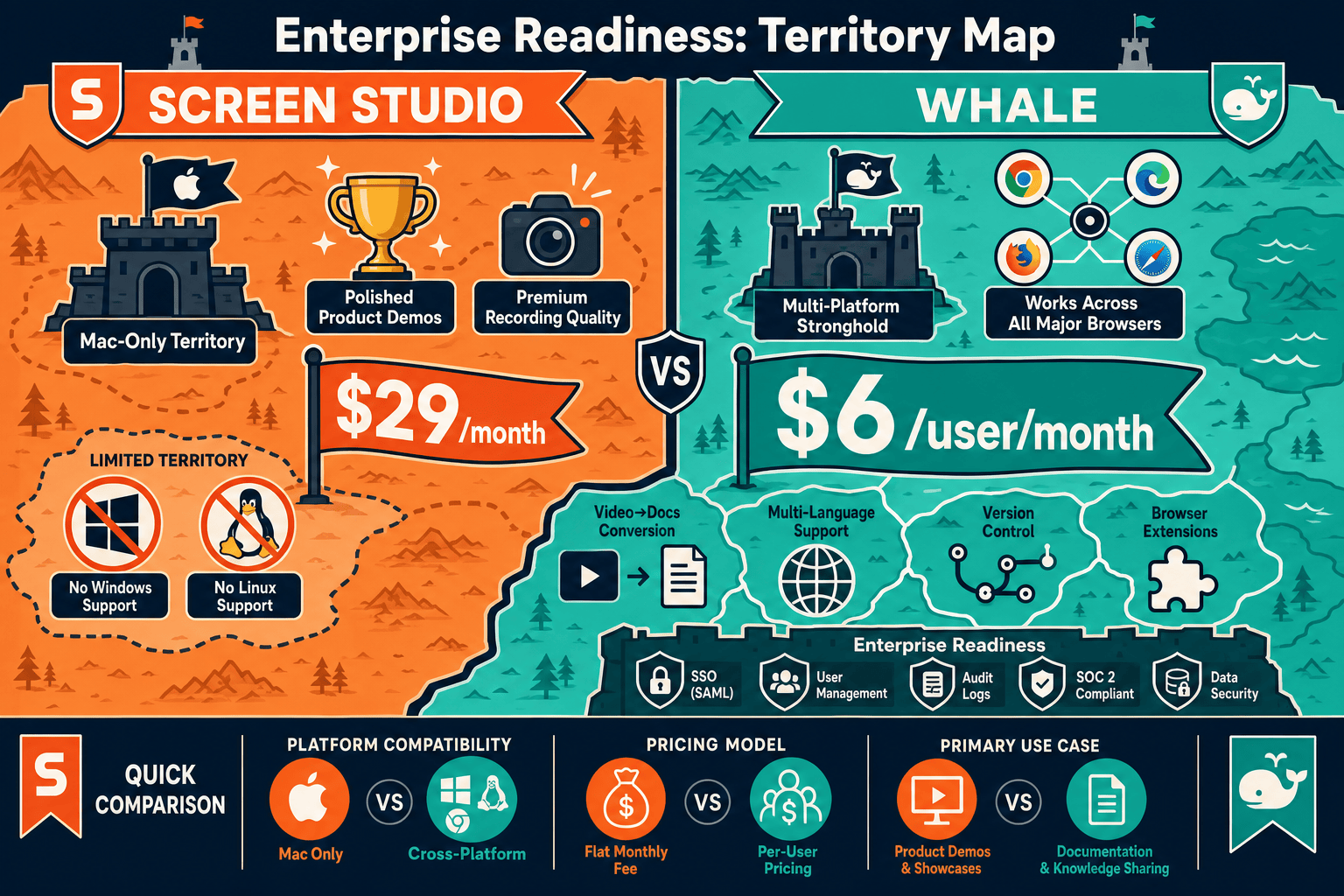
Screen Studio is a polished Mac screen recorder built for beautiful product demos, while Whale is an SOP and playbook platform aimed at small and mid-market teams. Neither was designed for enterprise scale. This comparison breaks down their security posture, compliance certifications, admin controls, and support tiers — then explains why Docsie Recorder is the stronger enterprise-ready alternative.
Screen Studio is a beautifully crafted Mac recorder for individual creators and small product teams — it is not enterprise software by any reasonable definition, lacking SSO, compliance certifications, team management, or a documentation output layer.
Enterprise Feature Matrix
A side-by-side comparison of enterprise-critical features including security, compliance, access control, scalability, and support across Screen Studio and Whale.
| Enterprise Feature |
Screen Studio
|
Whale
|
|---|---|---|
| SSO (SAML / OAuth) | Scale tier only | |
| Role-Based Access Control | ||
| Audit Logs | Scale tier only | |
| SOC 2 Type II | ||
| GDPR Compliance | ||
| HIPAA / ITAR-Compatible Deployment | ||
| Data Residency Options | ||
| On-Premise / Air-Gap Deployment | ||
| API Access | Scale tier only | |
| Multi-Tenant Portals | ||
| Custom Domain | ||
| Team / User Management | ||
| Advanced Permissions | Growth tier and above | |
| Dedicated Customer Success Manager | Scale tier only | |
| Uptime SLA | N/A (local Mac app) | Scale tier only |
| Windows & Linux Support | ||
| Version Control | ||
| Analytics & Reporting |
Data as of May 2026. Based on publicly available vendor documentation and pricing pages. Screen Studio pricing verified 2026-05-05. Whale Scale tier features reflect vendor-published plan details. Re-verify before publishing as SaaS plans change frequently.
Strengths & Weaknesses
Deep Dive
An in-depth analysis across four enterprise-critical dimensions — security and compliance, scalability and performance, administration and control, and support and SLA.
Whale holds a credible security baseline with SOC 2 Type II and GDPR compliance, plus SAML and Google SSO on its Scale tier — reasonable for mid-market buyers in non-regulated industries. Screen Studio has no published compliance certifications, no SSO support, and no audit trail of any kind, making it a non-starter for enterprise IT reviews. Neither tool offers HIPAA, ITAR, or finance-specific compliance modes, data residency options, or content compliance scanning. For regulated industries — healthcare, defense, financial services — both tools fall well short of enterprise security requirements.
Screen Studio is a local Mac application — it scales only as far as individual Mac users, with no centralized team infrastructure, no cloud management layer, and no Windows or Linux support. Whale's per-user pricing model scales linearly and becomes expensive quickly: a 100-user team on Scale exceeds $700/month, and a 500-user enterprise deployment has no self-serve path. Neither tool offers on-premise or air-gapped deployment. Whale's SOP-focused architecture was designed for 10–100 person teams running EOS®, not enterprise deployments requiring high availability, multi-region redundancy, or large-scale content delivery infrastructure.
Whale provides meaningful admin controls for its target market — role-based access control, team folders, advanced permissions on Growth and above, and audit logs on Scale. Screen Studio provides none of these; there is no team account structure, no user management, and no administrative dashboard. Whale's admin layer is genuinely useful for ops and HR teams standardizing SOPs, but it lacks the multi-tenant portal architecture, custom domain support, and content governance tooling that enterprise IT and documentation teams require. Both tools are missing compliance monitoring, content policy enforcement, and approval workflow management at scale.
Whale offers a dedicated Customer Success Manager and priority support on its Scale tier, with an uptime SLA attached to that plan — a reasonable offering for mid-market accounts. Screen Studio's support model is not enterprise-grade: the core product is a local Mac app with no published uptime SLA for shareable links hosting, no dedicated support tier, and no CSM program. For enterprise buyers who need guaranteed response times, named account support, and contractual uptime commitments, Whale clears a basic threshold at its top tier while Screen Studio does not meet enterprise support expectations at any tier.
Our Recommendation
Screen Studio is a beautifully crafted Mac recorder for individual creators and small product teams — it is not enterprise software by any reasonable definition, lacking SSO, compliance certifications, team management, or a documentation output layer. Whale is a genuine SOP platform with a credible security baseline for small and mid-market teams, but its per-user pricing model, SMB-first architecture, and absence of regulated-industry compliance make it a poor fit for enterprise deployments above 100 users or in regulated sectors.
Choose Screen Studio if you need. .
Choose Whale if you need. .
Choose Docsie Recorder if you need. .
Winner: Docsie Recorder
Docsie Recorder is the only option in this comparison that is free, open-source, and cross-platform at the recording layer — eliminating Screen Studio's Mac-only hard blocker — while connecting every recording to a full enterprise documentation pipeline that Whale cannot offer at scale. The downstream Docsie platform provides SSO, audit logs, multi-tenant portals, version control, compliance monitoring, and air-gapped deployment options, addressing every enterprise gap that Screen Studio ignores and every architectural ceiling that Whale hits at 100+ users or in regulated industries.
Decision Helper
A direct framework for picking between Screen Studio, Whale, and Docsie based on your specific needs.
Polished Mac-only product demos with cinematic zoom and motion.
SOP, training, and process documentation platform.

Convert real video into searchable docs, then deploy multi-tenant portals.
Common Questions
Q: Does Screen Studio meet enterprise security requirements?
A: No. Screen Studio has no published compliance certifications, no SSO support, no audit logs, and no role-based access control. It is a local Mac application designed for individual creators, not enterprise IT environments. Any organization running an enterprise security review — SOC 2, ISO 27001, or internal access control audits — will find Screen Studio fails to meet baseline requirements before the evaluation begins.
Q: Is Whale suitable for large enterprise deployments of 500 or more users?
A: Whale was designed for small to mid-market teams, typically 10–100 employees, and its per-user pricing reflects that. At 500 users on the Scale tier, costs escalate significantly with no self-serve enterprise tier and no on-premise or air-gapped deployment option. Whale also lacks regulated-industry compliance modes (HIPAA, ITAR) and multi-tenant customer portal delivery, which are common enterprise requirements. It is a strong mid-market SOP tool but not architected for large-scale enterprise deployment.
Q: Which tool offers better compliance for regulated industries like healthcare or finance?
A: Neither Screen Studio nor Whale supports HIPAA, ITAR, or finance-specific compliance modes. Whale holds SOC 2 Type II and GDPR certifications, which provide a credible baseline for general enterprise use, but it has no data residency options, no content compliance scanning, and no real-time policy monitoring. Screen Studio has no compliance certifications at all. For regulated industries, both tools require supplementation or replacement with a platform that has built-in compliance controls.
Q: Is there a better alternative to both Screen Studio and Whale for enterprise teams?
A: Yes — Docsie Recorder addresses the core gaps of both tools. Unlike Screen Studio, it is free, open-source, and runs on Mac, Windows, and Linux, removing the platform lock-in entirely. Unlike Whale, it connects recordings directly to an enterprise documentation platform with SSO, audit logs, multi-tenant portals, version control, compliance monitoring, and air-gapped deployment options. Docsie Recorder turns screen recordings into governed, versioned enterprise knowledge rather than stopping at a video file or a single-tenant SOP library.
Q: Can I use Screen Studio and Whale together to cover enterprise documentation needs?
A: In theory you could record with Screen Studio on Mac and upload videos into Whale's video-to-SOP converter. In practice, Screen Studio's Mac-only restriction means Windows and Linux team members are excluded, and Whale's per-user pricing and SMB architecture still apply. You would also inherit both tools' compliance gaps — no HIPAA, no data residency, no air-gap — and pay for two separate tools without solving the underlying enterprise readiness limitations.
Q: How does Docsie Recorder's pricing compare to Screen Studio and Whale for a 100-person enterprise team?
A: Screen Studio costs $29/month per user on monthly billing or roughly $9/month per user annually — for 100 Mac users that is $900 to $2,900 per month with no enterprise features included. Whale's Scale tier for 100 users runs $700 or more per month with enterprise features gated at the top tier. Docsie Recorder's core recording and editing layer is free and open-source with no per-seat cost, and Video-to-Docs conversion runs on Docsie AI credits. The Docsie platform's workspace-based pricing avoids the linear per-user cost inflation that makes both competitors expensive at enterprise scale.
Docsie Recorder gives your team a free, open-source cross-platform recorder — Mac, Windows, and Linux — that connects directly to an enterprise documentation pipeline with SSO, audit logs, multi-tenant portals, compliance monitoring, and air-gapped deployment. Record once, convert to structured docs, and deliver governed knowledge at enterprise scale. No Mac-only lock-in. No per-user pricing cliff.
Free recorder download is available. Docsie platform free trial includes AI credits for Video-to-Docs conversion.