
4.8
on G2
 Screen Studio
 Vmaker
Screen Studio offers polished Mac-only recording at a flat subscription price, while Vmaker targets cross-platform teams with a free tier and per-user scaling. This page breaks down every plan, what you get at each price point, and whether either tool delivers real value for teams that need more than a video file.
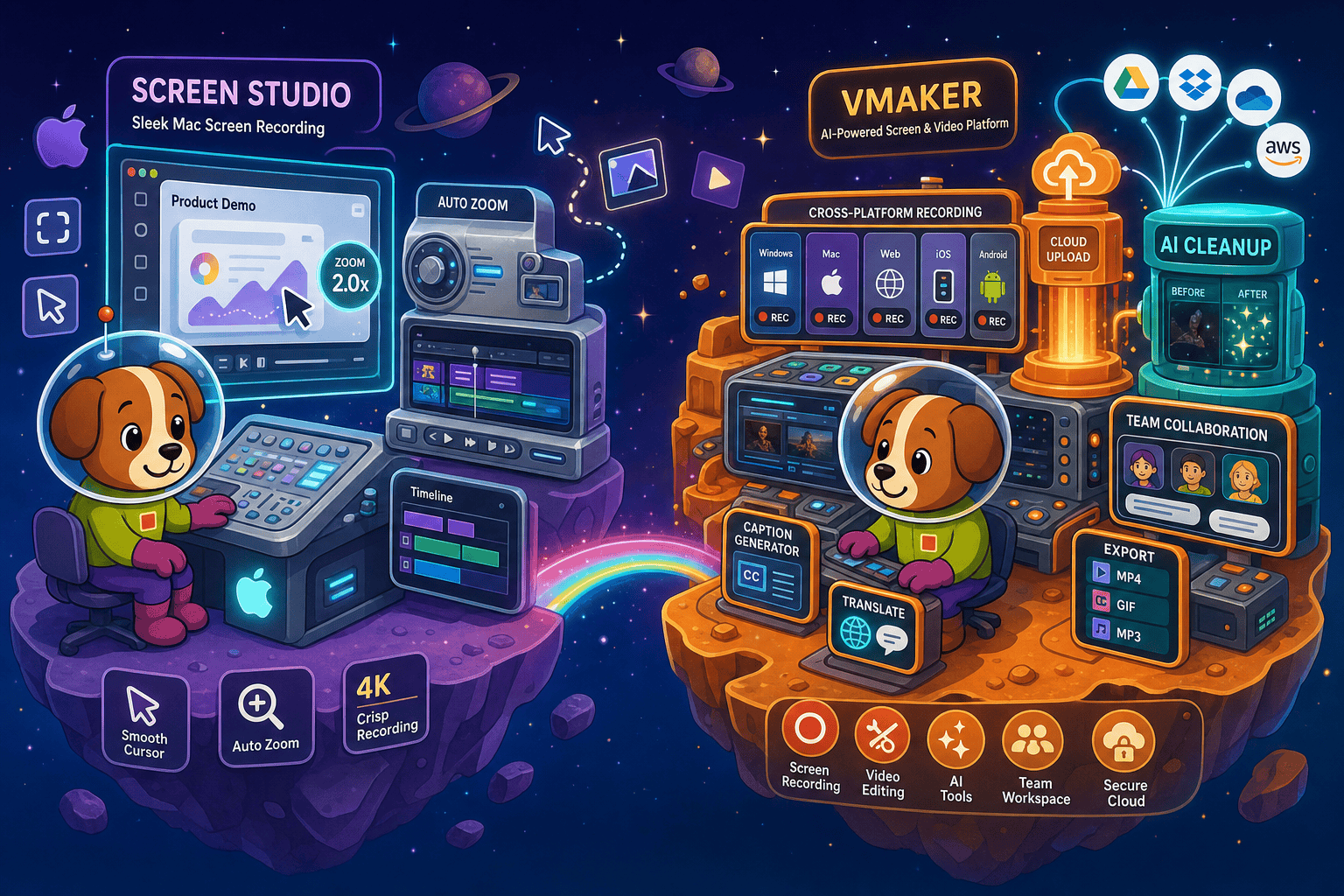
Screen Studio wins on visual quality and simplicity for Mac-only individuals, charging a flat $9/month yearly for every feature with no seat fees or collaboration overhead.
Feature Matrix
A detailed breakdown of recording features, editing capabilities, platform support, AI tools, and documentation outputs across both tools — so you know exactly what your money buys.
| Feature |
Screen Studio
|
Vmaker
|
|---|---|---|
| Free Plan Available | ||
| Starting Paid Price | $9/month (billed yearly) | Paid tier; verify current amount |
| Mac Support | ||
| Windows Support | ||
| Linux Support | ||
| Browser Extension | ||
| Mobile Recording | iOS device recording | |
| Webcam Overlay | ||
| System Audio Capture | ||
| Automatic Zoom & Cursor Polish | Verify current AI auto-zoom | |
| Backgrounds & Visual Effects | ||
| Crop, Trim & Speed Regions | ||
| AI Transcription & Captions | ||
| AI Video Cleanup | ||
| AI Summary | ||
| Team Workspace & Shared Library | ||
| Video Export (up to 4K 60fps) | ||
| GIF Export | ||
| Shareable Links | ||
| Analytics & Viewer Insights | ||
| SSO / Enterprise Auth | Enterprise plan only | |
| Video-to-Docs Conversion | ||
| Knowledge Base Publishing | ||
| Open-Source Recorder |
Pricing and features verified from publicly available information as of May 2026. Screen Studio pricing sourced from official site on 2026-05-05. Vmaker free plan limits and paid tier amounts should be verified against the live Vmaker pricing page before making a purchasing decision.
Strengths & Weaknesses
Deep Dive
An in-depth look at value for money, scalability costs, and hidden limitations — the three factors that matter most when choosing between these two pricing models.
Screen Studio's $9/month yearly plan is genuinely good value for a solo Mac user who needs polished marketing videos. You get every feature — 4K export, automatic zoom, backgrounds, GIF export, iOS recording — with no seat caps or feature gating. Vmaker's free plan sounds appealing but the watermark and storage limits make it impractical for professional output. At its paid tiers, Vmaker adds AI cleanup and team tools that Screen Studio lacks entirely, but the per-user structure means value erodes as your headcount grows. For individuals, Screen Studio wins on polish per dollar. For teams needing collaboration, Vmaker's structure is more appropriate even if the cost climbs.
Screen Studio's pricing is simple and flat — one person or ten people sharing one license pays the same monthly rate with no per-seat overhead. However, it has no team workspace, shared library, or collaborative features, so "scaling" simply means more people using separate accounts. Vmaker charges per user, which is the standard SaaS model but introduces meaningful cost growth. A team of ten on a paid Vmaker tier pays ten times the individual rate. The Teams plan adds admin controls and shared libraries that justify some of that cost, but buyers should calculate their total annual spend at realistic team sizes before committing to the per-user model.
Screen Studio's biggest hidden cost is platform lock-in — if any team member uses Windows or Linux, they need a completely different tool. That second tool purchase negates the apparent savings. Vmaker's hidden costs are subtler: the free plan's limits often force an immediate paid upgrade, and storage or export caps at lower tiers can create surprise overages. Neither tool has a path to written documentation, so teams that need knowledge base content from their recordings must pay for a separate documentation platform on top of their recorder subscription — a recurring cost that compounds over time and is easy to underestimate during initial budget planning.
Pricing Breakdown
Side-by-side breakdown of every available plan, what each tier includes, and how the total cost of ownership compares across individual users and growing teams.
Screen Studio's yearly plan at $9/month is the cleaner deal for solo Mac users who prioritize visual polish and need no collaboration features. Vmaker's per-user model costs more at scale but delivers genuine team value through shared workspaces, AI cleanup, and cross-platform reach. Neither tool, however, solves the downstream documentation problem: both stop at a video file and leave teams paying separately for knowledge base software to turn those recordings into searchable, versioned written content.
Recommendation: If you only need polished Mac videos, Screen Studio's yearly plan is hard to beat. If you need cross-platform recording and team workflows, Vmaker is the more complete option. But if your team ultimately needs recordings to become structured documentation — Markdown, DOCX, PDF, or published knowledge base articles — both tools require additional spend on a separate documentation platform. Docsie Recorder solves this with a free open-source recorder that feeds directly into a Video-to-Docs pipeline, eliminating the second tool entirely.
Our Recommendation
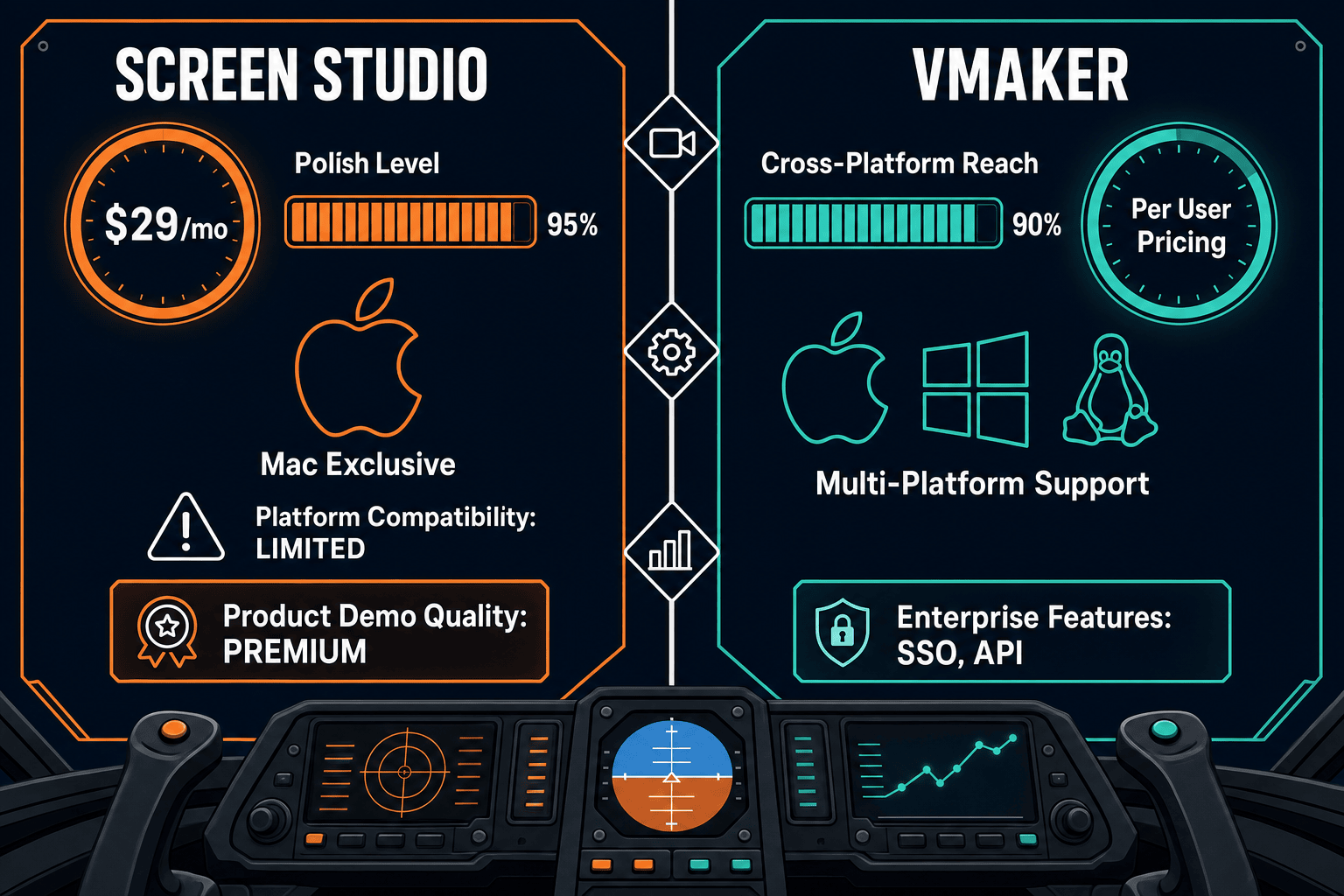
Screen Studio wins on visual quality and simplicity for Mac-only individuals, charging a flat $9/month yearly for every feature with no seat fees or collaboration overhead. Vmaker wins on breadth — cross-platform coverage, a free entry point, AI cleanup tools, and team workspaces — but the per-user pricing model compounds quickly and the free plan's practical limits push most users to a paid tier immediately. Both tools stop at video output and share the same critical gap: neither converts recordings into structured written documentation.
Choose Screen Studio if you need. .
Choose Vmaker if you need. .
Choose Docsie Recorder if you need. .
Winner: Docsie Recorder
Docsie Recorder is free and open-source, runs on Mac, Windows, and Linux, and delivers recorder-grade editing — zoom, backgrounds, trim, speed regions, annotations — with local MP4 and GIF export requiring no account or subscription. Where Screen Studio and Vmaker both stop at a video file, Docsie Recorder connects directly to the Video-to-Docs pipeline: one recording becomes structured Markdown, DOCX, or PDF content published into a versioned knowledge base with multi-tenant portal delivery. Teams that budget for a screen recorder plus a documentation platform will spend less and move faster with Docsie's unified CREATE-to-MANAGE workflow.
Decision Helper
A direct framework for picking between Screen Studio, Vmaker, and Docsie based on your specific needs.
Polished Mac-only product demos with cinematic zoom and motion.
Quick browser screen recording with annotations.

Convert real video into searchable docs, then deploy multi-tenant portals.
Common Questions
Q: Does Screen Studio have a free plan or free trial?
A: Screen Studio does not offer a permanent free plan. A downloadable version of the app may be available to try, but published pricing shows paid plans only — $29/month on a monthly basis or $9/month billed annually. Verify the current trial terms on the official Screen Studio site before making assumptions, as SaaS pricing and trial policies change frequently.
Q: Does Vmaker's free plan have real limitations or is it genuinely usable?
A: Vmaker's free plan is functional for testing but includes practical limits — typically a watermark on exports, storage caps, or resolution restrictions — that make it unsuitable for professional or customer-facing video production. Most teams find themselves upgrading to a paid tier quickly once they attempt to share a professional-quality recording. Verify the exact current limits on Vmaker's pricing page before relying on the free plan for team use.
Q: Which is cheaper for a team of five people?
A: Screen Studio does not have a native team workspace, so five people would each need an individual license — five times $9/month yearly equals approximately $540/year total, with no shared library or collaboration features. Vmaker's Teams plan charges per user and includes team workspace features, so the total cost depends on the current per-user rate multiplied by five. Check Vmaker's live pricing page for the exact per-user Teams amount and compare the two totals carefully, factoring in what collaboration features you actually need.
Q: Are there hidden costs with either tool?
A: Screen Studio's main hidden cost is platform exclusivity — Windows or Linux users on your team need an entirely separate recorder, which doubles your tooling spend. Vmaker's hidden costs include the free plan upgrade pressure and the recurring per-user fee growth as headcount increases. Both tools share a structural hidden cost — neither produces written documentation, so teams that need knowledge base content from recordings must also subscribe to a separate documentation platform, adding meaningful ongoing expense that neither tool's pricing page discloses.
Q: Is there a better alternative to both Screen Studio and Vmaker for teams that need documentation, not just video?
A: Yes — Docsie Recorder is a free, open-source screen recorder built for Mac, Windows, and Linux that records with professional-grade editing features (zoom, backgrounds, trim, speed regions, annotations) and exports MP4 and GIF locally at no cost. Unlike Screen Studio and Vmaker, it connects directly to Docsie's Video-to-Docs pipeline, turning a single recording into structured Markdown, DOCX, or PDF content published into a versioned knowledge base. Teams that currently pay for a screen recorder plus a documentation platform separately can consolidate both needs into one workflow without the per-user pricing pressure of Vmaker or the Mac-only limitation of Screen Studio.
Q: Can I use Screen Studio on Windows while some teammates use Vmaker on Windows?
A: Screen Studio is Mac-only and does not run on Windows, so Windows users on your team cannot use it at all. Vmaker runs on Windows, Mac, and via browser extension, making it the cross-platform choice for mixed-OS teams. If your team spans Mac and Windows, Vmaker is the only option of the two — or you can evaluate a cross-platform alternative like Docsie Recorder that covers Mac, Windows, and Linux under a single free open-source build.
Both Screen Studio and Vmaker produce polished videos — but neither converts recordings into structured documentation, neither is open-source, and neither connects to a knowledge base workflow. Docsie Recorder is a free, cross-platform, open-source recorder that does all three. Record on Mac, Windows, or Linux, export MP4 and GIF locally for free, then send the same recording through Docsie's Video-to-Docs pipeline to generate Markdown, DOCX, and PDF content published directly into a versioned, multi-tenant knowledge base — without paying for a second tool.
Docsie Recorder is free to download. AI credits are used only when you choose to convert a recording into documentation.