
4.8
on G2
 Screen Studio
 Tella
Tella
Screen Studio is the gold standard for polished Mac screen recordings, while Tella brings browser-based recording and AI document generation to cross-platform teams. Both are strong video tools — but neither gives you a full docs workflow. We compare every major feature and then show why Docsie Recorder is the stronger alternative for teams that need recordings to become structured documentation.
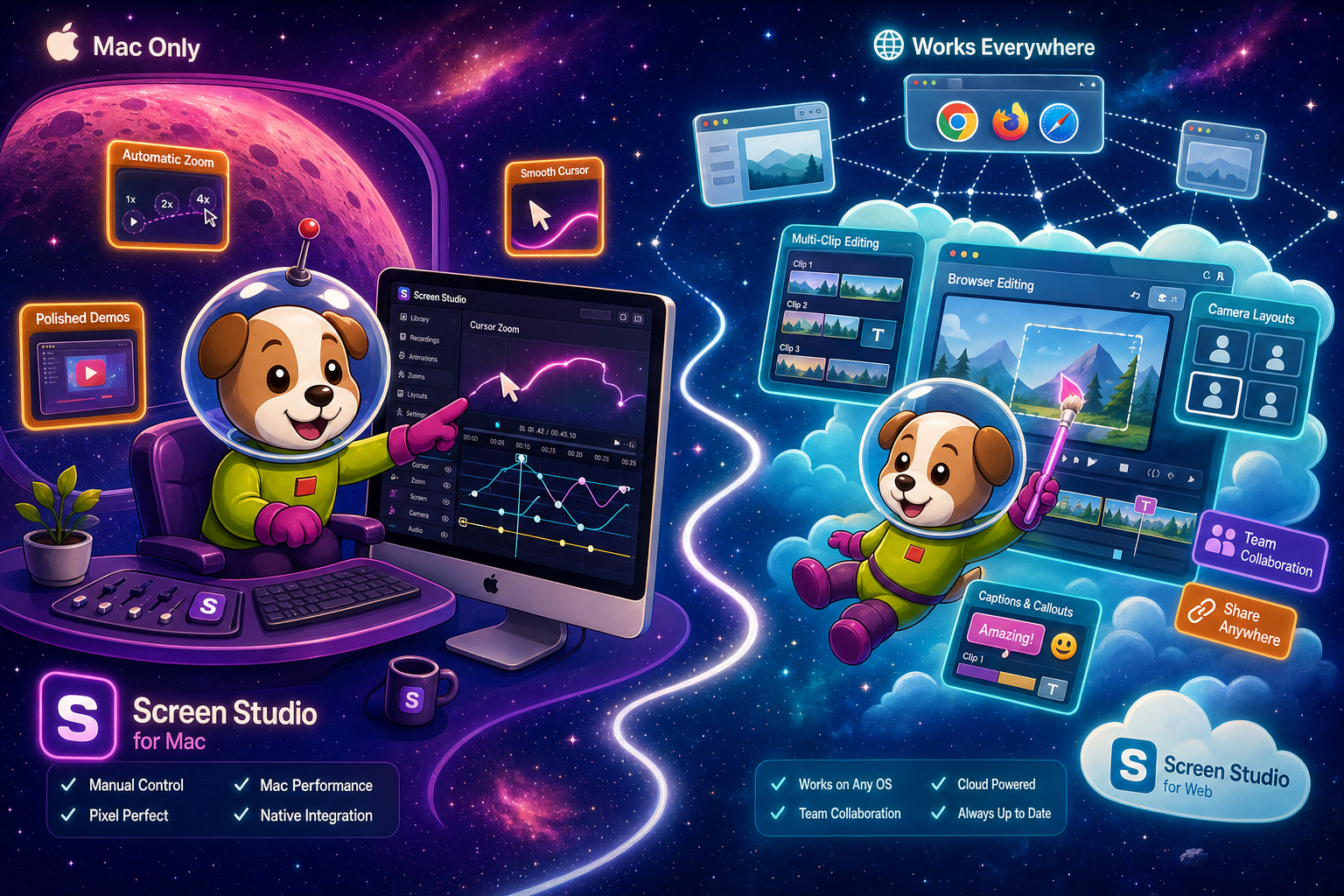
Screen Studio is the best choice for Mac users who need cinema-quality product demo videos with automatic zoom, motion blur, and cursor polish — and who do not need cross-platform support or documentation output.
Feature Matrix
A side-by-side comparison of recording capabilities, editing tools, platform support, video-to-docs features, and enterprise readiness across Screen Studio and Tella.
| Feature |
Screen Studio
|
Tella
|
|---|---|---|
| Free Plan | ||
| Starting Price | $9/month (billed yearly) | $0 (Free), $13/month (Pro) |
| Mac Support | ||
| Windows Support | ||
| Linux Support | ||
| Browser-Based Recording | ||
| Desktop App | Desktop helper workflow | |
| Open Source | ||
| Window & Full-Screen Capture | ||
| Webcam Overlay | ||
| Microphone Audio | ||
| System Audio | ||
| iOS Device Recording | ||
| Automatic Zoom | ||
| Manual Zoom (Timeline) | ||
| Cursor Smoothing & Polish | ||
| Backgrounds & Visual Effects | ||
| Motion Blur | ||
| Multi-Clip Editor | ||
| Crop, Trim & Speed Regions | ||
| Video Layouts | ||
| AI Transcription / Captions | ||
| AI Document Generation from Video | Premium plan | |
| Local MP4 Export (up to 4K) | Up to 4K 60fps | |
| GIF Export | ||
| Shareable Links | ||
| Team Collaboration | ||
| Analytics | ||
| Knowledge Base Publishing | ||
| Version Control | ||
| Markdown / DOCX / PDF Export | ||
| SSO | Enterprise only | |
| API Access |
Data as of May 2026. Features are based on publicly available information and vendor documentation. Verify current pricing and plan limits before purchasing.
Strengths & Weaknesses
Deep Dive
An in-depth look at the four dimensions that matter most when choosing between Screen Studio and Tella — recording quality, platform reach, video editing, and documentation output.
Screen Studio sets the bar for visual polish in Mac screen recording. Its automatic zoom tracks cursor focus without manual keyframes, cursor smoothing eliminates jitter, and motion blur adds cinematic depth that no browser-based tool currently matches. Tella offers automatic and manual zoom plus clean layouts and backgrounds, but it does not replicate Screen Studio's cursor telemetry or motion blur. For founders and creators who need marketing-grade demo videos on a Mac, Screen Studio's visual output is still the benchmark. Tella's polish is strong for a browser tool but trails on the fine-detail motion side.
This is where Tella wins decisively. Screen Studio is Mac-only — Windows and Linux users are completely locked out. Tella's browser-based recorder runs across all major operating systems without requiring a full desktop installation, making it the practical choice for cross-functional teams with mixed hardware. Tella also offers a free plan that removes financial friction for individual contributors and small teams evaluating the tool. Screen Studio requires a paid subscription from day one with no free tier currently offered. For distributed teams, Tella's platform reach is a hard requirement Screen Studio simply cannot meet.
Tella's multi-clip editor is a genuine differentiator. You can record multiple segments separately, arrange them in a timeline, switch between video layouts, and produce a final cut without leaving the browser — a workflow Screen Studio does not support. Screen Studio counters with deeper single-clip editing controls including speed regions, shadow and inset adjustments, manual zoom keyframes, and audio enhancement. Both tools offer crop and trim, but Screen Studio is optimized for refining one continuous recording to perfection, while Tella is built for assembling multi-take async content. The right fit depends on whether your workflow is single-take polish or multi-segment assembly.
Neither Screen Studio nor Tella was built to turn recordings into managed documentation. Screen Studio stops entirely at video and GIF output with no document generation whatsoever. Tella's AI document generation (Premium plan) is a meaningful step forward — it can produce a text summary from a video — but the output is not structured Markdown, DOCX, or PDF, and it does not connect to a versioned knowledge base, portal delivery system, or content management workflow. Teams that need a recording to become a searchable, versioned knowledge base article will find both tools incomplete. This is the gap that Docsie Recorder is specifically built to close.
Our Recommendation
Screen Studio is the best choice for Mac users who need cinema-quality product demo videos with automatic zoom, motion blur, and cursor polish — and who do not need cross-platform support or documentation output. Tella is the better all-rounder for cross-platform teams that want polished browser-based recording, multi-clip editing, team collaboration, and a stepping stone toward AI-generated content from videos. Neither tool, however, connects recordings to a structured documentation workflow, knowledge base, or versioned publishing pipeline.
Choose Screen Studio if you need. .
Choose Tella if you need. .
Choose Docsie Recorder if you need. .
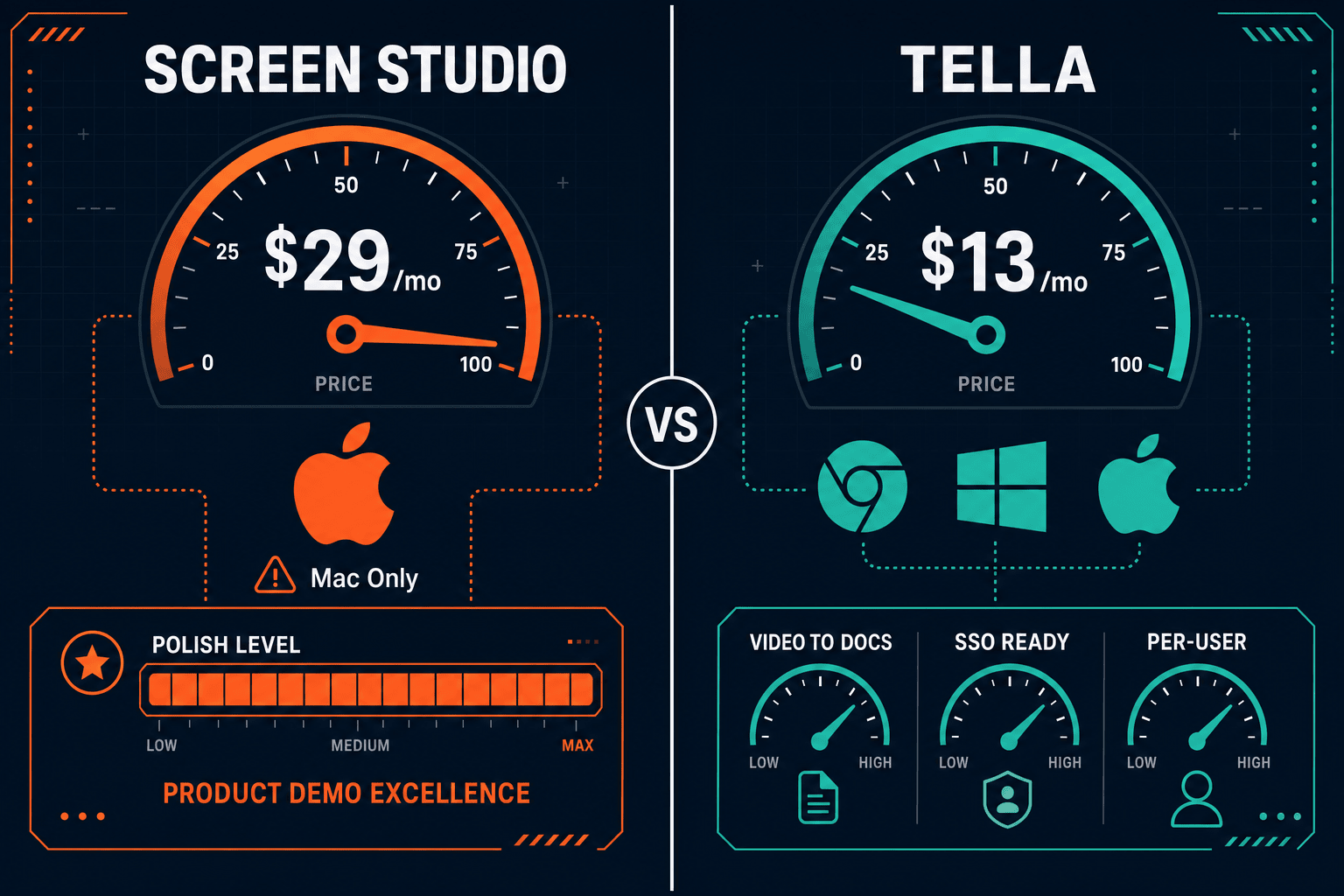
Winner: Docsie Recorder
Docsie Recorder is the only tool in this comparison that is free, open-source, cross-platform, and natively connected to a Video-to-Docs conversion pipeline and full knowledge base publishing workflow. Screen Studio excels at Mac video polish but stops at the video file. Tella adds cross-platform reach and AI document hints but still delivers isolated hosted videos rather than managed documentation. Docsie Recorder closes both gaps — it records and edits locally with zoom, crop, trim, speed regions, backgrounds, and annotations, then routes the recording directly into Docsie's CONVERT pipeline to generate structured docs that are versioned, searchable, and delivered through multi-tenant portals.
Decision Helper
A direct framework for picking between Screen Studio, Tella, and Docsie based on your specific needs.
Polished Mac-only product demos with cinematic zoom and motion.
Branded studio recordings with scenes and effects.

Convert real video into searchable docs, then deploy multi-tenant portals.
Common Questions
Q: Does Screen Studio work on Windows or Linux?
A: No. Screen Studio is a macOS-only application and requires macOS Ventura 13.1 or later. There is no Windows or Linux version. If your team uses mixed operating systems, Tella's browser-based recorder is a more practical option since it runs across Mac, Windows, and Linux without a platform restriction.
Q: Does Tella export documentation as Markdown, DOCX, or PDF?
A: No. Tella's AI document generation feature (available on the Premium plan) can produce a text summary from a video, but there is no native export to Markdown, DOCX, or PDF format. The output is primarily a hosted video with a generated text companion — not a structured document file you can import into a knowledge base or documentation platform.
Q: Which tool has better video editing — Screen Studio or Tella?
A: It depends on your workflow. Screen Studio offers deeper single-clip editing with motion blur, cursor smoothing, manual zoom keyframes, speed regions, and audio enhancement — making it the superior choice for refining one continuous recording to a polished finish. Tella offers a multi-clip editor with video layout switching, which is better suited for assembling multi-take async recordings. Neither tool is a full-featured video editor, but they each excel in their respective style.
Q: Is there a better alternative to both Screen Studio and Tella?
A: Yes — Docsie Recorder addresses the core limitation both tools share. Screen Studio and Tella both stop at video output; neither connects recordings to a structured documentation workflow. Docsie Recorder is a free, open-source desktop recorder for Mac, Windows, and Linux that records and edits locally with zoom, crop, trim, backgrounds, and annotations, then feeds recordings directly into Docsie's Video-to-Docs pipeline to generate Markdown, DOCX, and PDF and publish them into a versioned knowledge base. It is the only tool in this comparison that turns a screen recording into managed documentation.
Q: How do Screen Studio and Tella compare on pricing?
A: Screen Studio has no free plan and costs $29/month or $9/month billed annually. Tella offers a free tier with usage limits, a Pro plan from $13/month, and a Premium plan from $19/month. For budget-conscious teams or individuals wanting to evaluate before committing, Tella's free plan is a clear advantage. Docsie Recorder is free and open source with no subscription required for local recording and export.
Q: Which tool is better for team collaboration and async video?
A: Tella is the stronger choice for team workflows. It includes shared workspaces, role-based access control, team collaboration features, and analytics — none of which Screen Studio offers. Screen Studio is optimized for individual Mac creators producing polished solo recordings rather than team-based async communication workflows. If async team video is your primary use case, Tella is the more suitable option between the two.
Docsie Recorder is a free, open-source screen recorder for Mac, Windows, and Linux that does what neither Screen Studio nor Tella can — it turns your recordings into structured Markdown, DOCX, and PDF documentation and publishes them directly into a versioned knowledge base with multi-tenant portal delivery, SSO, and enterprise governance. Record once. Create docs. Publish everywhere.
Free and open source. No subscription required to record, edit, and export video locally.