
4.8
on G2
 Screen Studio
 ScreenApp
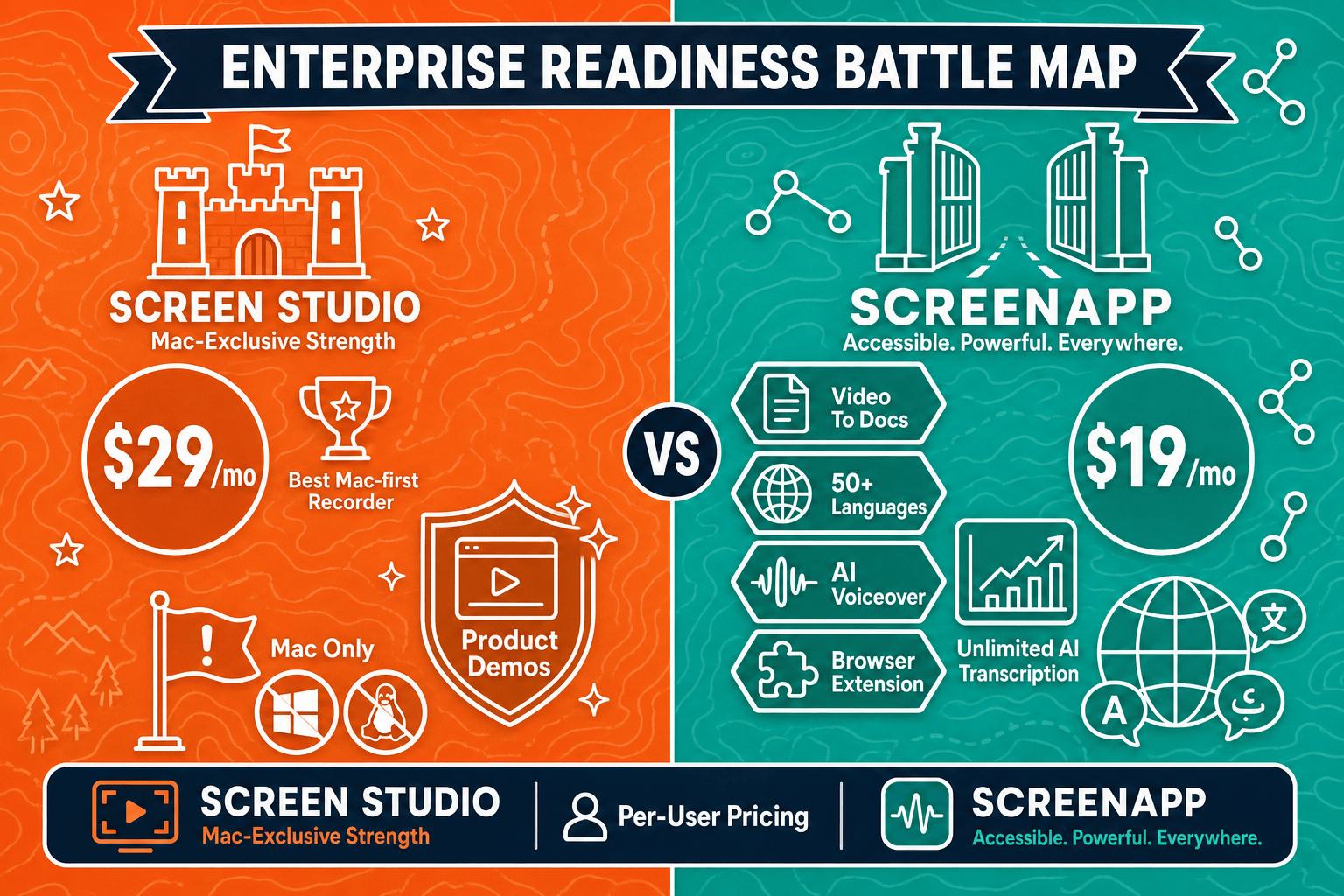
Screen Studio is a polished Mac-only recorder loved by creators but built without enterprise infrastructure. ScreenApp adds SOC 2 and SAML SSO at its Enterprise tier but remains a point tool without knowledge base management, audit trails at scale, or air-gapped deployment. This page compares both honestly — and then shows why Docsie Recorder is the more enterprise-ready alternative for teams that need recordings to become governed, versioned documentation.
Screen Studio is not enterprise-ready by any standard measure — it is a Mac-only prosumer recorder with no compliance, no SSO, no audit logs, and no team administration.
Enterprise Feature Matrix
A side-by-side look at the enterprise capabilities that matter most to IT, security, and documentation teams evaluating these two tools.
| Enterprise Capability |
Screen Studio
|
ScreenApp
|
|---|---|---|
| Free Plan Available | ||
| Windows & Linux Support | ||
| SSO / SAML Support | Enterprise only (SAML) | |
| Role-Based Access Control | Business+ tier | |
| Audit Logs | Enterprise only | |
| SOC 2 Type II | ||
| GDPR Compliance | ||
| HIPAA / ITAR Compliance | ||
| Data Residency Options | ||
| On-Premises / Air-Gap Deployment | ||
| API Access | Business+ tier | |
| Dedicated Support / Success Manager | Enterprise only | |
| Uptime SLA | Not applicable (local app) | Enterprise tier only |
| Team Administration Console | Business+ tier | |
| Video-to-Docs Export | ||
| Knowledge Base Management | ||
| Version Control for Docs | ||
| Multi-Tenant Portals | ||
| Custom Domain | ||
| Enterprise Pricing Entry Point | No enterprise tier | $199/month |
Data as of May 2026. Based on publicly available vendor documentation and pricing pages. Screen Studio enterprise features verified at screen.studio; ScreenApp enterprise features verified at screenapp.io. Re-verify before publishing as pricing and features change frequently.
Strengths & Weaknesses
Deep Dive
A four-category analysis of enterprise readiness across security and compliance, scalability, administration, and support.
Screen Studio has no compliance certifications whatsoever — no SOC 2, no GDPR controls, no audit logs, and no SSO. Its local-first recording model means data stays on device during capture, which is a narrow privacy advantage, but the shareable links infrastructure has no documented security controls for enterprise use. ScreenApp holds SOC 2 Type II and GDPR certifications and offers SAML SSO at its Enterprise tier. However, it lacks HIPAA, ITAR, data residency options, and on-premises deployment. Neither tool can serve regulated industries like healthcare, defense, or finance that require air-gapped infrastructure or industry-specific compliance frameworks.
Screen Studio is a local macOS application. There is no cloud infrastructure to scale, no uptime SLA for the app itself, and shareable link hosting has no documented performance guarantees. It is fundamentally a single-user tool with no team or org-level scalability story. ScreenApp offers unlimited recordings and users at its Enterprise tier with a dedicated success manager, positioning it as a scalable SaaS option. However, it lacks multi-region data residency, enterprise-grade CDN documentation delivery, and the content management scaffolding needed to grow a knowledge base alongside team size. Both tools stop at the recording and export layer without a platform to manage what comes after.
Screen Studio offers no administrative controls whatsoever — no team dashboard, no user provisioning, no role-based access, and no policy enforcement. Every user operates the Mac app independently. ScreenApp introduces team features at its Business tier and role-based access controls, with full administration and audit logs reserved for the Enterprise tier. This gives IT teams a baseline management layer, but it lacks the granular permission models, approval workflows, content governance, and provisioning integrations (SCIM) that enterprise documentation platforms provide. Neither tool offers version control over produced content or multi-tenant delivery of documentation to external audiences.
Screen Studio does not offer dedicated enterprise support, a named success manager, or a formal SLA. Support is self-serve, which is typical for a prosumer Mac application but problematic for enterprise procurement. ScreenApp provides a dedicated success manager and enterprise SLA at its $199/month+ Enterprise tier, which is a genuine differentiator over Screen Studio. That said, ScreenApp's Enterprise package is custom-quoted, meaning SLA terms, response times, and escalation paths must be negotiated rather than being transparently published. For enterprise procurement teams with formal vendor assessment requirements, ScreenApp clears a higher bar than Screen Studio, but neither tool offers the transparent, documented enterprise support contracts that regulated organizations typically require.
Our Recommendation
Screen Studio is not enterprise-ready by any standard measure — it is a Mac-only prosumer recorder with no compliance, no SSO, no audit logs, and no team administration. ScreenApp is meaningfully more enterprise-ready with SOC 2 Type II, GDPR, SAML SSO, and dedicated support at its $199/month Enterprise tier, but it remains a point tool without knowledge base governance, data residency, air-gapped deployment, or documentation lifecycle management. Both tools leave enterprise teams with a recording that has nowhere governed to go.
Choose Screen Studio if you need. .
Choose ScreenApp if you need. .
Choose Docsie Recorder if you need. .
Winner: Docsie Recorder
Docsie Recorder is the only option in this comparison that pairs a free, open-source cross-platform recorder with an enterprise knowledge management platform behind it. Where Screen Studio stops at a video file and ScreenApp stops at a basic document export, Docsie routes every recording through a Video-to-Docs pipeline that produces versioned, searchable Markdown, DOCX, and PDF content published into multi-tenant portals with SSO, audit logs, role-based access, and compliance monitoring. For enterprise teams that need recordings to become auditable, governed documentation — not just shareable links or AI summaries — Docsie Recorder delivers the complete workflow that neither competitor can offer.
Decision Helper
A direct framework for picking between Screen Studio, ScreenApp, and Docsie based on your specific needs.
Polished Mac-only product demos with cinematic zoom and motion.
Online recorder + AI transcription and summaries.

Convert real video into searchable docs, then deploy multi-tenant portals.
Common Questions
Q: Does Screen Studio have SOC 2 or GDPR compliance?
A: No. Screen Studio has no published compliance certifications — no SOC 2, no GDPR controls, no audit logs, and no SSO of any kind. It is a Mac desktop application designed for individual creators and small teams, not for enterprise procurement. Organizations with formal vendor security assessment requirements will not be able to complete a vendor review for Screen Studio.
Q: Is ScreenApp SOC 2 certified and does it support SAML SSO?
A: Yes, ScreenApp holds SOC 2 Type II certification and GDPR compliance, making it a viable candidate for many enterprise vendor assessments. SAML SSO is available, but only at the Enterprise tier which starts at $199/month and is custom-quoted. Audit logs are also gated to the Enterprise tier. Teams on lower-tier plans will not have SSO or audit trail access.
Q: Can either tool support air-gapped or on-premises deployment for regulated industries?
A: Neither Screen Studio nor ScreenApp supports on-premises or air-gapped deployment. Screen Studio is a local Mac app for recording but relies on cloud infrastructure for shareable links with no documented security controls. ScreenApp is a cloud-only SaaS product with no self-hosted or private cloud option. Regulated industries requiring air-gapped infrastructure — such as defense, government, or healthcare — cannot deploy either tool in a fully isolated environment.
Q: Is there a better alternative to both Screen Studio and ScreenApp for enterprise teams?
A: Yes — Docsie Recorder addresses the core gap both tools share. Screen Studio stops at video output with no enterprise controls, and ScreenApp provides basic compliance but no documentation governance or knowledge base management. Docsie Recorder is a free, open-source cross-platform recorder that routes recordings directly into Docsie's enterprise knowledge platform, giving teams versioned documentation, SSO, audit logs, multi-tenant portal delivery, and compliance monitoring in a single workflow. It is the only option in this comparison that connects the recording to a governed documentation lifecycle.
Q: Which tool is better for a Windows or Linux enterprise environment?
A: ScreenApp is the clear winner here — Screen Studio is Mac-only and cannot be deployed on Windows or Linux at all. ScreenApp's browser-based recorder, Chrome extension, and mobile app work cross-platform. However, if your enterprise needs a desktop recorder application with local-first capture on Windows and Linux, neither tool fully serves that need. Docsie Recorder provides native Mac, Windows, and Linux desktop builds as a free open-source alternative.
Q: How do Screen Studio and ScreenApp handle documentation management after recording?
A: Neither tool manages documentation in any meaningful enterprise sense. Screen Studio produces a video file or shareable link — there is no document output, no version control, and no knowledge base. ScreenApp exports AI-generated Word, PDF, Markdown, and TXT documents, which is a useful step forward, but these are standalone files with no versioning, governance, or publishing workflow. Enterprise teams still need a separate documentation platform to manage, update, and deliver that content. Docsie Recorder solves this by feeding recordings directly into Docsie's full documentation management and portal delivery platform.
Docsie Recorder gives enterprise teams a free, open-source cross-platform recorder that does what neither Screen Studio nor ScreenApp can — turn recordings into versioned, governed documentation published through multi-tenant portals with SSO, audit logs, and compliance monitoring. Record on Mac, Windows, or Linux. Convert to structured docs. Publish to a knowledge base your enterprise can actually govern.
Free to record and export. Video-to-Docs conversion uses Docsie AI credits.