
4.8
on G2
 Screen Studio
 RecordIt
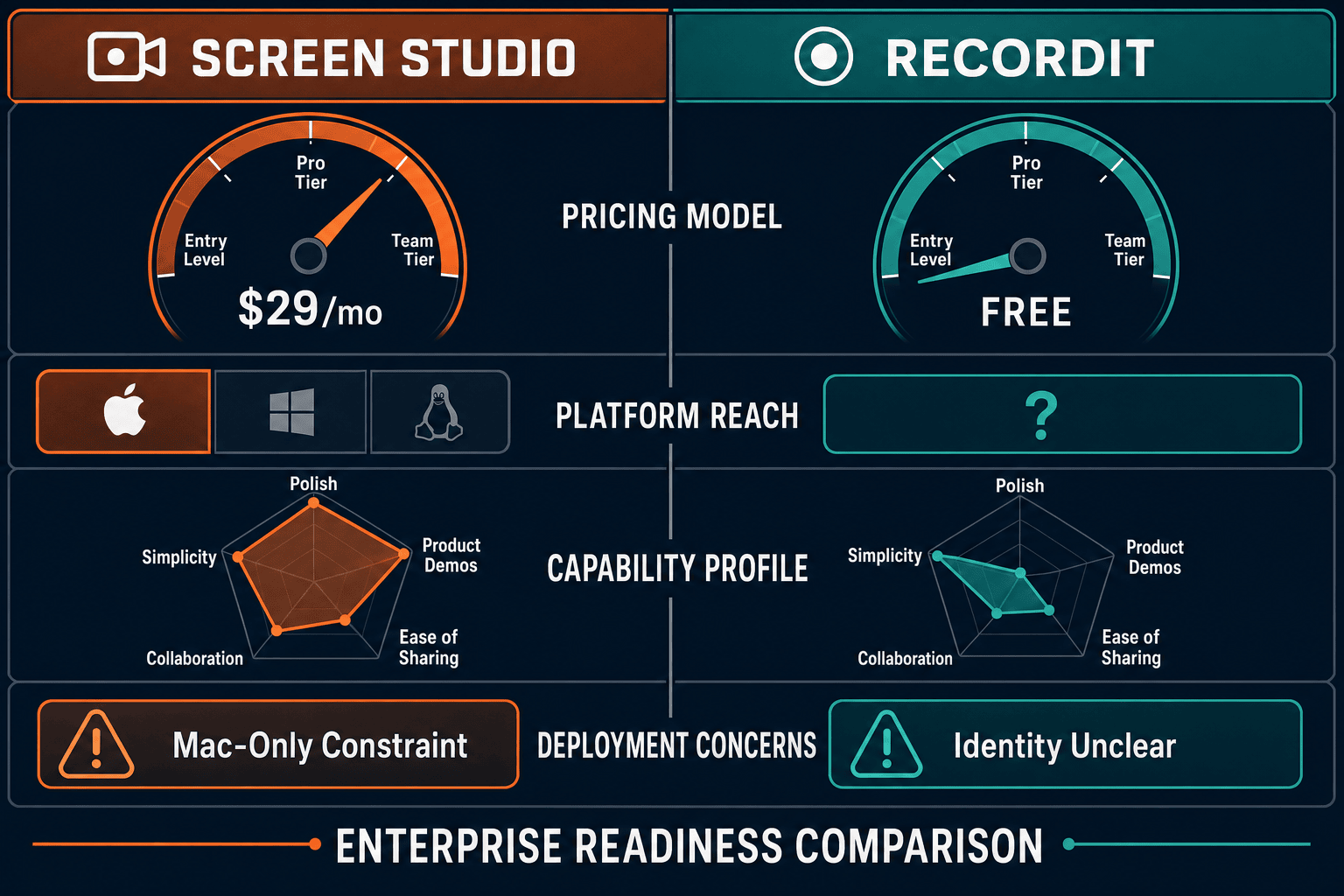
Screen Studio is a polished Mac-only screen recorder built for beautiful product demos. RecordIt is a lightweight free recorder aimed at debugging and quick sharing. Neither was designed for enterprise deployment. This comparison evaluates both tools across security, compliance, administration, and support — and then recommends a better path for enterprise teams.
Screen Studio is a genuinely excellent Mac recorder for individual creators and product teams who prioritize visual polish — but it is not an enterprise tool.
Enterprise Feature Matrix
A head-to-head comparison of enterprise-critical capabilities across security, compliance, administration, scalability, and support for Screen Studio and RecordIt.
| Enterprise Capability |
Screen Studio
|
RecordIt
|
|---|---|---|
| Free Plan Available | ||
| Cross-Platform Support (Mac/Win/Linux) | Mac only | Verify |
| SSO (SAML / OAuth / OIDC) | ||
| Role-Based Access Control | ||
| Audit Logs | ||
| Data Residency Options | ||
| SOC 2 Compliance | ||
| GDPR Compliance | Not stated | Not stated |
| HIPAA Readiness | ||
| Uptime SLA | N/A (local app) | Not published |
| Dedicated Enterprise Support | ||
| Admin Dashboard / Console | ||
| Team / Multi-User Management | ||
| API Access | ||
| Custom Domain | ||
| Video-to-Docs Conversion | ||
| Knowledge Base Publishing | ||
| Open Source |
Data as of May 2026. Based on publicly available information and vendor documentation. RecordIt product identity is partially unverified — confirm canonical product details before making procurement decisions.
Strengths & Weaknesses
Deep Dive Analysis
An in-depth look at how Screen Studio and RecordIt perform across the four enterprise readiness dimensions that matter most to IT, security, and documentation teams.
Screen Studio is a local Mac application — recordings stay on device during capture, which is a genuine privacy advantage. However, shareable links route through Screen Studio's cloud infrastructure with no published SLA, SOC 2, GDPR, or HIPAA documentation. RecordIt similarly lacks any published compliance certifications or security architecture documentation. Neither tool offers data residency controls, encryption-at-rest guarantees, or compliance audit trails. Enterprise security teams evaluating either tool will find no formal compliance posture to review, making both unsuitable for regulated industries without significant additional controls.
Screen Studio performs well for individual Mac users creating polished recordings locally — there is no server-side processing bottleneck for the recording and editing workflow. However, it is entirely single-user, with no team workspaces, shared libraries, or content management at scale. RecordIt's cloud sharing model introduces dependency on an external service with no published uptime guarantees. Neither tool has demonstrated architecture for enterprise-scale deployment — no multi-tenant support, no content delivery network documentation, and no stated capacity limits or performance benchmarks for teams larger than a handful of individual users.
Enterprise IT teams require centralized user provisioning, role-based permissions, and administrative visibility into how tools are used. Screen Studio offers none of these — there is no admin console, no team license management, and no usage reporting. RecordIt similarly provides no published admin controls or multi-user management features. Without SSO integration, teams cannot enforce corporate identity policies or automate deprovisioning when employees leave. The absence of audit logs in both tools means there is no record of who recorded what, when, or where recordings were shared — a critical gap for governance and compliance teams.
Screen Studio is a commercial product at $29/month (or $9/month billed annually), but does not publish enterprise support tiers, dedicated account management, or contractual SLA commitments. Support appears to be community or email-based. RecordIt is free with no stated support model at all, making enterprise-grade support effectively unavailable. Neither tool offers the professional services, implementation support, or named account management that enterprise procurement teams typically require. For organizations that need a vendor relationship backed by contractual obligations, both tools fall well short of enterprise support expectations.
Our Recommendation
Screen Studio is a genuinely excellent Mac recorder for individual creators and product teams who prioritize visual polish — but it is not an enterprise tool. RecordIt is a useful lightweight recorder for debugging and quick sharing, but its product identity is still unverified and its enterprise capabilities are essentially nonexistent. Both tools share the same fundamental enterprise gap — no SSO, no compliance certifications, no audit logs, no admin controls, and no documentation output workflow. Choosing between them for enterprise use is choosing between two consumer-grade tools.
Choose Screen Studio if you need. .
Choose RecordIt if you need. .
Choose Docsie Recorder if you need. .
Winner: Docsie Recorder
Docsie Recorder is the only tool in this comparison that bridges the gap between a capable free recorder and an enterprise-ready documentation platform. The MIT-licensed recorder core gives teams a cross-platform, auditable alternative to Screen Studio's Mac-only closed-source app. More importantly, Docsie Recorder connects directly to the Video-to-Docs pipeline — recordings become structured documentation published into a knowledge base with version control, multi-tenant delivery, SSO, and compliance-ready infrastructure. Where Screen Studio stops at a polished video file and RecordIt stops at a debug clip, Docsie Recorder starts a CREATE → CONVERT → MANAGE → DELIVER workflow that scales to enterprise documentation needs.
Decision Helper
A direct framework for picking between Screen Studio, RecordIt, and Docsie based on your specific needs.
Polished Mac-only product demos with cinematic zoom and motion.
Quick GIF screen captures with instant share links.

Convert real video into searchable docs, then deploy multi-tenant portals.
Common Questions
Q: Does Screen Studio support SSO for enterprise teams?
A: No. Screen Studio does not offer SSO integration of any kind — no SAML, OAuth, OIDC, Azure AD, or Okta support is documented. This means enterprise IT teams cannot enforce corporate identity policies or automate user provisioning and deprovisioning through Screen Studio. Teams requiring SSO for compliance or IT governance will need to look at a different tool.
Q: Is RecordIt compliant with SOC 2, GDPR, or HIPAA?
A: RecordIt does not publish any compliance certifications or security architecture documentation. Given that the product's canonical identity (recordit.co vs recordit.dev) is itself unverified, there is no reliable compliance posture to evaluate. Regulated industries should not rely on RecordIt for workflows involving sensitive data until formal compliance documentation is published and independently verified.
Q: Can either Screen Studio or RecordIt generate audit logs for enterprise governance?
A: Neither Screen Studio nor RecordIt provides audit logs. There is no record of who recorded what, when recordings were shared, or where recorded content was distributed. This is a critical gap for enterprise governance, security incident response, and compliance workflows. Organizations in regulated industries — healthcare, finance, legal — should treat the absence of audit logs as a disqualifying limitation.
Q: Is there a better alternative to both Screen Studio and RecordIt for enterprise teams?
A: Yes — Docsie Recorder is the most enterprise-capable alternative in this category. It is a free, open-source desktop recorder that runs on Mac, Windows, and Linux, making it viable for mixed-platform enterprise environments where Screen Studio's Mac-only limitation is a dealbreaker. More importantly, Docsie Recorder connects directly to Docsie's Video-to-Docs pipeline, converting recordings into structured documentation published into a knowledge base with SSO, audit logs, role-based access control, version control, and multi-tenant portals — the full enterprise documentation stack that neither Screen Studio nor RecordIt provides.
Q: Which tool is better for a team that includes both Mac and Windows users?
A: RecordIt is the only one of the two that could potentially support non-Mac users, though its cross-platform support is unverified. Screen Studio is strictly Mac-only and will not work on Windows or Linux at all. For truly cross-platform enterprise teams, Docsie Recorder offers verified Mac, Windows, and Linux builds as a free open-source recorder, making it the most practical choice for organizations with diverse operating system environments.
Q: How does the total cost of ownership compare for enterprise deployment?
A: Screen Studio costs $29/month per user (or $9/month billed annually) with no published enterprise volume pricing or team licensing. RecordIt is free but has no enterprise support tier or contractual SLA. Neither tool includes the documentation management, compliance, or admin infrastructure that enterprise teams need — meaning organizations would need to layer additional tools on top, increasing total cost. Docsie Recorder is free to download and record, with Video-to-Docs conversion using Docsie AI credits, and the downstream Docsie platform bundles knowledge base management, SSO, and compliance-ready infrastructure into a single workspace plan.
Both Screen Studio and RecordIt are useful recording tools for individuals — but neither was built for enterprise teams. Docsie Recorder is a free, open-source cross-platform recorder that connects directly to a Video-to-Docs pipeline and a full enterprise documentation platform with SSO, audit logs, version control, multi-tenant portals, and compliance-ready infrastructure. Record once. Convert to structured docs. Publish to your knowledge base. All from one workflow.
Free to download and record. Video-to-Docs conversion uses Docsie AI credits.