
4.8
on G2
 Screen Studio
 Loom
Loom
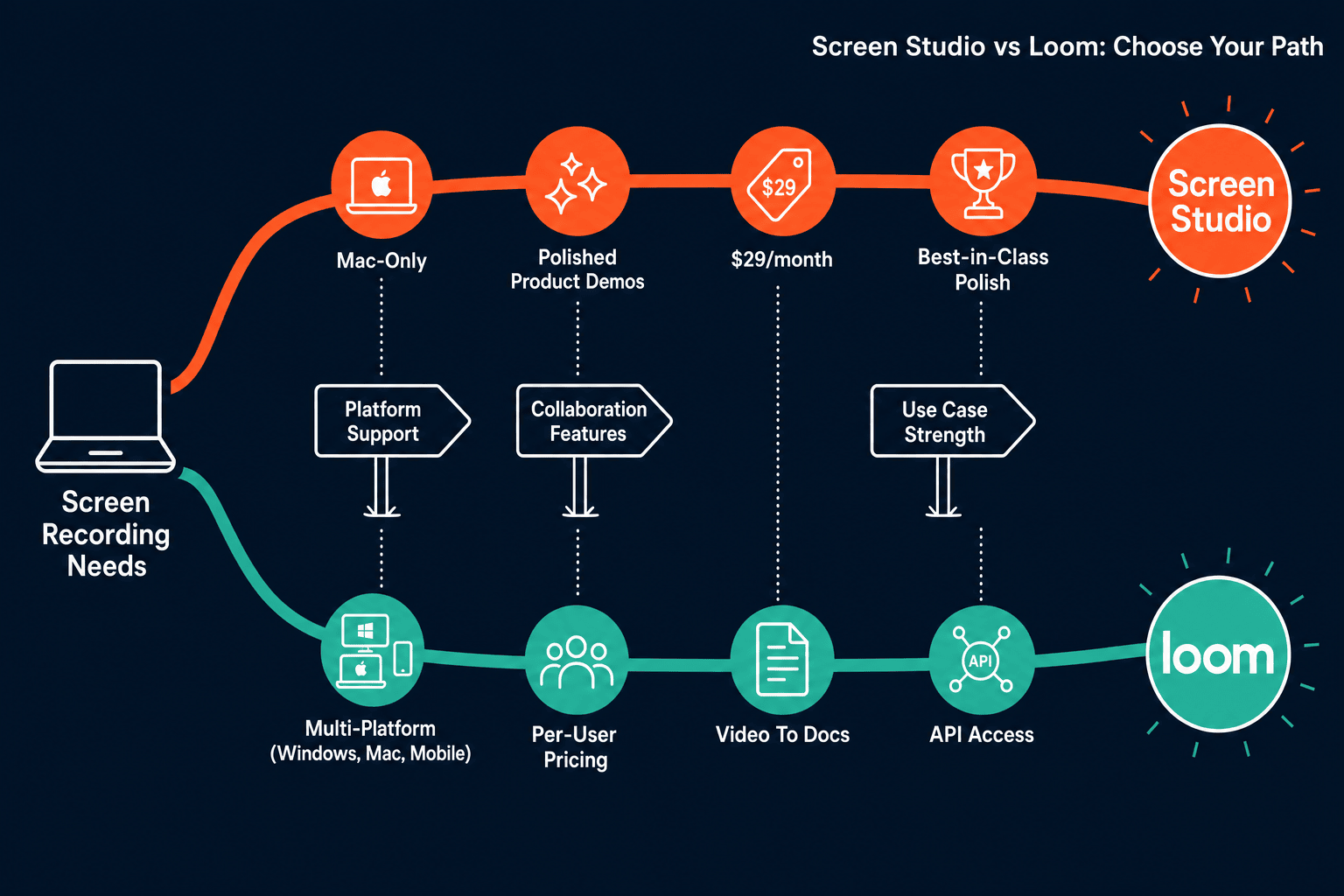
Screen Studio delivers polished Mac-only product demos with cinematic zoom and motion effects. Loom offers cross-platform async video messaging with AI summaries and Atlassian integrations. Neither turns recordings into structured documentation. Here is how they compare — and why Docsie Recorder may be the better choice for teams that need more than a video file.
Screen Studio wins on visual quality and Mac-specific polish — it is the right tool for founders and product marketers who need beautiful demo videos on macOS and do not need cross-platform support or documentation workflows.
Feature Matrix
A comprehensive side-by-side comparison of recording capabilities, platform support, editing tools, AI features, sharing options, and documentation workflow features.
| Feature |
Screen Studio
|
Loom
|
|---|---|---|
| Free Plan Available | ||
| Starting Price | $9/month (billed yearly) | $0 Starter (limits apply) |
| Mac Support | ||
| Windows Support | ||
| Linux Support | ||
| Browser Extension | ||
| Mobile Recording | ||
| iOS Device Recording | ||
| Open Source | ||
| Webcam Overlay | ||
| Microphone Audio | ||
| System Audio Capture | ||
| Automatic Zoom & Cursor Polish | ||
| Manual Zoom on Timeline | ||
| Backgrounds & Visual Effects | ||
| Motion Blur & Shadow | ||
| Crop, Trim & Speed Regions | ||
| 4K Video Export | Up to 4K 60fps | |
| GIF Export | ||
| AI Transcription | ||
| AI Summary & Chapters | ||
| AI Action Items | ||
| Viewer Analytics | ||
| Comments & Collaboration | ||
| Shareable Video Links | ||
| Video-to-Docs Conversion | ||
| Markdown / DOCX / PDF Export | ||
| Knowledge Base Publishing | ||
| Versioned Documentation Management | ||
| Multi-Tenant Portals | ||
| API Access | ||
| SSO / SCIM | Enterprise only | |
| Atlassian / Jira / Confluence Integration |
Data as of May 2026 based on publicly available vendor documentation and official pricing pages. Screen Studio pricing verified 2026-05-05 at $29/month or $9/month billed yearly. Loom free plan limits and paid plan prices should be verified before purchase as they change frequently.
Strengths & Weaknesses
Deep Dive
Screen Studio sets the standard for visual polish on Mac. Automatic zoom, cursor smoothing, motion blur, backgrounds, shadow, and inset controls produce marketing-ready videos without a dedicated editor. Manual zoom on the timeline lets creators control exactly what the viewer sees frame by frame. Loom prioritizes speed over polish — its recording workflow is faster and available on any platform, but the editing toolkit is significantly lighter. Teams that care deeply about how a demo looks will find Screen Studio's output more impressive; teams that care about getting a recording shared quickly will favor Loom's instant cloud link.
Platform support is the sharpest divide between these two tools. Screen Studio requires macOS Ventura 13.1 or later — Windows and Linux users simply cannot use it. Loom covers Mac, Windows, browser extension, and mobile apps, making it the practical choice for cross-functional teams on mixed hardware. If your organization standardizes on Windows laptops or employs a global team on varied operating systems, Screen Studio is a non-starter. Loom's breadth is one of its clearest competitive advantages, and it explains much of Loom's enterprise adoption despite Screen Studio's stronger visual output.
Loom's AI tier adds genuine value beyond raw recording. AI-generated summaries condense long walkthroughs into bullet points, chapters break recordings into navigable sections, and action items extract tasks for Jira or other workflows. Viewer analytics show engagement drop-off so creators can improve future recordings. Screen Studio offers AI-assisted transcription but does not generate summaries, chapters, or action items. Neither tool, however, converts a recording into structured written documentation — both stop at video output. Loom's AI is positioned around async communication efficiency; it does not produce governed knowledge base content.
Both Screen Studio and Loom are recorders, not documentation platforms. Screen Studio's output is a video file or GIF with a shareable link and no downstream documentation workflow. Loom's AI workflows can push action items to Jira or Confluence, and Loom Docs provides basic document creation alongside videos, but Loom is not a knowledge base — there is no version control, multi-tenant portal delivery, or structured content management layer. Teams that need recordings to become searchable, versioned documentation with approval workflows will find both tools hit a ceiling at the video library stage.
Our Recommendation
Screen Studio wins on visual quality and Mac-specific polish — it is the right tool for founders and product marketers who need beautiful demo videos on macOS and do not need cross-platform support or documentation workflows. Loom wins on platform breadth, async collaboration, and AI-assisted communication — it is the better choice for mixed-OS teams sharing quick walkthroughs internally with Atlassian tooling. Both tools stop at video output and neither supports structured documentation publishing, versioned knowledge bases, or multi-tenant portal delivery.
Choose Screen Studio if you need. .
Choose Loom if you need. .
Choose Docsie Recorder if you need. .
Winner: Docsie Recorder
Docsie Recorder is the only tool in this comparison that bridges the gap between polished screen recording and structured documentation publishing. It is free, open-source, and runs on Mac, Windows, and Linux — eliminating Screen Studio's platform lock-in. Its recorder-grade editing matches the core workflow of both competitors. But where Screen Studio and Loom both stop at a video file or share link, Docsie Recorder connects directly to the Docsie Video-to-Docs pipeline, turning one recording into structured documentation that flows into a versioned knowledge base, multi-tenant delivery portals, and the full Docsie CONVERT → MANAGE → DELIVER → LEARN workflow.
Decision Helper
A direct framework for picking between Screen Studio, Loom, and Docsie based on your specific needs.
Polished Mac-only product demos with cinematic zoom and motion.
Async video messaging with AI summaries and integrations.

Convert real video into searchable docs, then deploy multi-tenant portals.
Common Questions
Q: Can Screen Studio be used on Windows or Linux?
A: No. Screen Studio is a macOS-only application and requires macOS Ventura 13.1 or later. There is no Windows or Linux build available. If your team includes Windows or Linux users, you will need a different recorder — Loom and Docsie Recorder both support Windows, and Docsie Recorder also supports Linux.
Q: Does Loom convert recordings into written documentation?
A: Not in a structured, governed sense. Loom AI can generate summaries, chapters, and action items from a recording, and Loom Docs allows basic text alongside videos. However, Loom is not a documentation platform — there is no version control, knowledge base hierarchy, multi-tenant portal delivery, or Markdown/DOCX/PDF export. AI summaries are useful for async communication but are not the same as managed documentation.
Q: Which tool has better video editing features?
A: Screen Studio has significantly more advanced editing capabilities. It offers manual zoom controls on the timeline, automatic zoom, cursor smoothing, motion blur, shadow, backgrounds, inset, crop, trim, and speed regions. Loom's editing is primarily limited to basic trimming and stitching. If production quality matters, Screen Studio's editor is the stronger tool — but it only runs on Mac.
Q: Is there a better alternative to both Screen Studio and Loom?
A: Yes — Docsie Recorder addresses the core limitation both tools share. Screen Studio and Loom both stop at video output, with no path from recording to structured documentation. Docsie Recorder is a free, open-source desktop recorder (Mac, Windows, Linux) with recorder-grade editing including zooms, backgrounds, annotations, trim, and crop. It then connects directly to Docsie's Video-to-Docs pipeline, converting your recording into structured Markdown, DOCX, or PDF documentation that publishes into a versioned knowledge base — something neither Screen Studio nor Loom can do.
Q: Which tool is better for enterprise teams?
A: Loom has a clearer enterprise path with SAML SSO, SCIM, SOC 2 compliance, GDPR compliance, audit logs, and role-based access on its Enterprise tier. Screen Studio has no enterprise features — no SSO, no audit logs, no team administration. For enterprise teams with compliance or governance requirements, Loom is the more viable of the two, though per-user pricing can scale quickly for large organizations.
Q: How do Screen Studio and Loom compare on pricing for a small team?
A: Loom's Starter plan is free with limits on video count and recording length, making it the lower-cost entry point. Screen Studio has no free plan and costs $29/month or $9/month billed annually. For a solo creator or very small team on Mac who needs polished output, Screen Studio's yearly plan may be cost-effective. For teams needing unlimited recordings across platforms, Loom's paid tiers or Docsie Recorder's free open-source recorder are more practical starting points.
Docsie Recorder is free, open-source, and runs on Mac, Windows, and Linux. It records and edits screen videos locally, then connects directly to Docsie's Video-to-Docs pipeline to turn recordings into structured Markdown, DOCX, PDF, and published knowledge base content.
Free and open-source recorder core. Video-to-Docs conversion uses Docsie AI credits.