
4.8
on G2
 Screen Studio
 Kommodo
Screen Studio delivers polished Mac-only screen recordings with cinematic zoom and motion effects. Kommodo auto-generates step-by-step SOPs from recordings for individuals and small teams. Neither tool covers the full workflow from recording to structured knowledge base—here is how they compare and where Docsie Recorder fills the gap.
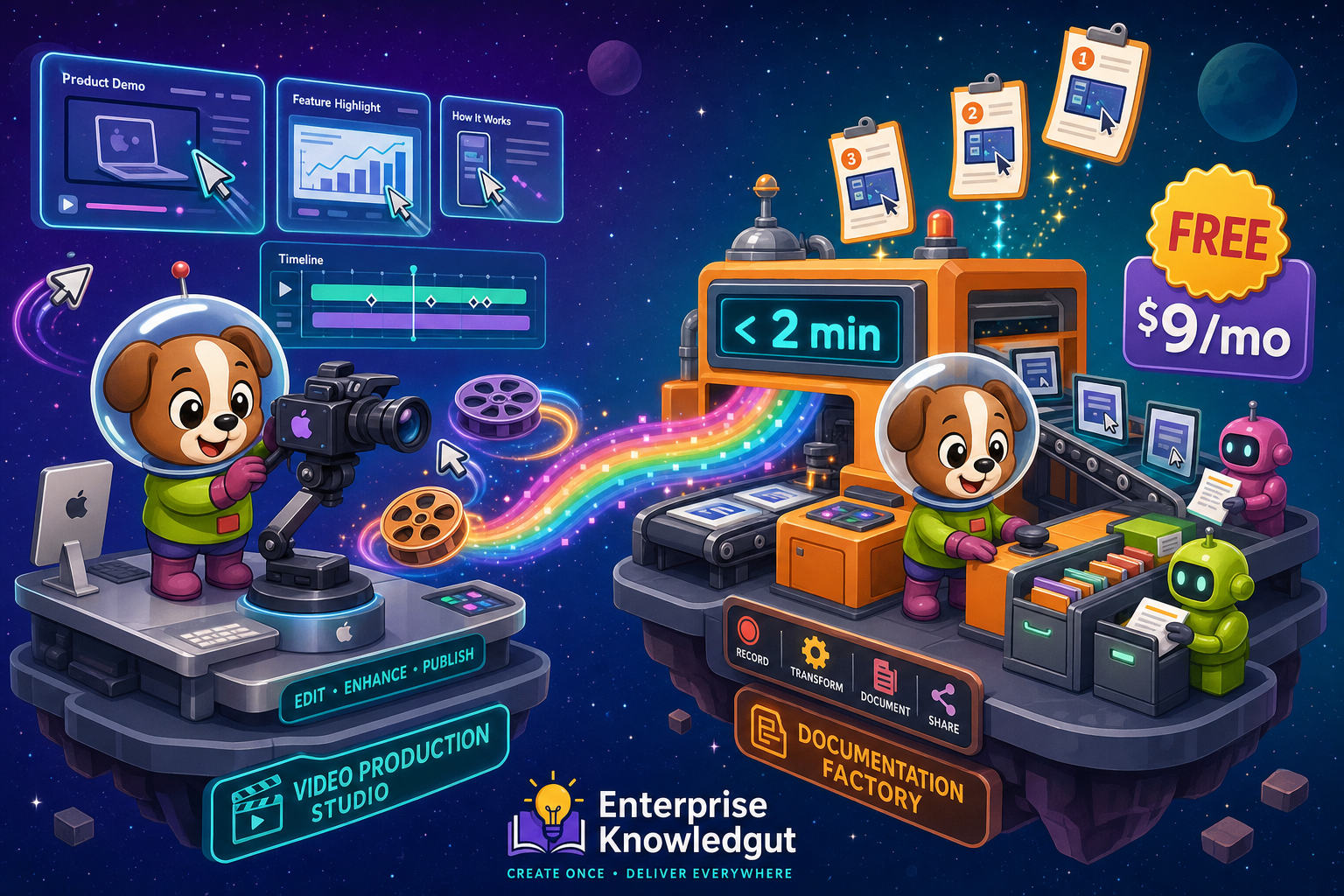
Screen Studio and Kommodo target fundamentally different outcomes from the same starting point.
Feature Matrix
A feature-by-feature comparison of recording capabilities, editing tools, AI-powered documentation, export formats, and enterprise readiness between Screen Studio and Kommodo.
| Feature |
Screen Studio
|
Kommodo
|
|---|---|---|
| Free Plan Available | ||
| Mac Support | ||
| Windows Support | ||
| Linux Support | ||
| Open-Source Recorder | ||
| Window & Full-Screen Capture | ||
| Webcam Overlay | ||
| Microphone Audio | ||
| System Audio Capture | ||
| iOS Device Recording | ||
| Automatic Zoom & Pan | ||
| Cursor Smoothing & Polish | ||
| Backgrounds & Visual Effects | ||
| Crop, Trim & Speed Regions | ||
| Motion Blur | ||
| AI-Generated Step-by-Step Docs | ||
| Auto-Screenshots per Step | ||
| Meeting Recorder | ||
| Video-to-Docs Conversion | ||
| MP4 / GIF Export | Partial (video only) | |
| PDF Export | ||
| Markdown Export | ||
| DOCX Export | ||
| Shareable Links | ||
| Knowledge Base | ||
| Team Collaboration | ||
| Role-Based Access Control | ||
| SSO | ||
| API Access | ||
| Version Control | ||
| Multi-Tenant Portals | ||
| Custom Domain | ||
| GDPR Compliance | Not published | |
| SOC 2 / ISO 27001 |
Data as of May 2026. Features based on publicly available vendor documentation. Verify pricing and features before purchasing as SaaS products change frequently.
Strengths & Weaknesses
Deep Dive
An in-depth look at how Screen Studio and Kommodo differ across recording quality, documentation output, team workflow, and enterprise readiness.
Screen Studio is the clear winner for recording polish. Its automatic zoom, cursor smoothing, motion blur, backgrounds, shadow, and inset controls produce cinematic product demos that stand out. Manual zoom on the timeline gives precise editorial control, and 4K 60fps export ensures quality for any screen. Kommodo's recorder is functional but unadorned — it captures the screen faithfully but offers no zoom automation, cursor effects, or visual styling. If the primary goal is a beautiful video for marketing or social media, Screen Studio's recording engine is significantly more capable than Kommodo's.
Kommodo wins decisively when the goal is written documentation. Its AI analyzes recordings and auto-generates step-by-step SOPs with screenshots attached at each step in under two minutes. This turns a screen recording directly into a deliverable process document, exported as PDF or shared via link. Screen Studio produces no documentation whatsoever — its output is a video file or GIF. Teams that need recordings to become written guides, SOPs, or onboarding materials will find Screen Studio entirely unsuited to that workflow, while Kommodo was purpose-built for exactly that use case.
Kommodo includes basic team collaboration with shared folders, role-based access, and team workspaces on the $9/user/month paid tier, making it viable for small teams of 2–20 people building a shared SOP library. Screen Studio is fundamentally a solo creator tool — there are no team workspaces, shared libraries, or collaboration features. Both tools lack version control, approval workflows, and content reuse, but Kommodo at least provides a shared environment. For teams producing documentation together, Kommodo's architecture is more accommodating, though neither tool scales to enterprise documentation governance requirements.
Neither Screen Studio nor Kommodo is enterprise-ready by any rigorous standard. Screen Studio has no published SSO, audit logs, RBAC, compliance certifications, or enterprise tier. Kommodo offers GDPR compliance and role-based access but has no SOC 2, ISO 27001, SSO, API access, audit logs, or published uptime SLA. Founded in 2023, Kommodo has no enterprise track record. Neither tool supports multi-tenant portals, custom domains, on-premise deployment, or regulated industry compliance modes. Organizations in healthcare, finance, or regulated sectors will find both tools unsuitable without significant compensating controls.
Our Recommendation
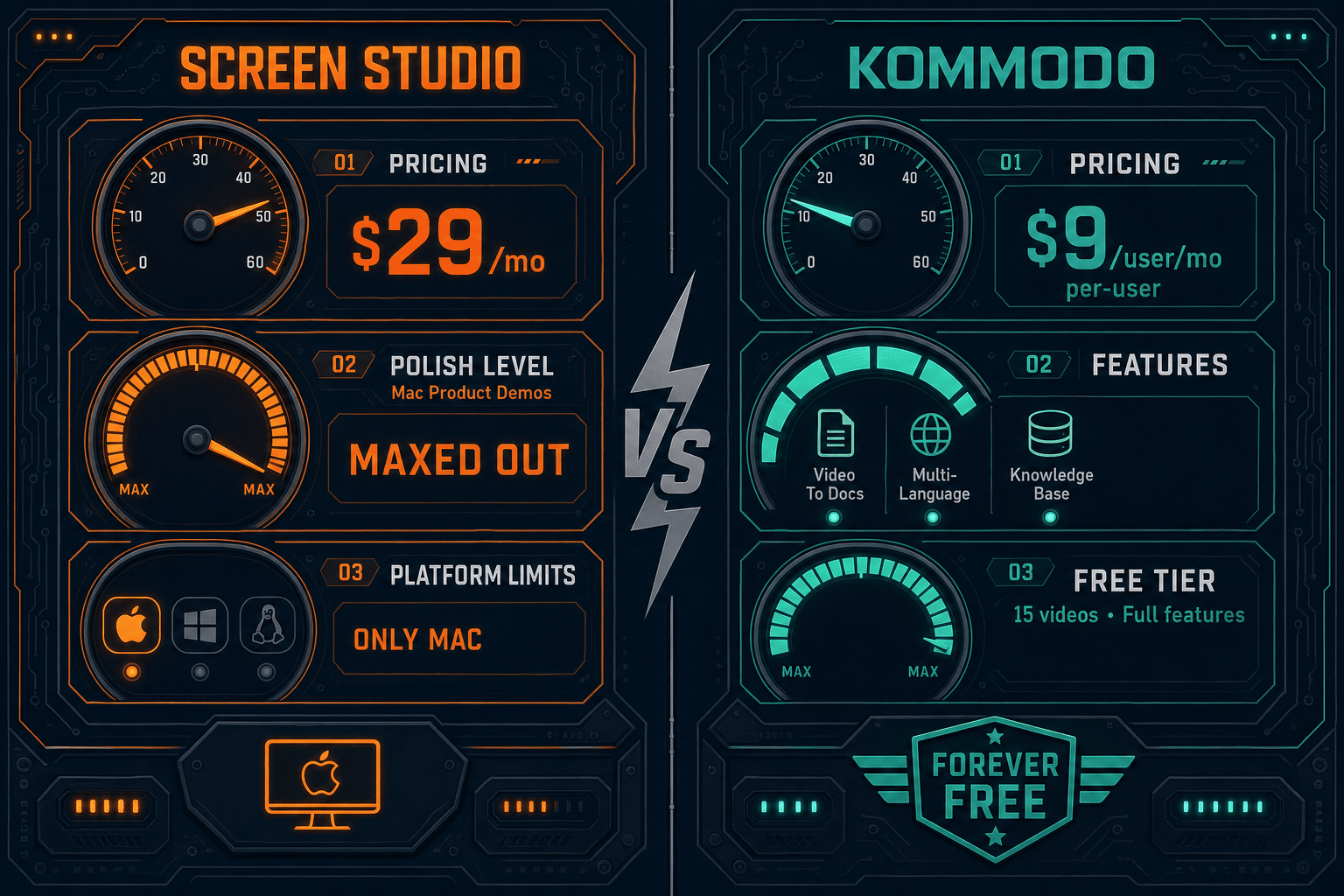
Screen Studio and Kommodo target fundamentally different outcomes from the same starting point. Screen Studio turns screen recordings into polished, cinematic videos for product marketing and demos — but only on Mac and only as video output. Kommodo turns screen recordings into step-by-step SOPs and process guides — affordably, cross-platform, and with a free tier — but with minimal polish and weak enterprise footing. The right choice depends entirely on whether you need a beautiful video or a written document at the end of the workflow.
Choose Screen Studio if you need. .
Choose Kommodo if you need. .
Choose Docsie Recorder if you need. .
Winner: Docsie Recorder
Docsie Recorder is the only tool in this comparison that bridges both worlds — it delivers recorder-grade editing (zoom, polish, backgrounds, annotations) across Mac, Windows, and Linux for free, then routes recordings directly into Docsie's Video-to-Docs pipeline to generate structured Markdown, DOCX, and PDF documentation. From there, the downstream Docsie platform handles MANAGE (knowledge base with version control), DELIVER (multi-tenant portals with custom domains), LEARN (course and certification reuse), and enterprise compliance — a complete workflow that Screen Studio stops before docs begin and Kommodo never scales to enterprise.
Decision Helper
A direct framework for picking between Screen Studio, Kommodo, and Docsie based on your specific needs.
Polished Mac-only product demos with cinematic zoom and motion.
AI agent that turns videos into searchable SOPs.

Convert real video into searchable docs, then deploy multi-tenant portals.
Common Questions
Q: Can Screen Studio generate step-by-step documentation like Kommodo?
A: No. Screen Studio's output is exclusively video (up to 4K 60fps) and GIF files with shareable links. It has no AI documentation generation, no SOP output, and no PDF, Markdown, or DOCX export. If you need written documentation from your recordings, Kommodo or a dedicated video-to-docs tool is required — Screen Studio is purpose-built for polished video output only.
Q: Does Kommodo match Screen Studio's visual recording quality?
A: No. Kommodo captures the screen accurately but offers no automatic zoom, cursor smoothing, motion blur, backgrounds, shadow effects, or cinematic styling. Screen Studio's recording engine is purpose-built for visual polish and stands in a different class for marketing and demo video quality. Kommodo's strength is in AI-generated SOP output, not visual recording aesthetics.
Q: Is Screen Studio available on Windows or Linux?
A: No. Screen Studio requires macOS Ventura 13.1 or later and has no Windows or Linux version. This is one of its most significant limitations for cross-platform teams. Kommodo works on both Mac and Windows, making it the more accessible choice for mixed operating system environments.
Q: What export formats do Screen Studio and Kommodo support?
A: Screen Studio exports MP4 video (up to 4K 60fps) and GIF, plus shareable links. Kommodo exports PDF and shareable links, with embed support. Neither tool exports Markdown or DOCX. If your workflow requires structured text formats like Markdown for documentation pipelines, both tools fall short and you will need a tool like Docsie Recorder that natively outputs those formats.
Q: Is there a better alternative to both Screen Studio and Kommodo?
A: Yes — Docsie Recorder addresses the core gaps in both tools. It is a free, open-source desktop recorder for Mac, Windows, and Linux that includes Screen Studio-style editing features (zoom, backgrounds, motion blur, crop, trim, annotations) without the Mac-only restriction or subscription cost. Unlike Kommodo, it connects natively to Docsie's Video-to-Docs pipeline to generate structured Markdown, DOCX, and PDF documentation, and feeds directly into the Docsie knowledge base platform for versioned publishing, multi-tenant portals, and enterprise compliance. Download it free at the Docsie Recorder GitHub page.
Q: Which tool is better for a small team building internal SOPs?
A: Kommodo is the better fit for small teams (2–20 people) that need to build a shared SOP library from screen recordings. Its free tier, $9/user/month paid plan, team folders, and AI-generated step-by-step guides make it practical and affordable for internal process documentation. Screen Studio is designed for individual creators and has no team collaboration features, making it unsuitable for shared documentation workflows at any team size.
Docsie Recorder gives you a free, open-source cross-platform recorder with Screen Studio-level editing on Mac, Windows, and Linux — then connects directly to Docsie's Video-to-Docs pipeline for structured Markdown, DOCX, and PDF output. Go further with a full knowledge base platform featuring version control, multi-tenant portals, SSO, and enterprise compliance that neither Screen Studio nor Kommodo can offer.
Free to download. Open-source MIT recorder core.