
4.8
on G2
 Screen Studio
 Kommodo
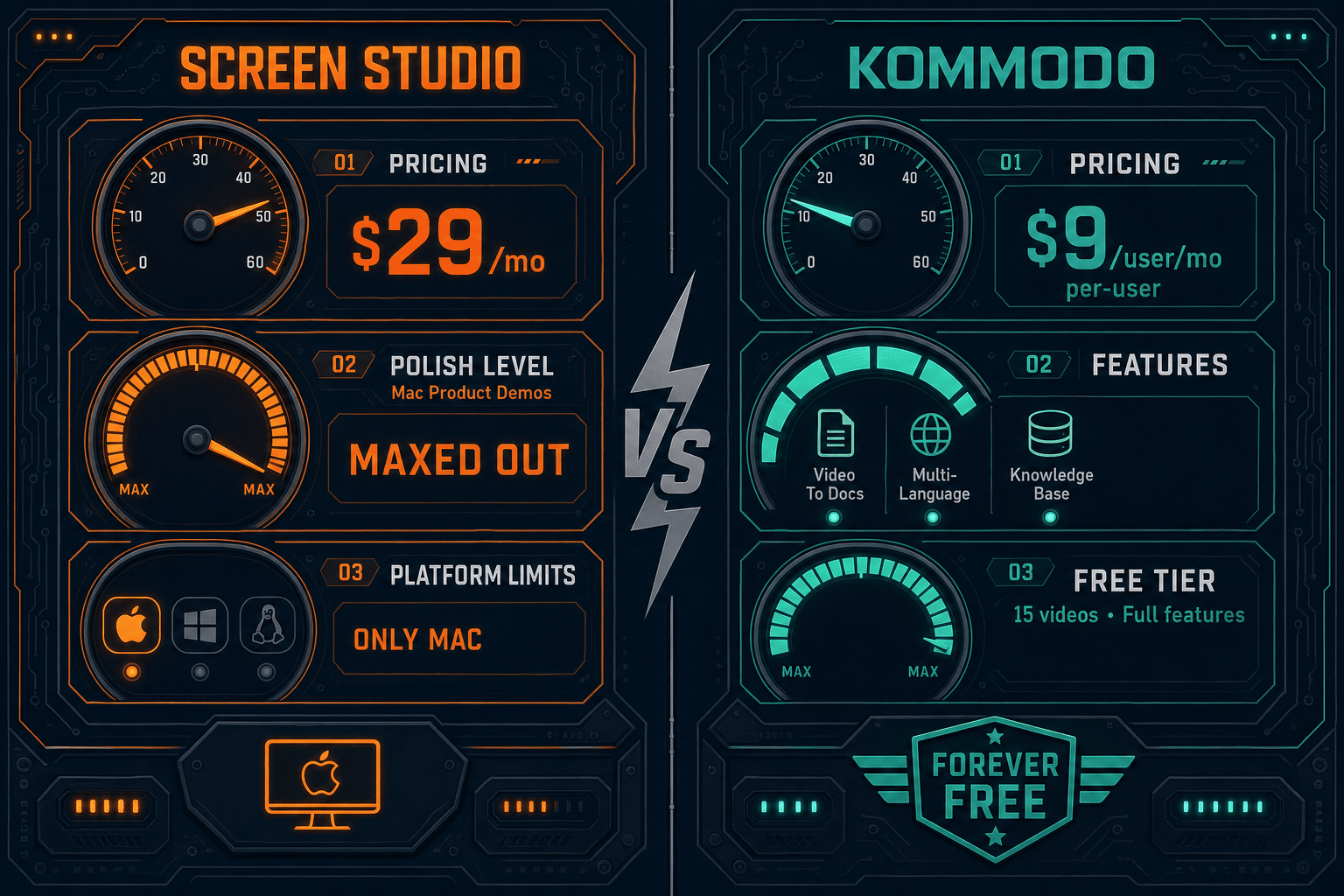
Screen Studio charges $29/month (or $9/month billed yearly) for a polished Mac-only screen recorder. Kommodo offers a free tier and $9/user/month paid plan for AI-powered SOP generation. We break down what you actually get at each price point and whether either tool is worth the spend.
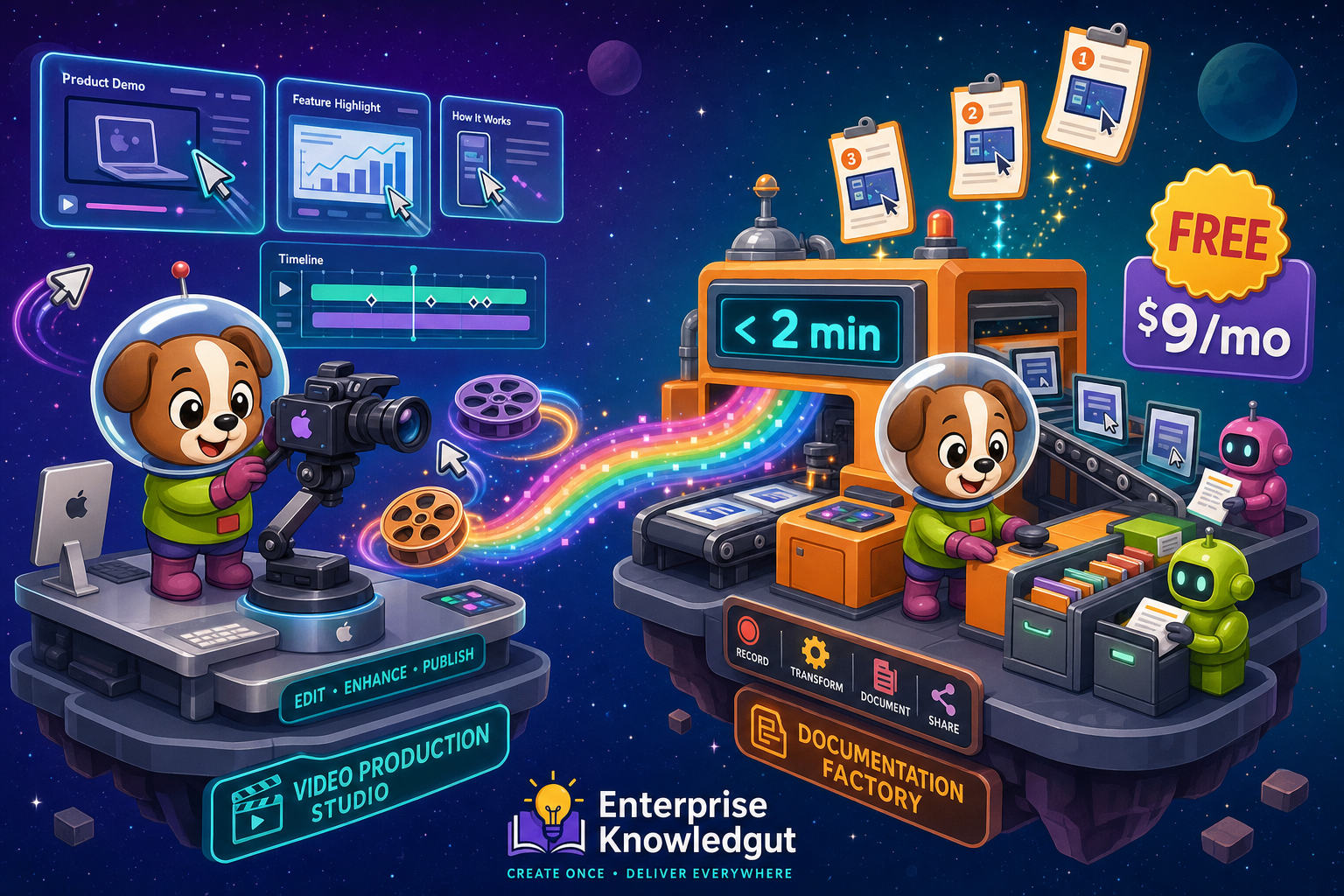
Screen Studio and Kommodo serve genuinely different use cases despite both involving screen recording.
Feature Matrix
A side-by-side breakdown of recording features, output types, export formats, collaboration, and enterprise capabilities across both tools' pricing tiers.
| Feature |
Screen Studio
|
Kommodo
|
|---|---|---|
| Free Plan Available | ||
| Starting Price | $9/month (billed yearly) | $0 (Starter tier) |
| Paid Plan Price | $29/month or $9/month yearly | $9/user/month yearly / $15/month |
| Mac Support | ||
| Windows Support | ||
| Linux Support | ||
| Screen & Window Recording | ||
| Webcam Overlay | ||
| Microphone Audio | ||
| Automatic Zoom & Cursor Polish | ||
| Backgrounds & Visual Effects | ||
| 4K Export | Up to 4K 60fps | 4K on paid plan |
| GIF Export | ||
| AI-Generated Step-by-Step SOPs | ||
| Video-to-Docs Conversion | ||
| PDF Export | ||
| Shareable Links | ||
| Team Collaboration & Folders | Paid plan only | |
| Meeting Recorder | ||
| Knowledge Base | ||
| SSO / Enterprise Auth | ||
| API Access | ||
| SOC 2 / ISO 27001 | ||
| Free Recording Limit | No free plan | 15 videos on Starter |
Pricing and features verified from official sources as of May 2026. SaaS pricing changes frequently — verify before making a purchase decision.
Strengths & Weaknesses
Deep Dive
An in-depth look at value for money, scalability costs, and hidden limitations across both tools' pricing structures.
Screen Studio's $9/month yearly plan delivers genuine value for Mac users who need polished product demo videos — the visual quality (4K, motion blur, zoom animations) rivals tools costing far more. However, you are paying purely for video output: there are no docs, no AI assistance, no collaboration features. Kommodo's free tier is arguably the strongest entry point in the SOP-generator category, and $9/user/month for unlimited SOPs and team collaboration is competitive. For individual creators and small teams primarily needing documentation output, Kommodo's pricing model delivers more functional value per dollar spent.
Screen Studio's pricing is flat per seat — one price covers all features regardless of team size, which is predictable. The problem is the tool doesn't scale functionally: there are no team workspaces, shared libraries, or collaboration features to grow into. Kommodo's per-user model starts cheaply but compounds linearly. A 10-person team pays $90/month yearly, a 50-person team pays $450/month — with no enterprise tier or volume discount published. Neither tool has a published enterprise pricing path, meaning larger organizations eventually hit a ceiling and must seek alternatives for governance, compliance, or scaled delivery.
Screen Studio's biggest hidden cost is platform lock-in: Mac-only means Windows or Linux team members must use a different tool entirely, fragmenting your workflow budget. There is also a workflow gap cost — video content must be manually re-documented for knowledge base use. Kommodo's hidden limitations are compliance-related: no SOC 2, no SSO, and no API mean enterprise procurement will flag it immediately, forcing a migration later. The free tier's 15-video and 10-step cap means any real business use quickly requires the paid plan. Neither tool includes Markdown, DOCX, or version-controlled documentation export.
Pricing Breakdown
Every published plan from both tools, with an honest look at what each tier actually delivers and where the value breaks down.
For solo users, Kommodo's free tier wins on pure value — you pay nothing for a functional SOP generator. For Mac-focused video creators, Screen Studio's $9/month yearly plan is strong. However, both tools have hard ceilings: Screen Studio stops at video output with no docs workflow, and Kommodo has no enterprise tier, no compliance certifications, and per-user pricing that becomes expensive past 20 users. Neither tool offers version control, API access, SSO, or a path to enterprise deployment. Teams that start with either tool will likely need to migrate when documentation governance or compliance becomes a requirement.
Our Recommendation
Screen Studio and Kommodo serve genuinely different use cases despite both involving screen recording. Screen Studio is a premium Mac video production tool — it makes beautiful demos but stops at the video file. Kommodo is a cross-platform AI SOP generator with a free entry point — it produces step-by-step guides but lacks enterprise compliance and governance. Both tools are useful in their lane, but neither connects the recording workflow to versioned, publishable documentation at scale.
Choose Screen Studio if you need. .
Choose Kommodo if you need. .
Choose Docsie Recorder if you need. .
Winner: Docsie Recorder
Docsie Recorder is free, open-source, and cross-platform — it eliminates Screen Studio's Mac-only limitation and Kommodo's compliance ceiling in one tool. After recording, the Docsie bridge converts your video into structured documentation via the Video-to-Docs pipeline, feeding directly into the Docsie knowledge base with version control, multi-tenant portal delivery, SSO, and enterprise deployment paths. You get Screen Studio's serious recording workflow and Kommodo's documentation output, without paying per-user fees or hitting a compliance wall when your team grows.
Decision Helper
A direct framework for picking between Screen Studio, Kommodo, and Docsie based on your specific needs.
Polished Mac-only product demos with cinematic zoom and motion.
AI agent that turns videos into searchable SOPs.

Convert real video into searchable docs, then deploy multi-tenant portals.
Common Questions
Q: Does Screen Studio have a free plan or free trial?
A: Screen Studio does not publish a permanent free plan. A download may be available to try the app, but current trial terms should be verified on the official site before making a decision. The paid plans are $29/month billed monthly or approximately $9/month billed yearly. There is no free tier that lets you record and export without purchasing.
Q: Is Kommodo's free plan genuinely useful or too limited?
A: Kommodo's free Starter tier is genuinely functional for individuals — unlimited recording length, screen and webcam recording, meeting recording, and instant share links are all included. The practical limits are 15 total videos and SOPs capped at 10 steps. For a freelancer or a small team running light documentation needs, this is a real free tool. Once you hit those caps or need team collaboration, the $9/user/month yearly plan is required.
Q: How does Screen Studio's per-seat cost compare to Kommodo at team scale?
A: Screen Studio's pricing is per user but flat — every individual pays $9/month yearly regardless of team size, and there are no shared team features to grow into. Kommodo's per-user model is identical at $9/user/month yearly, but it includes team folders, roles, and collaboration. A 10-person team pays roughly $90/month on either tool's yearly plan. Kommodo delivers more collaborative value at that price point; Screen Studio delivers better video quality but no team layer at all.
Q: Can Kommodo replace Screen Studio for video production?
A: No. Kommodo is focused on generating step-by-step SOPs and documentation from screen recordings — it does not offer Screen Studio's visual editing capabilities like automatic zoom, cursor smoothing, motion blur, custom backgrounds, or 4K GIF export. If polished video production for marketing or product demos is your goal, Kommodo is not a substitute. The two tools solve different problems: Screen Studio creates beautiful videos, Kommodo creates structured process documentation.
Q: Is there a better alternative to both Screen Studio and Kommodo?
A: Yes — Docsie Recorder addresses the core gaps in both tools. Unlike Screen Studio, it is free, open-source, and runs on Mac, Windows, and Linux. Unlike Kommodo, it connects your recording directly to a full documentation workflow: the Docsie Video-to-Docs pipeline converts recordings into structured Markdown, DOCX, and PDF content, which then publishes into a knowledge base with version control, multi-tenant portals, and enterprise compliance features. It is the only tool in this comparison that covers the full CREATE → CONVERT → MANAGE → DELIVER workflow.
Q: Which tool is better for enterprise teams with compliance requirements?
A: Neither Screen Studio nor Kommodo is suitable for enterprise compliance requirements. Screen Studio is a local Mac app with no enterprise features, no SSO, no audit logs, and no compliance certifications. Kommodo has no SOC 2, no ISO 27001, no SSO, and no published enterprise tier. Teams in regulated industries or those needing governance controls should evaluate Docsie Recorder, which routes into the broader Docsie platform offering SOC 2-ready infrastructure, SSO, role-based access, and audit capabilities.
Docsie Recorder is free, open-source, and runs on Mac, Windows, and Linux. Record locally, export MP4 or GIF, then use the Docsie Video-to-Docs pipeline to turn your recording into structured documentation — published into a knowledge base with version control, multi-tenant portals, and enterprise compliance. No per-user pricing wall. No Mac-only restriction. No documentation dead end.
Free and open-source recorder core. Video-to-Docs conversion uses Docsie AI credits — estimate before you convert.