
4.8
on G2
 Screen Studio
 Kommodo
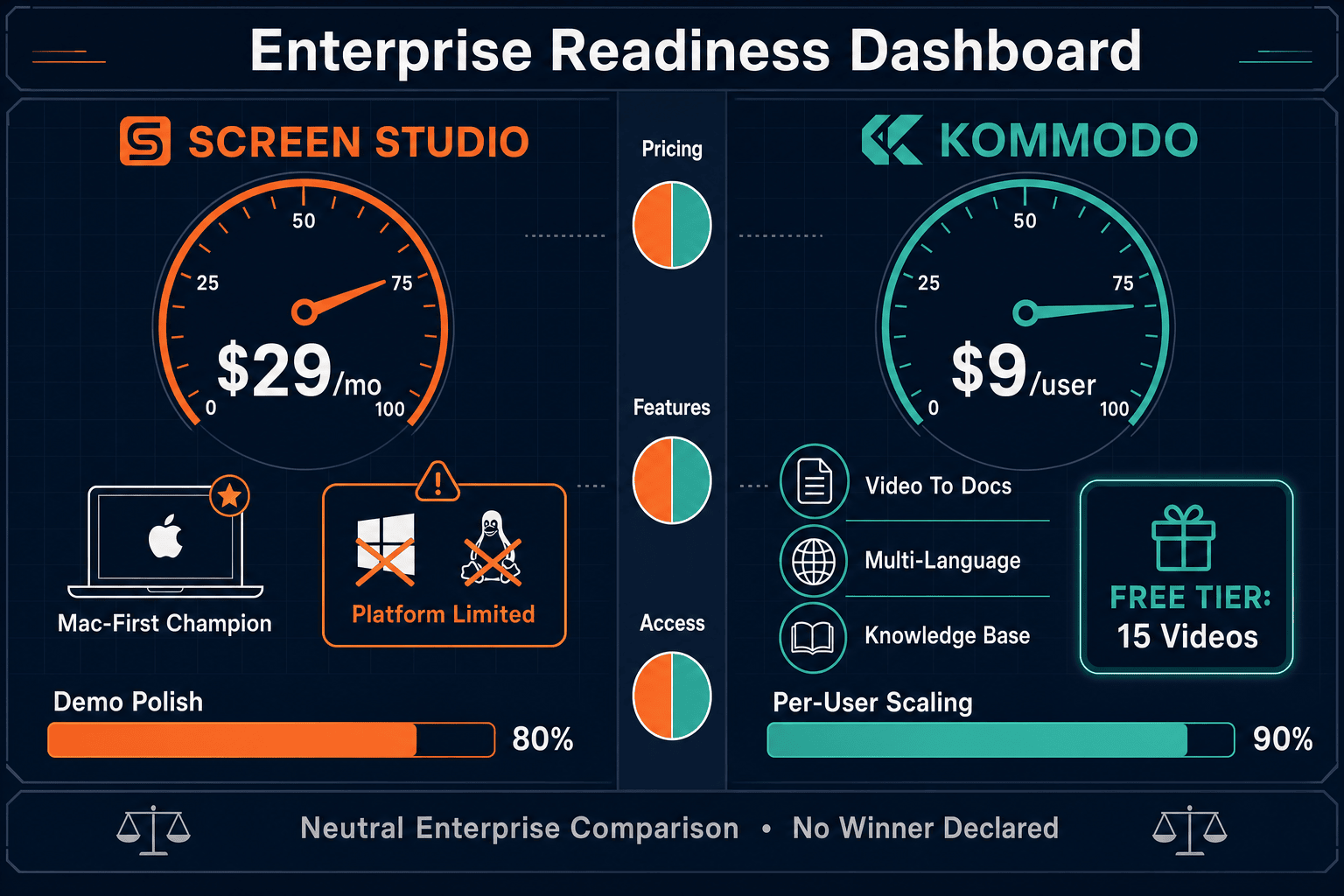
Screen Studio is a polished Mac-only screen recorder with no enterprise capabilities. Kommodo is a young AI-powered SOP generator built for individuals and small teams. Neither was designed for enterprise deployment. This comparison examines both tools honestly across security, compliance, scalability, and administration — then explains why Docsie Recorder is the more enterprise-ready path.

Screen Studio is a best-in-class Mac recorder for polished product demos — but it was never designed for enterprise deployment, and it has zero enterprise features to evaluate.
Enterprise Feature Matrix
A side-by-side look at the enterprise features that matter most to IT, security, and operations teams evaluating screen recording and documentation tools for organizational deployment.
| Enterprise Capability |
Screen Studio
|
Kommodo
|
|---|---|---|
| SSO (SAML / OAuth / OIDC) | ||
| SOC 2 Type II Compliance | ||
| ISO 27001 Certification | ||
| GDPR Compliance | ||
| HIPAA / ITAR / SOX Support | ||
| Audit Logs | ||
| Role-Based Access Control | ||
| Data Residency Options | ||
| On-Premise / Air-Gapped Deployment | ||
| API Access | ||
| Uptime SLA | Not published | Not published |
| Dedicated Enterprise Support | ||
| Multi-Tenant Portals | ||
| Custom Domain | ||
| Version Control | ||
| Admin Dashboard | ||
| Team Folders & Permissions | ||
| Published Enterprise Tier | ||
| Windows & Linux Support | ||
| Free Plan Available |
Data as of May 2026. Based on publicly available information from each vendor's official website. Neither Screen Studio nor Kommodo publishes a dedicated enterprise tier or enterprise SLA. Verify directly with each vendor before making procurement decisions.
Strengths & Weaknesses
Deep Dive Analysis
An in-depth look at how both tools perform across the four enterprise readiness dimensions that IT, security, and procurement teams evaluate most carefully.
Neither Screen Studio nor Kommodo publishes SOC 2 Type II or ISO 27001 certifications. Screen Studio is a local macOS app, so recording data stays on-device — but there are no published compliance controls for its shareable link hosting infrastructure. Kommodo acknowledges GDPR compliance, making it marginally stronger here, but it lacks HIPAA, ITAR, SOX, or any industry-specific compliance posture. Neither tool supports data residency selection, on-premise deployment, or bring-your-own-model configurations. For regulated industries — healthcare, finance, defense, or pharma — both tools would fail a standard vendor security review outright.
Screen Studio is a single-user macOS application with no team infrastructure — scalability simply is not a design goal. Kommodo's Premium tier supports teams with shared folders, but the company's own positioning targets individuals and small startups of 2–20 people. Neither tool publishes an uptime SLA, infrastructure redundancy details, or performance benchmarks for concurrent users. Kommodo claims 100,000+ users and 30,000+ SOPs generated, which offers some confidence in basic reliability, but there is no published enterprise architecture. Screen Studio's shareable link hosting uptime is unverified and undocumented.
Kommodo has a meaningful advantage here over Screen Studio: it offers team folders, basic role assignments, and collaboration features in its Premium tier at $9/user/month. Screen Studio has zero team administration features — it is a single-user Mac app with no team workspace concept. Neither tool offers audit logs, admin dashboards with user provisioning, centralized policy enforcement, or SSO integration. For enterprise IT teams expecting Active Directory or Okta integration, automated user lifecycle management, and granular permission policies, both tools require significant workarounds or flat-out cannot meet requirements.
Neither Screen Studio nor Kommodo publishes a dedicated enterprise support tier, named SLA commitment, or guaranteed response time. Screen Studio appears to operate with standard SaaS support channels for its small team. Kommodo, founded in 2023, has community support and standard channels but no evidence of enterprise support contracts, customer success management, or priority escalation paths. For enterprise procurement teams that require contractual SLAs, dedicated customer success managers, and documented escalation procedures, both tools would fail to satisfy standard enterprise vendor requirements at the time of this comparison.
Our Recommendation
Screen Studio is a best-in-class Mac recorder for polished product demos — but it was never designed for enterprise deployment, and it has zero enterprise features to evaluate. Kommodo is a capable AI SOP generator for individuals and small teams that edges ahead with GDPR compliance and basic role-based access, but its 2023-era architecture, absent compliance certifications, and missing SSO and audit logs make it unsuitable for enterprise procurement. Both tools share the same fundamental limitation — neither was built with enterprise requirements in mind.
Choose Screen Studio if you need. .
Choose Kommodo if you need. .
Choose Docsie Recorder if you need. .
Winner: Docsie Recorder
Docsie Recorder is the only tool in this comparison that bridges the gap between polished screen recording and enterprise-grade documentation infrastructure. It starts with a free, open-source cross-platform recorder with zoom, crop, trim, backgrounds, annotations, and local MP4/GIF export — matching the core recording capability both competitors offer. Then it does what neither competitor can — it sends that recording through Docsie's Video-to-Docs pipeline to generate structured Markdown, DOCX, and PDF content that publishes into a versioned knowledge base. The downstream Docsie platform adds SSO, audit logs, multi-tenant portals, custom domains, SOC 2 compliance, role-based access control, and API access — the exact enterprise features that Screen Studio and Kommodo both entirely lack. For enterprise teams, Docsie Recorder is not just a better recorder; it is the only option in this set with a credible enterprise deployment path.
Decision Helper
A direct framework for picking between Screen Studio, Kommodo, and Docsie based on your specific needs.
Polished Mac-only product demos with cinematic zoom and motion.
AI agent that turns videos into searchable SOPs.

Convert real video into searchable docs, then deploy multi-tenant portals.
Common Questions
Q: Does either Screen Studio or Kommodo support SSO for enterprise identity management?
A: No. Neither Screen Studio nor Kommodo supports SSO in any form — SAML, OAuth, OIDC, Azure AD, or Okta integrations are all absent from both tools. This is a hard blocker for most enterprise IT teams that require centralized identity management and automated user provisioning. Both tools would fail a standard enterprise security questionnaire on this point alone.
Q: Is Kommodo SOC 2 certified, and does that make it more enterprise-ready than Screen Studio?
A: Kommodo is not SOC 2 Type II or ISO 27001 certified as of this comparison. It does acknowledge GDPR compliance, which gives it a marginal edge over Screen Studio, which publishes no compliance certifications at all. However, GDPR acknowledgment alone is not sufficient for enterprise procurement in regulated industries. Neither tool has a compliance posture that would satisfy standard enterprise vendor security reviews for healthcare, finance, or defense sectors.
Q: Can Screen Studio be deployed on-premise or in an air-gapped environment?
A: No. Screen Studio is a macOS desktop application and its shareable link hosting is cloud-based with no published on-premise or air-gapped deployment option. The local recording capability means capture data stays on-device, but the broader infrastructure for sharing and collaboration has no documented deployment flexibility. Regulated industries requiring air-gapped or private cloud deployment cannot use Screen Studio for their documentation workflow.
Q: Does Kommodo publish an enterprise tier with SLA commitments?
A: No. Kommodo only publishes a free Starter tier and a Premium tier at $9/user/month (yearly) or $15/user/month (monthly). There is no published enterprise tier, no named SLA, no dedicated support offering, and no custom pricing path listed on its website. For enterprise procurement teams that require contractual uptime guarantees and dedicated customer success, Kommodo does not currently offer a formal enterprise engagement model.
Q: Is there a better alternative to both Screen Studio and Kommodo for enterprise teams?
A: Yes — Docsie Recorder is the recommended alternative for enterprise teams. Unlike Screen Studio (Mac-only, no enterprise features) and Kommodo (consumer-grade, no SOC 2 or SSO), Docsie Recorder is a free open-source cross-platform recorder that feeds directly into Docsie's enterprise knowledge platform. The downstream Docsie platform provides SSO, audit logs, SOC 2 compliance, multi-tenant portals, version control, API access, and role-based access control — covering every enterprise gap that both competitors leave open. You get a capable recorder plus a credible enterprise deployment path in one workflow.
Q: Which tool handles team collaboration better — Screen Studio or Kommodo?
A: Kommodo is clearly ahead on team collaboration. It offers team folders, basic role assignments, and shared workspaces in its $9/user/month Premium tier. Screen Studio has no team features at all — it is a single-user macOS application with no workspace concept, no shared libraries, and no collaborative review capabilities. For any team larger than one person, Kommodo's collaboration model is more practical, though both tools fall short of enterprise-grade administration requirements like centralized provisioning, granular permissions, and audit trails.
Both Screen Studio and Kommodo were built for individual creators and small teams — not enterprise deployment. Docsie Recorder gives you a free, open-source cross-platform recorder with the visual polish you expect, plus a direct path to SSO, SOC 2 compliance, audit logs, multi-tenant portals, and a full Video-to-Docs workflow that turns recordings into versioned knowledge base content. Download the recorder free and see how far one recording can go.
Free and open-source recorder.