
4.8
on G2
 Screen Studio
 Kap
Kap
Both Screen Studio and Kap are Mac-only screen recorders, but neither was designed with enterprise security, compliance, or administration in mind. This comparison evaluates how each tool holds up against real enterprise requirements — and why teams with serious governance needs should consider a more capable alternative.
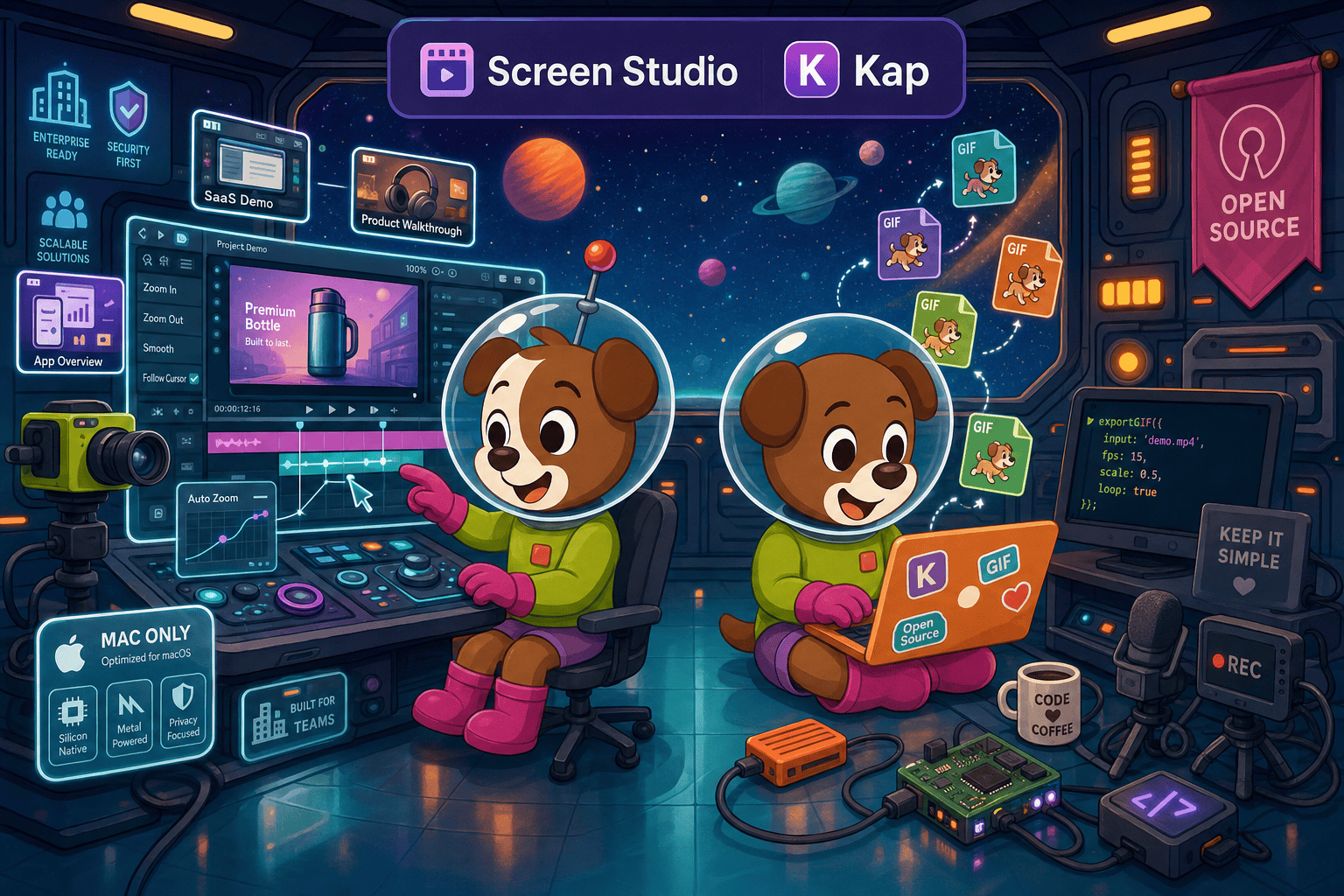
Screen Studio and Kap are both excellent tools for individual Mac users who need polished screen recordings or quick GIFs, respectively.
Enterprise Feature Matrix
A focused comparison of enterprise-relevant features including security, compliance, administration, scalability, and support across both tools.
| Enterprise Capability |
Screen Studio
|
Kap
|
|---|---|---|
| Free to Use | ||
| Open-Source Codebase | ||
| Windows Support | ||
| Linux Support | ||
| SSO (SAML / OAuth) | ||
| Role-Based Access Control | ||
| Audit Logs | ||
| SOC 2 Compliance | ||
| GDPR Compliance | Verify | Verify |
| Data Residency Options | ||
| Admin / Team Management Dashboard | ||
| Multi-Tenant Portal Delivery | ||
| API Access | ||
| Uptime SLA | Not applicable (local app) | Not applicable (local app) |
| Dedicated Support / SLA | ||
| Custom Domain | ||
| Version Control for Content | ||
| Knowledge Base Publishing | ||
| Enterprise Deployment Path |
Data as of 2026. Features are based on publicly available information from official product sites. Verify compliance and GDPR status with each vendor before enterprise procurement decisions.
Strengths & Weaknesses
Deep Dive Analysis
A four-category deep dive into enterprise readiness — examining security and compliance, scalability and performance, administration and control, and support and SLA for both tools.
Neither Screen Studio nor Kap publishes SOC 2, HIPAA, or formal compliance certifications. Screen Studio is a closed-source Mac app, making independent security audits impossible. Kap's MIT-licensed open-source codebase is fully auditable, which is a genuine advantage for security-conscious teams. Kap also processes recordings locally by default, so data never leaves the device unless the user explicitly exports or uploads. Screen Studio's shareable link feature introduces cloud data handling that is not governed by published compliance documentation. For regulated industries, both tools fail to meet baseline enterprise security requirements, but Kap's open-source, local-first model is the more defensible choice.
Both tools are lightweight Mac desktop apps designed for individual use, not enterprise-scale deployment. Screen Studio exports up to 4K 60fps video, which is capable for high-fidelity output, but there is no infrastructure for managing, distributing, or versioning recordings across a large team. Kap is intentionally minimal and fast, suited to quick GIF and clip workflows, but it has no cloud backend to support organizational scale. Neither tool offers a centralized content repository, usage analytics, or bandwidth management. Enterprises needing to scale screen recording workflows across dozens or hundreds of contributors will quickly exhaust what both tools can support without additional infrastructure.
Enterprise administration requires centralized user management, role-based permissions, activity logs, and policy enforcement — none of which exist in either Screen Studio or Kap. Screen Studio has no documented team or admin dashboard; it is structured as a single-user subscription. Kap, being open-source and locally installed, has no centralized administration layer at all. There is no way for IT teams to manage deployments, enforce recording policies, or monitor usage across either platform. Custom domain support, multi-tenant delivery, and API-driven workflow integration are all absent. For IT and security teams that need visibility and control over recording workflows, both tools require significant manual governance workarounds.
Screen Studio offers no publicly documented dedicated support tier, enterprise SLA, or guaranteed response times. Support channels appear to be community and email-based, appropriate for individual users but insufficient for enterprise incident management. Kap is community-maintained open-source software with no commercial support offering whatsoever. There are no SLA commitments, no priority support queues, and no enterprise escalation paths. Release cadence for Kap depends on volunteer maintainers, introducing long-term support uncertainty. Organizations with procurement requirements for vendor support agreements, uptime guarantees, or named account managers will find neither tool viable without supplementary support arrangements.
Our Recommendation
Screen Studio and Kap are both excellent tools for individual Mac users who need polished screen recordings or quick GIFs, respectively. However, neither was designed with enterprise requirements in mind — both lack SSO, audit logs, compliance certifications, admin dashboards, API access, and cross-platform support, making them unsuitable as enterprise-grade recording solutions without significant workarounds.
Choose Screen Studio if you need. .
Choose Kap if you need. .
Choose Docsie Recorder if you need. .
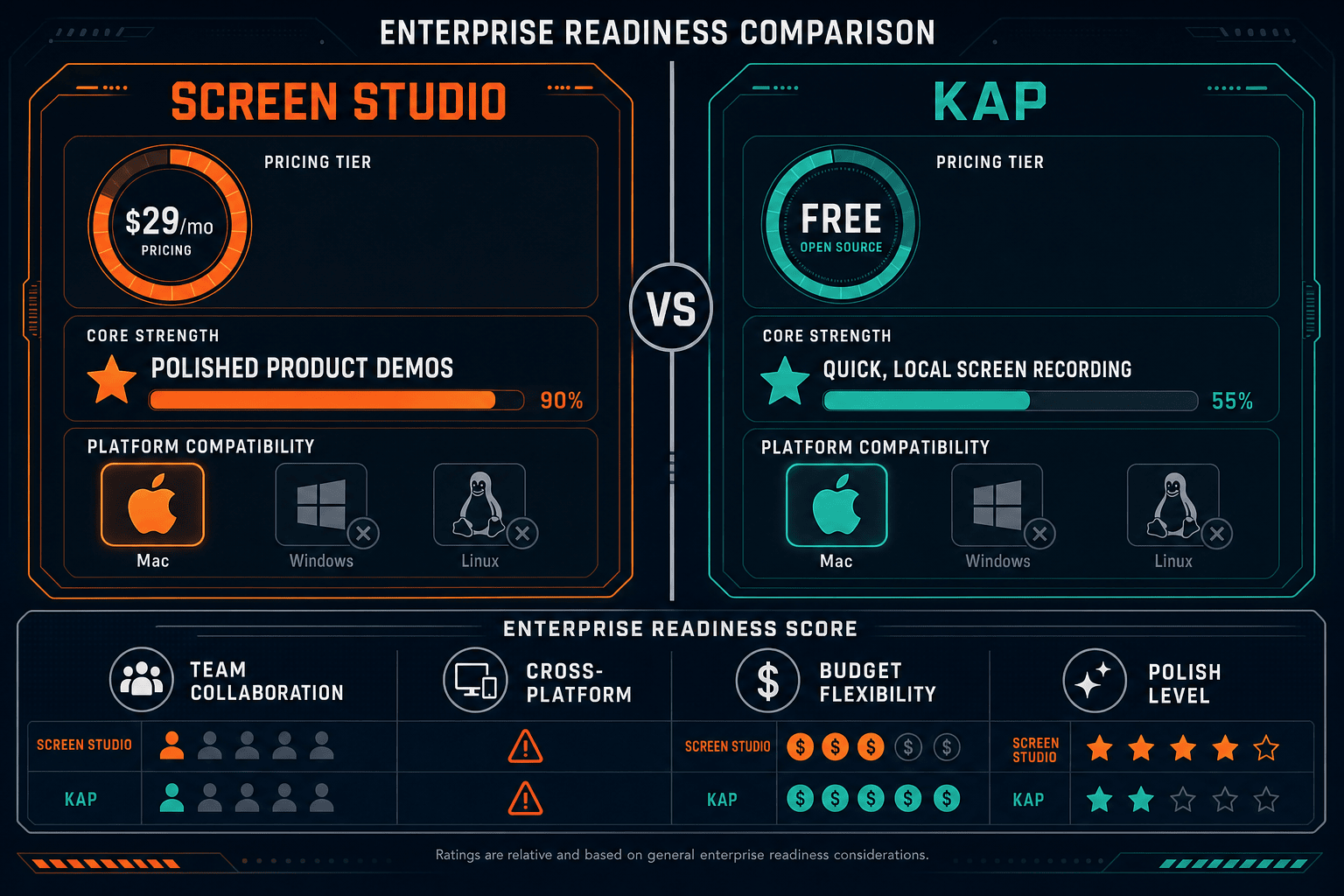
Winner: Docsie Recorder
Docsie Recorder is the only tool in this comparison that combines a free, open-source, cross-platform recording core with a genuine enterprise deployment path. While Screen Studio and Kap both stop at video or GIF output on Mac only, Docsie Recorder routes recordings into Docsie's Video-to-Docs pipeline — generating structured Markdown, DOCX, and PDF documentation, then publishing into versioned knowledge bases with SSO, audit logs, role-based permissions, multi-tenant portals, and a 99.9% uptime SLA. For enterprise teams, Docsie Recorder provides the CREATE workflow both competitors offer, plus the CONVERT, MANAGE, and DELIVER infrastructure neither competitor has.
Decision Helper
A direct framework for picking between Screen Studio, Kap, and Docsie based on your specific needs.
Polished Mac-only product demos with cinematic zoom and motion.
Free open-source Mac screen recorder for GIFs and videos.

Convert real video into searchable docs, then deploy multi-tenant portals.
Common Questions
Q: Does Screen Studio support SSO or SAML for enterprise identity management?
A: No. Screen Studio does not offer SSO, SAML, or OAuth integration based on publicly available information. It is a single-user Mac subscription without documented enterprise identity provider support. Organizations requiring SSO for compliance or IT policy reasons will need to look elsewhere.
Q: Is Kap safe to use in an enterprise environment given it is open-source?
A: Kap's MIT-licensed open-source codebase is a genuine security advantage — IT teams can audit the code directly. Its local-first processing also means recordings do not leave the device by default. However, Kap has no formal compliance certifications, no SOC 2 or HIPAA documentation, and no commercial support, so it still falls short of formal enterprise procurement requirements in regulated industries.
Q: Which tool offers better data residency controls — Screen Studio or Kap?
A: Kap has a practical advantage here because it processes recordings entirely locally by default. Recordings stay on the user's machine unless explicitly exported. Screen Studio's shareable links feature implies some cloud data handling, though the specifics are not publicly documented. Neither tool offers configurable data residency controls or EU-hosted cloud options.
Q: Can Screen Studio or Kap be deployed at scale across a large enterprise team?
A: Neither tool was designed for enterprise-scale deployment. Screen Studio is a single-user Mac subscription with no team administration dashboard, and Kap is a locally installed open-source app with no centralized management layer. Both require manual deployment and governance workarounds for large teams, and neither provides usage analytics or policy enforcement at scale.
Q: Is there a better alternative to both Screen Studio and Kap for enterprise teams?
A: Yes — Docsie Recorder addresses the core gaps both tools share. It is a free, open-source, cross-platform desktop recorder (Mac, Windows, and Linux) with an MIT-licensed core that security teams can audit. Beyond recording, Docsie Recorder connects directly to Docsie's Video-to-Docs pipeline, turning recordings into structured documentation published into a knowledge base with SSO, audit logs, role-based access, SOC 2 compliance, and multi-tenant portal delivery. It is the recorder-first entry point into a complete enterprise documentation workflow — something neither Screen Studio nor Kap can offer.
Q: What happens to recordings made in Screen Studio or Kap after they are exported?
A: Both tools stop at the video or GIF file. Screen Studio can generate shareable links, but there is no versioning, knowledge base publishing, or structured documentation output. Kap exports to local files with no built-in sharing or management layer. Neither tool has a downstream workflow for turning recordings into searchable, versioned documentation — which is a significant limitation for support, enablement, and training teams.
Docsie Recorder gives you a free, open-source, cross-platform recording workflow — plus the enterprise infrastructure both Screen Studio and Kap are missing. Record on Mac, Windows, or Linux, convert recordings into structured docs with Video-to-Docs, and publish into a knowledge base with SSO, audit logs, role-based access, and multi-tenant portal delivery. One workflow from recording to enterprise-ready documentation.
Free recorder Video-to-Docs uses Docsie AI credits — estimate costs before converting.