
4.8
on G2
 Screen Studio
 Cap
Cap
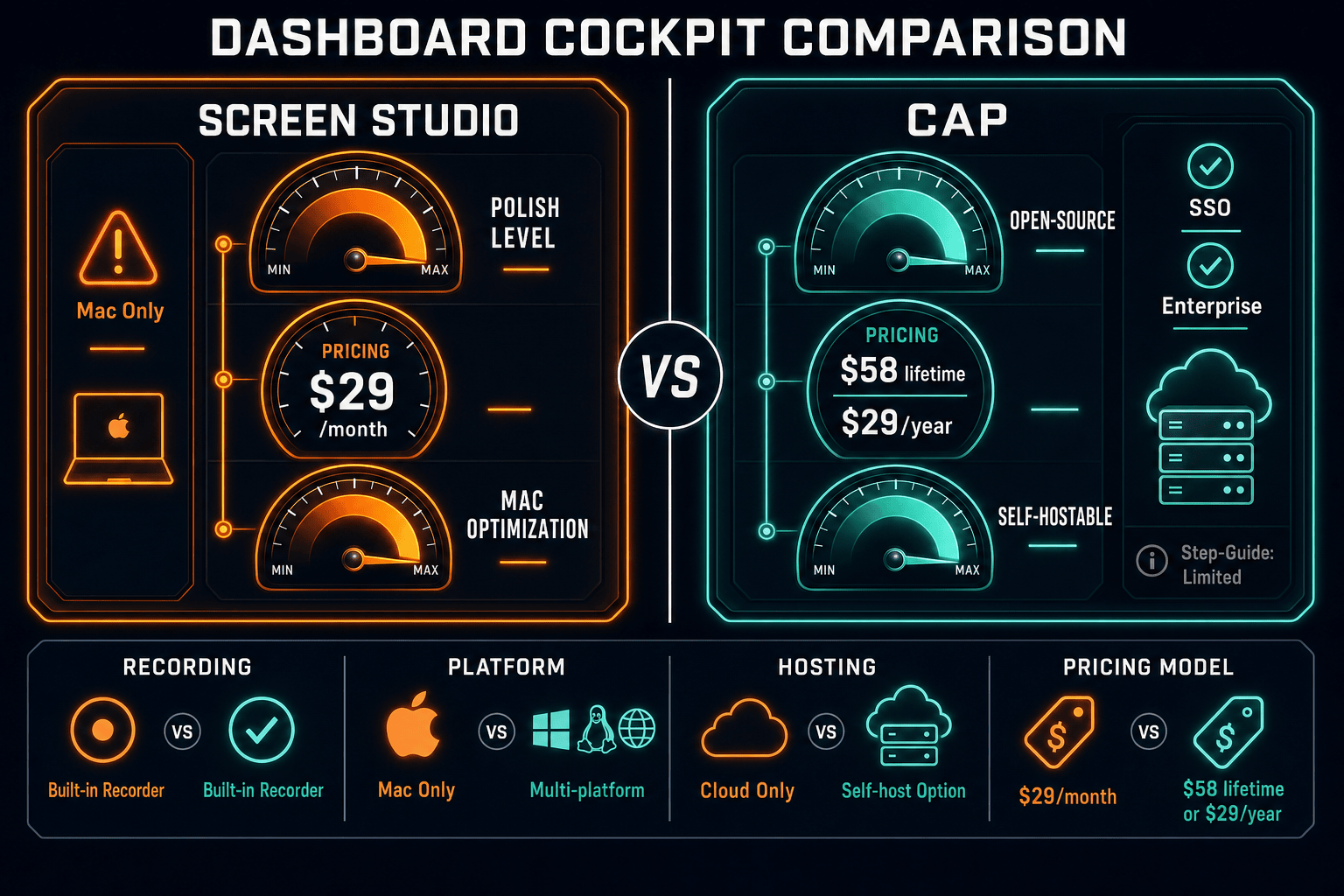
Screen Studio charges $29/month or $9/month billed yearly with no free plan. Cap offers a free open-source tier, a $58 lifetime desktop license, and a $12/user/month Pro cloud plan. This page breaks down what you actually get at each price point and whether either tool is worth the cost.
Screen Studio is the cleaner choice for Mac users who need polished marketing videos and are willing to pay a flat subscription with no free tier.
Feature Matrix
A feature-by-feature breakdown of both tools across recording capabilities, editing polish, output formats, platform support, and documentation workflow — tied to what each pricing tier actually unlocks.
| Feature |
Screen Studio
|
Cap
|
|---|---|---|
| Free Plan Available | ||
| Starting Price | $9/month (billed yearly) | $0 (self-host) or $12/user/month Pro |
| Lifetime License Option | $58 one-time desktop license | |
| Mac Support | ||
| Windows Support | ||
| Linux Support | Verify current support | |
| Open-Source Codebase | ||
| Self-Hosting Option | ||
| Webcam Overlay | ||
| Microphone & System Audio | ||
| Automatic Zoom & Cursor Polish | ||
| Backgrounds & Visual Effects | ||
| Crop, Trim & Speed Regions | Partial — verify full timeline editing | |
| AI Transcription & Summaries | ||
| AI Chapters | ||
| Video Export (up to 4K) | ||
| GIF Export | Verify | |
| Shareable Cloud Links | ||
| Team Collaboration Features | ||
| Analytics | ||
| Knowledge Base / Docs Export | ||
| Markdown / DOCX / PDF Export | ||
| Enterprise / SSO | Custom — verify |
Pricing and features verified from official sources as of May 2026. SaaS pricing changes frequently — verify current plans before purchasing. Screen Studio is Mac-only. Cap's open-source license is AGPLv3; verify current license files on GitHub.
Strengths & Weaknesses
Deep Dive
An in-depth look at three dimensions that matter most when evaluating pricing — value for money, how costs scale with your team, and the hidden costs neither pricing page advertises.
Screen Studio's $9/month yearly plan is competitively priced for a polished Mac recorder, but you are paying for a single-platform tool with no free tier and no path to team features. Cap's $58 lifetime desktop license offers exceptional value for solo users, while the free self-hosted tier gives cost-sensitive teams a zero-dollar recording option. However, both tools stop at video output — neither converts recordings into structured documentation, meaning teams that need written docs must buy a second tool on top of whichever recorder they choose. That hidden second-tool cost matters when calculating true value.
Screen Studio has no team pricing whatsoever — every user needs a separate subscription, and there is no volume discount or seat management visible at any tier. At five Mac users on the monthly plan, you are spending $145/month with no collaboration layer to show for it. Cap's Pro plan at $12/user/month is more team-friendly and includes collaboration and analytics, but scales linearly per seat with no bundled documentation workflow. A team of ten pays $120/month on Cap Pro — reasonable for video sharing, but still leaves the documentation gap unfilled. Neither tool has a fixed-team plan that caps seat costs at scale.
Screen Studio's biggest hidden cost is platform lock-in — any Windows or Linux user on your team needs a completely different tool, creating a fragmented workflow at additional expense. Cap's hidden cost is the AGPLv3 license, which requires any software that embeds or distributes Cap's code to open-source its own codebase — a serious constraint for commercial teams. Both tools share the same documentation gap — neither produces Markdown, DOCX, PDF, or knowledge base content, so teams building product docs, support articles, or onboarding guides face a mandatory second-tool purchase. That downstream cost is rarely included in recorder pricing comparisons but is real for most professional teams.
Pricing Breakdown
Side-by-side pricing tiers for Screen Studio and Cap, including what each plan covers, who it is designed for, and where the value breaks down.
Screen Studio's pricing is simpler — one plan, all features, Mac only. Cap's pricing ladder is more flexible, offering a genuine free tier, a lifetime option, and a team-ready Pro plan. However, both tools share a fundamental pricing limitation: neither includes a documentation workflow at any price point. Teams that record videos to produce written documentation, support articles, or knowledge base content will need to pay for a second tool regardless of which recorder they choose. Cap wins on pricing flexibility and cross-platform value; Screen Studio wins on recording polish per dollar for committed Mac users. Neither wins on total cost of ownership for teams that need docs.
Our Recommendation
Screen Studio is the cleaner choice for Mac users who need polished marketing videos and are willing to pay a flat subscription with no free tier. Cap is the more flexible and cost-effective option for cross-platform teams, offering a free self-hosted tier, a lifetime desktop license, and a team-friendly Pro plan with AI features. Both tools are strong recorders that stop at video output — neither converts recordings into structured documentation, which is a shared gap that matters for most professional teams.
Choose Screen Studio if you need. .
Choose Cap if you need. .
Choose Docsie Recorder if you need. .
Winner: Docsie Recorder
Both Screen Studio and Cap are strong recorders that stop at video output. Docsie Recorder is free, open-source, and cross-platform — matching Cap on cost and platform breadth while matching Screen Studio on recording quality. The decisive advantage is downstream: Docsie Recorder feeds directly into Docsie's Video-to-Docs pipeline, turning recordings into structured documentation that can be versioned, published to a knowledge base, delivered through multi-tenant portals, and reused as course material. For teams evaluating recorder pricing, the real question is not Screen Studio vs Cap — it is whether your recorder workflow ends at a video file or produces the structured docs your team actually needs.
Decision Helper
A direct framework for picking between Screen Studio, Cap, and Docsie based on your specific needs.
Polished Mac-only product demos with cinematic zoom and motion.
Open-source screen recorder with cloud sharing.

Convert real video into searchable docs, then deploy multi-tenant portals.
Common Questions
Q: Does Screen Studio have a free plan or free trial?
A: Screen Studio does not offer a confirmed free plan. The tool is available as a download for macOS, but current free trial terms should be verified on the official site before purchasing. Paid plans start at $29/month or $9/month billed yearly, with all features included at both tiers. There is no team or enterprise pricing visible.
Q: Is Cap's free plan genuinely free or just a trial?
A: Cap's free tier is a genuine open-source self-hosted option — not a time-limited trial. You can download and self-host the AGPLv3 recorder at no cost indefinitely. The trade-off is that self-hosting requires your own infrastructure and ongoing maintenance. Cap's cloud features, AI transcription, summaries, and team collaboration are available on the Pro plan at $12/user/month or through the $58 lifetime desktop license.
Q: Which tool is cheaper for a team of five people?
A: For a team of five on yearly plans, Screen Studio costs approximately $540/year ($108/year per Mac user) but only covers Mac users and includes no team features. Cap Pro costs $720/year ($144/year per user at $12/month) but works cross-platform and includes collaboration, analytics, and AI features. If your team has any Windows users, Screen Studio is not a viable option regardless of price. Cap's lifetime desktop license at $58/user is the cheapest upfront option for teams that do not need cloud sharing.
Q: Does either tool charge extra for AI features like transcription or summaries?
A: Screen Studio includes transcription as part of its standard subscription with no separate AI add-on charge. Cap includes AI transcription, summaries, and chapters in its Pro cloud plan at $12/user/month — these features are not available on the free self-hosted tier. Neither tool charges a separate per-minute or per-video AI fee at the time of research, but pricing details should be verified before purchasing.
Q: Is there a better alternative to both Screen Studio and Cap for teams that need documentation?
A: Yes — Docsie Recorder addresses the core limitation both tools share. Screen Studio and Cap both stop at video output; neither converts recordings into structured documentation. Docsie Recorder is a free, open-source, cross-platform recorder that connects directly to Docsie's Video-to-Docs pipeline. You record once and get both a local MP4/GIF export and a structured Markdown, DOCX, or PDF document published into a versioned knowledge base — without paying for a second tool. For teams that record walkthroughs, tutorials, or product demos and then need to produce written documentation from those recordings, Docsie Recorder eliminates the gap that Screen Studio and Cap both leave open.
Q: Should I pick Screen Studio or Cap if I only need a recorder for marketing videos?
A: If you are on a Mac and want the most polished visual output for marketing videos — automatic zoom, motion blur, cursor smoothing, and iOS recording — Screen Studio is the stronger choice at $9/month yearly. If you are on Windows or want to avoid a recurring subscription, Cap's $58 lifetime desktop license is the better value for marketing video output. Neither tool requires a knowledge base or documentation workflow for this use case, so the decision comes down to platform and preferred payment model.
Both Screen Studio and Cap are solid recorders — but both stop at the video file. Docsie Recorder is free, open-source, and cross-platform. It records and edits screen videos locally, then connects directly to Docsie's Video-to-Docs pipeline to turn your recordings into structured Markdown, DOCX, PDF, and knowledge base articles. No second tool required. No platform lock-in. No recurring subscription for the recorder itself.
Free and open-source recorder. Video-to-Docs conversion uses Docsie AI credits — estimate costs before converting.