
4.8
on G2
 Notion
 Zendesk Guide
Notion is a flexible all-in-one workspace popular with startups and growing teams, while Zendesk Guide is a support-focused help center bundled with Zendesk Suite. Neither was purpose-built for enterprise knowledge management at scale. This comparison breaks down how each performs on security, compliance, scalability, and administration — and why enterprise buyers increasingly look beyond both.
Notion is the all-in-one docs and databases workspace, Zendesk Guide ships a help center tied to Zendesk Support, while Docsie covers what both miss — video conversion, multi-tenant portals, and enterprise compliance in one platform.
Feature Matrix
A detailed comparison of enterprise-critical capabilities across security, compliance, administration, scalability, and support for Notion and Zendesk Guide.
| Feature |
Notion
|
Zendesk Guide
|
|---|---|---|
| SOC 2 Type II Compliance | ||
| GDPR Compliance | ||
| HIPAA Readiness | ||
| SAML SSO | Business+ only | |
| SCIM Provisioning | Enterprise only | |
| Audit Logs | Enterprise only | |
| Role-Based Access Control | ||
| Granular Permissions | ||
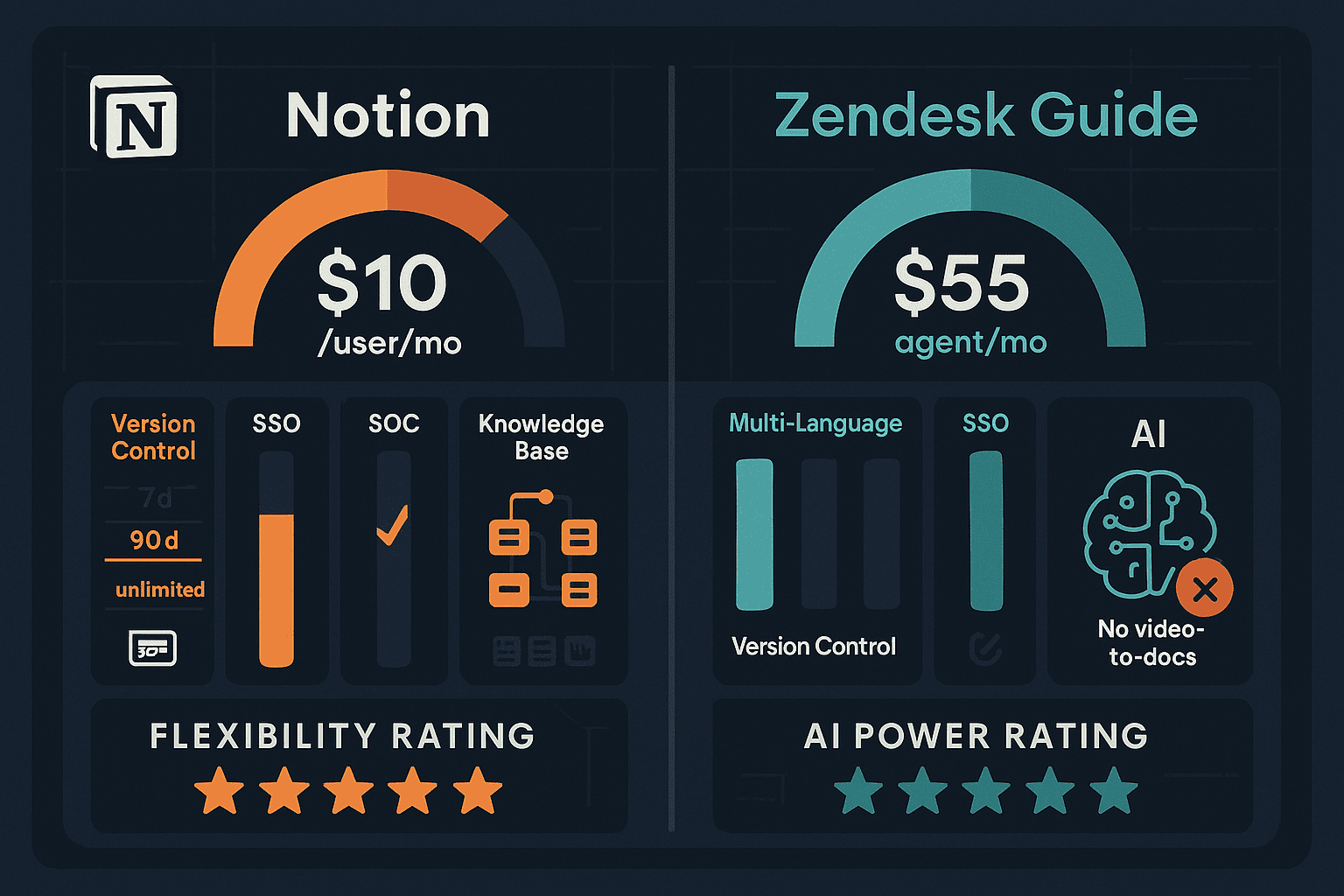
| Version Control | 7 days (Free/Plus), 90 days (Business), unlimited (Enterprise) | |
| Approval & Review Workflows | ||
| Multi-Language Support | ||
| Auto-Translation | ||
| Custom Domain | ||
| Multi-Tenant Portals | ||
| Uptime SLA | ||
| Dedicated Success Manager | Enterprise only | Enterprise only |
| API Access | ||
| Advanced Analytics & Reporting | Business+ | |
| Ticket Deflection Analytics | ||
| Air-Gap / Private Infrastructure |
Data as of February 2026. Features are based on publicly available information and vendor documentation. Zendesk Guide is not sold standalone — it requires purchase of Zendesk Suite starting at $55/agent/month.
Strengths & Weaknesses
Deep Dive
An in-depth analysis of enterprise-critical dimensions including security and compliance, scalability, administration, and support SLAs.
Both Notion and Zendesk Guide hold SOC 2 Type II and GDPR certifications, establishing a baseline of enterprise security. However, neither offers HIPAA readiness or air-gap deployment for regulated industries. Notion gates audit logs and SCIM provisioning behind its custom Enterprise tier, meaning Business plan customers ($20/user) lack key compliance controls. Zendesk Guide includes SSO, SCIM, and audit logs across more tiers, giving it an edge for compliance-conscious buyers — though its $10B private equity acquisition in 2022 has raised concerns among enterprise security teams about data governance trajectory and pricing stability.
Zendesk Guide is designed to handle high-volume customer support environments with dedicated infrastructure at the enterprise tier, ticket deflection analytics, and a proven track record with large-scale deployments. Notion, while technically capable of supporting large teams, is prone to organizational drift at scale — its flexible, free-form structure requires disciplined governance to remain navigable as content volumes grow. Neither tool supports multi-tenant portals, meaning teams managing documentation for multiple clients must maintain entirely separate workspaces, creating a significant scalability bottleneck for consultancies and implementation partners.
Zendesk Guide provides stronger out-of-the-box administrative controls for enterprise deployments — including approval workflows, team publishing, granular permissions, SCIM provisioning, and version control without time caps. Notion's administrative features are more limited until Enterprise tier: version history is capped at 90 days on Business (7 days on Plus), and there are no formal approval workflows for content governance. For enterprises that require structured content review processes before publishing, Zendesk Guide's editorial controls are meaningfully more mature. Neither platform, however, offers the kind of multi-tenant workspace isolation that enterprise implementation partners typically require.
Zendesk Guide benefits from being part of the broader Zendesk ecosystem — enterprises can expect dedicated support, formal SLAs, and a large professional services network, though post-PE-acquisition pricing has escalated significantly. Notion offers a dedicated success manager at Enterprise tier and has improved its enterprise support posture, but it still lags Zendesk's institutional depth for mission-critical deployments. Both tools offer priority support at their highest tiers. Critically, neither offers the kind of documentation-specific SLAs that enterprises running customer-facing knowledge bases with compliance requirements demand — uptime guarantees are present but not documentation-workflow-specific.
Our Recommendation
Notion is the stronger choice for internal team workspaces where flexibility and collaboration matter more than governance rigor. Zendesk Guide wins for customer support teams that are already invested in the Zendesk ecosystem and need AI-powered ticket deflection — but its bundled pricing and lack of standalone availability make it a poor fit for teams that only need documentation. Both tools share critical gaps for enterprise knowledge management at scale.
Choose Notion if you need...
Choose Zendesk Guide if you need...
Choose Docsie if you need...
Winner: Docsie
Neither Notion nor Zendesk Guide was built for the enterprise knowledge management challenges that matter most in 2026 — converting existing video content into structured docs, delivering branded portals to multiple clients simultaneously, and running compliance monitoring on private infrastructure. Docsie's six-pillar CONVERT → MANAGE → DELIVER → LEARN → AUTOMATE → MONITOR framework addresses every gap both competitors share, with purpose-built multi-tenant architecture, unlimited version control, built-in LMS with certifications, autonomous agents, and real-time HIPAA/SOX/ITAR/GDPR compliance monitoring — all on private infrastructure with a 99.9% uptime SLA.
Decision Helper
A direct framework for picking between Notion, Zendesk Guide, and Docsie based on your specific needs.
All-in-one workspace combining docs, databases, and project management.
Help center bundled with Zendesk Support for ticket-deflection knowledge bases.

AI-powered knowledge base with multi-tenant portals, video conversion, and compliance scanning.
Common Questions
Q: Does Notion have the security controls enterprises require?
A: Notion offers SOC 2 Type II and GDPR compliance across all paid tiers, but critical enterprise controls like SCIM provisioning, audit logs, and advanced security are gated behind its custom Enterprise plan. Businesses on the $20/user Business plan lack these controls. There is no HIPAA readiness, no air-gap deployment option, and version history is capped at 90 days — insufficient for regulated industries with longer retention requirements.
Q: Is Zendesk Guide sold as a standalone product?
A: No. Zendesk Guide is exclusively bundled with Zendesk Suite and cannot be purchased independently. The entry price is $55/agent/month for Suite Team, rising to $249+/agent/month at enterprise tier. AI Agents and Agent Copilot are additional add-ons at $50/agent/month each. If your organization only needs a knowledge base and not a full ticketing system, you will be paying for significant functionality you don't use.
Q: Which tool handles multi-language enterprise documentation better?
A: Zendesk Guide has a clear advantage here — it includes multi-language support and auto-translation as part of its core feature set, which is essential for global enterprise deployments. Notion does not support multi-language documentation or auto-translation at any tier, making it a poor fit for enterprises serving international audiences or operating across multiple regional offices.
Q: Is there a better alternative to both Notion and Zendesk Guide for enterprise documentation?
A: Yes. Docsie was purpose-built to address the gaps both tools share. It offers multi-tenant portals (neither Notion nor Zendesk Guide supports this), video-to-documentation conversion from any source, 100+ language auto-translation, unlimited version control, built-in LMS with certifications, autonomous agents, and real-time compliance monitoring for HIPAA, SOX, ITAR, and GDPR — all deployable on private infrastructure. For enterprises managing documentation across multiple clients or product lines, Docsie's six-pillar knowledge orchestration platform covers the full lifecycle that neither Notion nor Zendesk Guide can match.
Q: How does per-user pricing compare between Notion and Zendesk Guide at enterprise scale?
A: Notion Business costs $20/user/month (annual) for full AI features, scaling to custom Enterprise pricing for audit logs and SCIM. Zendesk Guide requires purchasing Zendesk Suite — starting at $55/agent/month and reaching $249+/agent/month at the enterprise tier, with AI Agents as additional $50/agent/month add-ons. For a 100-person team, Zendesk Suite enterprise can exceed $300,000 per year before AI add-ons, making Notion significantly more cost-efficient for pure documentation use cases. Neither tool uses workspace-based pricing, which means costs scale directly and steeply with headcount.
Q: Can either Notion or Zendesk Guide support multi-tenant client portals for implementation partners?
A: Neither Notion nor Zendesk Guide supports multi-tenant portals — the ability to deliver one knowledge base through multiple separately branded portals to different clients. Notion requires entirely separate workspaces per client, with no unified management layer. Zendesk Guide is designed for a single organization's customer base, not for implementation partners serving multiple enterprise clients. This is one of the most significant shared gaps between the two tools and a primary reason enterprise implementation partners evaluate purpose-built alternatives like Docsie.
Start creating professional documentation that your users will love