
4.8
on G2
 Guru
Guru
 Zendesk Guide
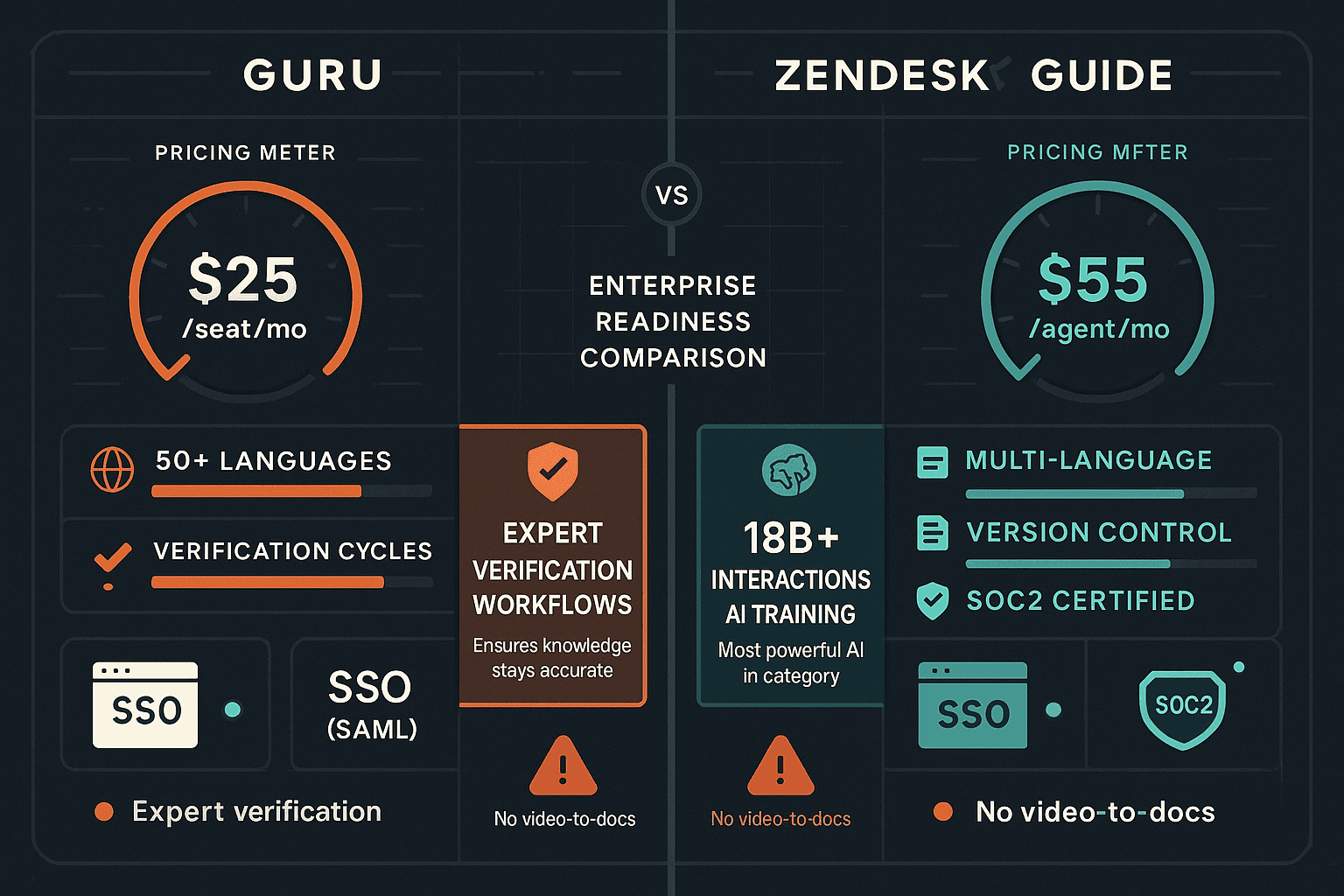
Both Guru and Zendesk Guide serve enterprise teams, but in fundamentally different ways. Guru is an internal knowledge management platform with AI-powered verification workflows, while Zendesk Guide is a customer-facing help center bundled inside the Zendesk support suite. This head-to-head comparison examines how each platform performs on security, compliance, scalability, administration, and enterprise support — so you can make an informed decision for your organization.
Guru and Zendesk Guide cover different enterprise needs but share gaps in SSO depth, multi-tenancy, and audit-grade compliance—where Docsie was built from the ground up.
Enterprise Feature Matrix
A comprehensive comparison of enterprise-critical features including security, compliance, scalability, administration controls, and support across both platforms.
| Enterprise Feature |
Guru
|
Zendesk Guide
|
|---|---|---|
| SOC 2 Type II Compliance | ||
| GDPR Compliance | ||
| HIPAA Readiness | Enterprise only | |
| SAML SSO | Enterprise only | |
| OAuth / OIDC SSO | ||
| Role-Based Access Control | ||
| Granular Permissions | ||
| Audit Logs | Enterprise only | |
| Data Residency Options | Enterprise Plus | |
| Air-Gap / Private Infrastructure | ||
| Multi-Tenant Portals | ||
| Custom Domain Support | ||
| Custom Branding / White-Label | ||
| Uptime SLA | Not published | 99.9% (Enterprise) |
| Dedicated Customer Success Manager | Enterprise only | Enterprise Plus |
| Priority / Enterprise Support | Builder+ plans | Suite Professional+ |
| API Access | ||
| Advanced Analytics & Reporting | Builder+ plans | |
| Approval & Verification Workflows | ||
| Scalability (number of sites/portals) | Single internal KB | Single help center per brand |
Data as of February 2026. Features are based on publicly available information and vendor documentation. Zendesk Guide is not sold standalone — it requires purchase of Zendesk Suite starting at $55/agent/month.
Strengths & Weaknesses
Deep Dive
An in-depth analysis of enterprise-critical dimensions including security, scalability, administration, and support — with an honest assessment of where each platform excels and falls short.
Both Guru and Zendesk Guide achieve SOC 2 Type II and GDPR compliance, establishing a solid security baseline. However, their enterprise security depth diverges significantly. Zendesk offers SAML and OAuth/OIDC SSO across plans, dedicated infrastructure on Enterprise Plus, and audit logs for compliance tracking. Guru restricts SAML SSO to its Enterprise tier and offers no data residency options, limiting organizations with strict EU data sovereignty requirements. Neither platform supports air-gap deployment or private infrastructure — a critical gap for regulated industries such as defense, healthcare, and financial services requiring zero external data exposure.
Zendesk Guide benefits from Zendesk's battle-tested infrastructure serving thousands of enterprise customers globally, with a published 99.9% uptime SLA on Enterprise plans — a contractual commitment enterprises can anchor vendor agreements to. Guru lacks a published uptime SLA, which complicates procurement for organizations with strict availability requirements. Both platforms are architected around a single knowledge base or help center per account — neither supports multi-tenant delivery where one system powers multiple branded portals simultaneously. Organizations managing knowledge for multiple clients, business units, or brands will hit architectural limits with both tools.
Zendesk Guide provides more comprehensive administration controls out of the box — granular permissions, audit logs, approval workflows, team publishing, and custom domain management are available across its tiers. Guru's verification workflows are a genuine differentiator for internal knowledge governance, ensuring subject matter experts review and certify content on a defined cadence. However, Guru restricts key enterprise admin features like SAML SSO and audit logs to its highest Enterprise tier, requiring organizations to upgrade before accessing controls that Zendesk includes at lower tiers. Both tools offer role-based access, but Zendesk's configuration depth is broader for large support operations.
Zendesk Guide's support offering reflects its enterprise heritage — dedicated CSMs on Enterprise Plus, priority support on Professional, and a contractual 99.9% uptime SLA giving procurement teams a concrete commitment to negotiate against. Guru provides dedicated CSMs on its Enterprise tier with priority support on Builder plans, but the absence of a published uptime SLA is a meaningful gap when enterprise buyers need formal SLA documentation for vendor risk assessments. Both vendors offer 14-day free trials. For organizations entering multi-year contracts with strict vendor management requirements, Zendesk's formalized SLA structure provides more contractual clarity than Guru's current offering.
Our Recommendation
Guru and Zendesk Guide are enterprise-capable platforms built for fundamentally different buyers. Guru is purpose-built for internal knowledge management — keeping tribal knowledge verified, searchable, and surfaced inside Slack and other work tools. Zendesk Guide is a customer-facing help center that only makes sense if you are already invested in the Zendesk support ecosystem. Choosing between them is less about feature parity and more about whether your primary need is internal knowledge governance or customer support deflection.
Choose Guru if you need...
Choose Zendesk Guide if you need...
Choose Docsie if you need...
Winner: Docsie
Guru and Zendesk Guide both leave critical enterprise gaps unaddressed — neither supports multi-tenant portal delivery, neither can convert video content into structured documentation, and neither offers air-gap deployment or real-time compliance monitoring for regulated industries. Docsie's six-pillar platform covers CONVERT, MANAGE, DELIVER, LEARN, AUTOMATE, and MONITOR in one system — with SOC 2 Type II, GDPR, HIPAA, SOX, and ITAR compliance, 99.9% uptime SLA, private infrastructure deployment, and the ability to scale to 10,000+ documentation sites across unlimited client portals. For enterprise teams that need more than internal wikis or bundled help centers, Docsie provides the knowledge orchestration infrastructure both competitors were never designed to offer.
Decision Helper
A direct framework for picking between Guru, Zendesk Guide, and Docsie based on your specific needs.
AI-powered enterprise wiki with verification workflows.
Help center module inside the Zendesk customer support suite.

Multi-tenant knowledge portals with AI chatbot and video-to-docs.
Common Questions
Q: Does Guru or Zendesk Guide support HIPAA compliance?
A: Guru does not currently offer HIPAA compliance. Zendesk offers HIPAA-eligible configuration on Enterprise Plus plans, but it requires additional setup and is not available on lower tiers. For organizations in healthcare or adjacent regulated industries that need HIPAA-ready documentation infrastructure with real-time compliance monitoring, neither platform provides it natively — Docsie supports HIPAA-ready deployments with frame-by-frame content monitoring as part of its MONITOR pillar.
Q: Can I get a contractual uptime SLA from Guru?
A: Guru does not publish a formal uptime SLA, which is a meaningful gap for enterprise procurement teams that require vendor SLA documentation for risk assessments and contract negotiations. Zendesk Guide provides a contractual 99.9% uptime SLA on its Enterprise and Enterprise Plus plans. If a published SLA is a hard requirement for your organization, Zendesk Suite has a clear advantage over Guru in this area.
Q: Does either platform support air-gap or private infrastructure deployment?
A: Neither Guru nor Zendesk Guide supports air-gap deployment or private infrastructure operation. Both platforms run on shared cloud infrastructure, which disqualifies them from use cases in defense, government, or heavily regulated industries that prohibit external data exposure. Docsie's AUTOMATE and MONITOR pillars are designed to run entirely on private infrastructure, making it the only option among these three for organizations with zero-external-data-exposure requirements.
Q: Do I have to buy all of Zendesk to get Zendesk Guide?
A: Yes. Zendesk Guide is not sold as a standalone product — it is bundled exclusively with Zendesk Suite, starting at $55 per agent per month. If your organization only needs a documentation or help center platform and does not require Zendesk's ticketing system, you will be paying for significant functionality you are not using. This bundled pricing model makes Zendesk Guide a poor fit for teams whose primary need is knowledge management rather than customer support ticket handling.
Q: Is there a better alternative to both Guru and Zendesk Guide for enterprise documentation?
A: Yes — Docsie is purpose-built for enterprise knowledge orchestration and addresses the core limitations both platforms share. Guru is internal-only with no multi-tenant portal delivery or video conversion; Zendesk Guide is support-team-centric and requires purchasing the full Zendesk Suite. Docsie converts any content — video, PDF, web — into structured documentation, delivers it through unlimited branded multi-tenant portals, includes a built-in LMS with certifications, runs autonomous agents on private infrastructure, and monitors content compliance in real time for HIPAA, SOX, ITAR, and GDPR. For enterprise teams managing knowledge across multiple clients or business units, Docsie provides capabilities neither competitor was designed to offer.
Q: How do Guru and Zendesk Guide compare on per-seat pricing at enterprise scale?
A: Guru's Enterprise tier is custom-priced but built on a per-seat model with a 10-seat minimum floor of $250/month — costs scale linearly as headcount grows. Zendesk Guide on Enterprise Plus runs approximately $249 per agent per month, and AI Agents are an additional $50 per agent on top. For large organizations with hundreds of agents or knowledge workers, both platforms can become extremely expensive. Docsie's workspace-based pricing with AI credits — rather than per-seat fees — typically offers better economics at scale, especially for organizations managing documentation across multiple clients or departments without needing every user to be a licensed seat.
Guru excels at internal knowledge verification but lacks external portal delivery, video conversion, and private infrastructure. Zendesk Guide requires buying the full support suite and offers no multi-tenant documentation delivery. Docsie addresses both gaps — converting any video or document into structured knowledge bases, delivering them through unlimited branded portals, and running on private infrastructure with SOC 2 Type II, GDPR, HIPAA, SOX, and ITAR compliance. One platform. Six pillars. Enterprise-ready from day one.
Free plan includes AI credits to convert a 10-minute training video. No credit card required.