
4.8
on G2
 GitBook
 Scribe
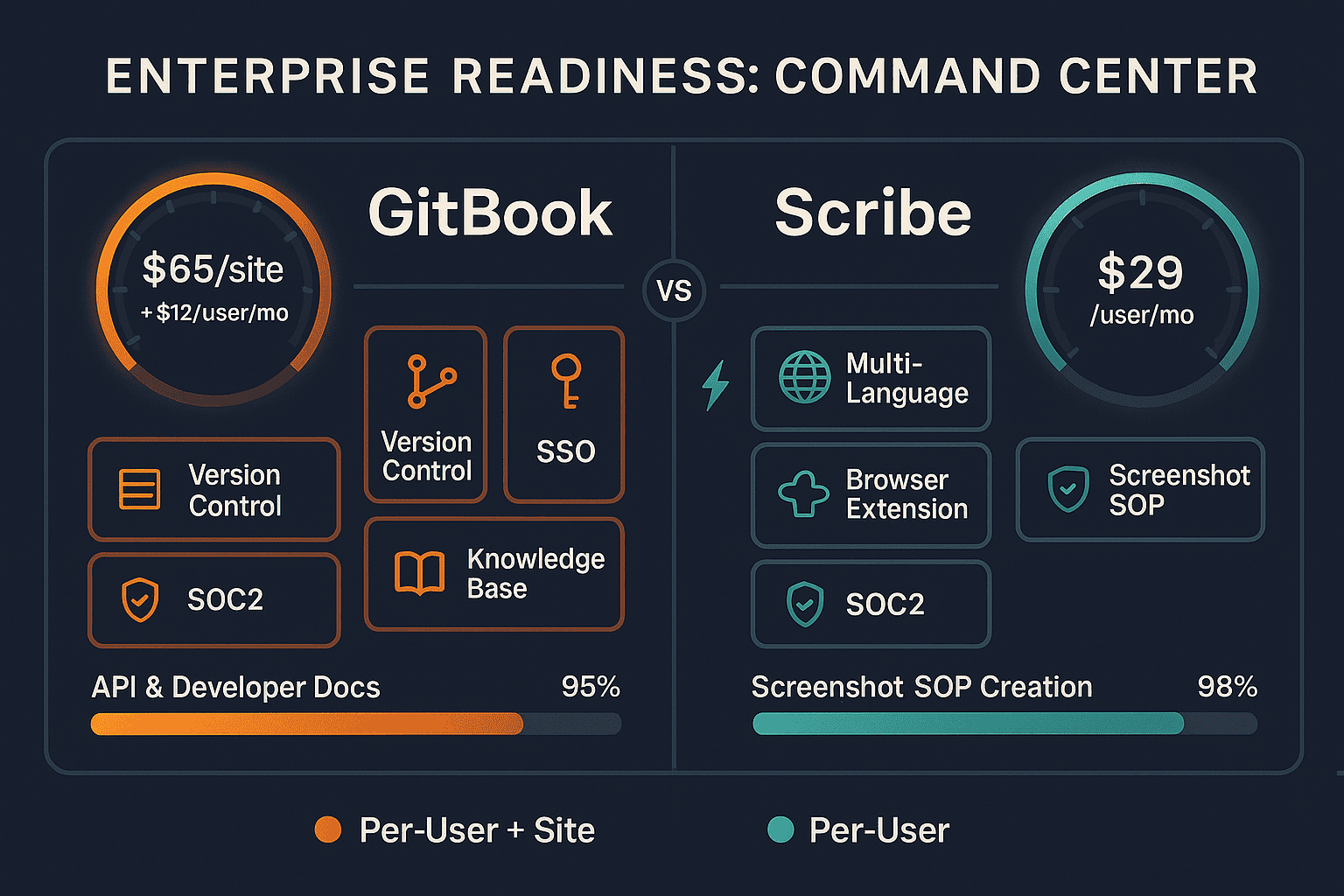
GitBook and Scribe both serve enterprise teams, but their security models, compliance certifications, administrative controls, and scalability differ significantly. This head-to-head breaks down exactly how each platform performs for enterprise buyers—and where both fall short.
For enterprise: GitBook brings git-native developer documentation with branching workflows, Scribe brings browser-based step capture for screenshot-driven how-to guides, yet neither delivers multi-tenant portals or full multi-tenancy — gaps Docsie fills with SOC 2 Type II and SSO.
Enterprise Feature Matrix
A feature-by-feature comparison of enterprise readiness across security, compliance, administration, scalability, and support for both platforms.
| Enterprise Capability |
GitBook
|
Scribe
|
|---|---|---|
| SOC 2 Type II Compliance | ||
| GDPR Compliance | ||
| ISO 27001 Certification | ||
| HIPAA Support | Enterprise (PHI redaction) | |
| SSO (SAML / SCIM) | Paid tiers | Enterprise only |
| Role-Based Access Control | Paid tiers | |
| Granular Permissions | Advanced on Pro+ | Enterprise only |
| IP Whitelisting | Enterprise only | |
| Audit Logs | ||
| Data Residency Options | ||
| Air-Gap / Private Infrastructure | ||
| Uptime SLA | Enterprise SLA | |
| Dedicated Support | Ultimate tier | Enterprise tier |
| Custom Branding / White Label | Pro+ only | |
| Custom Domain Support | $65/site fee | |
| API Access | ||
| Multi-Tenant Portals | ||
| Content Approval Workflows | Change requests (Git-style) | Pro Team+ |
| Analytics & Reporting | Basic (paid tiers) | Pro Team+ |
| Compliance Monitoring |
Data as of February 2026. Features based on publicly available vendor documentation and pricing pages. Enterprise tier pricing for Scribe reported at $18,000+ annually.
Strengths & Weaknesses
Deep Dive Analysis
An in-depth analysis of enterprise readiness across four critical dimensions — security and compliance, scalability, administration, and support.
GitBook holds SOC 2 Type II and ISO 27001 certifications, making it one of the stronger compliance postures in the documentation space. SAML SSO and visitor authentication are available on paid tiers. However, GitBook lacks audit logs, IP whitelisting, and data residency controls — significant gaps for heavily regulated industries. Scribe counters with HIPAA PHI redaction and IP whitelisting at Enterprise, making it attractive for healthcare. Both tools miss audit logging and private infrastructure options, leaving compliance-heavy organizations (finance, government, defense) without adequate controls for full enterprise deployments.
GitBook scales well for developer documentation teams, supporting multiple sites and advanced Git-based workflows. However, the 2024–2025 pricing shift to $65/site means scaling to dozens of documentation properties becomes expensive quickly. Scribe is fundamentally an internal process documentation tool with no custom domain support, no multi-tenant delivery, and no infrastructure built for external-facing scale. Neither platform publishes uptime SLAs on standard plans. For enterprises needing to deliver documentation to multiple client organizations simultaneously — or run knowledge operations across hundreds of product lines — both tools hit ceilings that their architectures weren't designed to overcome.
GitBook provides Git-style change request workflows, branching, and role-based permissions on higher tiers, which gives technical administrators meaningful content governance. Scribe offers SCIM provisioning for automated user lifecycle management and approval workflows on Pro Team plans, which is useful for HR and ops teams. Both tools, however, lack audit logs — a baseline requirement for enterprise governance in most regulated industries. Neither supports data residency, air-gap deployment, or granular tenant-level isolation. Scribe has no API access, limiting automation and integration with enterprise ITSM or HRMS platforms. GitBook's API provides more administrative flexibility but still lacks native enterprise governance tooling.
GitBook offers priority support and dedicated assistance on its Ultimate tier (custom pricing), but standard plans lack documented SLA commitments. Scribe provides an Enterprise SLA with dedicated support at its top tier, reported at $18,000+ annually. Both tools concentrate enterprise-grade support behind their most expensive plans, leaving mid-market buyers with standard support coverage only. Neither publishes a 99.9% uptime guarantee across their general plan stack. For organizations that require guaranteed response times, named success managers, and contractual uptime commitments as a baseline — not a premium add-on — both GitBook and Scribe fall short of what purpose-built enterprise knowledge platforms deliver.
Our Recommendation
GitBook is the stronger enterprise option for developer-facing technical documentation, with ISO 27001 certification, Git-native version control, and API access that technical teams value. Scribe is the stronger option for internal HR and ops workflows requiring HIPAA-compliant process documentation. Neither tool, however, was architected for enterprise-wide knowledge orchestration — both lack audit logs, data residency, multi-tenant delivery, and the administrative controls that large organizations require across regulated industries.
Choose GitBook if you need...
Choose Scribe if you need...
Choose Docsie if you need...
Winner: Docsie
Both GitBook and Scribe leave enterprise buyers without audit logs, data residency, air-gap deployment, multi-tenant delivery, and compliance monitoring — the table-stakes features regulated industries require. Docsie's six-pillar platform (CONVERT → MANAGE → DELIVER → LEARN → AUTOMATE → MONITOR) addresses every gap both competitors share, with 99.9% uptime SLA, private infrastructure capability, real-time compliance scanning for HIPAA/SOX/ITAR/GDPR, and multi-tenant portals that scale to 10,000+ documentation sites — all from a single platform.
Decision Helper
A direct framework for picking between GitBook, Scribe, and Docsie based on your specific needs.
Git-native developer documentation with branching workflows.
Browser-based step capture for screenshot-driven how-to guides.

Convert real video into searchable docs, then deploy multi-tenant portals.
Common Questions
Q: Does GitBook have audit logs for enterprise compliance?
A: No. GitBook does not currently offer audit logs, which is a meaningful gap for enterprises in regulated industries. While GitBook provides Git-based change history at the content level, there is no centralized audit trail of user actions, permission changes, or administrative events. Organizations requiring audit logging for SOX, HIPAA, or FedRAMP compliance will need to look elsewhere.
Q: Is Scribe HIPAA compliant for healthcare documentation?
A: Scribe offers AI PII/PHI redaction and an Enterprise SLA at its top tier, positioning it as a viable option for healthcare process documentation. However, Scribe does not provide data residency, audit logs, or private infrastructure deployment, which are typically required for full HIPAA compliance programs. Organizations should conduct a detailed BAA review before relying on Scribe for protected health information workflows.
Q: Can GitBook or Scribe deliver documentation to multiple client organizations?
A: Neither GitBook nor Scribe supports multi-tenant portal delivery. GitBook creates documentation sites for a single organization, while Scribe is built exclusively for internal audiences. Agencies, consultancies, or enterprises needing to deliver branded, access-controlled documentation to multiple external clients simultaneously will find both platforms architecturally unsuited for that use case.
Q: Which tool offers better SSO support for enterprise identity management?
A: Both tools offer SAML SSO, but only at higher paid tiers. Scribe adds SCIM provisioning at Enterprise, enabling automated user lifecycle management through identity providers like Okta or Azure AD — a meaningful advantage for large IT teams. GitBook supports SAML on paid plans but lacks SCIM, requiring manual user management at scale. Neither tool offers the breadth of SSO options (SAML, OAuth, OIDC, Azure AD, Google, Okta) that full enterprise knowledge platforms provide.
Q: Is there a better alternative to both GitBook and Scribe for enterprise knowledge management?
A: Yes — Docsie was purpose-built to address the enterprise gaps both GitBook and Scribe share. Docsie provides audit logs, 99.9% uptime SLA, multi-tenant portals, real-time compliance monitoring for HIPAA/SOX/ITAR/GDPR, air-gap deployment on private infrastructure, and a built-in LMS with certifications. It converts any video or document into structured knowledge bases and delivers them across unlimited branded client portals — capabilities neither GitBook nor Scribe offer at any price tier.
Q: How does enterprise pricing compare between GitBook and Scribe?
A: Both tools concentrate enterprise features behind custom or high-cost plans. Scribe Enterprise is reported at $18,000+ annually with custom per-user pricing. GitBook's Ultimate tier (which includes AI and dedicated support) is also custom-priced, while standard plans now charge $65/site for custom domains — costs that escalate quickly across multiple documentation properties. Docsie's Organization plan starts at $750/month for up to 90 users with enterprise features included, offering more predictable pricing without per-seat or per-site cost inflation.
Docsie delivers the enterprise capabilities both GitBook and Scribe are missing — audit logs, 99.9% uptime SLA, multi-tenant portals, real-time compliance monitoring for HIPAA/SOX/ITAR/GDPR, and private infrastructure deployment. Convert any video or document into structured knowledge bases, deliver them across unlimited branded client portals in 100+ languages, and monitor compliance in real time — all from one platform.
No credit card required. Free AI credits included. Enterprise security review available on request.