
4.8
on G2
 Document360
 Guidde
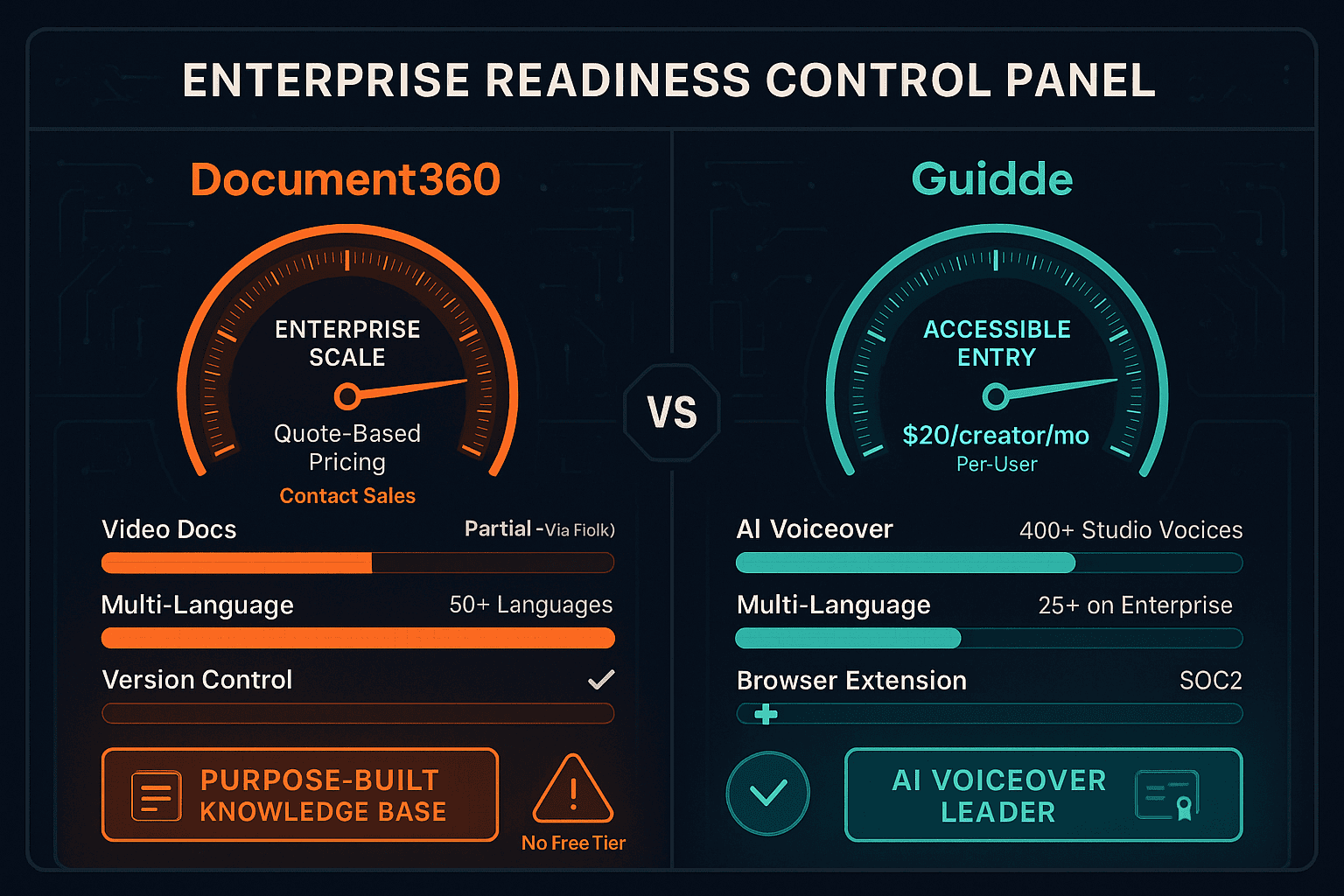
Document360 is a purpose-built knowledge base platform with enterprise content governance features, while Guidde is a screen-capture video tool that bolts on enterprise controls at its top tier. This head-to-head examines which is truly ready for enterprise documentation demands — and where both fall short.
For enterprise: Document360 runs a structured knowledge base, Guidde captures workflows into quick guides, while Docsie turns existing video into docs and deploys them through multi-tenant portals — features neither tool offers.
Enterprise Feature Matrix
A detailed comparison of enterprise-critical capabilities including security, compliance, administration, scalability, and support across both platforms.
| Enterprise Capability |
Document360
|
Guidde
|
|---|---|---|
| SOC 2 Compliance | SOC 2 | SOC 2 Type II |
| GDPR Compliance | ||
| HIPAA Readiness | ||
| SSO Support | SAML, SSO | SAML (Enterprise only) |
| Role-Based Access Control | ||
| Audit Logs | ||
| Data Residency Options | ||
| Air-Gap / Private Infrastructure | ||
| Multi-Tenant Portals | ||
| Custom Domain Support | ||
| API Access | ||
| Approval & Review Workflows | ||
| Version Control | ||
| Analytics & Reporting | Enterprise only | |
| Auto-Translation / Localization | 50+ languages | Enterprise only |
| Dedicated Enterprise Support | ||
| Published / Transparent Pricing | ||
| Uptime SLA | Not published | Not published |
| Compliance Monitoring | ||
| Autonomous Agents |
Data as of February 2026. Based on publicly available vendor documentation and product pages. Enterprise feature availability may vary by contract tier.
Strengths & Weaknesses
Deep Dive Analysis
An in-depth analysis of enterprise readiness across four critical dimensions — security and compliance, scalability and performance, administration and control, and support and SLA.
Document360 holds SOC 2 certification with GDPR compliance and SAML-based SSO, making it suitable for mid-market enterprise environments. However, it lacks HIPAA readiness, data residency options, and private infrastructure capability — meaningful gaps for regulated industries. Guidde achieves SOC 2 Type II (a stronger certification) with GDPR compliance and PII redaction in videos, but its enterprise security controls — including SSO and advanced analytics — are locked behind the Enterprise tier. Neither platform offers air-gap deployment, compliance monitoring, or HIPAA-ready infrastructure, which limits both for highly regulated verticals such as healthcare, finance, and defense.
Document360 is purpose-built for knowledge base delivery at scale, supporting large content libraries with hierarchical organization, content reuse, and versioning — fundamentals for enterprise documentation growth. It handles multi-language content across 50+ languages, which matters for global deployments. Guidde's scalability story is weaker for enterprise: its Business plan caps at 5 creators, and per-creator pricing makes large-team expansion expensive. It has no version control or content reuse, meaning documentation debt accumulates as teams grow. Neither tool publishes a formal uptime SLA, and neither supports multi-tenant architecture for scaling documentation delivery across multiple client organizations simultaneously.
Document360 delivers the stronger administration story: audit logs, approval workflows, role-based access control, and content governance features give documentation managers meaningful oversight. API access enables integration with enterprise identity and workflow systems. Guidde's administration controls are limited — it lacks audit logs entirely, has no approval workflows, and offers no API access for programmatic management. Its role-based access is present but basic. For enterprises that require content governance — tracking who changed what, when, and with whose approval — Document360 is materially ahead of Guidde. That said, neither platform offers the granular multi-tenant permission controls that enterprise consultancies and implementation partners require for client-segregated documentation delivery.
Both Document360 and Guidde offer dedicated support on their respective enterprise tiers, with Document360 providing a more mature enterprise support motion given its longer market presence since 2017 versus Guidde's 2021 founding. Document360's enterprise plan includes onboarding assistance and priority support, reflecting its positioning for mid-market and enterprise customers. Guidde's enterprise support is present but less documented in terms of response time commitments or dedicated success management. Critically, neither platform publishes a formal uptime SLA — a standard expectation for enterprise buyers — and neither offers custom SLA negotiation that mission-critical deployments typically require. This represents a shared gap that enterprise procurement teams will likely flag during evaluation.
Our Recommendation
Document360 is the more enterprise-ready of the two platforms, offering a proper knowledge base foundation with audit logs, approval workflows, API access, and content governance that Guidde simply doesn't match. Guidde is fundamentally a tutorial video creation tool that has added enterprise security controls at its top tier — it is not an enterprise documentation platform. For teams evaluating these two specifically for enterprise documentation management, Document360 is the stronger choice, but both share significant gaps that enterprise buyers should weigh carefully.
Choose Document360 if you need...
Choose Guidde if you need...
Choose Docsie if you need...
Winner: Docsie
Both Document360 and Guidde share the same critical enterprise gaps — no multi-tenant portals, no HIPAA readiness, no private infrastructure, no published uptime SLA, and no compliance monitoring. Docsie addresses all of these simultaneously with SOC 2 Type II, GDPR, HIPAA-ready infrastructure, air-gap capability, real-time frame-by-frame compliance scanning for HIPAA/SOX/ITAR/GDPR, 99.9% uptime SLA, and true multi-tenant architecture that scales to 10,000+ documentation sites. Its transparent workspace-based pricing avoids the per-creator inflation that makes Guidde expensive at scale and the opaque sales-led model that makes Document360 difficult to procure.
Decision Helper
A direct framework for picking between Document360, Guidde, and Docsie based on your specific needs.
Self-service knowledge base for external customer-facing documentation.
AI video documentation tool that generates voiced walkthroughs.

Convert real video into searchable SOPs, then deploy multi-tenant portals.
Common Questions
Q: Which platform has stronger security compliance — Document360 or Guidde?
A: Guidde holds SOC 2 Type II certification, which is a stronger audit standard than Document360's SOC 2 (Type I) certification. Both are GDPR compliant. However, Document360 provides audit logs and approval workflows that are essential for enterprise content governance, while Guidde does not. For regulated industries requiring HIPAA readiness or data residency, neither platform is suitable without significant gaps.
Q: Does either platform support SSO for enterprise identity management?
A: Yes, both support SAML-based SSO, but the availability differs significantly. Document360 includes SSO on its enterprise plans as a standard feature. Guidde restricts SSO entirely to its Enterprise tier, meaning Business plan customers — even teams of five — cannot use centralized identity management. Enterprises standardized on Okta, Azure AD, or similar identity providers should confirm SSO is included in the tier they are evaluating before signing a contract.
Q: Is there a better alternative to both Document360 and Guidde for enterprise documentation?
A: Yes — Docsie is purpose-built for enterprise knowledge orchestration with capabilities that neither Document360 nor Guidde offer. Docsie provides HIPAA-ready compliance, air-gap deployment on private infrastructure, real-time compliance monitoring for HIPAA, SOX, ITAR, and GDPR, multi-tenant portals for client-segregated documentation delivery, a published 99.9% uptime SLA, and a complete CONVERT → MANAGE → DELIVER → LEARN → AUTOMATE → MONITOR workflow in a single platform. It also offers transparent workspace-based pricing instead of per-creator fees or opaque quote-based models.
Q: Can Document360 or Guidde support multi-tenant documentation delivery for multiple clients?
A: Neither platform supports multi-tenant portals. Document360 is a single-tenant knowledge base platform where content is delivered through one branded portal. Guidde provides a video library with an embeddable player but no concept of separate client-facing portals. For implementation partners, consultancies, or SaaS companies needing to deliver separate branded documentation experiences to multiple customers from one content source, both platforms are unsuitable.
Q: How does per-creator pricing in Guidde affect enterprise scalability?
A: Guidde's Business plan caps at 5 creators and charges $35–$44 per creator per month, which forces any team larger than five content creators onto a custom Enterprise contract. Document360 uses quote-based pricing for all tiers since discontinuing its free plan in November 2024, making cost comparison difficult without a sales conversation. Both models become expensive at scale — Docsie's workspace-based pricing at $750/month for up to 90 users avoids per-creator inflation entirely.
Q: Do Document360 or Guidde publish formal uptime SLAs for enterprise buyers?
A: Neither Document360 nor Guidde publishes a formal uptime SLA on their public documentation or pricing pages. This is a notable gap for enterprise procurement teams that require contractual availability guarantees for mission-critical documentation systems. Docsie publishes a 99.9% uptime SLA and offers custom SLA negotiation on Enterprise plans, which is a standard expectation for enterprise-grade infrastructure commitments.
Docsie delivers what both Document360 and Guidde cannot — multi-tenant portals for unlimited clients, HIPAA-ready compliance with real-time monitoring, air-gap private infrastructure, a published 99.9% uptime SLA, and a complete knowledge orchestration platform with built-in LMS and autonomous agents. All with transparent pricing and no per-creator fees.
Free AI credits included. No credit card required. Enterprise trials available with dedicated onboarding.