
4.8
on G2
 Document360
 GitBook
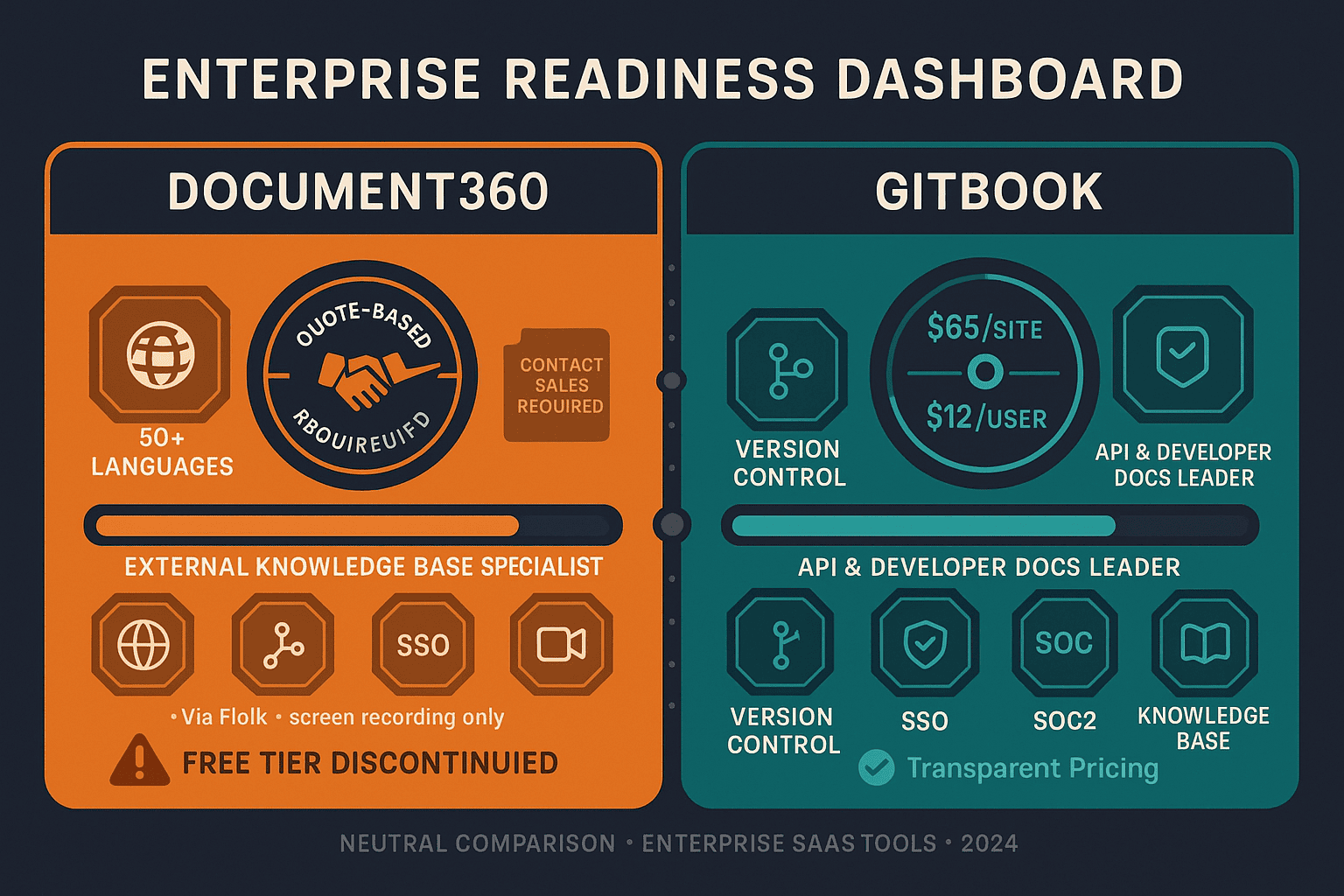
Document360 and GitBook both serve enterprise documentation needs, but they target very different buyers. Document360 is a purpose-built external knowledge base with strong AI and help desk integrations, while GitBook is a developer-first platform optimized for API docs and Git-native workflows. Neither is a complete enterprise knowledge orchestration solution.
For enterprise: Document360 runs a structured knowledge base, GitBook ships interactive API documentation, while Docsie pairs developer-grade docs with multi-tenant portals and AI-powered video conversion.
Feature Matrix
A comprehensive comparison of enterprise capabilities including security, compliance, scalability, administration, and support between Document360 and GitBook.
| Feature |
Document360
|
GitBook
|
|---|---|---|
| SSO Support | SAML, SSO | SAML (paid tiers) |
| SOC 2 Compliance | ||
| ISO 27001 Certification | ||
| GDPR Compliance | ||
| Audit Logs | ||
| Role-Based Access Control | ||
| Approval & Review Workflows | Git-style change requests | |
| Custom Domain Support | $65/site additional fee | |
| Multi-Tenant Portals | ||
| API Access | ||
| Multi-Language / Auto-Translation | 50+ languages | |
| Version Control | Git-native (excellent) | |
| Analytics & Reporting | Basic (paid tiers) | |
| Dedicated Support | Priority (Pro/Ultimate) | |
| Uptime SLA | Not published | Not published |
| AI Content Generation | Eddy AI (all tiers) | Ultimate tier only |
| Help Desk Integrations | Zendesk, Intercom, Freshdesk | |
| OpenAPI / Developer Docs | ||
| Transparent Published Pricing | ||
| Free Plan Available | 1 user (limited) |
Data as of February 2026. Features are based on publicly available information and vendor documentation. Document360 discontinued its free tier in November 2024. GitBook introduced per-site pricing ($65/site) in 2024-2025.
Strengths & Weaknesses
Deep Dive
Document360 holds SOC 2 certification with GDPR compliance, audit logs, and SAML/SSO support — a solid baseline for enterprise security. GitBook goes further with both SOC 2 and ISO 27001 certification, giving it a stronger compliance posture for regulated industries and international procurement. Neither platform offers air-gap deployment, data residency controls, or real-time compliance monitoring. Document360 provides audit logs which GitBook notably lacks. For highly regulated industries such as healthcare, defense, or financial services, both platforms fall short of the compliance depth required without significant workarounds.
Document360 is built for external knowledge bases serving large end-user audiences, with strong content management and help desk integrations that support scale. GitBook's per-site pricing model ($65/site for custom domains) creates a real cost barrier for organizations managing multiple documentation properties — a single enterprise with ten product docs sites faces $650/month in domain fees alone before user seats. Neither platform publishes an uptime SLA, which is a gap for enterprise buyers requiring contractual availability commitments. Document360's architecture handles large knowledge bases better; GitBook scales naturally for developer portal use cases but struggles economically at multi-site scale.
Document360 provides enterprise administrators with approval workflows, role-based access control, audit logs, and content governance features — making it the stronger choice for teams with compliance and editorial control requirements. GitBook leverages Git-native workflows (branch, PR, merge) as its governance model, which is powerful for developer teams but unfamiliar territory for non-technical content owners. GitBook lacks audit logs, which limits administrative visibility into who changed what and when. Neither platform offers granular multi-tenant administration, meaning organizations serving multiple clients must maintain separate instances rather than controlling everything from one admin console.
Document360 includes dedicated support on enterprise plans with a clear commitment to account management, making it more predictable for enterprise procurement teams. GitBook offers priority support on Pro and Ultimate tiers, and its self-serve model means enterprises can move faster without waiting for sales conversations. However, neither platform publishes formal SLA terms or uptime guarantees in their public documentation, which is a meaningful gap when procurement teams require contractual commitments. Document360's sales-led model means SLA terms can be negotiated, but transparency is low. GitBook's published pricing provides clarity on tier differences but not on support response time commitments.
Our Recommendation
Document360 and GitBook are purpose-built for fundamentally different enterprise documentation needs. Document360 excels as an external knowledge base for customer-facing content with strong AI, help desk integrations, and content governance — but its hidden pricing and discontinued free tier create friction for enterprise evaluation. GitBook is the gold standard for developer-facing API documentation with superior compliance certification (SOC 2 + ISO 27001) and Git-native workflows, but its 2024-2025 pricing restructure and lack of multi-language support limit its enterprise appeal outside pure developer teams.
Choose Document360 if you need...
Choose GitBook if you need...
Choose Docsie if you need...
Winner: Docsie
Both Document360 and GitBook leave critical enterprise gaps — neither offers multi-tenant client portal delivery, neither publishes a contractual uptime SLA, and neither provides real-time compliance monitoring or air-gap deployment for regulated industries. Docsie addresses all of these gaps with a six-pillar knowledge orchestration platform that includes multi-tenant portals, built-in LMS with certifications, autonomous agents, and real-time compliance monitoring for HIPAA, SOX, ITAR, and GDPR — all running on private infrastructure with transparent pricing and a 30-day free trial.
Decision Helper
A direct framework for picking between Document360, GitBook, and Docsie based on your specific needs.
Self-service knowledge base for external customer-facing documentation.
Modern documentation platform popular with developer and product teams.

Developer-grade docs with diagram rendering, OpenAPI sync, and multi-tenant portals.
Common Questions
Q: Which platform has stronger security and compliance — Document360 or GitBook?
A: GitBook holds a technical edge in compliance certification, offering both SOC 2 and ISO 27001 — the latter being a requirement for many international enterprise procurement processes. Document360 holds SOC 2 and GDPR compliance but not ISO 27001. However, Document360 provides audit logs which GitBook lacks, making Document360 stronger for administrative accountability. For highly regulated industries like healthcare or defense, neither platform provides the air-gap deployment or real-time compliance monitoring that enterprise buyers increasingly require.
Q: Does either Document360 or GitBook publish an uptime SLA?
A: Neither Document360 nor GitBook publicly publish a formal uptime SLA in their standard documentation or pricing pages. Document360's sales-led model means SLA terms can theoretically be negotiated in enterprise contracts, but there is no standard published commitment. GitBook does not publish an uptime SLA either. Enterprise buyers requiring contractual availability guarantees will need to negotiate these terms directly and should treat the absence of published SLAs as a procurement risk to address during the sales process.
Q: Can either platform support multi-tenant documentation delivery for multiple clients?
A: No. Neither Document360 nor GitBook offers native multi-tenant portal architecture. Both platforms are designed around single-organization documentation delivery. Organizations that need to serve multiple clients from a single knowledge base — such as implementation partners, consulting firms, or SaaS companies with distinct customer segments — would need to maintain separate instances, which significantly increases administration overhead and cost. This is one of the most significant enterprise gaps both platforms share.
Q: Is Document360 or GitBook better for non-technical documentation teams?
A: Document360 is significantly better suited for non-technical teams. Its approval workflows, WYSIWYG editing, AI-assisted content generation, and help desk integrations are designed for content managers, technical writers, and support teams who do not work in code. GitBook's Git-native model requires comfort with branching, pull requests, and change request workflows — concepts that are intuitive for developers but create friction for business users. If your documentation team is not primarily developers, Document360 is the more practical choice.
Q: How does the 2024-2025 pricing change affect GitBook's enterprise value?
A: GitBook's shift to per-site pricing ($65/site/month for custom domains) significantly increases costs for enterprises managing multiple documentation properties. A company with ten separate product or API documentation sites now faces $650/month in site fees alone before accounting for user seats. This makes GitBook increasingly expensive for large enterprises with complex documentation portfolios. The pricing restructure has drawn criticism from existing users and should be carefully modeled against your specific site count before committing.
Q: Is there a better alternative to both Document360 and GitBook for enterprise use?
A: Yes — Docsie is purpose-built to address the enterprise gaps that both Document360 and GitBook share. Docsie offers multi-tenant portal delivery (one knowledge base powering unlimited branded client portals), a published 99.9% uptime SLA, air-gap deployment on private infrastructure, real-time compliance monitoring for HIPAA, SOX, ITAR, and GDPR, and a built-in LMS with certifications — all with transparent published pricing starting at $199/month. It converts any content type (video, PDF, website) into structured documentation across 100+ languages, making it the more complete enterprise knowledge orchestration platform.
Docsie delivers what both Document360 and GitBook cannot — multi-tenant portals for multiple clients, a published 99.9% uptime SLA, air-gap deployment on private infrastructure, real-time HIPAA/SOX/ITAR/GDPR compliance monitoring, built-in LMS with certifications, and transparent pricing with a genuine free plan. One platform to convert, manage, deliver, train, automate, and monitor — across 100+ languages, for unlimited clients simultaneously.
30-day free trial. No credit card required. Free AI credits included to convert a 10-minute training video.