
4.8
on G2
 Docsie
 ScribeHow
A comprehensive analysis of enterprise capabilities, security compliance, scalability, and administration features. Docsie provides full-stack knowledge orchestration with multi-tenant portals and video-to-docs conversion, while ScribeHow specializes in browser-based screenshot guide creation for internal processes.

Enterprise Feature Matrix
Detailed comparison of security, compliance, authentication, scalability, administration, and support capabilities for enterprise deployments.
| Enterprise Capability |
Docsie
Enterprise-Ready
|
ScribeHow
|
|---|---|---|
| SSO (SAML) | Enterprise only | |
| SSO (OAuth/OIDC) | ||
| Azure AD Integration | ||
| Okta Support | Enterprise only | |
| SCIM Provisioning | Enterprise only | |
| SOC 2 Type II Compliance | ||
| GDPR Compliance | ||
| HIPAA-Ready | Enterprise (PHI redaction) | |
| EU Data Residency | ||
| Data Centers | Multi-region | US only |
| Audit Logs | ||
| Role-Based Access Control | ||
| Granular Permissions | ||
| Multi-Tenant Architecture | ||
| Custom Domain Support | ||
| White-Label Capability | ||
| API Access | ||
| Webhooks | ||
| Uptime SLA | 99.9% | Enterprise SLA |
| Dedicated Support | Enterprise only | |
| Custom Integrations | ||
| Scalability Limit | 10,000+ sites | Internal only |
| Version Control | ||
| Content Reuse & Templates | ||
| Multi-Language Support | 100+ | Translation feature |
Data as of February 2026. Enterprise features verified from vendor documentation and public compliance certifications.
Enterprise Analysis
Enterprise Deep Dive
Analyzing how Docsie and ScribeHow compare on security & compliance, scalability & performance, administration & control, and support & SLA—the pillars of enterprise software evaluation.
Docsie maintains SOC 2 Type II certification with comprehensive security controls, GDPR compliance with EU data residency options, and HIPAA-ready architecture for healthcare organizations. Multiple SSO methods (SAML, OAuth, OIDC) integrate with Azure AD, Okta, and Google Workspace. Audit logs track all content changes and access events for compliance reporting. JWT authentication and OTP access provide flexible security models. ScribeHow offers SOC 2 and GDPR compliance with SAML SSO and SCIM provisioning, but only on Enterprise plans. AI PII/PHI redaction protects sensitive data in healthcare and finance workflows. However, ScribeHow lacks audit logs, data residency options, and multi-region support, limiting compliance capabilities for global enterprises. Docsie provides deeper security posture for regulated industries.
Docsie's multi-tenant architecture scales to 10,000+ documentation sites from a single platform instance, enabling SAP and Workday consultancies to serve hundreds of clients simultaneously. Workspace-based pricing (15-90 users per tier) with AI credit pools prevents per-seat cost inflation. The platform handles 50GB-custom storage with custom credit volumes processing 100-500+ hours of video monthly at Enterprise scale. Content delivery through CDN ensures fast global performance. ScribeHow scales for internal process documentation but lacks multi-tenant capabilities for client-facing deployments. Per-user pricing ($15/seat minimum 5 seats) becomes expensive beyond small teams. The Business plan caps at 5 creators, forcing costly Enterprise upgrades. ScribeHow works well for documenting internal workflows but cannot scale to serve multiple external clients or large documentation portfolios like Docsie.
Docsie provides granular permission controls at shelf, book, and article levels with role-based access management across unlimited workspaces. Version control with inheritance lets administrators manage documentation lifecycles, EOL versions, and approval workflows. Content reuse blocks and templates ensure brand consistency. Multi-tenant architecture allows central administration while delivering isolated, branded portals per client with custom domains. API access and webhooks enable programmatic control and custom integrations with enterprise systems. ScribeHow offers basic role-based access and team workspaces with approval workflows on Pro Team plans. Enterprise adds SSO and SCIM for user provisioning. However, ScribeHow lacks version control, content templates, API access, and multi-tenant administration. For organizations managing complex documentation portfolios across multiple departments or clients, Docsie delivers significantly deeper administrative capabilities.
Docsie Enterprise includes dedicated success managers, custom onboarding with migration assistance, 99.9% uptime SLA, and priority support channels. Annual procurement workflows accommodate enterprise buying processes with custom security documentation and legal review. Custom integration development and white-labeling ensure the platform fits enterprise branding and technical requirements. Premium plans include priority onboarding, and all paid tiers receive responsive support. ScribeHow provides dedicated support on Enterprise plans with defined SLAs. Pro Team users access standard support, while free users rely on community resources. Enterprise customers receive account management and implementation assistance. However, ScribeHow's extremely high Enterprise pricing ($18,000+ reported annually) and limited customization options make it less flexible for complex enterprise requirements. Docsie's transparent pricing and comprehensive enterprise support packages provide better value for organizations needing documentation infrastructure at scale.
Enterprise Verdict
Docsie and ScribeHow target fundamentally different enterprise use cases. Docsie functions as a complete knowledge orchestration platform with multi-tenant portals, comprehensive compliance, and external customer-facing capabilities. ScribeHow excels at internal process documentation with screenshot-based guides. For true enterprise readiness—including security, scalability, multi-tenant delivery, and external documentation needs—Docsie provides significantly deeper capabilities. ScribeHow works well for internal SOPs but lacks the architecture for client-facing enterprise documentation.
Choose Docsie for enterprise deployments when you need...
Choose ScribeHow for enterprise if you only need...
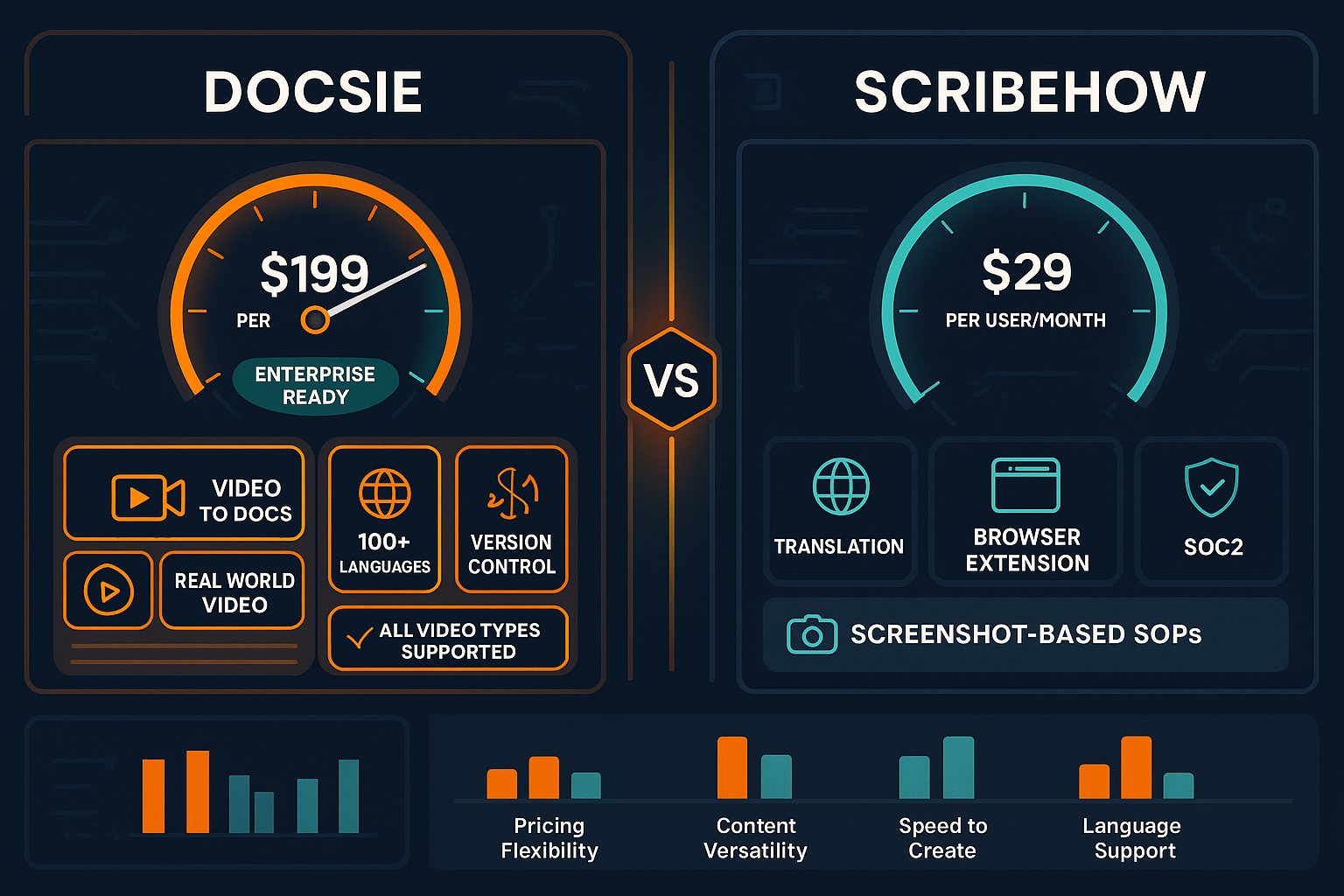
Winner: Docsie
Docsie delivers comprehensive enterprise readiness across all four critical dimensions—security & compliance, scalability & performance, administration & control, and support & SLA. Multi-tenant architecture, multiple SSO methods, audit logs, EU data residency, API access, and 99.9% uptime SLA make Docsie suitable for regulated industries and client-facing deployments. ScribeHow provides basic enterprise security for internal use but lacks multi-tenant capabilities, audit logs, data residency, API access, and the scalability required for external documentation delivery. For organizations needing true enterprise documentation infrastructure, Docsie is significantly more enterprise-ready.
Enterprise FAQ
Q: Which platform offers better compliance for regulated industries?
A: Docsie provides deeper compliance capabilities with SOC 2 Type II, GDPR, HIPAA-ready architecture, EU data residency, and audit logs tracking all access and changes. ScribeHow offers SOC 2 and GDPR compliance with AI PII/PHI redaction on Enterprise plans, but lacks audit logs and data residency options. For healthcare, financial services, and government sectors requiring comprehensive compliance documentation, Docsie delivers more robust capabilities.
Q: Does ScribeHow support multi-region data centers like Docsie?
A: No. ScribeHow operates US-based infrastructure only, while Docsie provides EU data residency and multi-region data center options. Organizations subject to GDPR data localization requirements or global enterprises needing regional data storage will find Docsie's architecture more compliant with international data sovereignty regulations.
Q: Which tool provides better audit capabilities for enterprise governance?
A: Only Docsie includes comprehensive audit logs tracking content changes, access events, and user activity for compliance reporting and security investigations. ScribeHow does not provide audit logs even on Enterprise plans, limiting visibility into system usage and making compliance audits more difficult. For enterprises requiring detailed activity tracking, Docsie is the only viable option.
Q: Can ScribeHow serve external clients like Docsie's multi-tenant portals?
A: No. ScribeHow is designed for internal process documentation only and lacks multi-tenant architecture, custom domains, or white-labeling capabilities. Docsie's multi-tenant system allows one knowledge base to power unlimited branded portals for different clients, making it ideal for consultancies, SaaS companies, and agencies serving multiple customers. ScribeHow cannot support client-facing documentation deployments.
Q: How does pricing scale for large enterprise teams?
A: Docsie uses workspace-based pricing ($199-$750/month for 15-90 users) with AI credit pools, avoiding per-seat inflation. ScribeHow charges per creator ($15/seat minimum 5 seats), with Business plans capped at 5 creators before forcing Enterprise upgrades reportedly costing $18,000+ annually. For teams larger than 10 people, Docsie typically provides 50-70% cost savings while offering significantly more enterprise capabilities.
Q: Which platform provides API access for custom integrations?
A: Only Docsie provides API access and webhooks for programmatic control and custom integrations with enterprise systems like HRIS, LMS, or CRM platforms. ScribeHow offers no API access, limiting integration capabilities to pre-built connectors with tools like Notion, Confluence, and SharePoint. Enterprises requiring custom workflows or automated documentation pipelines will find Docsie's open architecture essential for their integration requirements.
See how Docsie delivers multi-tenant portals, SOC 2 compliance, 100+ language support, and video-to-docs conversion with enterprise security and scalability.
30-day free trial with enterprise features. Custom security documentation and legal review available for procurement.
Start creating professional documentation that your users will love