
4.8
on G2
 Docsie Recorder
 Zight
Zight
Both Docsie Recorder and Zight capture your screen, but they diverge sharply after the recording stops. Docsie Recorder is a free, open-source desktop recorder that converts video directly into structured docs and a knowledge base. Zight is a mature visual sharing tool built for support and sales teams sending cloud-hosted screenshots, GIFs, and clips. If you searched for a Screen Studio alternative or a way to turn recordings into documentation, this comparison is for you.
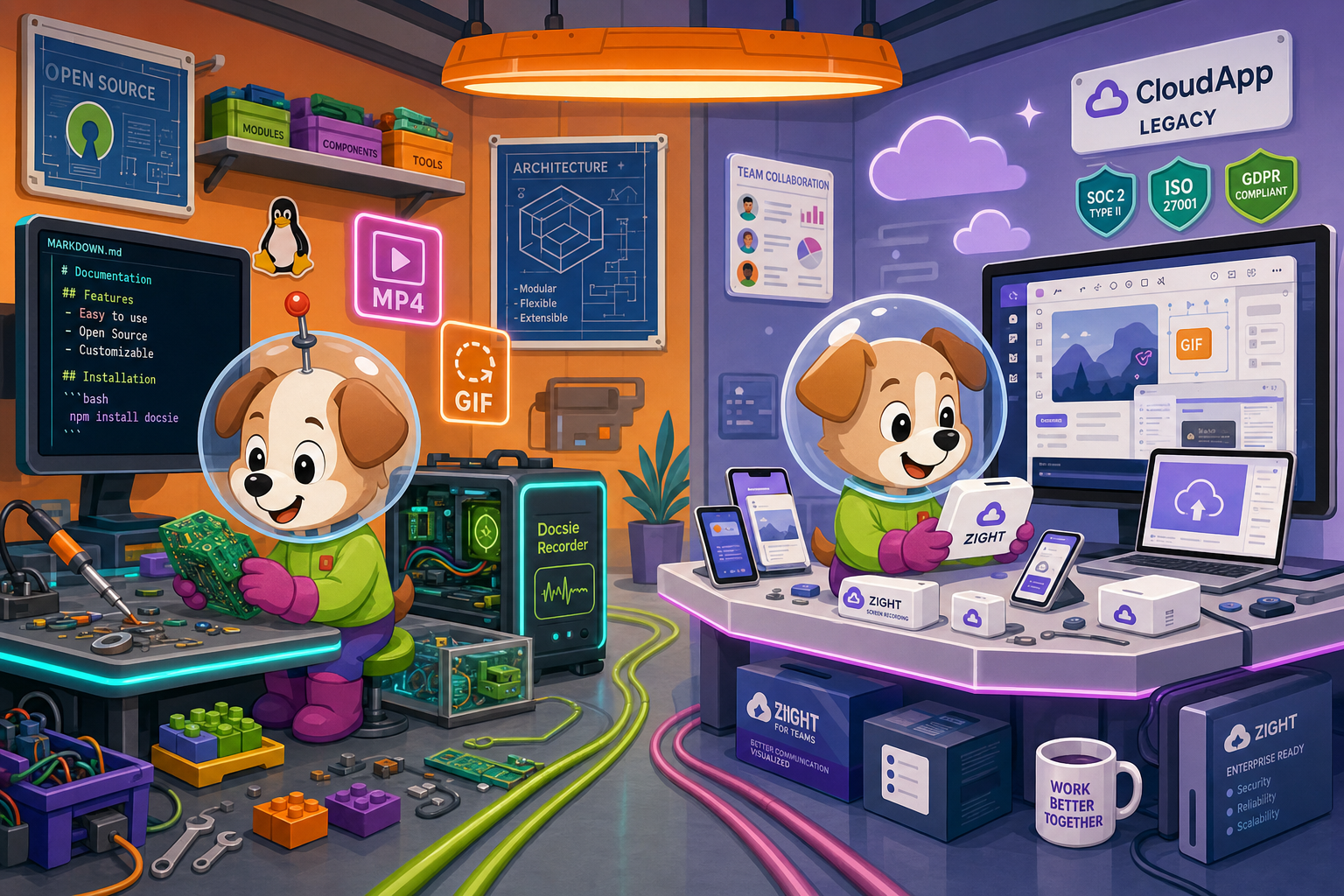
Docsie Recorder runs video-to-docs plus multi-tenant portals, Zight captures workflows into quick guides, while Docsie Recorder fits when you also need video → structured docs → multi-tenant portals end-to-end.
Feature Matrix
A row-by-row comparison of recording capabilities, editing tools, export formats, video-to-docs conversion, and downstream documentation features.
| Feature |
Docsie Recorder
Our Pick
|
Zight
|
|---|---|---|
| Free Desktop Recorder | ||
| Open-Source Recorder Base | ||
| Mac Support | ||
| Windows Support | ||
| Linux Support | ||
| Window & Full-Screen Capture | ||
| Microphone Capture | ||
| System Audio Capture | Platform-specific | |
| Webcam Overlay | ||
| Automatic or Manual Zoom | ||
| Cursor & Focus Polish | ||
| Backgrounds & Visual Effects | ||
| Crop, Trim & Speed Regions | Trim only | |
| Annotations & Blur Regions | ||
| Local MP4 Export | ||
| Local GIF Export | ||
| Project Save Format | .docsiescreen | |
| Video-to-Docs Conversion | ||
| Markdown Export | ||
| DOCX Export | ||
| PDF Export | ||
| Knowledge Base Publishing | ||
| Versioned Documentation Management | ||
| Multi-Tenant Portal Delivery | ||
| Enterprise SSO | Enterprise only (SAML) |
Data as of early 2026. Features based on publicly available information and vendor documentation. Confirm current Zight recording limits, pricing, and AI summary availability before relying on this comparison.
Strengths & Weaknesses
Deep Dive
An in-depth analysis of recording capabilities, AI and automation, enterprise features, and integrations—focused on teams evaluating screen recorders and video-to-docs tools.
Docsie Recorder is built on OpenScreen's open-source core and delivers a polished editing layer comparable to Screen Studio—automatic and manual zoom, cursor telemetry, motion blur, custom backgrounds, speed regions, crop, trim, annotations, and blur. Everything renders locally before any export. Zight captures quickly via desktop app or browser extension but ships minimal post-capture editing. There is no automatic zoom, no cursor polish, and no background replacement. For teams that want walkthrough recordings to look polished before becoming documentation, Docsie Recorder's editing depth is the clear advantage.
Docsie Recorder's defining capability is its direct bridge to Docsie's Video-to-Docs API. After recording, you select a Docsie workspace, estimate AI credits, choose quality tier, language, and doc style, and submit the job. The pipeline uses multimodal AI—transcription, computer vision, and OCR—to generate structured Markdown with embedded screenshots and timestamps. The output is a reviewable result payload that publishes directly into Docsie's knowledge base. Zight offers AI transcription and—depending on plan—AI summaries, but no structured doc generation, no Markdown output, and no knowledge base publishing. Recordings stay as video links.
Zight provides enterprise SSO (SAML), SOC 2, GDPR, role-based access, audit logs, and dedicated support on its Enterprise tier. These are solid capabilities for teams managing cloud-hosted video libraries. Docsie Recorder's MIT recorder core adds a different enterprise angle—an auditable, self-hostable codebase that engineering teams can inspect and deploy without a SaaS dependency. The downstream Docsie platform adds SAML SSO, custom domains, versioned documentation, multi-tenant portal delivery, and compliance monitoring. For regulated industries or agencies serving multiple clients from one knowledge base, Docsie's combined recorder-plus-platform path offers capabilities Zight simply does not address.
Zight integrates well with Slack, Salesforce, and Zendesk—strong for support and sales teams routing visual feedback through existing communication tools. Docsie Recorder's integration story is deeper on the documentation side. Once a recording passes through the Video-to-Docs pipeline, the generated content enters Docsie's full ecosystem—versioned knowledge bases, multi-tenant portals with custom domains, AI chatbot widgets, API access, webhooks, and automation workflows. The same source recording and its generated docs can also be reused as structured course material through Docsie's LEARN pillar, or routed into compliance monitoring via AUTOMATE and MONITOR. Zight has no equivalent downstream documentation layer.
Our Recommendation
Docsie Recorder and Zight overlap at the point of capture but diverge immediately after. Zight is a proven visual communication tool for support and sales teams who need to share screenshots, GIFs, and short recordings via cloud links—it does that workflow well. Docsie Recorder is for teams who treat recording as the first step in a documentation workflow, not the final deliverable. It records and edits locally with Screen Studio-level polish, exports MP4 and GIF without cloud dependency, and then converts the recording into structured Markdown, DOCX, PDF, and knowledge base content through Docsie's pipeline. The right choice depends entirely on whether your recording needs to become a document.
Choose Docsie Recorder if you need...
Choose Zight if you need...
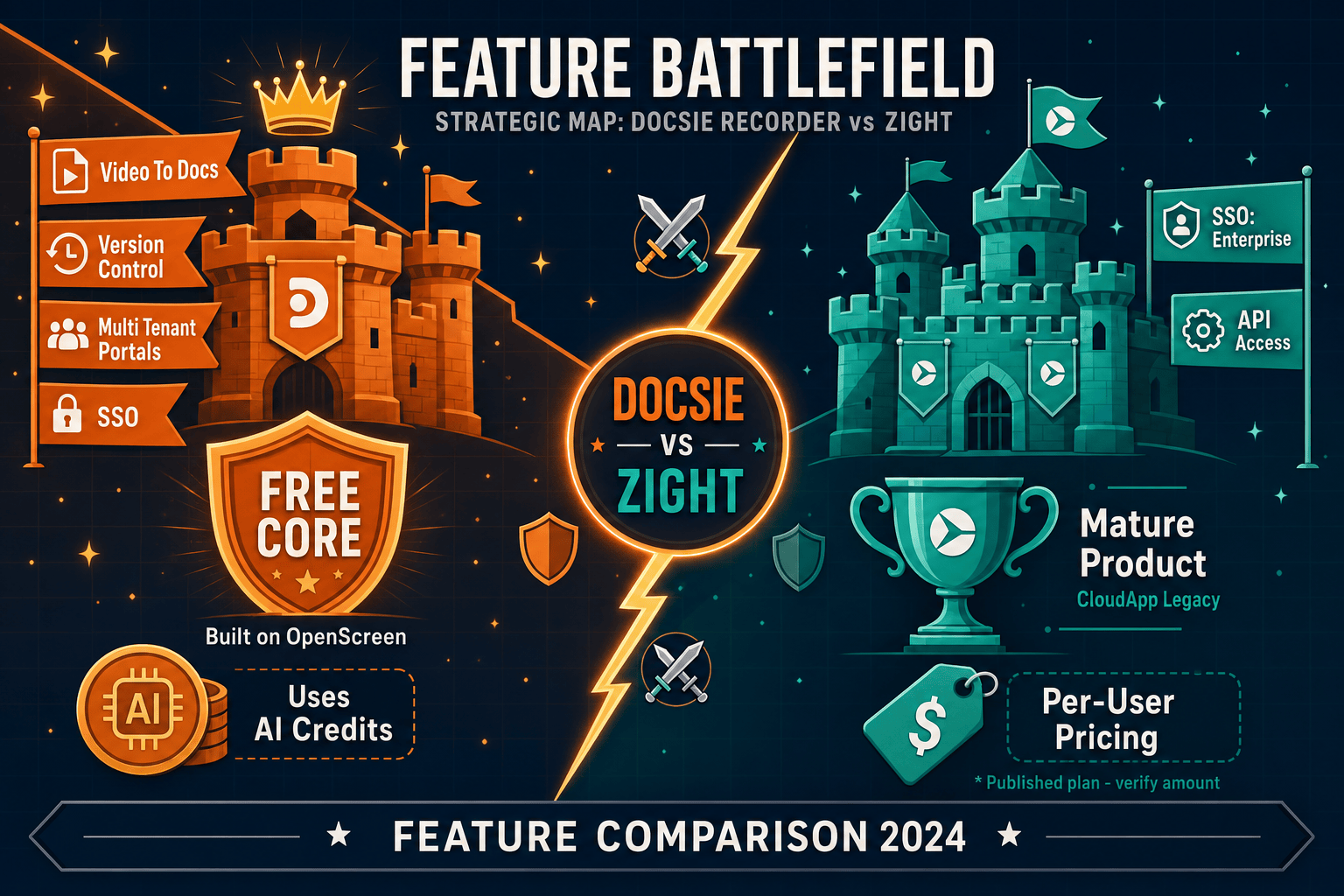
Winner: Docsie Recorder
For teams evaluating Screen Studio alternatives or any recorder where the output needs to become documentation, Docsie Recorder wins decisively. It is the only free, open-source option in this comparison with recorder-grade editing polish, local MP4/GIF export, and a direct bridge into a full Video-to-Docs and knowledge base publishing workflow. Zight is a better tool for cloud-hosted visual sharing; Docsie Recorder is a better tool for teams where recording is step one of a documentation process.
Decision Helper
A direct framework for picking between Docsie Recorder, Zight based on your specific needs.
Free, open-source desktop screen recorder that feeds a Video-to-Docs pipeline.
Screen capture, annotation, and quick video sharing tool.
Common Questions
Q: Can Zight convert screen recordings into structured documentation?
A: No. Zight does not offer video-to-docs conversion. Recordings made in Zight are stored as cloud-hosted video links with optional AI transcription or summary, but there is no workflow to generate structured Markdown, DOCX, PDF, or knowledge base articles from a recording. Docsie Recorder is purpose-built for that conversion through its direct bridge to Docsie's Video-to-Docs API pipeline.
Q: Does Docsie Recorder have the same editing features as Screen Studio?
A: Docsie Recorder is built on OpenScreen's open-source core and includes automatic and manual zoom, cursor telemetry, motion blur, custom backgrounds and gradients, speed regions, crop, trim, annotations, and blur regions—a feature set comparable to Screen Studio's editing layer. The key difference is that Docsie Recorder is free, open-source, and cross-platform (macOS, Windows, Linux), while Screen Studio is macOS-only and closed-source. Docsie Recorder also routes recordings into structured documentation, which Screen Studio does not.
Q: Does Zight work on Linux?
A: No. Zight provides desktop apps for macOS and Windows and a browser extension for web-based capture, but there is no Linux desktop build. Docsie Recorder ships cross-platform builds for macOS, Windows, and Linux, making it the better choice for engineering teams or organizations running mixed operating environments.
Q: Which tool is better for support teams creating visual walkthroughs?
A: Zight has a strong history serving support teams—its cloud sharing, Zendesk integration, viewer analytics, and team library are well-suited for sharing short recordings and annotated screenshots with customers. Docsie Recorder is better suited when the support team's walkthroughs need to become searchable knowledge base articles rather than one-off video links, enabling the same recording to power both a video clip and a versioned documentation article.
Q: Is Docsie Recorder's video-to-docs conversion fully local or does it require a cloud call?
A: The recording and editing are fully local—no account is required to capture, edit, and export MP4 or GIF. The Video-to-Docs conversion step uses Docsie's cloud API and consumes Docsie AI credits, so it does require an internet connection and a Docsie account for that specific step. Teams that only need the recorder and local export can use it entirely offline.
Q: Can I use Docsie Recorder as a free Zight replacement just for recording and GIF export?
A: Yes. Docsie Recorder exports MP4 and GIF locally without requiring any account or cloud upload—you can use it purely as a free, open-source recorder and exporter without ever connecting it to Docsie's Video-to-Docs pipeline. The downstream documentation workflow is available when you need it but is not required for basic capture and export use.
Download Docsie Recorder free—open-source, cross-platform, and built to convert your recordings into structured docs and a knowledge base when you're ready.
Free to download. MIT license recorder core. No account required to record and export MP4 or GIF.