
4.8
on G2
 Docsie Recorder
 VEED.IO
Docsie Recorder is a free, open-source desktop screen recorder that turns your recordings into structured documentation. VEED.IO is a browser-based video creation suite built for marketing teams. If you searched for a Screen Studio alternative, Loom alternative, or a tool that converts recordings into knowledge base content, this comparison breaks down exactly where each tool fits.

Docsie Recorder runs video-to-docs plus multi-tenant portals, VEED.IO captures workflows into quick guides, while Docsie Recorder fits when you also need video → structured docs → multi-tenant portals end-to-end.
Feature Matrix
A comprehensive feature-by-feature comparison of recording capabilities, editing tools, export options, AI features, and downstream documentation workflows.
| Feature |
Docsie Recorder
Our Pick
|
VEED.IO
|
|---|---|---|
| Free Desktop Recorder | ||
| Open-Source Recorder Base | ||
| Mac Support | ||
| Windows Support | ||
| Linux Support | ||
| Window and Full-Screen Capture | ||
| Microphone Capture | ||
| System Audio Capture | ||
| Webcam Overlay | ||
| Automatic Zoom | ||
| Manual Zoom | ||
| Cursor & Focus Polish | ||
| Backgrounds & Visual Effects | ||
| Crop, Trim, Speed Regions | ||
| Annotations & Blur Regions | ||
| Local MP4 Export | ||
| Local GIF Export | ||
| Project Save Format | .docsiescreen project files | Cloud only |
| Video-to-Docs Conversion | ||
| Markdown Export | ||
| DOCX Export | ||
| PDF Export | ||
| Knowledge Base Publishing | ||
| Versioned Documentation Management | ||
| Multi-Tenant Portal Delivery | ||
| AI Captions & Transcription | ||
| AI Translation & Dubbing | ||
| AI Avatars & Templates | ||
| Enterprise Deployment Path |
Data as of 2026. Features are based on publicly available information and vendor documentation. Confirm current VEED.IO pricing and AI minute limits before relying on this comparison.
Strengths & Weaknesses
Deep Dive
An in-depth look at recording and editing capabilities, AI and automation, enterprise readiness, and integrations — examined through the lens of teams who searched for a screen recorder or a recorder-to-docs workflow.
Docsie Recorder is a native desktop application built on the open-source OpenScreen core. It captures specific windows or full screens, overlays webcam, records microphone and system audio, and applies automatic zoom driven by cursor telemetry — the same kind of recording polish that Screen Studio buyers expect. Projects save locally as .docsiescreen files, export to MP4 and GIF with no watermark, and include backgrounds, motion blur, crop, trim, speed regions, annotations, and blur regions. VEED.IO is a browser-based video editor first: its recorder is one feature inside a broad suite, lacks automatic zoom, and stores everything in the cloud rather than locally.
VEED.IO leads on video-side AI — its captions, translation, dubbing, and AI avatars are mature, battle-tested features designed for marketing teams that produce polished video content at scale. Docsie Recorder's AI differentiator is entirely different in direction: after recording, you send the video to Docsie's Video-to-Docs API, which uses multimodal AI to generate structured Markdown, DOCX, and PDF documentation. The output is not a caption file or a translated video — it is a structured knowledge base article ready to publish. For teams whose goal is documentation rather than video distribution, Docsie's AI automation closes a workflow gap that VEED.IO does not address at all.
Both tools offer a path to enterprise, but they serve very different enterprise needs. VEED.IO's enterprise tier provides team seats, SSO, advanced AI minutes, and brand controls — appropriate for marketing and content teams. Docsie Recorder connects to the broader Docsie enterprise platform, which includes versioned documentation management, multi-tenant portal delivery, custom domains, SAML/OAuth SSO, role-based access control, and audit trails. Critically, Docsie's enterprise path extends the recorder's output: a recorded walkthrough becomes a versioned, compliance-tracked KB article delivered through a branded customer portal. VEED.IO's enterprise path produces better videos; Docsie's produces managed documentation assets.
VEED.IO integrates well within video distribution and social media workflows, connecting to tools teams use to share and publish video content. Its API and embeddable player extend video reach. Docsie Recorder's integration story runs downstream from the recording itself: once a video is converted through the Docsie bridge, the resulting documentation enters Docsie's full ecosystem — version control, portal publishing, embeddable AI-powered doc widgets, helpdesk integrations, webhooks, and API access. For teams building a CREATE → CONVERT → MANAGE → DELIVER pipeline, Docsie's integrations are purpose-built for knowledge management. For teams building a video production and distribution pipeline, VEED.IO's integrations fit naturally.
Our Recommendation
Docsie Recorder and VEED.IO are built for fundamentally different jobs. Docsie Recorder is a free, open-source native desktop recorder that doubles as the entry point to a structured documentation pipeline — record, edit locally, convert to docs, publish to a knowledge base. VEED.IO is a browser-based video creation suite optimized for marketing teams producing captions, translations, avatars, and branded video content. The right choice depends on whether your end goal is a documentation asset or a video asset.
Choose Docsie Recorder if you need...
Choose VEED.IO if you need...
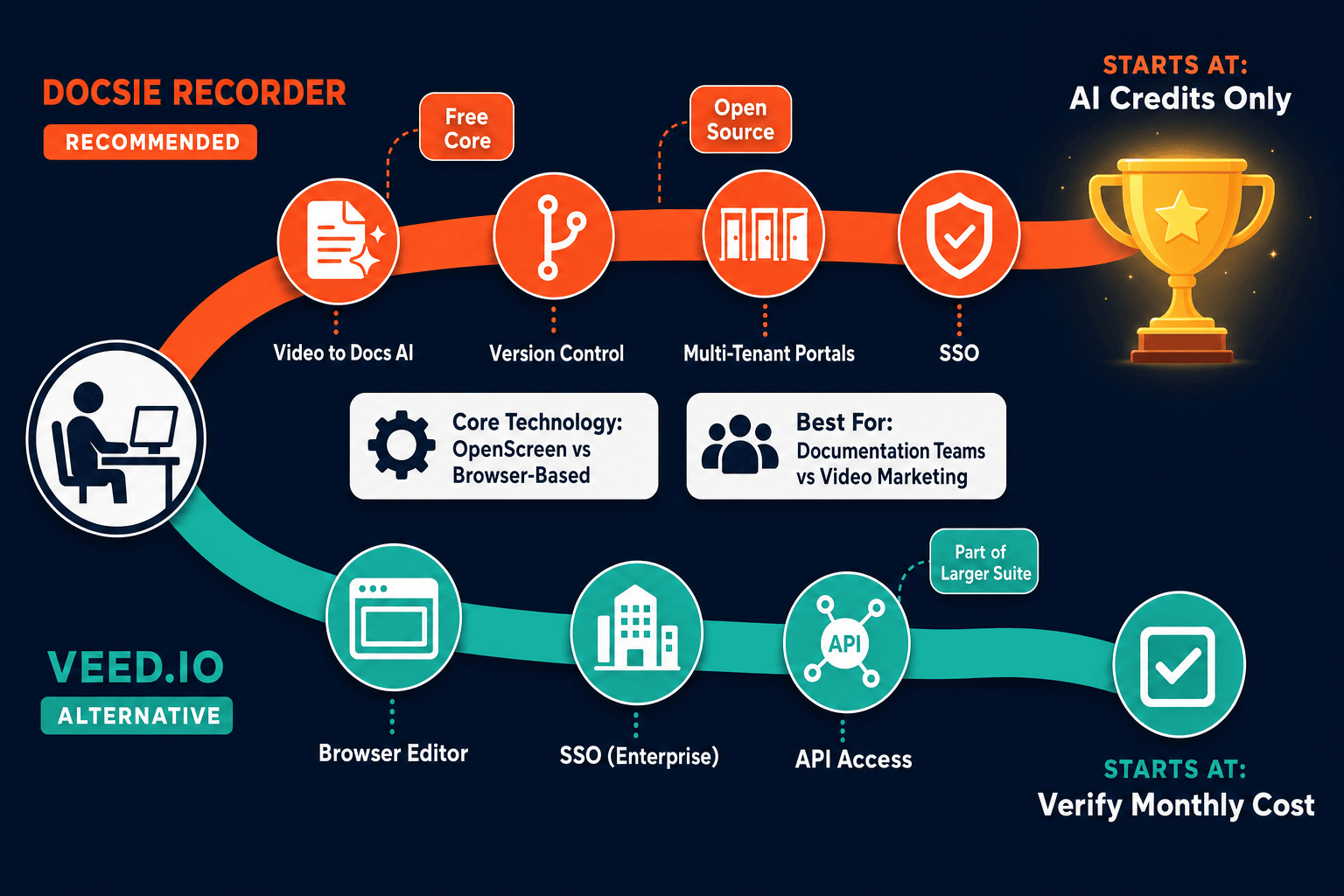
Winner: Docsie Recorder
For teams evaluating screen recorders, Screen Studio alternatives, or recorder-to-docs tools, Docsie Recorder wins on the features that matter most in this category — free open-source native desktop recording, automatic zoom, cross-platform support, local MP4 and GIF export with no watermark, and a direct pipeline from recording to structured documentation. VEED.IO is a capable browser video editor but it does not compete in the recorder-to-docs category at all. Docsie Recorder gives you the recording quality of a polished desktop tool plus the downstream CREATE → CONVERT → MANAGE → DELIVER workflow that no video editor in this comparison provides.
Decision Helper
A direct framework for picking between Docsie Recorder, VEED.IO based on your specific needs.
Free, open-source desktop screen recorder that feeds a Video-to-Docs pipeline.
Browser-based video editor with subtitles, transcription, and effects.
Common Questions
Q: Does VEED.IO have a native desktop recorder like Docsie Recorder?
A: No. VEED.IO's screen recording happens entirely in the browser, either through a browser tab capture or a browser-based desktop capture prompt. Docsie Recorder is a standalone native desktop application for macOS, Windows, and Linux that records specific windows or full screens locally, applies automatic zoom and cursor polish during editing, and saves projects as local .docsiescreen files. If you need a native recorder comparable to Screen Studio or Kap, VEED.IO does not provide that workflow.
Q: Can VEED.IO convert a screen recording into a knowledge base article?
A: No. VEED.IO's output is always a video file — edited, captioned, translated, or voiced, but still a video. Docsie Recorder connects to Docsie's Video-to-Docs API, which converts your screen recording into structured Markdown, DOCX, and PDF documentation that can be published directly into a Docsie knowledge base. If your goal is a written KB article rather than a shareable video, VEED.IO does not address that workflow at all.
Q: Does Docsie Recorder support automatic zoom like Screen Studio?
A: Yes. Docsie Recorder includes automatic zoom driven by cursor telemetry as well as manual zoom regions, so you can highlight key interactions in your recording without manually keyframing zoom in a timeline editor. This is one of the recorder-side features that Screen Studio buyers typically cite as essential, and it is available in Docsie Recorder at no cost.
Q: Is Docsie Recorder really free and open source?
A: Yes. The recorder and editor core is built on OpenScreen under an MIT license, and the desktop application is free to download and use with no watermark, no account required, and no subscription. Local MP4 and GIF export are included. The Video-to-Docs conversion feature uses Docsie API credits, which require a Docsie account, but the recorder itself is fully free and open source.
Q: When does VEED.IO make more sense than Docsie Recorder?
A: VEED.IO makes sense when your primary output is polished video content for marketing, social media, or customer education — especially if you need AI captions, translation, dubbing, or avatar-driven video at scale. It is a strong browser-based video creation suite for teams that think in terms of video assets rather than documentation assets. If you are not trying to turn a recording into a structured knowledge base article, VEED.IO's broader editing toolkit may serve you better.
Q: Can I use Docsie Recorder just as a screen recorder without using the Video-to-Docs feature?
A: Absolutely. Docsie Recorder works as a fully standalone desktop recorder and editor. You can record, edit with zoom, backgrounds, annotations, crop, trim, and speed regions, then export MP4 or GIF locally — all without connecting to Docsie or using any API credits. The Video-to-Docs pipeline is an optional downstream step for teams that want to turn their recordings into documentation, not a requirement for using the recorder itself.
Docsie Recorder is free, open-source, and works on macOS, Windows, and Linux. Record with automatic zoom and cursor polish, export MP4 or GIF locally, and optionally convert your recording into structured Markdown, DOCX, and knowledge base content — all from one workflow.
No account required to record and export. Free and open source under MIT license.