
4.8
on G2
 Docsie Recorder
 Trupeer
Both Docsie Recorder and Trupeer turn screen recordings into polished videos and written docs—but they diverge sharply on recorder ownership, open-source transparency, and what happens to your content after conversion. Docsie Recorder is a free, open-source desktop app that records, edits, and routes output into a full versioned knowledge base. Trupeer is a closed-source AI SaaS that polishes recordings and generates step guides, but stops short of a native documentation management platform.
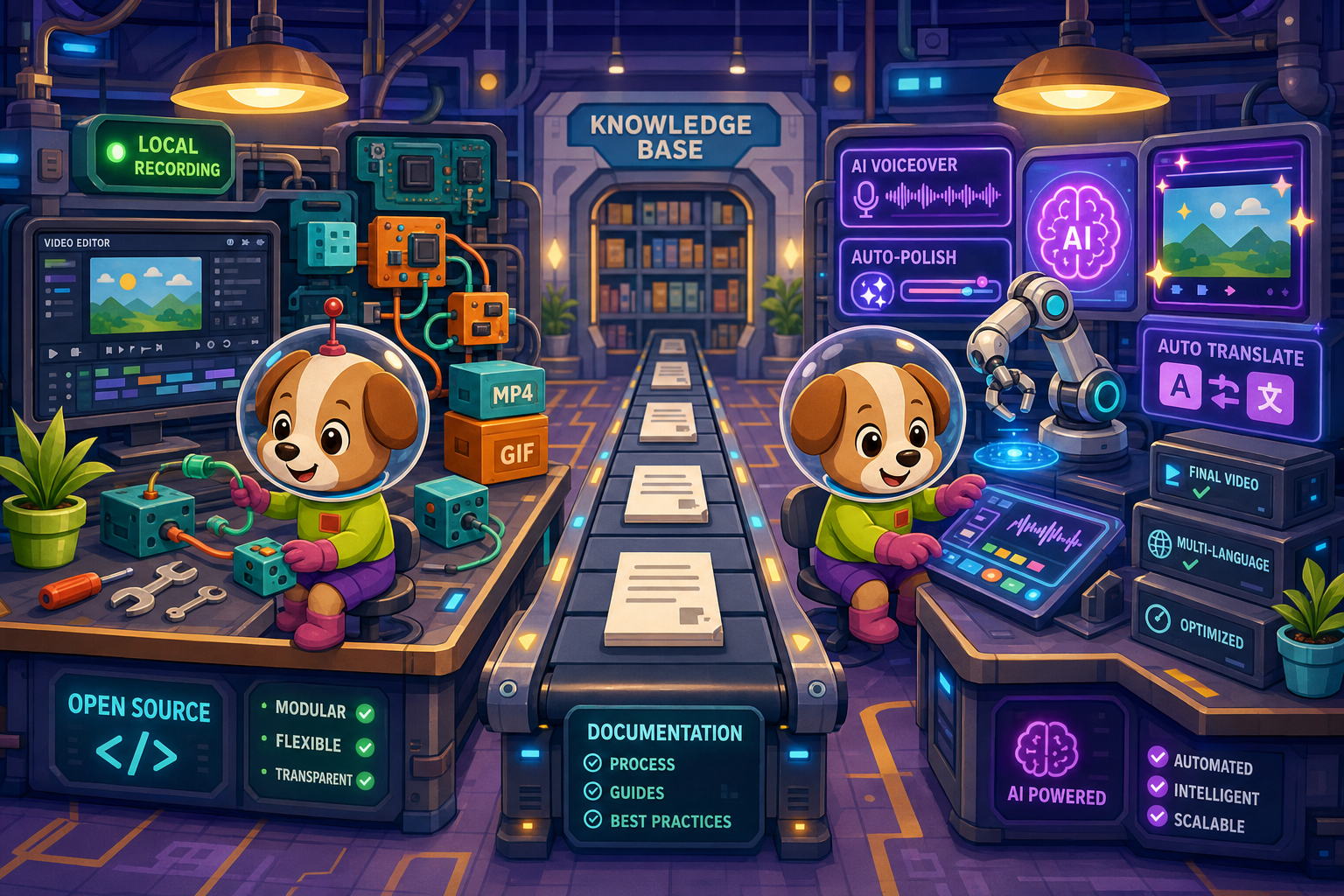
Docsie Recorder runs video-to-docs plus multi-tenant portals, Trupeer captures workflows into quick guides, while Docsie Recorder fits when you also need video → structured docs → multi-tenant portals end-to-end.
Feature Matrix
A comprehensive feature-by-feature comparison covering recorder capabilities, editing tools, AI conversion, export formats, and downstream knowledge base workflows.
| Feature |
Docsie Recorder
Our Pick
|
Trupeer
|
|---|---|---|
| Free Desktop Recorder | ||
| Open-Source Recorder Base | ||
| Mac Support | ||
| Windows Support | ||
| Linux Support | ||
| Window & Full-Screen Capture | ||
| Microphone Capture | ||
| System Audio Capture | Platform-specific | |
| Webcam Overlay | ||
| Automatic & Manual Zoom | ||
| Cursor & Focus Polish | ||
| Backgrounds & Visual Effects | ||
| Crop, Trim & Speed Regions | Limited public detail | |
| Annotations & Blur Regions | Limited public detail | |
| Local MP4 Export | ||
| Local GIF Export | ||
| Project Save Format | .docsiescreen project files | |
| AI Voiceover Generation | ||
| Auto-Translation | Via Docsie platform | |
| Video-to-Docs Conversion | ||
| Markdown Export | Limited public detail | |
| DOCX Export | Limited public detail | |
| PDF Export | Limited public detail | |
| Knowledge Base Publishing | Add-on / hosted output | |
| Versioned Documentation Management | ||
| Multi-Tenant Portal Delivery | ||
| API Access | Limited public detail | |
| SSO (SAML/OAuth) | Enterprise only | |
| Enterprise Deployment Path |
Data as of 2026. Docsie Recorder features reflect the open-source recorder core plus the Docsie platform pipeline. Trupeer features are based on publicly available documentation and the official pricing page; items marked "Limited public detail" should be checked before relying on this comparison.
Strengths & Weaknesses
Deep Dive
An in-depth analysis of recording and editing capabilities, AI conversion workflows, enterprise readiness, and ecosystem integrations between Docsie Recorder and Trupeer.
Docsie Recorder is built on the OpenScreen open-source core and ships a full desktop editing suite—automatic and manual zoom driven by cursor telemetry, crop and trim, speed regions, background replacement, motion blur, webcam overlay, annotations, blur regions, and .docsiescreen project files for non-destructive re-editing. It exports MP4 and GIF locally with no account required. Trupeer matches basic recording and overlay features and adds stronger AI voiceover polish, but it lacks a structured project save format, GIF export, and an auditable open-source recorder base. For teams that need a full editing environment they can inspect and extend, Docsie Recorder holds a clear structural advantage.
Both tools convert screen recordings into written documentation using AI, but their pipelines differ meaningfully. Trupeer's AI is optimized for voiceover generation, auto-translation, and visual polish—turning rough recordings into narrated tutorial videos alongside step-by-step guides. Docsie Recorder routes recordings through the Docsie Video-to-Docs API, generating structured Markdown, DOCX, and PDF with configurable quality tiers, language, document style, rewrite instructions, and template instructions before the result is previewed and published. Docsie's conversion output feeds directly into a versioned knowledge base; Trupeer's output is primarily a polished video and formatted guide without a native downstream documentation management layer.
Docsie Recorder's open-source base means enterprise security teams can audit the recorder codebase, and the downstream Docsie platform adds SSO (SAML, OAuth, OIDC, Azure AD, Okta), multi-tenant portals, versioned documentation management, custom domains, API access, and a full enterprise deployment path. Trupeer offers SSO on its Enterprise tier and provides role-based access and collaboration, but lacks version control for generated documentation, multi-tenant portal delivery, and the open-source auditability that regulated industries often require. For organizations evaluating recorder tools under security review, the open-source Docsie Recorder core is a meaningful differentiator that Trupeer's closed-source SaaS model cannot match.
Docsie Recorder is one entry point into the broader Docsie workflow framework. A single recording can be converted to structured docs via the Video-to-Docs API, published into a Docsie knowledge base with versioning and approval workflows, served through branded portals with custom domains, reused as course material in Docsie's LMS, and routed into automation and compliance monitoring pipelines. Trupeer integrates well within its own video and guide workflow but does not connect to a native documentation platform with versioning, portal delivery, or downstream reuse. Teams that want CREATE to feed CONVERT, MANAGE, DELIVER, LEARN, and AUTOMATE from one toolchain will find Docsie's integrated ecosystem significantly more capable than Trupeer's standalone guide-creation workflow.
Our Recommendation
Docsie Recorder and Trupeer are genuine head-to-head competitors in the video-to-docs space, and Trupeer's AI voiceover and polished video output are real strengths. But for teams that need an open-source recorder they can audit, cross-platform desktop builds including Linux, a full editing environment with non-destructive project files, and a native path from recording to versioned knowledge base—Docsie Recorder is the more complete tool. The choice comes down to whether you need a polished AI video creator or a documented, open workflow that produces structured knowledge as its primary output.
Choose Docsie Recorder if you need...
Choose Trupeer if you need...
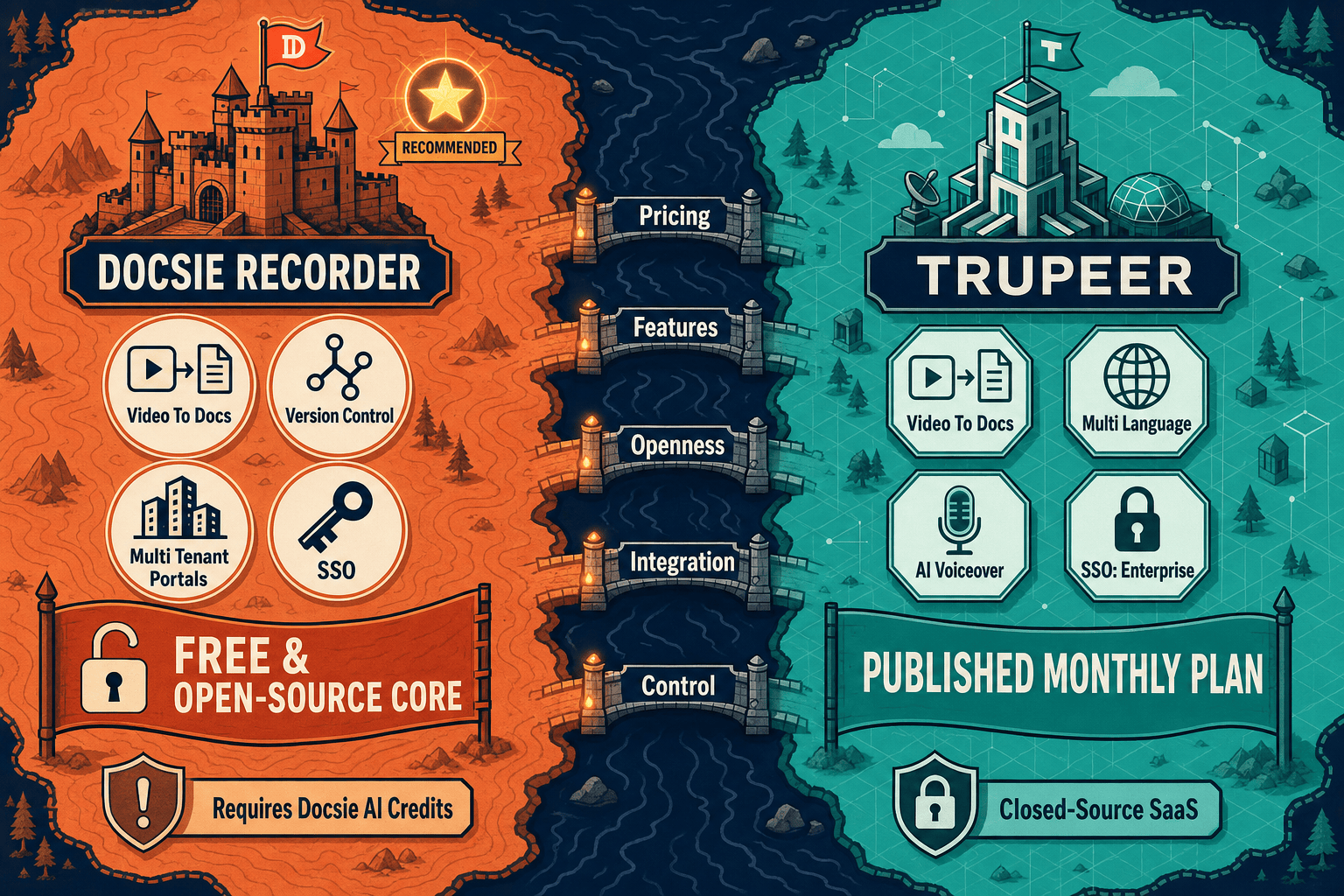
Winner: Docsie Recorder
Docsie Recorder wins for teams that want an open-source, cross-platform recorder with a full editing suite and a native path from video capture to structured, versioned knowledge base documentation. The MIT-licensed recorder core provides auditability that Trupeer's closed-source SaaS cannot offer, Linux support extends the platform to engineering teams, and the direct Docsie Video-to-Docs pipeline means one recording produces structured Markdown, DOCX, PDF, and published knowledge base content—not just a polished video file. Trupeer is a strong AI voiceover and video polish tool, but Docsie Recorder is the right choice when documentation is the primary deliverable.
Decision Helper
A direct framework for picking between Docsie Recorder, Trupeer based on your specific needs.
Free, open-source desktop screen recorder that feeds a Video-to-Docs pipeline.
AI video editing platform that turns rough recordings into polished tutorials.
Common Questions
Q: Is Docsie Recorder really free, or is there a catch?
A: Docsie Recorder's desktop app—including recording, editing, and local MP4 and GIF export—is completely free and open source under the MIT license. No account is required to capture and export video. The only paid component is the Video-to-Docs conversion, which uses Docsie AI credits to process your recording through the cloud pipeline and generate structured documentation. You can record and edit locally for free indefinitely.
Q: Does Trupeer support Linux like Docsie Recorder does?
A: No. Trupeer does not currently offer a Linux desktop build. Docsie Recorder ships cross-platform builds for macOS, Windows, and Linux, making it the better choice for engineering and DevOps teams whose workflows run on Linux. If your team includes Linux users who need to record and edit locally, Docsie Recorder is the only option between these two.
Q: How does the video-to-docs conversion differ between Docsie Recorder and Trupeer?
A: Trupeer converts recordings into formatted step-by-step guides with AI-generated voiceovers, primarily oriented around video as the output artifact. Docsie Recorder routes recordings through the Docsie Video-to-Docs API to generate structured Markdown, DOCX, and PDF, which then publishes directly into a versioned Docsie knowledge base. Docsie's output is documentation-first; Trupeer's output is video-first with a text guide alongside it.
Q: Can Docsie Recorder match Trupeer's AI voiceover feature?
A: Not in the recorder itself—Docsie Recorder does not include native AI voiceover generation, which is a genuine strength of Trupeer. However, Docsie's downstream platform supports translation and multi-language documentation publishing, addressing the global content need from a different angle. If AI-narrated video is your primary deliverable, Trupeer has the edge here; if structured written documentation is the goal, Docsie Recorder's pipeline is more capable.
Q: Which tool is better for a team that needs a knowledge base, not just a video?
A: Docsie Recorder is the clear choice here. Trupeer produces polished videos and step-by-step guides but does not include a native knowledge base platform with versioning, approval workflows, or multi-tenant portal delivery. Docsie Recorder connects directly to the Docsie platform, where converted documentation can be versioned, organized, translated, and delivered through branded portals to multiple audiences—all from the same recording workflow.
Q: Is Docsie Recorder a viable Screen Studio or Loom alternative?
A: Yes. Docsie Recorder covers the core Screen Studio and Loom use case—high-quality screen recording with zoom, background replacement, crop, trim, and webcam overlay—while adding cross-platform Linux support, an open-source codebase, local GIF export, and a direct path to structured documentation. Unlike Loom, which stops at a shareable video link, Docsie Recorder's output becomes versioned knowledge base content. Unlike Screen Studio, it runs on Windows and Linux in addition to Mac.
Download Docsie Recorder free, capture your workflow locally, and connect to Docsie's Video-to-Docs pipeline to turn one recording into structured Markdown, DOCX, PDF, and a versioned knowledge base—no closed-source SaaS required.
Free to record, edit, and export locally. Video-to-Docs uses Docsie AI credits. No account required to download.