
4.8
on G2
 Docsie Recorder
 Tella
Tella
Both Docsie Recorder and Tella let teams capture and share screen recordings, but their enterprise stories diverge sharply. Docsie Recorder is a free, open-source desktop recorder anchored to an enterprise documentation platform with SSO, audit logs, versioning, and multi-tenant portal delivery. Tella is a polished browser-based video tool with an Enterprise tier that is still primarily optimized for async video sharing rather than managed documentation workflows.
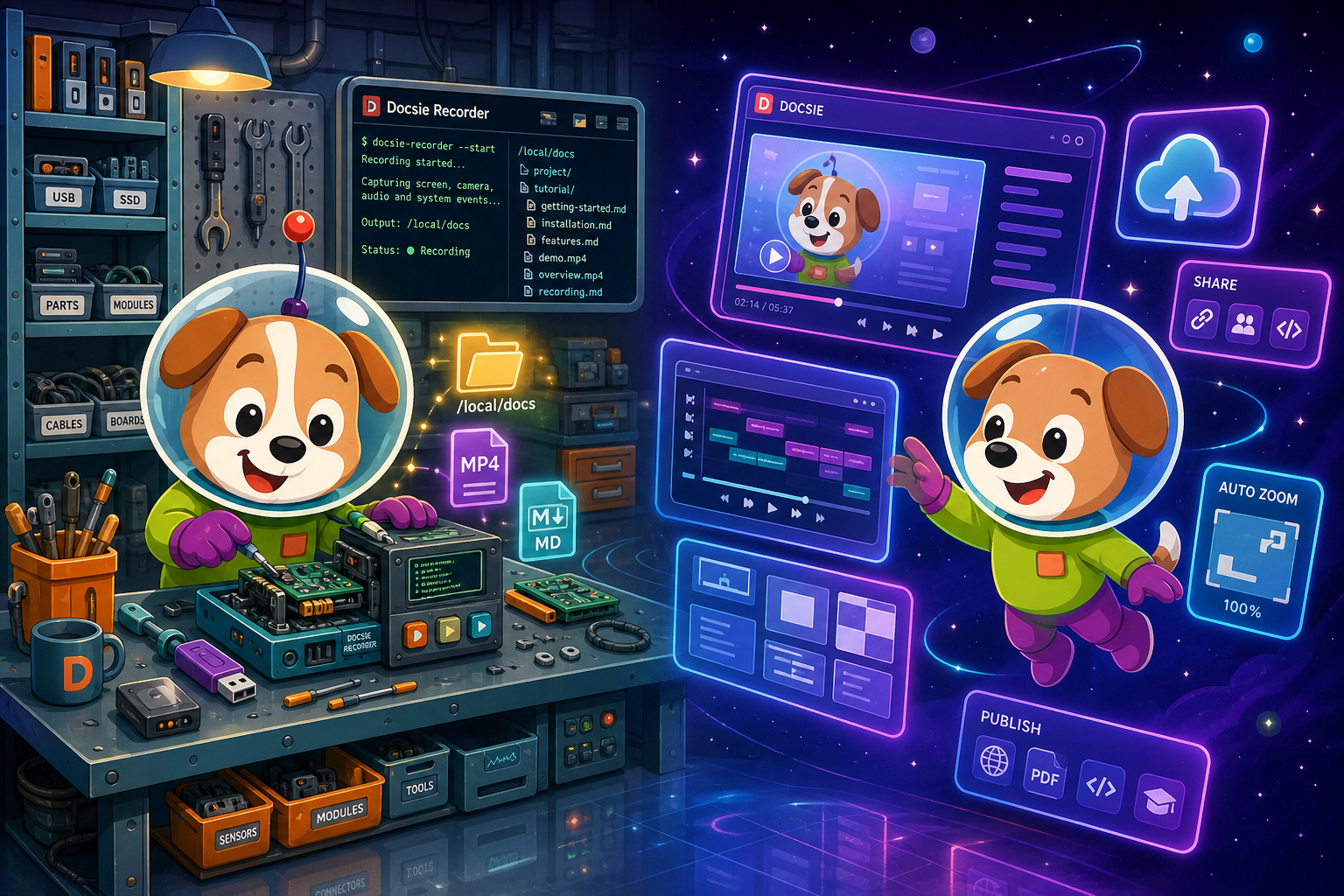
For enterprise: Docsie Recorder runs video-to-docs plus multi-tenant portals, Tella captures workflows into quick guides, while Docsie Recorder fits when you also need video → structured docs → multi-tenant portals end-to-end.
Enterprise Feature Matrix
A focused comparison of enterprise-grade capabilities including security, compliance, administration, scalability, and downstream documentation management for teams evaluating screen recorders at scale.
| Feature |
Docsie Recorder
Our Pick
|
Tella
|
|---|---|---|
| Free Desktop Recorder | ||
| Open-Source Recorder Core | ||
| Mac Support | ||
| Windows Support | ||
| Linux Support | ||
| Local-First Recording (No Upload Required) | ||
| Local MP4 Export | ||
| Video-to-Docs Conversion | Premium tier | |
| Markdown / DOCX / PDF Export | ||
| Knowledge Base Publishing | ||
| Versioned Documentation Management | ||
| Multi-Tenant Portal Delivery | ||
| SSO (SAML / OAuth / OIDC) | Enterprise custom | |
| Role-Based Access Control | ||
| Audit Logs | ||
| API Access | ||
| Custom Domain Support | ||
| On-Premises / Air-Gap Deployment | Via Docsie enterprise | |
| Compliance Monitoring | ||
| Dedicated Enterprise Support / SLA | Enterprise custom |
Data as of 2026. Based on publicly available vendor documentation and pricing pages. Enterprise features for both tools should be checked directly with each vendor before procurement decisions.
Strengths & Weaknesses
Deep Dive
An in-depth analysis of how Docsie Recorder and Tella compare on Security and Compliance, Scalability and Performance, Administration and Control, and Support and SLA for enterprise procurement teams.
Docsie Recorder's open-source MIT core means enterprise security teams can audit every line of the recording layer—a level of transparency no closed-source SaaS recorder can match. Recordings are captured locally and only transmitted when the user explicitly initiates a Video-to-Docs conversion. The downstream Docsie platform adds SOC 2 Type II compliance, GDPR readiness, SAML/OAuth/OIDC SSO, and real-time compliance monitoring for HIPAA, SOX, ITAR, and GDPR violations in generated documentation. Tella is a closed-source SaaS; its Enterprise tier mentions security features but audit logs, data residency, and compliance monitoring are not confirmed in public documentation.
Docsie Recorder handles recording and editing locally regardless of team size, keeping capture performance independent of cloud infrastructure. The Docsie platform behind it is built for multi-tenant scale—one workspace can serve multiple products, teams, or client portals from a single documentation source. Version control with inheritance means documentation scales without duplication. Tella's browser-based architecture means recording quality and upload performance depend on the user's browser environment and Tella's cloud infrastructure. There is no multi-tenant architecture for scaling documentation delivery across multiple clients or branded portals, and no versioning layer for managing documentation at enterprise scale.
Enterprise administrators need granular control over who records, who accesses generated content, and how documentation is published. Docsie's platform provides role-based access control, audit logs, workspace-level permissions, custom domains, and API access for integrating recording-to-docs workflows into broader enterprise toolchains. IT teams can also inspect the open-source recorder codebase directly. Tella offers role-based sharing and team collaboration within its product, and its Enterprise tier allows custom terms, but audit logs, API access, and custom domain control are not available on self-serve plans. Administrative control is limited to what Tella exposes through its SaaS interface, with no programmatic control layer.
Docsie's enterprise plan includes dedicated support with defined SLA commitments, onboarding assistance, and access to the Docsie team for documentation workflow design. The open-source recorder core also benefits from community visibility—bugs and security issues are publicly trackable on GitHub. Tella's Enterprise tier offers dedicated support and custom terms, but specific uptime SLA figures are not published in public documentation and must be negotiated. For teams requiring contractual uptime guarantees, response time commitments, and a documented escalation path, Docsie's enterprise offering provides a more structured and verifiable support baseline than Tella's current Enterprise positioning.
Our Recommendation
For teams evaluating screen recorders through an enterprise lens, Docsie Recorder and Tella occupy very different positions. Tella is a polished browser video tool with a maturing Enterprise tier—excellent for async video sharing and product demos, but not yet a documentation platform. Docsie Recorder is a free, open-source desktop recorder that serves as the CREATE entry point into an enterprise-grade documentation workflow covering conversion, versioning, multi-tenant delivery, compliance, and audit. The recorder is the wedge; the enterprise story is the platform behind it.
Choose Docsie Recorder if you need...
Choose Tella if you need...
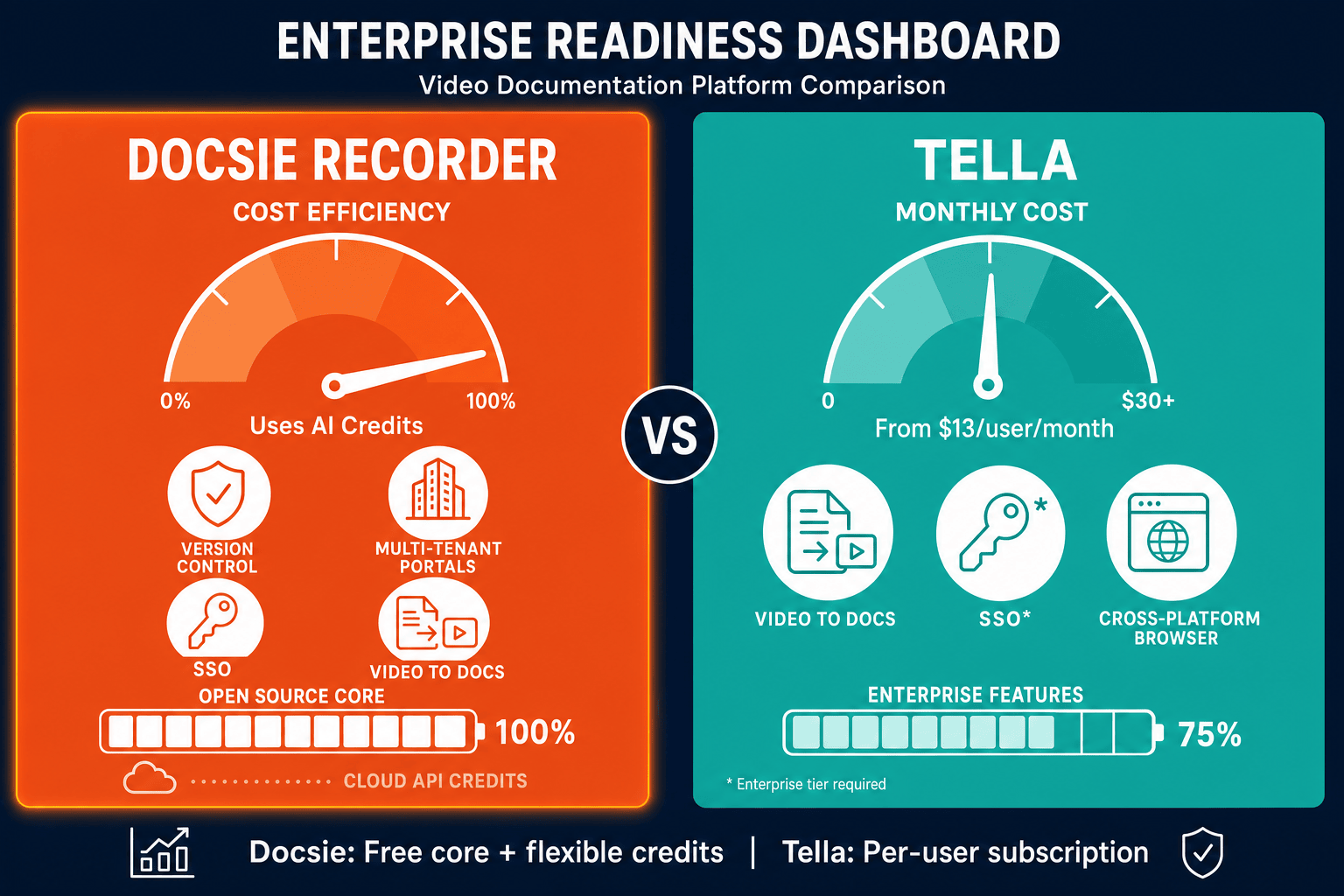
Winner: Docsie Recorder
Docsie Recorder wins the enterprise readiness comparison because it is the only option in this pairing that offers a fully auditable open-source recorder core, local-first capture, downstream SSO and audit log integration, multi-tenant portal delivery, versioned documentation management, and a compliance monitoring layer. Tella is a strong async video tool but its enterprise story is still primarily centered on video sharing rather than managed documentation workflows. For procurement teams that need to answer questions about source auditability, data residency, access control, and documentation lifecycle management, Docsie Recorder backed by the Docsie enterprise platform provides a materially stronger and more verifiable enterprise posture.
Decision Helper
A direct framework for picking between Docsie Recorder, Tella based on your specific needs.
Free, open-source desktop screen recorder that feeds a Video-to-Docs pipeline.
Polished browser-based screen and webcam recorder for content creators.
Common Questions
Q: Can enterprise security teams audit the Docsie Recorder codebase before deployment?
A: Yes. Docsie Recorder's core is built on OpenScreen and published under an MIT license on GitHub at github.com/LikaloLLC/docsie-screen-recorder. Security teams can review every line of the recording and editing layer before approving it for deployment. Tella is a closed-source SaaS and does not provide access to its source code for enterprise security review.
Q: Does Tella support SSO for enterprise authentication?
A: Tella lists SSO as an Enterprise custom feature, meaning it is available through negotiated enterprise agreements rather than self-serve Pro or Premium plans. Docsie's platform supports SAML, OAuth, OIDC, Azure AD, and Okta SSO on enterprise plans, integrated into the same workflow that receives and manages recordings converted to documentation. Teams requiring SSO on a defined timeline should confirm Tella's availability and timeline directly before committing.
Q: Does Docsie Recorder store recordings on the cloud automatically?
A: No. Docsie Recorder captures and edits recordings locally on the user's machine. Recordings are stored as local project files and exported to MP4 or GIF locally. Content is only sent to Docsie's cloud when the user explicitly initiates a Video-to-Docs conversion through the Docsie bridge, giving enterprise teams full control over when and whether recorded content leaves the endpoint.
Q: Does Docsie Recorder include audit logs for compliance teams?
A: Audit logging is available through the Docsie enterprise platform that Docsie Recorder connects to downstream. When recordings are converted to documentation and published into Docsie workspaces, administrative actions are captured in audit logs that compliance teams can review. Tella does not list audit logs in its public documentation for any plan tier including Enterprise.
Q: Can Docsie Recorder support multi-tenant documentation delivery for enterprises serving multiple clients?
A: Yes. Once a recording is converted to documentation through Docsie's Video-to-Docs pipeline, the resulting content can be published into Docsie's multi-tenant portal architecture. One workspace can power multiple branded documentation portals for different clients or products, each with custom domains, branding, and access controls. Tella has no equivalent multi-tenant delivery capability—its output is hosted video and share links, not structured documentation portals.
Q: What is the enterprise deployment path for Docsie Recorder compared to Tella?
A: Docsie Recorder deploys as a free desktop application on macOS, Windows, and Linux with no account required for recording and local export. Enterprise teams connect it to the Docsie platform for the documentation workflow layer, where enterprise SSO, audit logs, RBAC, and compliance features apply. Tella deploys as a browser-based tool requiring no desktop installation, with enterprise features negotiated through Tella's Enterprise tier. Teams requiring desktop deployment with an auditable recorder layer will find Docsie Recorder's path more suitable for enterprise IT governance requirements.
Download the free, open-source Docsie Recorder today and see how your screen recordings become structured documentation inside an enterprise-grade knowledge base—with SSO, audit logs, versioning, and multi-tenant portal delivery built in downstream.
Free to record and export locally. No account required. Docsie AI credits used only when you initiate Video-to-Docs conversion.