
4.8
on G2
 Docsie Recorder
 Screen Studio
Screen Studio is the go-to Mac recorder for polished product demos. Docsie Recorder is a free, open-source cross-platform alternative that records and edits with the same core feature set—then goes further by converting your recording into structured Markdown, DOCX, PDF, and a versioned knowledge base. If you need more than a video file at the end, this comparison explains the difference.

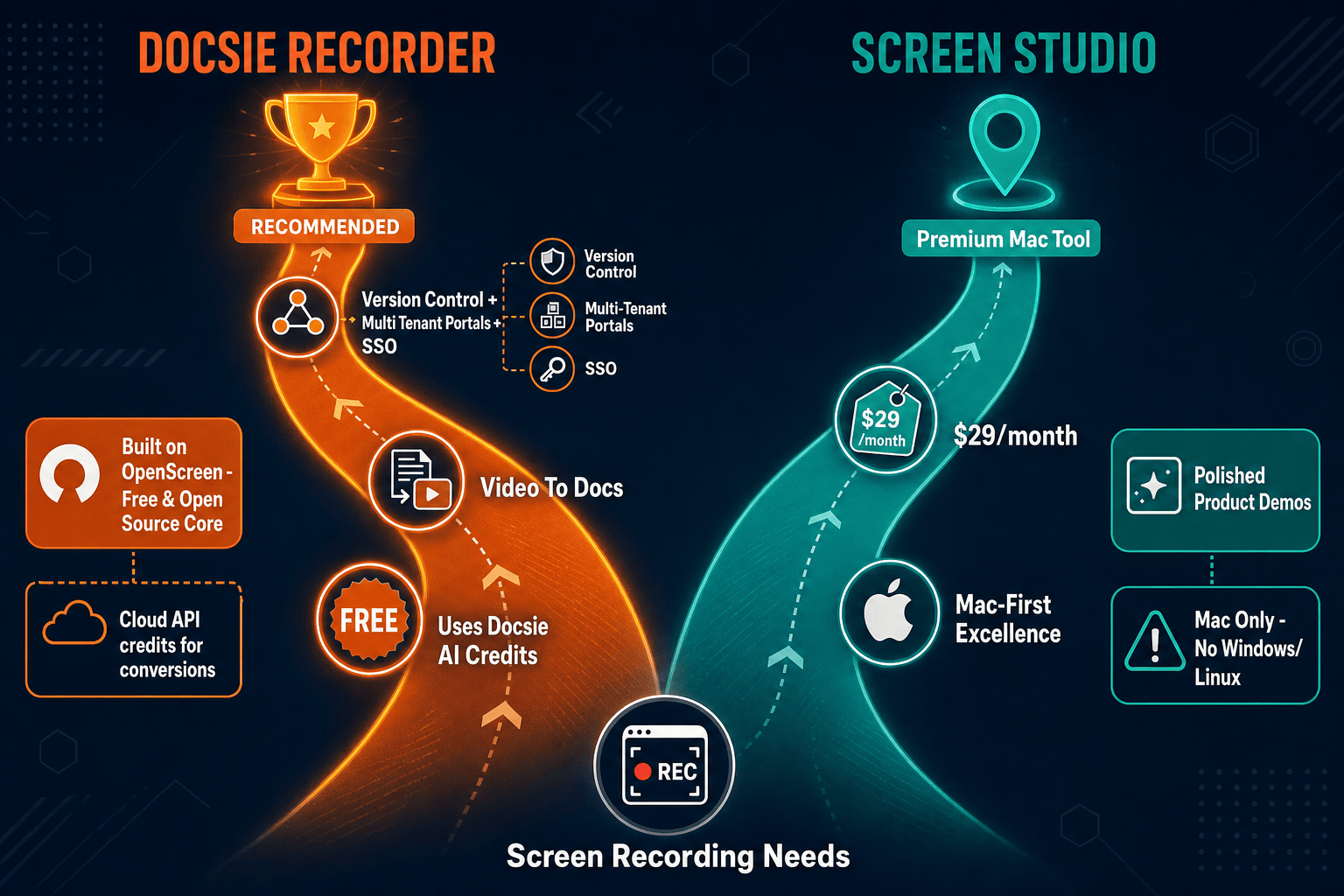
Docsie Recorder leads with free and open-source recorder/editor core built on openscreen (mit license); Screen Studio leads with best-known mac-first recorder for polished product demos and marketing videos. Neither converts real video into docs and deploys multi-tenant portals; Docsie does both.
Feature Matrix
A feature-by-feature comparison of recording capabilities, editing tools, export formats, video-to-docs conversion, and downstream knowledge base publishing between Docsie Recorder and Screen Studio.
| Feature |
Docsie Recorder
Our Pick
|
Screen Studio
|
|---|---|---|
| Free to use | ||
| Open-source recorder base | ||
| Mac support | ||
| Windows support | ||
| Linux support | ||
| Window and full-screen capture | ||
| Microphone capture | ||
| System audio capture | Platform-specific | |
| Webcam overlay | ||
| Automatic zoom | ||
| Manual zoom on timeline | ||
| Cursor smoothing and polish | ||
| Backgrounds and visual effects | ||
| Motion blur | ||
| Crop, trim, and speed regions | ||
| Annotations and blur regions | ||
| Local MP4 export | ||
| Local GIF export | ||
| Shareable video links | ||
| iOS device recording | ||
| Keyboard shortcut display overlay | ||
| Video-to-docs conversion | ||
| Markdown export | ||
| DOCX export | ||
| PDF export | ||
| Knowledge base publishing | ||
| Versioned documentation management | ||
| Multi-tenant portal delivery | ||
| SSO and enterprise access controls | ||
| API access |
Data as of 2026. Features based on publicly available information and vendor documentation. Screen Studio pricing confirmed May 2026 at $29/month or ~$9/month billed yearly. Reconfirm before relying on this comparison.
Strengths & Weaknesses
Deep Dive
An in-depth analysis of the recording and editing workflow, AI and automation capabilities, enterprise readiness, and integration ecosystem between Docsie Recorder and Screen Studio.
Both tools share a strong recording and editing foundation. Screen Studio leads on motion polish—its automatic zoom, smooth cursor physics, and iOS device capture are best-in-class for Mac-only teams. Docsie Recorder matches the core editing toolkit with zooms, crop, trim, speed regions, backgrounds, motion blur, annotations, and blur regions, while adding cross-platform reach across macOS, Windows, and Linux. The critical difference is output destiny. Screen Studio stops at a polished video file or GIF. Docsie Recorder treats the recording as the starting point for structured documentation, not the end product.
Screen Studio has no AI documentation layer. Its automation is limited to cursor smoothing, auto-zoom detection, and audio enhancement applied to the video itself. Docsie Recorder connects directly to Docsie's Video-to-Docs API, which uses multimodal AI to analyze the recording, extract steps, generate screenshots, and produce structured Markdown output with configurable doc style, language, rewrite instructions, and template rules. Teams can estimate credit cost before submitting, choose quality tier, and preview the Markdown payload before relying on this comparison—turning a single recording session into a usable knowledge base article.
Screen Studio is a polished local Mac app with shareable links. It has no SSO, no audit logs, no role-based access, no data residency options, and no multi-tenant portal delivery. It is a strong individual and small-team tool, but it was not designed for enterprise documentation governance. Docsie Recorder's downstream platform supports SAML SSO, granular permissions, versioned content with inheritance, multi-tenant portals with custom domains, and compliance workflows. For regulated industries or teams managing documentation at scale, Docsie's enterprise boundary provides a complete governance path that Screen Studio cannot match.
Screen Studio integrates with macOS system-level features and outputs video files or shareable links. There is no API, no webhook, and no programmatic integration path. Docsie Recorder exposes an API bridge to Docsie's platform, enabling video jobs to route into documentation automation, translation pipelines, LMS course creation, and compliance monitoring workflows. Teams can use the same source recording as a training video, a knowledge base article, a translated doc for a global portal, and a compliance audit artifact—all without re-recording or duplicating work across separate tools.
Pricing Comparison
Docsie Recorder is free and open-source for recording and editing. Screen Studio requires a paid subscription. Video-to-Docs conversion in Docsie uses AI credits billed through the Docsie platform.
For teams that only need a polished Mac video file, Screen Studio's yearly plan is reasonable. For teams on Windows or Linux, teams that need docs from their recordings, or teams that want an auditable open-source recorder, Docsie Recorder is free with no subscription required. Confirm Screen Studio pricing at screen.studio before purchasing—SaaS pricing changes frequently.
Our Recommendation
Screen Studio is the gold standard for polished Mac screen recordings. Its motion physics, cursor animations, and visual styling are hard to beat for creators and founders who need beautiful demo videos fast—on a Mac. But Screen Studio's workflow ends at a video file. Docsie Recorder starts from the same recording and editing capability, extends it across Windows and Linux, makes the codebase auditable, and then routes the recording into a structured documentation pipeline. If your goal is a beautiful video, Screen Studio is excellent. If your goal is documentation, knowledge base articles, or enterprise content governance, Docsie Recorder is the better tool.
Choose Docsie Recorder if you need...
Choose Screen Studio if you need...
Winner: Docsie Recorder
Docsie Recorder wins for teams that need more than a video file. It is free, open-source, and cross-platform—matching Screen Studio's core recording and editing capabilities on macOS while also supporting Windows and Linux. More importantly, it is the only recorder in this comparison that natively routes recordings into structured documentation through the Docsie Video-to-Docs pipeline, turning a single recording session into versioned knowledge base content deliverable through multi-tenant portals. For support teams, product teams, and enablement teams, that CREATE-to-CONVERT-to-MANAGE workflow is a fundamentally different value proposition than Screen Studio's polished-video-only output.
Decision Helper
A direct framework for picking between Docsie Recorder, Screen Studio, and Docsie based on your specific needs.
Docsie's free browser-based recorder that pipes captures straight into Docsie SOPs.
Premium Mac screen recorder with cinematic auto-zoom and polished output.

Convert real video into searchable docs, then deploy via multi-tenant portals.
Common Questions
Q: Is Docsie Recorder really free, or is there a catch?
A: The recorder and editor core is genuinely free and open-source under the MIT license—you can download it, record, edit, and export MP4 or GIF with no account and no subscription. The only paid component is Video-to-Docs conversion, which uses Docsie AI credits when you submit a recording to the cloud pipeline. If you only need local video export, you will never spend a dollar.
Q: Can Docsie Recorder match Screen Studio's visual polish and zoom quality?
A: Docsie Recorder includes automatic zoom with cursor telemetry suggestions, manual zoom controls, cursor polish, backgrounds, motion blur, annotations, and blur regions—the same functional toolkit Screen Studio provides. Screen Studio's motion physics and cursor animations are widely considered best-in-class for Mac, so if ultra-smooth demo video polish is your primary criterion and you are on a Mac, Screen Studio has a genuine edge. For teams that value cross-platform reach, open-source auditability, or documentation output over maximum motion quality, Docsie Recorder is the stronger choice.
Q: Does Screen Studio have any video-to-docs or knowledge base features?
A: No. Screen Studio produces polished video files and GIFs with shareable links. It has no video-to-docs conversion, no Markdown or DOCX export, no knowledge base, and no versioning or portal delivery. If your workflow requires the recording to become a documentation artifact rather than a video-only deliverable, Screen Studio does not support that path.
Q: Which tool works on Windows and Linux?
A: Docsie Recorder provides native builds for macOS, Windows, and Linux. Screen Studio is Mac-only and has no Windows or Linux version available. This is a hard requirement difference—if your team includes Windows or Linux users, Screen Studio is not a viable option.
Q: I searched for a Screen Studio alternative—is Docsie Recorder actually comparable?
A: Yes, at the recording and editing layer. Docsie Recorder covers the same functional ground—window and full-screen capture, zooms, trim, crop, speed regions, backgrounds, webcam overlay, microphone, and local export. The meaningful differences are platform coverage (Docsie adds Windows and Linux), codebase transparency (Docsie is open-source), price (Docsie is free), and output scope (Docsie can convert the recording into structured docs). If you are looking for a Screen Studio alternative that does not lock you to Mac or a subscription, Docsie Recorder is the most direct match in this comparison set.
Q: How does the Video-to-Docs workflow actually work after recording?
A: After you finish editing in Docsie Recorder, you connect your Docsie workspace and submit the recording through the built-in bridge. The Video-to-Docs pipeline analyzes the footage using multimodal AI, extracts steps and screenshots, and returns a structured Markdown preview you can review before relying on this comparison. You can configure document style, target language, rewrite instructions, and template rules before submitting. Once approved, the output publishes directly into your Docsie knowledge base where it can be versioned, translated, delivered through portals, or reused as course material.
Download Docsie Recorder free—no subscription, no account required for local recording. When you are ready to turn a recording into a knowledge base article, connect your Docsie workspace and run the Video-to-Docs pipeline.
Free recorder and editor. No subscription. Video-to-Docs conversion uses Docsie AI credits. Estimate cost before submitting.