
4.8
on G2
 Docsie Recorder
 RecordIt
Both Docsie Recorder and RecordIt offer free screen recording, but they diverge sharply after you hit stop. Docsie Recorder is a cross-platform, open-source desktop recorder built to convert captures into structured documentation and publish them to a knowledge base. RecordIt is a lightweight recording utility aimed at quick sharing and debug context. If you searched for a Screen Studio alternative or a recorder that produces real docs — not just a share link — this comparison is for you.
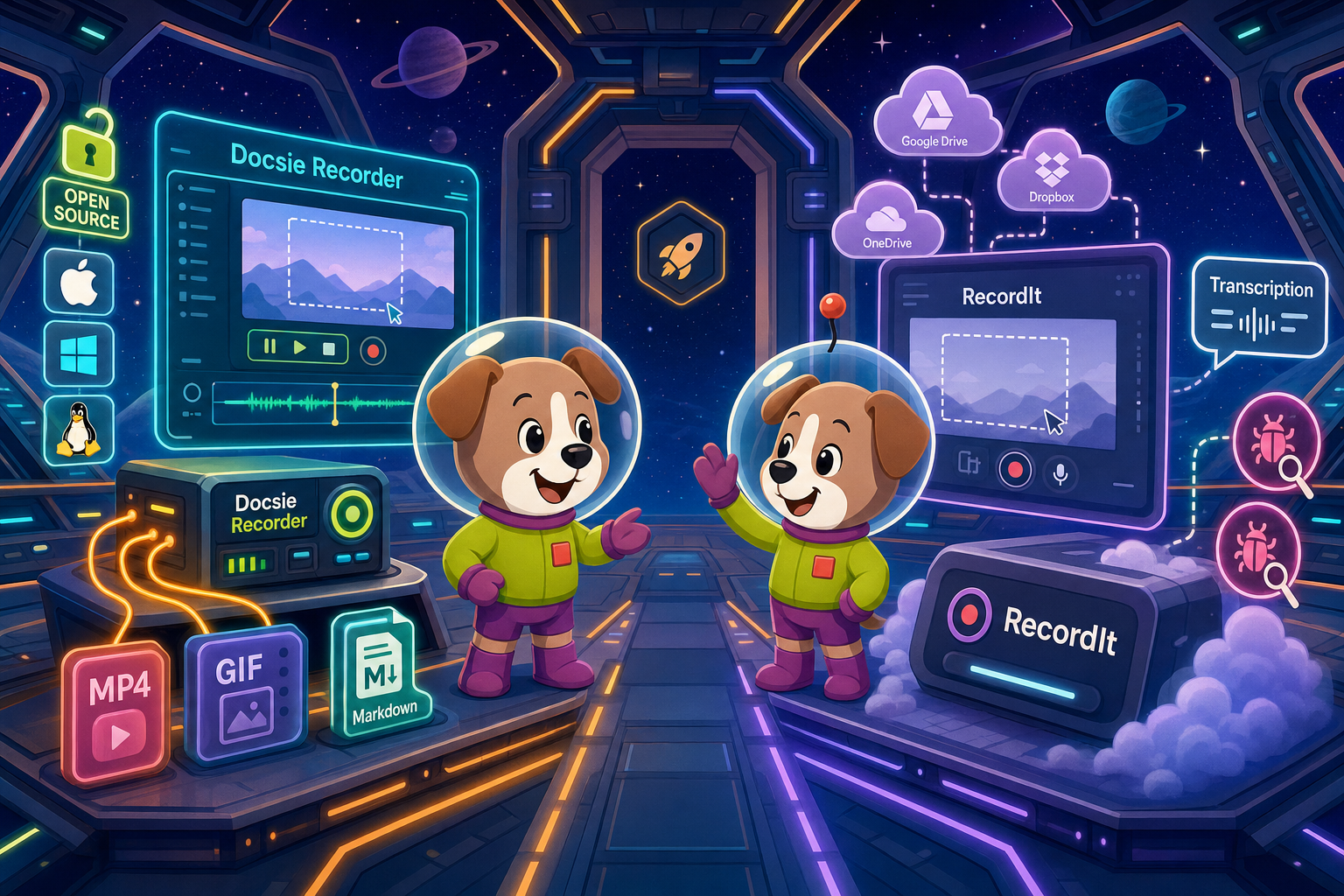
Docsie Recorder leads with free; RecordIt leads with simple. Neither converts real video into docs and deploys multi-tenant portals; Docsie does both.
Feature Matrix
A feature-by-feature comparison of recording capabilities, editing tools, export formats, AI-powered documentation, and enterprise readiness between Docsie Recorder and RecordIt.
| Feature |
Docsie Recorder
Our Pick
|
RecordIt
|
|---|---|---|
| Free Desktop Recorder | ||
| Open-Source Recorder Base | ||
| Mac Support | Limited public detail | |
| Windows Support | Limited public detail | |
| Linux Support | ||
| Window and Full-Screen Capture | ||
| Microphone Capture | ||
| System Audio Capture | Platform-specific | Limited public detail |
| Webcam Overlay | Limited public detail | |
| Automatic or Manual Zoom | ||
| Cursor or Focus Polish | ||
| Backgrounds and Visual Effects | Wallpapers, gradients, custom | |
| Crop, Trim, Speed Regions | ||
| Annotations and Blur Regions | Text, arrows, blur regions | |
| Local MP4 Export | ||
| Local GIF Export | ||
| Project Save Format | .docsiescreen project files | |
| AI Transcription | ||
| Video-to-Docs Conversion | ||
| Markdown Export | ||
| DOCX Export | ||
| PDF Export | ||
| Knowledge Base Publishing | ||
| Versioned Documentation Management | ||
| Multi-Tenant Portal Delivery | ||
| API Access | ||
| SSO (SAML/OAuth) | ||
| Enterprise Deployment Path |
Data as of 2026. RecordIt feature data is based on publicly available information from recordit.dev. Some RecordIt capabilities have limited public detail; confirm current platform support before making a purchasing decision.
Strengths & Weaknesses
Deep Dive
An in-depth look at recording and editing capabilities, AI-powered documentation, enterprise readiness, and ecosystem integrations — the four dimensions that matter most when choosing a screen recorder that goes beyond the share link.
Docsie Recorder is a full desktop recording and editing application. After you stop recording, you have a native timeline editor with automatic and manual zoom, cursor tracking and polish, webcam overlay, background replacement, motion blur, speed regions, crop, trim, and annotation tools including blur regions for sensitive content. RecordIt focuses on fast capture and sharing — it records your screen and surfaces debug context or a transcript, but provides no editing layer. If you need to produce a polished walkthrough or tutorial rather than a raw clip, Docsie Recorder's editing suite is in a different class entirely.
Docsie Recorder's AI story begins where RecordIt's ends. Both tools offer transcription, but Docsie's bridge sends the recording through a multimodal Video-to-Docs pipeline that uses computer vision, OCR, and audio analysis to generate structured Markdown, DOCX, and PDF documentation — not just a transcript. You can configure quality tier, output language, doc style, and custom rewrite or template instructions before submitting the job. RecordIt's AI surfaces a transcript and debug context, which is useful for issue reporting but produces no exportable structured documentation. For teams that need documentation as the output — not just a searchable clip — Docsie Recorder's AI pipeline is the decisive difference.
Docsie Recorder connects into the broader Docsie enterprise platform, which includes versioned documentation management, multi-tenant portals with custom domains, SAML and OAuth SSO, role-based access control, audit logs, and API access. Recordings converted through the Video-to-Docs bridge feed directly into this governed documentation workflow. RecordIt has no confirmed enterprise features at the time of publication — no SSO, no audit logs, no versioning, no multi-tenant delivery. For engineering teams sharing a bug clip, that is acceptable. For organizations building a governed documentation library from screen recordings, RecordIt does not provide a credible enterprise path.
Docsie Recorder's value compounds downstream. A recording captured and edited locally is sent through the Docsie Video-to-Docs API, generating structured content that publishes into Docsie's knowledge base. From there, the same source material can be versioned, translated into 100+ languages, served through branded customer portals, reused as course material in Docsie's LMS, and routed through automation and compliance monitoring workflows. RecordIt integrates with cloud sharing for rapid link distribution and surfaces debug metadata alongside transcripts — well-suited for engineering issue workflows but with no path into documentation publishing, course delivery, or compliance monitoring. Docsie Recorder is a CREATE entry point to a full documentation ecosystem; RecordIt is a standalone sharing utility.
Our Recommendation
Docsie Recorder and RecordIt are both free screen recorders, but they occupy very different positions. RecordIt is a lightweight capture tool built for fast sharing and debug context — it is genuinely useful for engineers who need to share a quick recording with a support ticket. Docsie Recorder is a cross-platform, open-source desktop recorder with a full editing suite that connects directly to a Video-to-Docs pipeline and a knowledge base publishing workflow. If your goal is to record a screen and share a link, either tool can help. If your goal is to turn recordings into structured, versioned, published documentation, only Docsie Recorder has a path to get you there.
Choose Docsie Recorder if you need...
Choose RecordIt if you need...
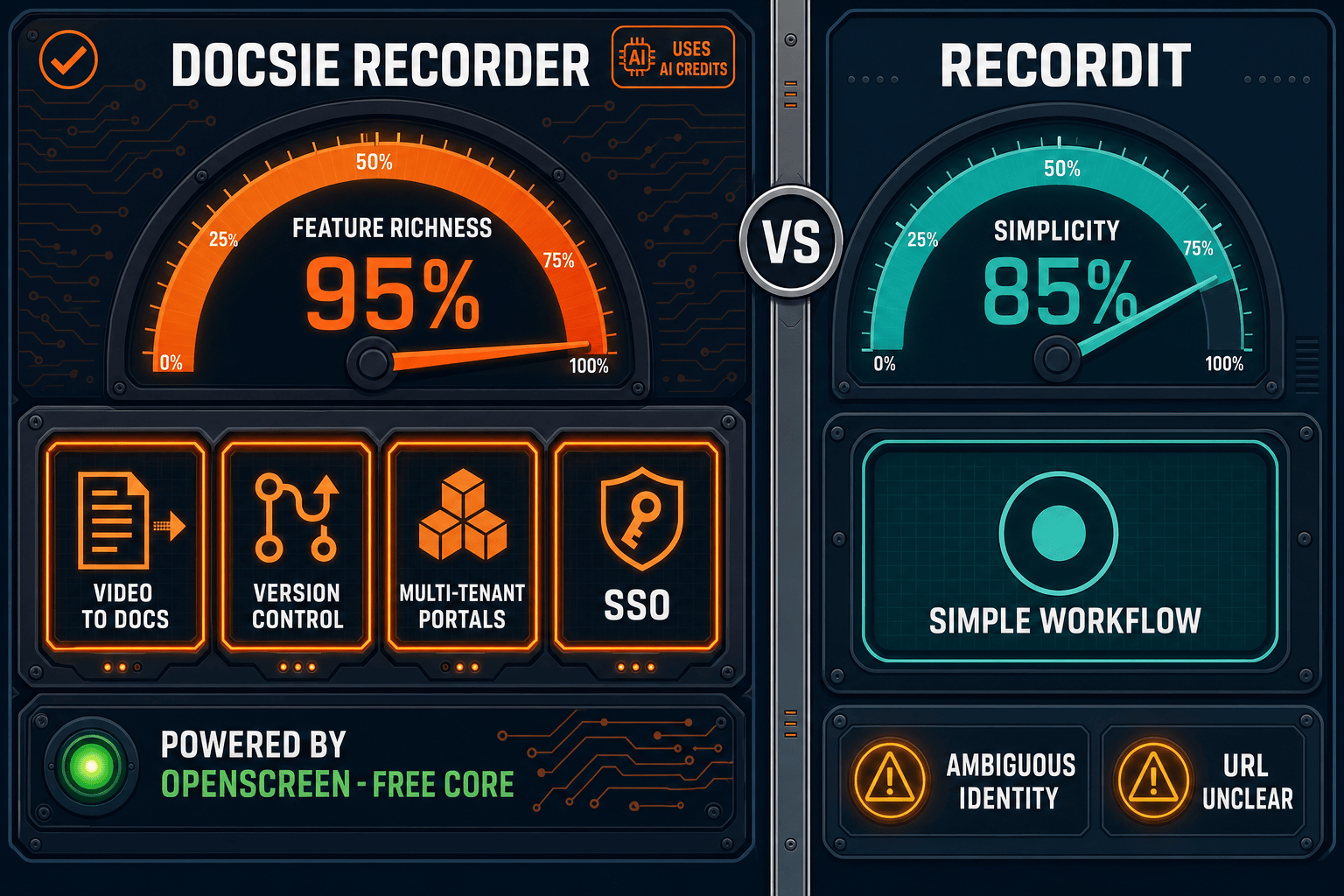
Winner: Docsie Recorder
For any team that records screens to produce documentation — not just to share a clip — Docsie Recorder is the clear choice. It is the only free, open-source recorder in this comparison that includes a full editing suite, exports MP4 and GIF locally, and connects directly to an AI Video-to-Docs pipeline that turns recordings into structured Markdown, DOCX, PDF, and knowledge base content. RecordIt is a useful lightweight capture tool, but it stops at the share link. Docsie Recorder starts the CREATE workflow and feeds it forward into a complete documentation ecosystem.
Decision Helper
A direct framework for picking between Docsie Recorder, RecordIt, and Docsie based on your specific needs.
Docsie's free browser-based recorder that pipes captures straight into Docsie SOPs.
Simple screen-to-gif recorder for quick share links.

Convert real video into searchable docs, then deploy via multi-tenant portals.
Common Questions
Q: Can RecordIt convert a recording into structured documentation like Docsie Recorder?
A: No. RecordIt produces a share link, debug context, and a transcript from your recording. It does not generate Markdown, DOCX, PDF, or knowledge base articles. Docsie Recorder sends your recording through the Docsie Video-to-Docs pipeline, which uses multimodal AI to produce structured documentation you can publish, version, and deliver through a knowledge base portal.
Q: Does Docsie Recorder work on Linux, or is it Mac and Windows only?
A: Docsie Recorder supports macOS, Windows, and Linux. It is built on the open-source OpenScreen core, and cross-platform builds are available. RecordIt's platform support is unconfirmed from public sources — confirm current availability on recordit.dev before assuming Windows or Linux builds exist.
Q: Is Docsie Recorder actually free, or is there a hidden cost?
A: The Docsie Recorder desktop application — including recording, editing, and local MP4/GIF export — is completely free and requires no account. The Video-to-Docs conversion step uses Docsie AI credits, which are separate from the recorder itself. You can record, edit, and export video indefinitely at no cost; you only consume credits when you submit a recording for documentation conversion.
Q: RecordIt has transcription — does that make it equivalent for documentation purposes?
A: Transcription and structured documentation are meaningfully different outputs. RecordIt's transcription produces a text log of spoken audio. Docsie Recorder's Video-to-Docs pipeline uses computer vision, OCR, and audio analysis together to generate organized step-by-step documentation with configurable doc style, language, and formatting — output that is ready to publish into a knowledge base rather than a raw text transcript.
Q: If I only need to share a quick recording with my team, do I need Docsie Recorder?
A: Not necessarily. If your workflow begins and ends with sharing a raw recording link — for a bug report, a quick demo, or a team message — RecordIt's lightweight approach may be sufficient. Docsie Recorder is the stronger choice when you need to edit the recording, export a polished MP4 or GIF, or convert it into documentation that lives in a searchable knowledge base.
Q: Can I use Docsie Recorder as a Screen Studio alternative on Windows or Linux?
A: Yes. Screen Studio is Mac-only and closed-source. Docsie Recorder provides a comparable recording and editing experience — including zoom, backgrounds, cursor polish, annotations, and blur regions — across macOS, Windows, and Linux with an open-source MIT-licensed recorder core. It also adds Video-to-Docs conversion as a capability Screen Studio does not offer at all.
Download Docsie Recorder free — no account required to capture, edit, and export. When you are ready to turn a recording into structured Markdown, DOCX, or a published knowledge base article, the Docsie Video-to-Docs bridge is one click away.
MIT open-source recorder core. Free local MP4 and GIF export. Video-to-Docs conversion uses Docsie AI credits.