
4.8
on G2
 Docsie Recorder
 Kommodo
Both Docsie Recorder and Kommodo turn screen recordings into step-by-step documentation, but they take very different paths. Docsie Recorder is a free, open-source desktop recorder built on OpenScreen that exports MP4/GIF locally and routes directly into Docsie's Video-to-Docs pipeline for structured Markdown, DOCX, PDF, and full knowledge base publishing. Kommodo is a cloud-based SaaS SOP generator that auto-captures screenshots during recording and generates guides in a hosted workspace. If you searched for a Screen Studio alternative, a Loom alternative, or an AI video-to-docs tool that gives you real recorder control before the AI step, this comparison is for you.
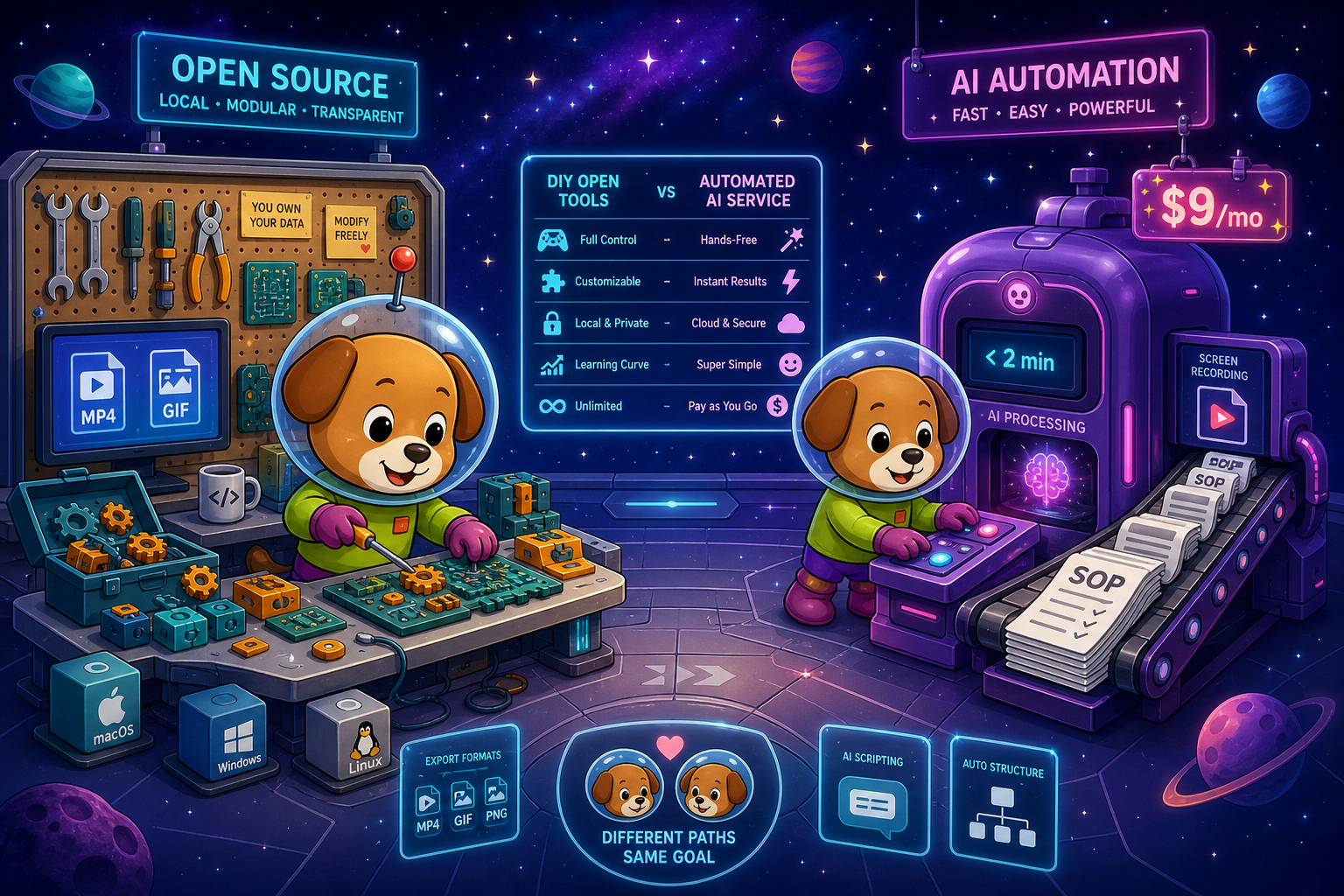
Docsie Recorder leads with free and open-source recorder/editor core under mit license; Kommodo leads with free forever starter tier with 15 videos and full recording features. Neither converts real video into docs and deploys multi-tenant portals; Docsie does both.
Feature Matrix
A feature-by-feature comparison of recording capabilities, editing tools, AI documentation output, export formats, and downstream knowledge base publishing between Docsie Recorder and Kommodo.
| Feature |
Docsie Recorder
Our Pick
|
Kommodo
|
|---|---|---|
| Free Desktop Recorder | ||
| Open-Source Recorder Base | ||
| Mac Support | ||
| Windows Support | ||
| Linux Support | ||
| Window and Full-Screen Capture | ||
| Microphone Capture | ||
| System Audio Capture | Platform-specific | |
| Webcam Overlay | ||
| Automatic or Manual Zoom | ||
| Cursor or Focus Polish | ||
| Backgrounds and Visual Effects | ||
| Crop, Trim, Speed Regions | ||
| Annotations and Blur Regions | Partial | |
| Local MP4 Export | ||
| Local GIF Export | ||
| Project Save Format | .docsiescreen | Cloud only |
| Video-to-Docs Conversion | ||
| Markdown Export | ||
| DOCX Export | ||
| PDF Export | ||
| Knowledge Base Publishing | ||
| Versioned Documentation Management | ||
| Multi-Tenant Portal Delivery | ||
| SSO / Enterprise Auth | ||
| API Access | ||
| SOC 2 / ISO 27001 Compliance | ||
| Enterprise Deployment Path |
Data as of February 2026. Features based on publicly available information and vendor documentation. Docsie Recorder is the free open-source desktop app; downstream Docsie platform features (versioning, portals, SSO, compliance) are available via Docsie workspace plans.
Strengths & Weaknesses
Deep Dive
An in-depth analysis of recording and editing capabilities, AI documentation output, enterprise readiness, and ecosystem integrations for teams evaluating screen recorder and video-to-docs alternatives.
Docsie Recorder is built on OpenScreen and delivers a genuine desktop recorder experience — window or full-screen capture, microphone and webcam overlay, automatic and manual zoom with cursor telemetry suggestions, background wallpapers and gradients, motion blur, crop, trim, speed regions, text and arrow annotations, and blur regions for sensitive content. You record locally, edit to a polished cut, and export MP4 or GIF before any cloud step is involved. Kommodo records screen and webcam and captures auto-screenshots at each step, but it offers no zoom polish, no cursor focus, no background styling, no trim or speed controls, and no local export. If the recording itself needs to look professional before it becomes a doc, Docsie Recorder is the stronger starting point.
Both tools turn a recording into documentation, but the conversion architectures differ significantly. Docsie Recorder sends the finished recording through Docsie's Video-to-Docs API, which uses multimodal AI to generate structured Markdown with a result preview, configurable quality tier, language, doc style, rewrite instructions, and template instructions before relying on this comparison into a Docsie workspace. Kommodo auto-captures screenshots during the recording session and generates step-by-step SOPs in under two minutes using OCR and AI content generation. Docsie's pipeline produces Markdown, DOCX, and PDF with full knowledge base integration; Kommodo outputs a shareable link, embed, or PDF. Teams that want structured, editable documentation downstream should evaluate Docsie's conversion output format carefully against Kommodo's SOP cards.
Docsie Recorder's open-source core is paired with a Docsie platform that delivers versioned documentation management, multi-tenant portals with custom domains, SSO via SAML and OAuth, role-based access control, audit logs, SOC 2 and ISO 27001 compliance, and an enterprise deployment path including air-gapped options. The recording workflow connects to the same compliance and governance infrastructure. Kommodo has no published enterprise tier, no SSO, no audit logs, no API access, no SOC 2, and no ISO 27001. It is architected for individuals and small teams — its free and $9/user plans reflect that scope. For any regulated industry, agency, or team requiring enterprise governance over the documentation lifecycle, Kommodo has no architectural foundation to support those requirements.
Docsie Recorder connects directly to the Docsie platform via a built-in bridge that handles workspace selection, credit estimation, quality tier, language, and job polling — the recording feeds into a broader ecosystem covering CONVERT, MANAGE, DELIVER, LEARN, AUTOMATE, and MONITOR. Downstream, generated docs can be published to Docsie portals, versioned, translated into 100+ languages, reused as course material in the built-in LMS, and routed through compliance scanning workflows. Kommodo integrates as a standalone SOP and knowledge base with shareable links and embed support, but offers no API, no webhook, no custom domain, no helpdesk integration, and no LMS. If your team needs the recording to feed a broader documentation and delivery workflow, Docsie's ecosystem is the only one of the two built for that path.
Our Recommendation
Docsie Recorder and Kommodo both start from screen recording and end at documentation, but they serve different buyer profiles at every step. Docsie Recorder is a free, open-source desktop app with genuine recorder-grade editing that exports locally and routes into a full knowledge base publishing pipeline. Kommodo is a cloud-based SOP generator with a fast free tier, auto-screenshot capture, and a simple shareable output — well-suited for individuals and small teams who need SOPs quickly without editing polish or downstream doc management. The decision comes down to whether you need a recorder you own and control, or a hosted SOP shortcut.
Choose Docsie Recorder if you need...
Choose Kommodo if you need...
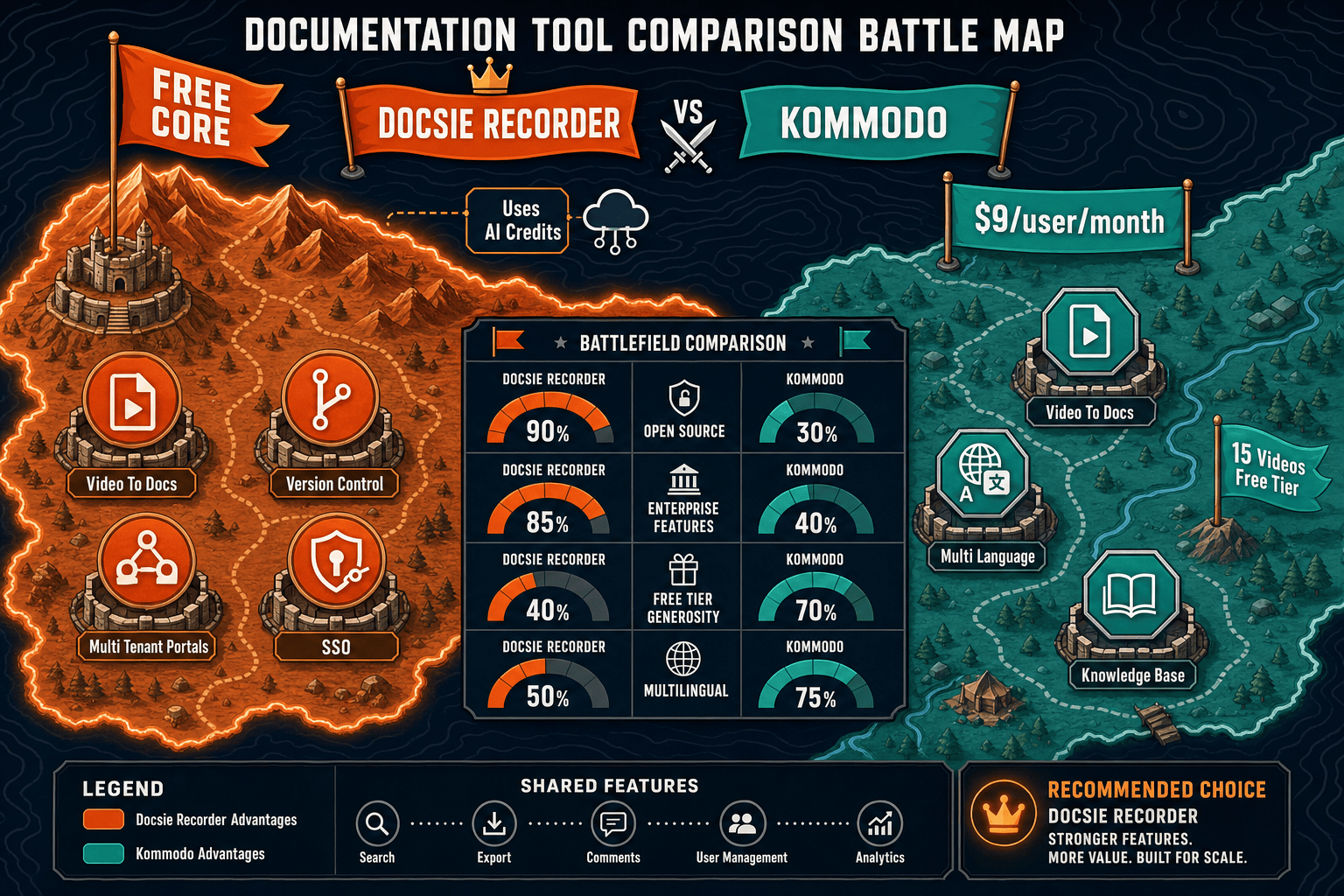
Winner: Docsie Recorder
For teams that searched for a Screen Studio alternative, a Loom alternative, or an AI video-to-docs tool with real recorder control, Docsie Recorder is the stronger choice. It is the only free, open-source desktop recorder in this comparison that delivers editing polish before the AI step, exports locally to MP4 and GIF, and then routes directly into a full knowledge base pipeline producing Markdown, DOCX, PDF, and versioned docs published through Docsie portals. Kommodo is a useful SOP shortcut for individuals and small teams, but it has no open-source recorder, no local export, no editing tools, no versioned docs, no enterprise compliance, and no downstream publishing path beyond a shareable link or PDF. If you need CREATE to feed CONVERT and MANAGE rather than producing an isolated SOP card, Docsie Recorder wins this comparison.
Decision Helper
A direct framework for picking between Docsie Recorder, Kommodo, and Docsie based on your specific needs.
Docsie's free browser-based recorder that pipes captures straight into Docsie SOPs.
AI screen recording that auto-generates step-by-step SOP videos.

Convert real video into searchable docs, then deploy via multi-tenant portals.
Common Questions
Q: Does Docsie Recorder work on Linux, or is it Mac and Windows only like Kommodo?
A: Docsie Recorder provides desktop builds for macOS, Windows, and Linux — all three platforms are supported through the open-source OpenScreen core. Kommodo does not publish a Linux build. If your team includes Linux users or runs Linux-based development workstations, Docsie Recorder is the only option of the two that covers the full platform matrix.
Q: Can I export a local MP4 or GIF from Docsie Recorder without uploading to the cloud?
A: Yes. Docsie Recorder exports MP4 and GIF locally from the desktop app with no account required and no cloud upload needed for the video file itself. The cloud step only begins when you choose to send the recording to Docsie's Video-to-Docs pipeline. Kommodo does not offer local export — recordings and generated SOPs live in the Kommodo cloud workspace.
Q: Does Kommodo have zoom, background styling, or crop-and-trim editing like Docsie Recorder?
A: No. Kommodo focuses on fast SOP generation from recordings rather than polished video editing. It does not offer automatic or manual zoom, cursor focus polish, background wallpapers or gradients, motion blur, speed regions, or crop-and-trim controls. Docsie Recorder includes all of these editing features in the desktop app before any AI conversion step, making it the stronger choice when the recording itself needs to look professional.
Q: Is the Docsie Recorder source code available to inspect and self-host?
A: Yes. Docsie Recorder's recorder and editor core is released under the MIT license on GitHub at github.com/LikaloLLC/docsie-screen-recorder. Teams that require an auditable, forkable, or self-hosted recorder can inspect and build from source. Kommodo is a closed-source SaaS product with no published open-source components.
Q: What documentation formats does Docsie Recorder produce compared to Kommodo's SOP output?
A: Docsie Recorder routes recordings through Docsie's Video-to-Docs API and produces structured Markdown with a preview, DOCX, and PDF — all publishable into a versioned Docsie knowledge base. Kommodo generates step-by-step SOP cards with auto-screenshots that can be exported as PDF or shared via link. If your team needs editable Markdown or Word-compatible DOCX output that feeds a knowledge base with version control, Docsie Recorder's pipeline is the appropriate choice.
Q: Can Kommodo publish docs to a versioned knowledge base with multi-tenant portals like Docsie?
A: No. Kommodo provides a hosted knowledge base with team folders and role-based access, but it does not offer versioned documentation management, multi-tenant portal delivery, custom domains, SSO, or API access. Docsie's downstream platform supports all of these capabilities, meaning a recording made in Docsie Recorder can ultimately be published through a branded customer portal with version history and enterprise access controls — a workflow Kommodo's architecture does not support.
Download Docsie Recorder — a free, open-source desktop recorder built on OpenScreen. Record and edit locally, export MP4 or GIF, then send to Docsie's Video-to-Docs pipeline to generate structured Markdown, DOCX, PDF, and publish into a versioned knowledge base. No subscription required to record.
Free recorder and editor. Video-to-Docs conversion uses Docsie AI credits. No account required to record and export video locally.