
4.8
on G2
 Docsie Recorder
 Kap
Kap
Both Docsie Recorder and Kap are free, open-source screen recorders — but they diverge sharply after you hit stop. Kap is a lightweight Mac-only clip tool loved by developers for quick GIFs. Docsie Recorder is cross-platform, adds modern editing polish, and routes recordings directly into a Video-to-Docs pipeline that turns your capture into structured Markdown, DOCX, PDF, and a published knowledge base.
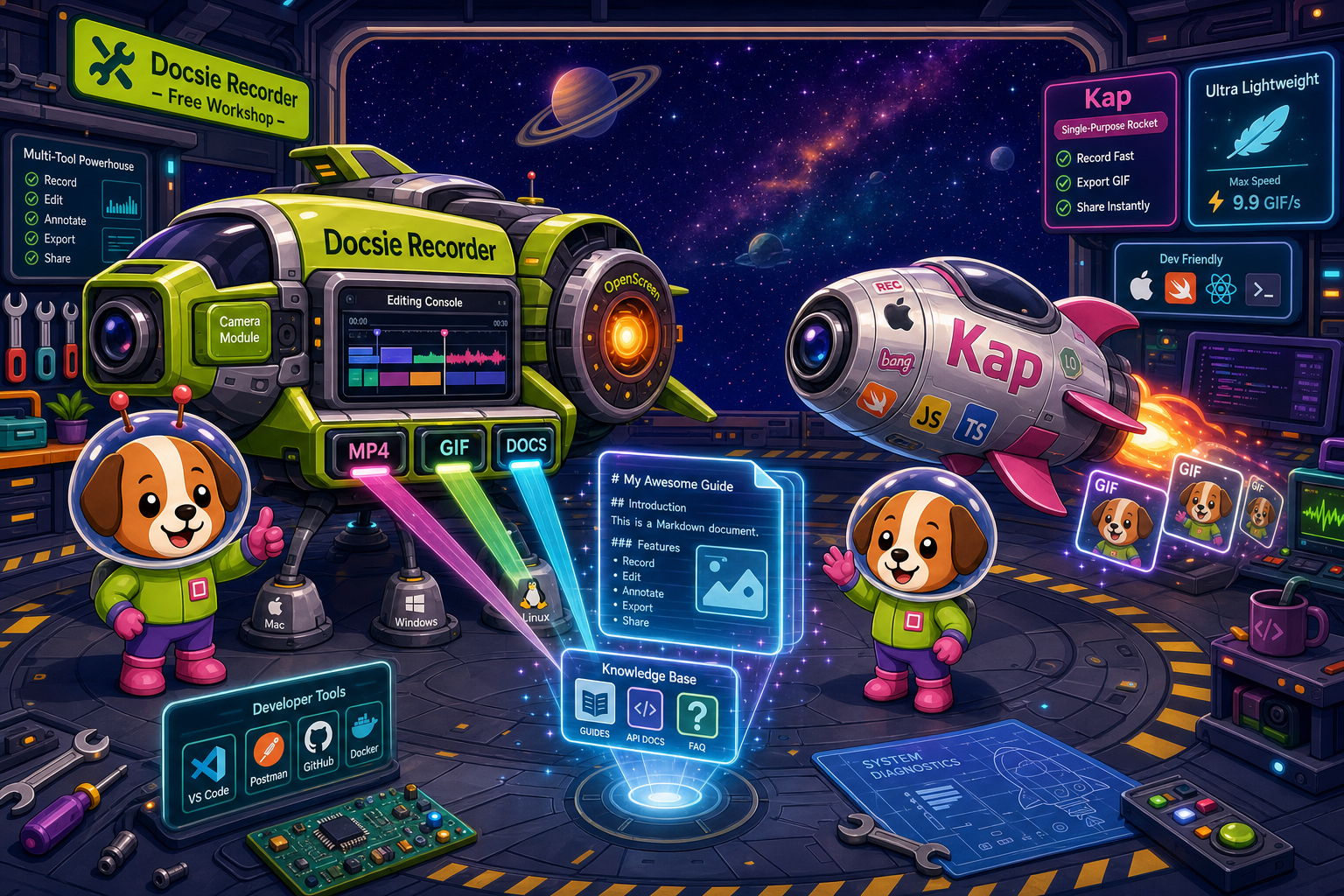
Docsie Recorder leads with free; Kap leads with free and open-source with no pricing tiers or paywalls. Neither converts real video into docs and deploys multi-tenant portals; Docsie does both.
Feature Matrix
A row-by-row comparison of recording capabilities, editing tools, export formats, and downstream documentation workflows between Docsie Recorder and Kap.
| Feature |
Docsie Recorder
Our Pick
|
Kap
|
|---|---|---|
| Free Desktop Recorder | ||
| Open-Source Recorder Base | ||
| Mac Support | ||
| Windows Support | ||
| Linux Support | ||
| Window and Full-Screen Capture | ||
| Microphone Capture | ||
| System Audio Capture | Platform-specific | Limited public detail |
| Webcam Overlay | ||
| Automatic or Manual Zoom | ||
| Cursor or Focus Polish | ||
| Backgrounds and Visual Effects | Wallpapers, gradients, custom | |
| Crop, Trim, Speed Regions | ||
| Annotations and Blur Regions | ||
| Local MP4 Export | ||
| Local GIF Export | ||
| Project Save Format | .docsiescreen project files | |
| Video-to-Docs Conversion | ||
| Markdown Export | ||
| DOCX Export | ||
| PDF Export | ||
| Knowledge Base Publishing | ||
| Versioned Documentation Management | ||
| Multi-Tenant Portal Delivery | ||
| Enterprise Deployment Path | ||
| Plugin Ecosystem |
Data as of 2026. Features based on publicly available information and vendor documentation. Confirm Kap repository activity and system audio support before relying on this comparison.
Strengths & Weaknesses
Deep Dive
An in-depth analysis of recording and editing capabilities, AI and automation, enterprise readiness, and ecosystem integrations between Docsie Recorder and Kap.
Docsie Recorder is built on the OpenScreen open-source core and ships with a full editing timeline — zoom (automatic and manual with cursor telemetry suggestions), crop, trim, speed regions, motion blur, background replacement, webcam overlay, annotations, and blur regions. You can save work as a .docsiescreen project file and return to it later. Kap is intentionally minimal — it captures your screen and exports the clip. It has no editing timeline, no zoom polish, no webcam overlay, and no background controls. For developers recording a quick terminal GIF, Kap is fast and frictionless. For product, support, or enablement teams recording walkthroughs that need polish before sharing, Docsie Recorder provides substantially more editing depth without leaving the free tier.
This is the sharpest divide between the two tools. After you record in Docsie Recorder, you can route the video directly through the Docsie Video-to-Docs bridge. The pipeline estimates AI credits, accepts your language and doc-style preferences, and generates structured Markdown that you can preview before relying on this comparison. The same recording that produced an MP4 now also produces a DOCX, PDF, and a versioned knowledge base article. Kap has no AI features whatsoever — no transcription, no step detection, no doc generation. If your goal is to turn a screen recording into written documentation, Kap stops at the video file and you must rebuild the documentation workflow from scratch elsewhere.
Docsie Recorder's MIT recorder core is freely auditable, and the downstream Docsie platform adds enterprise controls — SSO (SAML, OAuth, OIDC), role-based access, custom domains, versioned documentation with inheritance, multi-tenant portal delivery, and an enterprise deployment path for teams that need governance over their knowledge base. Kap has no enterprise features by design. It is a single-user Mac utility with no cloud platform, no access controls, no audit logs, and no deployment path for organizations. Teams that need to standardize on a recorder with a documented open-source license and an enterprise upgrade path will find Docsie Recorder's architecture more suitable, even before considering the documentation output.
Kap's strength in this dimension is its plugin ecosystem, which lets community contributors add export targets and workflow hooks. It is the more extensible tool at the pure-recorder layer for developers comfortable with Node-based plugins. Docsie Recorder's integration story runs in the opposite direction — instead of extending the recorder outward, it connects downward into the Docsie platform. Converted documentation flows into Docsie's knowledge base, can be delivered through portals, reused as course material in the LEARN pillar, and routed into AUTOMATE and MONITOR workflows. For teams that need recordings to feed a documentation system rather than a plugin pipeline, Docsie Recorder's downstream integration is more directly useful.
Our Recommendation
Kap and Docsie Recorder share an open-source foundation and a free price tag, but they serve meaningfully different audiences. Kap is an excellent lightweight Mac recorder for developers who need quick clips and GIFs with no friction and no cloud dependency. Docsie Recorder is for teams that want the same open-source recorder ethos but need cross-platform support, modern editing polish, and a clear path from recording to structured documentation and knowledge base publishing.
Choose Docsie Recorder if you need...
Choose Kap if you need...
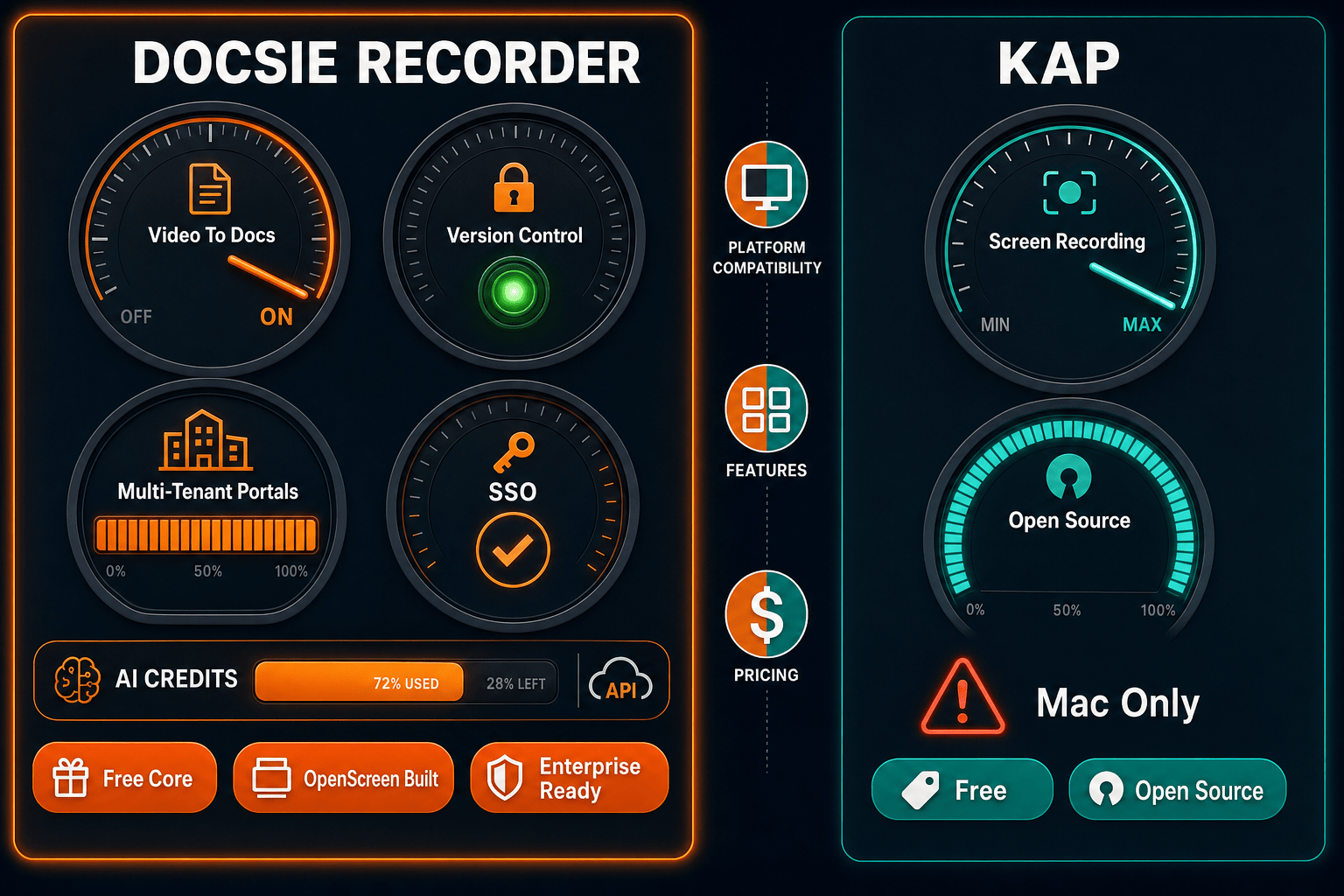
Winner: Docsie Recorder
For any team that records walkthroughs, product demos, or support videos with the intent to create documentation, Docsie Recorder wins on every functional dimension. It matches Kap on the open-source and free recorder basics, then adds cross-platform support, a full editing timeline, and a direct Video-to-Docs pipeline that turns one recording into structured Markdown, DOCX, PDF, and a published knowledge base article. Kap remains the right choice for developers who want the fastest possible Mac-to-GIF workflow with no extras — but if the recording is meant to become documentation, Docsie Recorder removes the gap between capture and published content.
Decision Helper
A direct framework for picking between Docsie Recorder, Kap, and Docsie based on your specific needs.
Docsie's free browser-based recorder that pipes captures straight into Docsie SOPs.
Open-source Mac screen recorder with GIF export.

Convert real video into searchable docs, then deploy via multi-tenant portals.
Common Questions
Q: Is Kap truly open source and free like Docsie Recorder?
A: Yes — both tools are free and open source with MIT-style licenses at their recorder core. Kap's codebase is maintained on GitHub and has no paid tiers. Docsie Recorder's recorder and editor core is also MIT-licensed and free to download with no account required for local recording and export. The difference is that Docsie Recorder also connects to the Docsie Video-to-Docs pipeline, which uses Docsie cloud AI credits — that downstream step is not free in the same way.
Q: Can Kap export structured documentation the way Docsie Recorder can?
A: No. Kap exports video clips and GIFs only — there is no transcription, no step extraction, no Markdown output, and no knowledge base integration. Docsie Recorder connects to Docsie's Video-to-Docs API to generate structured Markdown, DOCX, and PDF from a recording, and can publish the result directly into a Docsie knowledge base. If your goal is documentation rather than a video file, Kap requires you to rebuild the entire documentation workflow manually outside the recorder.
Q: Does Docsie Recorder work on Windows and Linux, or is it Mac-only like Kap?
A: Docsie Recorder provides builds for macOS, Windows, and Linux. Kap is macOS-only and has no plans to support other platforms. For teams with mixed operating systems — or for organizations standardizing on a single recorder across engineering, support, and product teams — Docsie Recorder is the only cross-platform choice between the two.
Q: Does Kap have zoom, webcam overlay, or background features like Docsie Recorder?
A: No. Kap is intentionally minimal and does not include automatic zoom, cursor polish, webcam overlay, background replacement, motion blur, or annotation tools. Docsie Recorder includes all of these in its free editing timeline, making it the more capable tool for producing polished walkthrough videos without purchasing a separate paid editor like Screen Studio or Screenflow.
Q: I already use Kap for quick GIFs — do I need to switch to Docsie Recorder?
A: Not necessarily. If your workflow is genuinely just quick terminal demos or README GIFs for a developer audience, Kap's minimal interface and plugin ecosystem may be faster for that specific job. Switch to Docsie Recorder when you need to record product walkthroughs or support content that will become written documentation, when you need Windows or Linux support, or when you want editing polish — zoom, backgrounds, annotations — without paying for a separate tool.
Q: What happens to my recording after Video-to-Docs conversion in Docsie Recorder?
A: After conversion, Docsie Recorder generates a structured Markdown preview you can review before relying on this comparison. The output can be pushed into your Docsie workspace as a versioned knowledge base article, exported as DOCX or PDF, delivered through Docsie portals to customers or internal teams, reused as course material via the LEARN pillar, and routed into Docsie's AUTOMATE and MONITOR workflows. The recording becomes the source of truth for both a video asset and a living documentation artifact — rather than a standalone video file with no downstream workflow.
Download Docsie Recorder to capture, edit, and convert screen recordings into structured documentation — on Mac, Windows, or Linux. No account required to record and export. Connect to Docsie when you're ready to turn your video into a knowledge base.
Free and open source. MIT recorder core. No account required to record, edit, and export MP4 or GIF locally.