
4.8
on G2
 Docsie Recorder
 Kap
Kap
Both Docsie Recorder and Kap are free, open-source screen recorders loved by developers. But when your team needs cross-platform recording, structured documentation output, governance controls, and a downstream knowledge base workflow, the two tools diverge sharply. This page compares them on the dimensions enterprises actually care about.
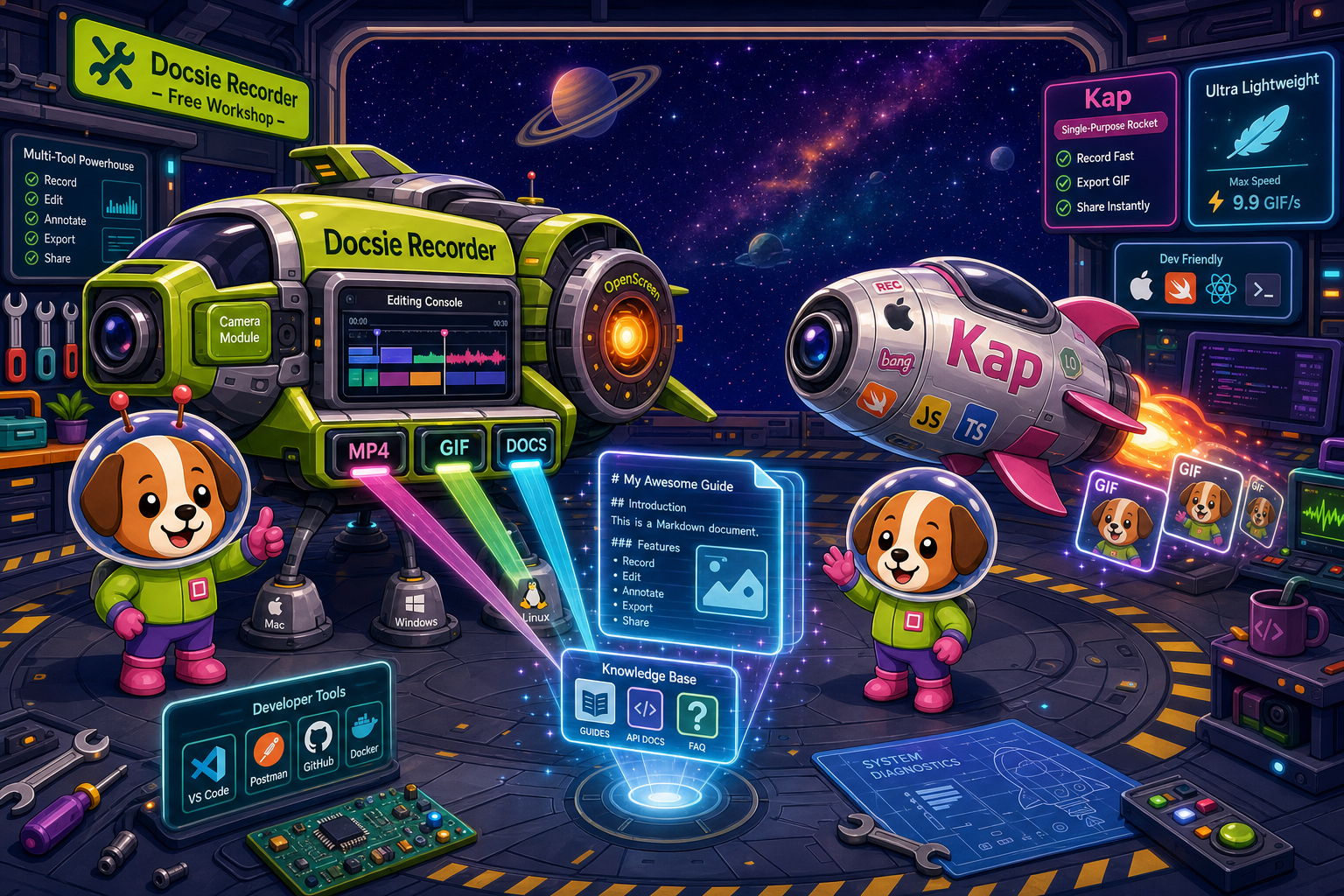
For enterprise buyers, Docsie Recorder and Kap cover narrow slices (free and free and open-source with a well-known developer following) while Docsie adds SSO, audit trails, multi-tenant portals, and compliance monitoring in one platform.
Feature Matrix
A focused comparison of recording capabilities, editing features, cross-platform support, documentation output, and enterprise-grade controls. Rows are chosen specifically for teams evaluating screen recorders in an organizational context.
| Feature |
Docsie Recorder
Our Pick
|
Kap
|
|---|---|---|
| Free Desktop Recorder | ||
| Open-Source Recorder Base | ||
| Mac Support | ||
| Windows Support | ||
| Linux Support | ||
| Window and Full-Screen Capture | ||
| Microphone Capture | ||
| System Audio Capture | Platform-dependent | Limited public detail |
| Webcam Overlay | ||
| Automatic or Manual Zoom | ||
| Cursor or Focus Polish | ||
| Backgrounds and Visual Effects | ||
| Crop, Trim, Speed Regions | ||
| Annotations and Blur Regions | ||
| Local MP4 Export | ||
| Local GIF Export | ||
| Project Save Format | .docsiescreen project files | |
| Video-to-Docs Conversion | ||
| Markdown Export | ||
| DOCX Export | ||
| PDF Export | ||
| Knowledge Base Publishing | ||
| Versioned Documentation Management | ||
| Multi-Tenant Portal Delivery | ||
| SSO (SAML/OAuth) | ||
| API Access | ||
| Audit Logs | ||
| Role-Based Access Control | ||
| Enterprise Deployment Path |
Data as of 2026. Features are based on publicly available information and vendor documentation. Confirm Kap repository activity and system audio support before relying on this comparison.
Strengths & Weaknesses
Deep Dive
For teams evaluating screen recorders in an organizational context, raw recording quality is only the starting point. Enterprise readiness covers security and compliance, scalability across platforms and teams, administrative control, and the support structures that keep workflows running. Here is how Docsie Recorder and Kap compare across each dimension.
Kap is a local desktop recorder with no cloud surface, which means no data leaves the machine during capture — a genuine security advantage for isolated clip creation. However, it offers no SSO, no audit logs, no role-based access, and no compliance certifications. Docsie Recorder's open-source capture core is equally local. The difference emerges downstream: when recordings flow into the Docsie platform, teams get SAML/OAuth SSO, granular RBAC, audit logs, and a compliance-ready infrastructure. For teams that need both a clean capture tool and a governed documentation destination, Docsie Recorder covers both ends of the chain.
Kap runs exclusively on macOS, which immediately eliminates it for any cross-platform team. Windows and Linux users must find a separate tool, fragmenting the recording workflow. Docsie Recorder ships builds for macOS, Windows, and Linux from the same open-source base, so every team member records in the same environment and exports to the same project format. At the documentation layer, Docsie's knowledge base scales from a single workspace to multi-tenant portal delivery serving unlimited client portals from one system — a scalability ceiling Kap cannot approach because it has no platform layer at all.
Kap has no administrative surface. There are no user accounts, no workspace settings, no permission tiers, and no way to enforce recording standards across a team. Every Kap user operates independently with no shared governance. Docsie Recorder introduces administrative control at the Docsie workspace level: workspace selection during the recording bridge, credit estimation before conversion jobs, quality tiers, language settings, and documentation style controls. Published output lands inside Docsie's managed environment where admins can assign roles, control publish access, set approval workflows, and version-lock documentation. For organizations that need accountability over what gets published, Docsie provides the control layer Kap entirely lacks.
Kap is a community-maintained open-source project. There is no dedicated support channel, no SLA, and no guaranteed response time for issues. Teams adopting Kap for organizational workflows absorb all maintenance and troubleshooting responsibility internally. Docsie Recorder's open-source core carries the same community support model for the recorder itself, but the downstream Docsie platform provides structured support tiers including dedicated support options, uptime SLA commitments, and an account team for enterprise deployments. Teams that need a recorder feeding a governed knowledge base with support coverage have a clear path through Docsie that Kap cannot offer.
Our Recommendation
Kap is a respected open-source Mac recorder ideal for individual developers who need quick GIFs and lightweight screen clips. It has no enterprise governance, no cross-platform support, no editing pipeline, and no documentation output. Docsie Recorder starts from the same open-source, free-to-use recorder philosophy but adds cross-platform builds, a full editing layer, a Video-to-Docs conversion bridge, and downstream access to Docsie's enterprise-grade knowledge base platform with SSO, RBAC, audit logs, versioning, and multi-tenant delivery. For any team that needs to record, document, govern, and publish — Docsie Recorder is the only enterprise-ready choice in this comparison.
Choose Docsie Recorder if you need...
Choose Kap if you need...
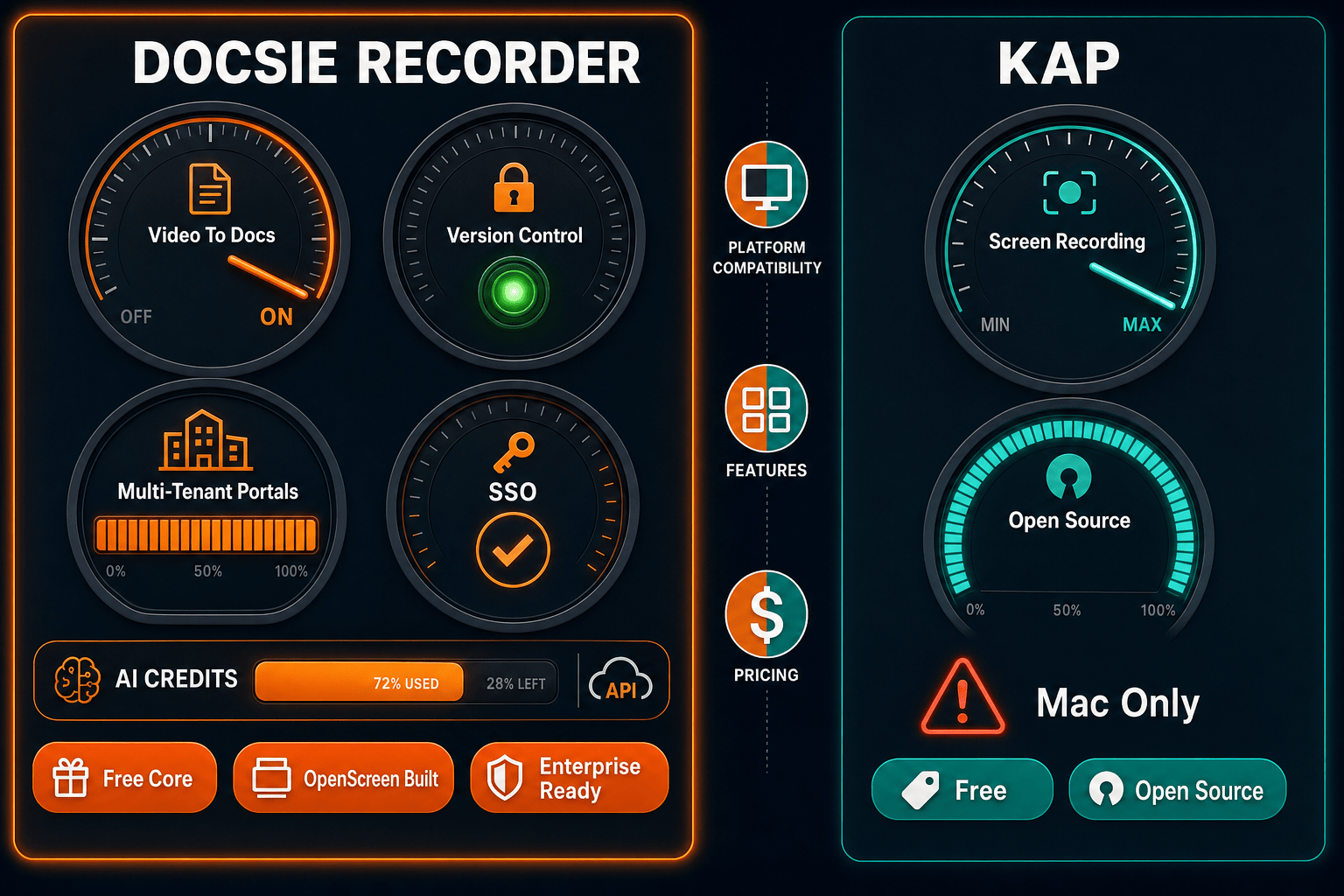
Winner: Docsie Recorder
Docsie Recorder is the enterprise-ready choice because it combines a free, open-source, cross-platform recorder with a full editing pipeline and a governed documentation workflow. While Kap excels as a personal Mac clip tool, it offers nothing for teams that need Windows or Linux support, structured documentation output, versioned knowledge bases, SSO, audit logs, or multi-tenant publishing. Docsie Recorder covers the full CREATE → CONVERT → MANAGE → DELIVER chain that enterprise teams require, with an open-source capture core that satisfies security-conscious buyers at the same time.
Decision Helper
A direct framework for picking between Docsie Recorder, Kap, and Docsie based on your specific needs.
Docsie's free browser-based recorder that pipes captures straight into Docsie SOPs.
Open-source Mac screen recorder with GIF export.

Convert real video into searchable docs, then deploy via multi-tenant portals.
Common Questions
Q: Does Kap support enterprise SSO or role-based access control?
A: No. Kap has no user account system, no SSO integration, and no role-based access controls of any kind. It is a standalone local recorder with no administrative surface. Docsie Recorder connects to the Docsie platform which supports SAML, OAuth, and OIDC SSO alongside granular RBAC and audit logs for teams that need governed documentation publishing.
Q: Can Kap be deployed across Windows and Linux teams?
A: No. Kap is macOS-only and has no Windows or Linux builds. Teams with mixed operating systems cannot standardize on Kap. Docsie Recorder provides native builds for macOS, Windows, and Linux from the same open-source codebase, so every team member records in the same environment and exports to compatible project files.
Q: How does Docsie Recorder handle compliance for documented content?
A: The Docsie Recorder capture core is local and open-source, so no recording data leaves the device during capture. When teams use the Video-to-Docs bridge, recordings are processed through Docsie's cloud API which operates under Docsie's compliance infrastructure including audit logging, data residency options, and SSO-gated workspace access. Kap has no compliance controls at any layer.
Q: Is Kap still actively maintained for enterprise use in 2026?
A: Kap's repository activity should be checked before any organizational adoption decision. Even when active, Kap is a community-maintained project with no dedicated support, no SLA, and no enterprise roadmap. For teams that need a recorder backed by a supported platform, Docsie Recorder's downstream Docsie environment provides structured support tiers and an enterprise deployment path.
Q: Can I use Docsie Recorder without converting recordings to documentation?
A: Yes. Docsie Recorder works entirely as a standalone local recorder and editor with no account required. You can record, edit with zoom, trim, backgrounds, and annotations, then export MP4 or GIF locally. The Video-to-Docs bridge is an optional downstream step that uses Docsie AI credits only when you choose to convert a recording into structured documentation.
Q: What makes Docsie Recorder a better enterprise screen recorder than Kap specifically?
A: The gap comes down to four things enterprise teams need beyond basic capture. First, cross-platform support — Docsie Recorder runs on Mac, Windows, and Linux while Kap is Mac-only. Second, editing depth — Docsie Recorder includes zoom, backgrounds, blur, annotations, and speed regions that Kap lacks entirely. Third, documentation output — recordings can be converted to structured Markdown, DOCX, and PDF and published into a versioned knowledge base. Fourth, governance — SSO, RBAC, audit logs, and multi-tenant portals give administrators the control that Kap simply does not have.
Docsie Recorder is free, open-source, and runs on Mac, Windows, and Linux. Record, edit, and export locally — then convert recordings into structured documentation and publish to a governed knowledge base when your team is ready.
No account required to record and export. Docsie AI credits used only when you convert a recording to documentation.