
4.8
on G2
 Docsie Recorder
 Guidde
Both Docsie Recorder and Guidde capture screen workflows and turn them into shareable content—but they take fundamentally different paths. Docsie Recorder is a free, open-source desktop recorder that exports MP4 and GIF locally, then routes recordings into a structured documentation pipeline. Guidde is a browser extension that captures screen workflows and auto-generates AI-voiced tutorial videos with step guides. If you searched for a Screen Studio alternative, a Loom alternative, or an AI video-to-docs tool, this comparison will tell you which recorder actually takes your content further.
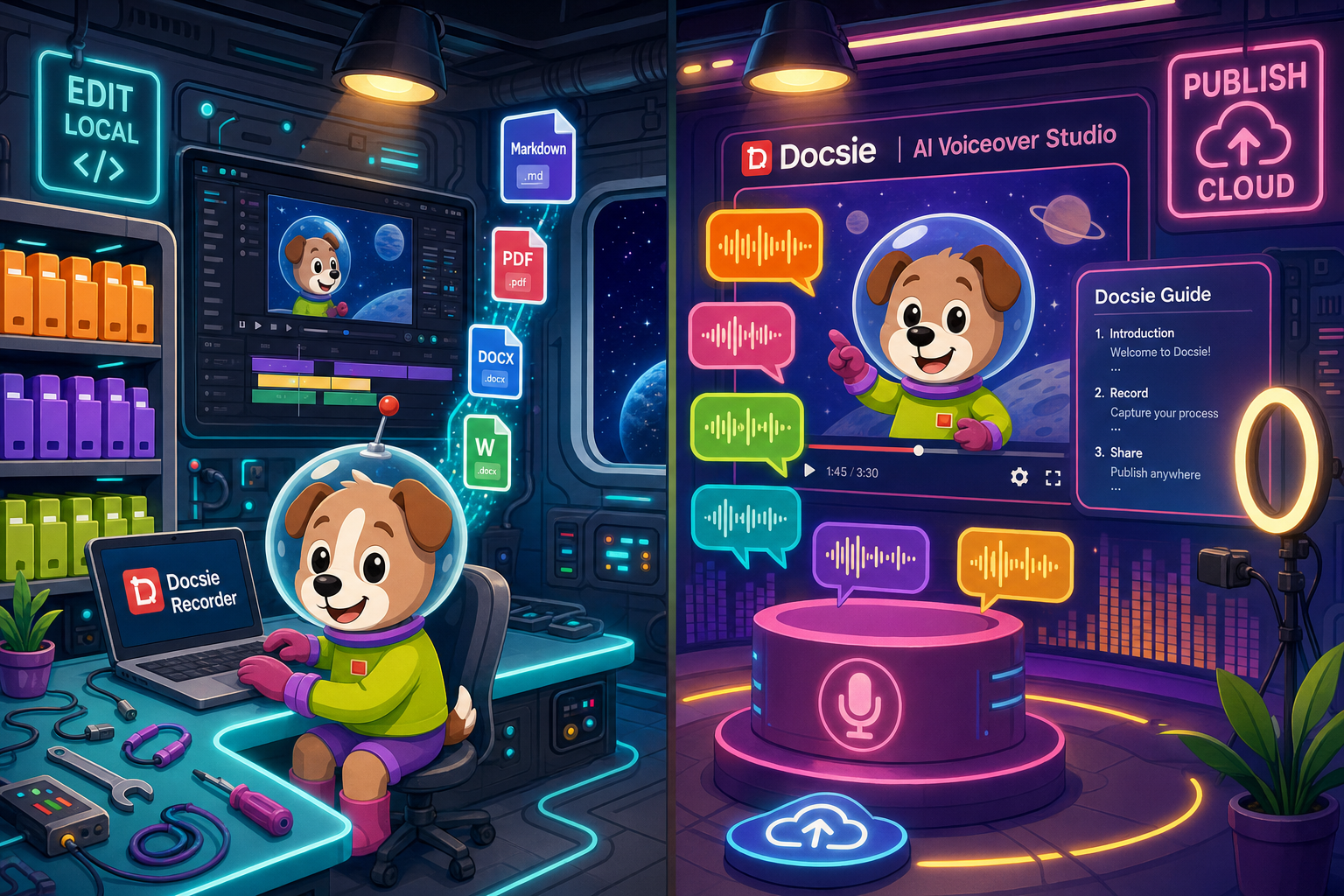
Docsie Recorder leads with free and open-source recorder/editor core built on openscreen with mit license; Guidde leads with best-in-class ai voiceover with 200–400+ studio voices across 50+ languages. Neither converts real video into docs and deploys multi-tenant portals; Docsie does both.
Feature Matrix
A comprehensive feature-by-feature comparison covering recorder capabilities, editing tools, export options, AI documentation conversion, and downstream knowledge base publishing.
| Feature |
Docsie Recorder
Our Pick
|
Guidde
|
|---|---|---|
| Free Desktop Recorder | ||
| Open-Source Recorder Base | ||
| Mac Support | ||
| Windows Support | ||
| Linux Support | ||
| Window and Full-Screen Capture | ||
| Microphone Capture | ||
| System Audio Capture | Platform-dependent | |
| Webcam Overlay | ||
| Automatic or Manual Zoom | ||
| Cursor or Focus Polish | ||
| Backgrounds and Visual Effects | Wallpapers, gradients, custom | |
| Crop, Trim, Speed Regions | ||
| Annotations and Blur Regions | ||
| Local MP4 Export | Pro+ only | |
| Local GIF Export | Pro+ only | |
| Project Save Format | .docsiescreen project files | |
| Video-to-Docs Conversion | ||
| Markdown Export | ||
| DOCX Export | ||
| PDF Export | ||
| AI Voiceover Generation | 200–400+ voices | |
| Knowledge Base Publishing | Video library only | |
| Versioned Documentation Management | ||
| Multi-Tenant Portal Delivery | ||
| Enterprise Deployment Path | Enterprise plan required | |
| API Access | ||
| SSO | Enterprise only | |
| SOC 2 Type II Compliance | ||
| Browser Extension Capture |
Data as of 2026. Features are based on publicly available information and vendor documentation. Confirm current release status before purchase.
Strengths & Weaknesses
Deep Dive
An in-depth analysis of recording and editing capabilities, AI and automation approaches, enterprise readiness, and integration ecosystems for teams evaluating screen recorders and AI video-to-docs tools.
Docsie Recorder is a full desktop app running on macOS, Windows, and Linux—the only tool in this comparison with native Linux support. It captures specific windows or full screen, supports webcam overlay, microphone, and system audio, and provides a proper editing suite with auto and manual zoom, cursor polish, backgrounds, motion blur, annotations, blur regions, crop, trim, and speed regions. Recordings save as .docsiescreen project files for non-destructive re-editing. Guidde captures screen workflows via a browser extension with no desktop editing suite on free or Pro tiers. Desktop capture requires the Business plan, and editing is limited to basic trimming and annotation rather than a full post-production editor.
Docsie Recorder's AI story lives downstream of the capture. After recording locally, you send the video through Docsie's Video-to-Docs pipeline, which uses multimodal AI to generate structured Markdown, DOCX, and PDF documentation with a credit-estimated, quality-tiered conversion job. The output is a knowledge base article, not a polished video. Guidde's AI runs during and after capture—it auto-detects steps, generates a narrated voiceover from 200–400+ studio voices in 50+ languages, and produces a step guide alongside the video. Guidde excels at narrated video output; Docsie Recorder excels at turning recordings into searchable structured documentation that can be versioned, translated, and published to portals.
Docsie Recorder's enterprise story extends well beyond the recorder itself. The downstream Docsie platform provides versioned documentation management, multi-tenant portal delivery with custom domains, SSO, API access, SOC 2 compliance, and role-based access control. Teams can route converted documentation into approval workflows, compliance monitoring, and localization pipelines without leaving the platform. Guidde offers SOC 2 Type II and GDPR compliance with SAML SSO at the Enterprise tier, but lacks version control, multi-tenant portals, audit logs, and data residency options. The Business plan's 5-creator cap means most growing teams hit an Enterprise wall quickly, with no public pricing transparency.
Docsie Recorder connects to the broader Docsie ecosystem through a native bridge that routes recordings into the Video-to-Docs API, then into documentation and knowledge base workflows, portal delivery, LMS course material, and automation pipelines. The Docsie platform exposes API access and webhooks for custom integrations and is MCP-ready for AI agent workflows. Guidde integrates with Notion, Confluence, Zendesk, Intercom, and Slack for video sharing and distribution, and offers an embeddable branded video player. However, it has no API access for programmatic control. Docsie's ecosystem is built for documentation at scale; Guidde's integrations are optimized for sharing and embedding tutorial videos within existing tools.
Our Recommendation
Docsie Recorder and Guidde are both video capture tools, but they serve very different buyer needs. Docsie Recorder is a free, open-source desktop recorder with a full editing suite that connects directly to a structured documentation pipeline—record once, convert to Markdown or DOCX, publish to a knowledge base. Guidde is a browser-extension-first tool that creates AI-voiced tutorial videos with step guides, optimized for teams whose primary deliverable is a narrated how-to video rather than a written knowledge base article. The right choice depends on whether your end goal is a video or a document.
Choose Docsie Recorder if you need...
Choose Guidde if you need...
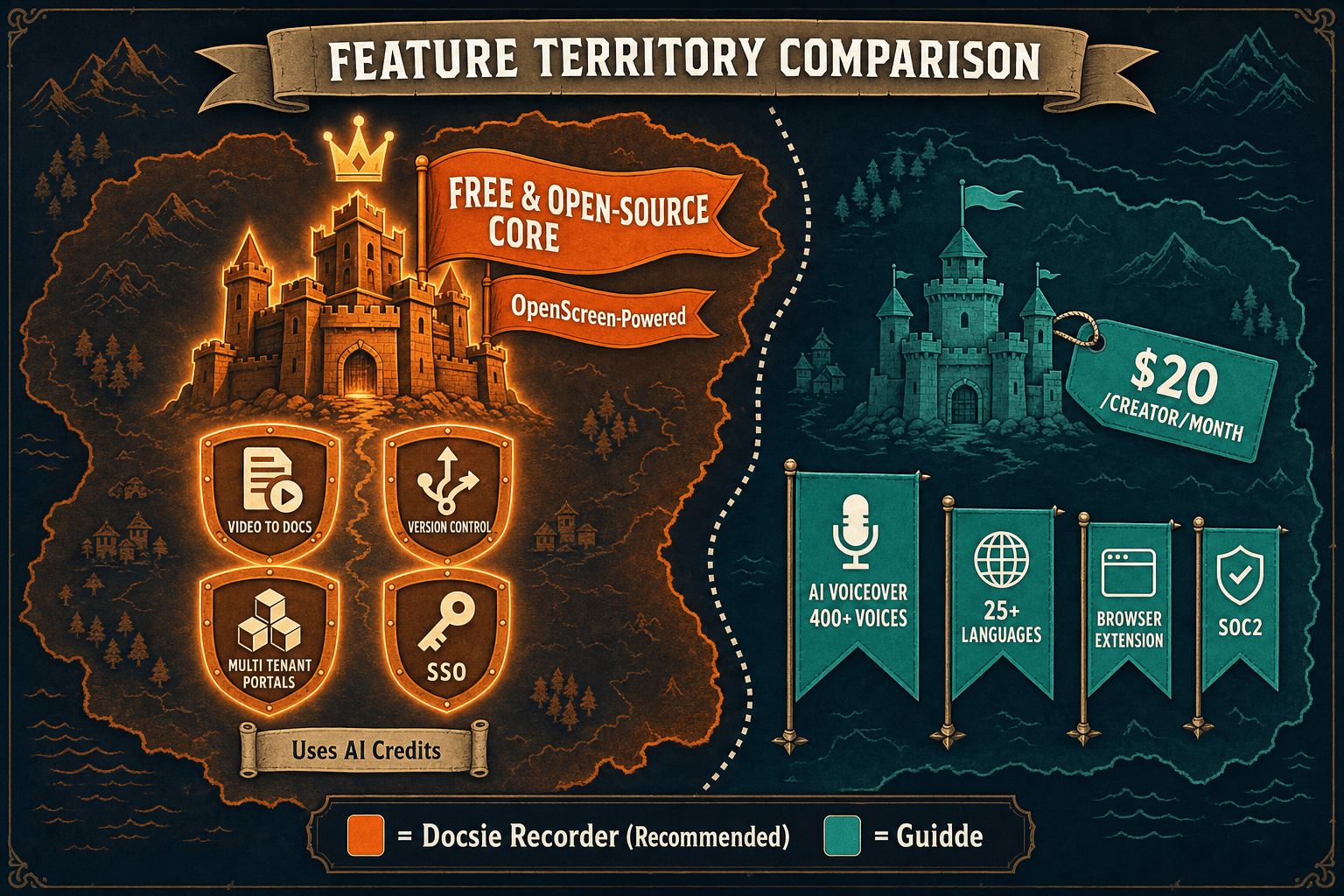
Winner: Docsie Recorder
For teams evaluating screen recorders and video-to-docs tools, Docsie Recorder wins on scope, openness, and workflow depth. It is the only free, open-source, cross-platform desktop recorder in this comparison that natively routes a recording into structured documentation—Markdown, DOCX, PDF, and a live knowledge base article—without stopping at a video file or a share link. Guidde creates excellent AI-voiced tutorial videos but cannot upload existing videos, has no Linux support, locks desktop capture behind a $44/creator/month paywall, and produces no structured documentation output. For buyers who searched for a Screen Studio alternative or a Loom alternative and need the recording to become documentation, Docsie Recorder is the clear choice.
Decision Helper
A direct framework for picking between Docsie Recorder, Guidde, and Docsie based on your specific needs.
Docsie's free browser-based recorder that pipes captures straight into Docsie SOPs.
AI video walkthroughs with auto-generated transcripts and voiceover.

Convert real video into searchable docs, then deploy via multi-tenant portals.
Common Questions
Q: Is Docsie Recorder actually free, and do I need an account to use it?
A: Yes. Docsie Recorder is free to download and use for local recording and export with no account required. You only need a Docsie account when you choose to send a recording through the Video-to-Docs conversion pipeline, which uses Docsie AI credits. The recorder and editor work entirely offline for local MP4 and GIF export.
Q: Does Guidde work on Linux or as a desktop app on all platforms?
A: Guidde does not support Linux. Its primary capture method is a Chrome or Edge browser extension, which works on any OS that runs those browsers. However, desktop app capture—required for recording outside a browser—is only available on the Business plan at $44 per creator per month. Docsie Recorder provides native desktop apps for macOS, Windows, and Linux at no cost.
Q: Can Guidde convert an existing video file into documentation like Docsie Recorder can?
A: No. Guidde only captures screen workflows through its browser extension or desktop app—it cannot accept uploaded video files. Docsie Recorder records locally, and its connected Video-to-Docs pipeline can process any video file into structured Markdown, DOCX, or PDF documentation. This is a fundamental architectural difference between the two tools.
Q: How does the editing experience compare between Docsie Recorder and Guidde?
A: Docsie Recorder provides a full post-production editing suite including automatic and manual zoom, cursor polish, webcam overlay, backgrounds, motion blur, annotations, blur regions, crop, trim, and speed regions, all saved in a non-destructive .docsiescreen project file. Guidde's editing tools are more limited—basic trim and annotation are available, but zooms, backgrounds, speed regions, and a full project save format are not part of its workflow.
Q: Which tool is better if I want to create customer-facing tutorial videos with voiceovers?
A: Guidde is the stronger choice specifically for narrated tutorial video creation. Its AI voiceover engine with 200–400+ studio voices and Magic Mic narration is best-in-class for producing polished how-to videos from screen recordings. Docsie Recorder does not generate AI voiceovers—its output is structured documentation rather than narrated video.
Q: If I record with Docsie Recorder, what happens to the recording after I convert it to docs?
A: After conversion, the original recording is preserved locally as a .docsiescreen project file and as your exported MP4 or GIF. The converted documentation output—structured Markdown, DOCX, or PDF—is published into your Docsie workspace where it can be versioned, translated into 100+ languages, delivered through multi-tenant portals, reused as LMS course material, and routed into automation and compliance workflows. The recording becomes a permanent source artifact for your knowledge base, not just a one-time share link.
Download Docsie Recorder free, record and edit locally with no account required, then send your recording through the Video-to-Docs pipeline to generate structured Markdown, DOCX, and PDF content—published directly into a versioned knowledge base.
Free and open-source. No account required to record and export. Video-to-Docs conversion uses Docsie AI credits.