
4.8
on G2
 Docsie Recorder
 Dubble
Docsie Recorder is a free, open-source desktop screen recorder that feeds directly into Docsie's enterprise documentation platform—delivering SSO, audit logs, versioned knowledge bases, and multi-tenant portals. Dubble is a lightweight Chrome extension for generating browser-based step guides, with minimal enterprise infrastructure. If your team needs recording-to-docs with real enterprise controls, this comparison shows exactly where each tool stands.
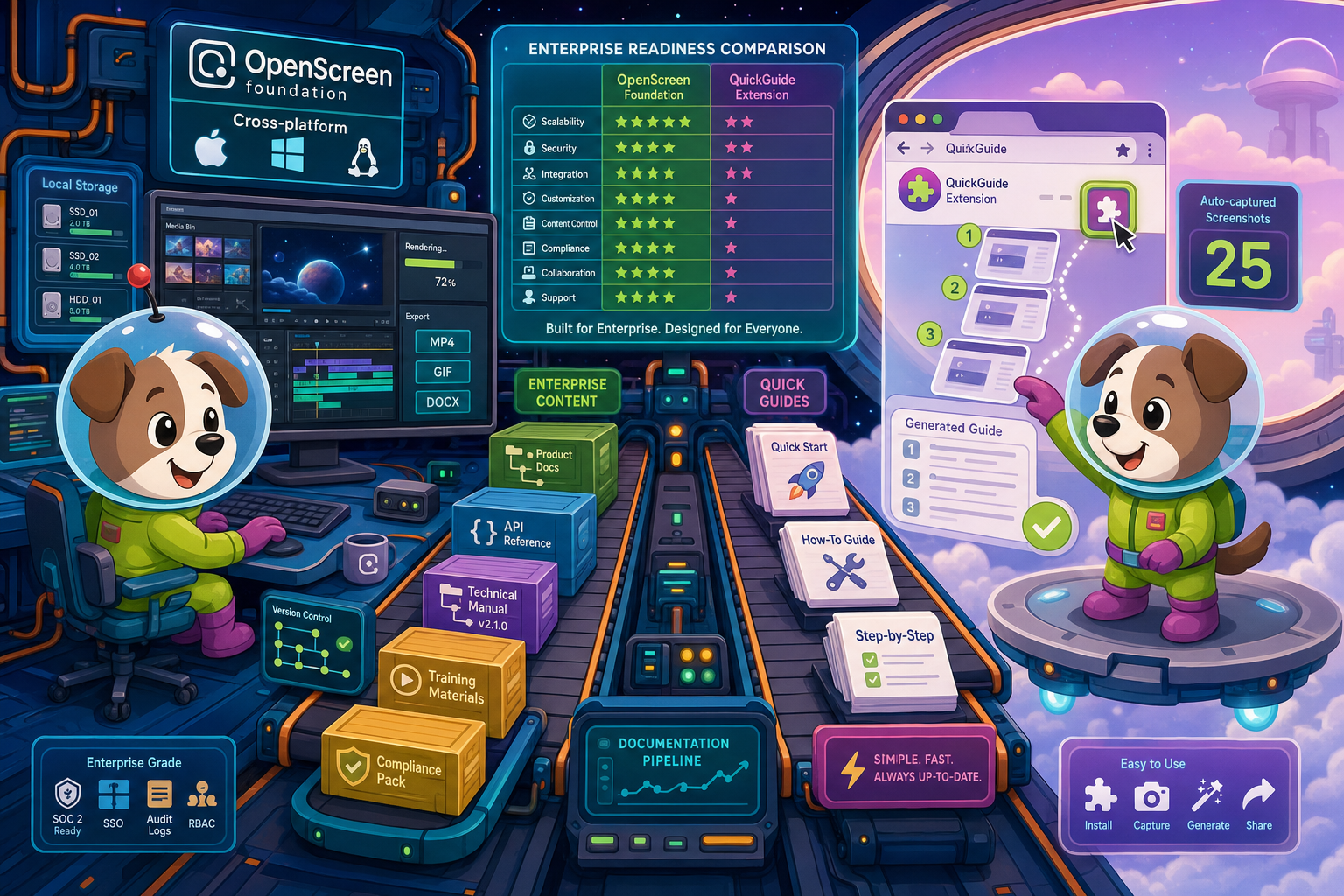
For enterprise buyers, Docsie Recorder and Dubble cover narrow slices (free and zero-friction chrome extension) while Docsie adds SSO, audit trails, multi-tenant portals, and compliance monitoring in one platform.
Enterprise Feature Matrix
A focused comparison of enterprise-critical capabilities including security, compliance, administration, scalability, and downstream documentation infrastructure for teams evaluating both tools.
| Feature |
Docsie Recorder
Our Pick
|
Dubble
|
|---|---|---|
| Free Desktop Recorder | ||
| Open-Source Recorder Base | ||
| Mac Support | ||
| Windows Support | ||
| Linux Support | ||
| Browser Extension Only | ||
| Video-to-Docs Conversion | ||
| Knowledge Base Publishing | ||
| Versioned Documentation Management | ||
| Multi-Tenant Portal Delivery | ||
| SSO (SAML / OAuth) | ||
| SOC 2 Compliance | ||
| GDPR Compliance | ||
| HIPAA Readiness | ||
| Audit Logs | ||
| Role-Based Access Control | ||
| Data Residency Options | ||
| API Access | ||
| Custom Domain Support | ||
| Uptime SLA |
Data as of February 2026. Features reflect Docsie Recorder's downstream Docsie platform capabilities alongside the recorder itself. Confirm enterprise plan details with each vendor before purchasing.
Strengths & Weaknesses
Deep Dive
An in-depth analysis of how Docsie Recorder and Dubble compare across Security & Compliance, Scalability & Performance, Administration & Control, and Support & SLA — the four pillars enterprise buyers must evaluate before committing to any documentation capture tool.
Docsie Recorder's MIT-licensed open-source core gives security teams full auditability of the recording engine itself — a meaningful advantage for organizations with software supply chain requirements. The downstream Docsie platform adds SOC 2 Type II certification, GDPR compliance, HIPAA readiness, and real-time compliance monitoring. SSO is supported via SAML, OAuth, OIDC, Azure AD, and Okta. Data residency options and EU-hosted infrastructure are available for regulated industries. Dubble acknowledges GDPR compliance but holds no SOC 2 certification, no HIPAA readiness, no audit logs, and no data residency controls. For any regulated industry or enterprise security review, Docsie Recorder's stack clears the bar that Dubble cannot approach.
Docsie Recorder operates as a local-first desktop application with no browser tab or network dependency during capture — recordings are not throttled by browser memory limits or tab restrictions. The downstream Docsie platform delivers documentation through multi-tenant portals with a 99.9% uptime SLA, supporting unlimited branded portals per workspace. Dubble is a Chrome extension constrained to browser-recorded workflows, with no published uptime SLA, no multi-tenant architecture, and a 25-guide free tier cap. As team size grows and documentation volume increases, Dubble's per-user pricing and platform ceiling become friction points. Docsie Recorder scales from a single engineer's workflow capture to an enterprise documentation operation without architectural changes.
Enterprise IT and documentation leads need centralized administration: role-based access, team management, content governance, and audit visibility. Docsie Recorder connects to the Docsie platform's full administrative layer — granular role-based access control, approval workflows, version inheritance, and audit logs that surface who changed what and when. Custom domains and multi-tenant portals allow department or client-specific knowledge bases to be managed from a single administrative console. Dubble offers basic team workspace and shared collections on its Team plan, but provides no audit logs, no role-based permissions beyond basic team management, and no content governance controls. For organizations that must demonstrate documentation control during compliance audits, Dubble cannot satisfy these requirements.
Enterprise buyers require contractual uptime commitments and escalation paths. Docsie's platform provides a documented 99.9% uptime SLA, dedicated support channels on enterprise plans, and a structured onboarding process for large deployments. The open-source recorder core additionally benefits from community visibility and GitHub issue tracking, giving engineering teams direct access to maintainers for recorder-specific questions. Dubble's Pro plan lists priority support as a feature, but no uptime SLA is published, no dedicated support tier is documented for enterprise accounts, and the company's small team size makes enterprise escalation commitments uncertain. For procurement teams that need SLA terms to sign off on a tool, Docsie Recorder's platform is the only option between the two with documented commitments.
Our Recommendation
Docsie Recorder and Dubble are not comparable at the enterprise level. Dubble is a capable, lightweight Chrome extension for teams that need fast browser-based SOP guides — it excels at simplicity and low friction for small teams. But it has no SSO, no SOC 2, no audit logs, no API, no version control, and no uptime SLA. It is not an enterprise documentation tool. Docsie Recorder, by contrast, is a free open-source desktop recorder whose output feeds a full enterprise documentation platform with every control an enterprise buyer requires. If your evaluation criteria include any of the standard enterprise checkboxes, Docsie Recorder is the only rational choice in this comparison.
Choose Docsie Recorder if you need...
Choose Dubble if you need...
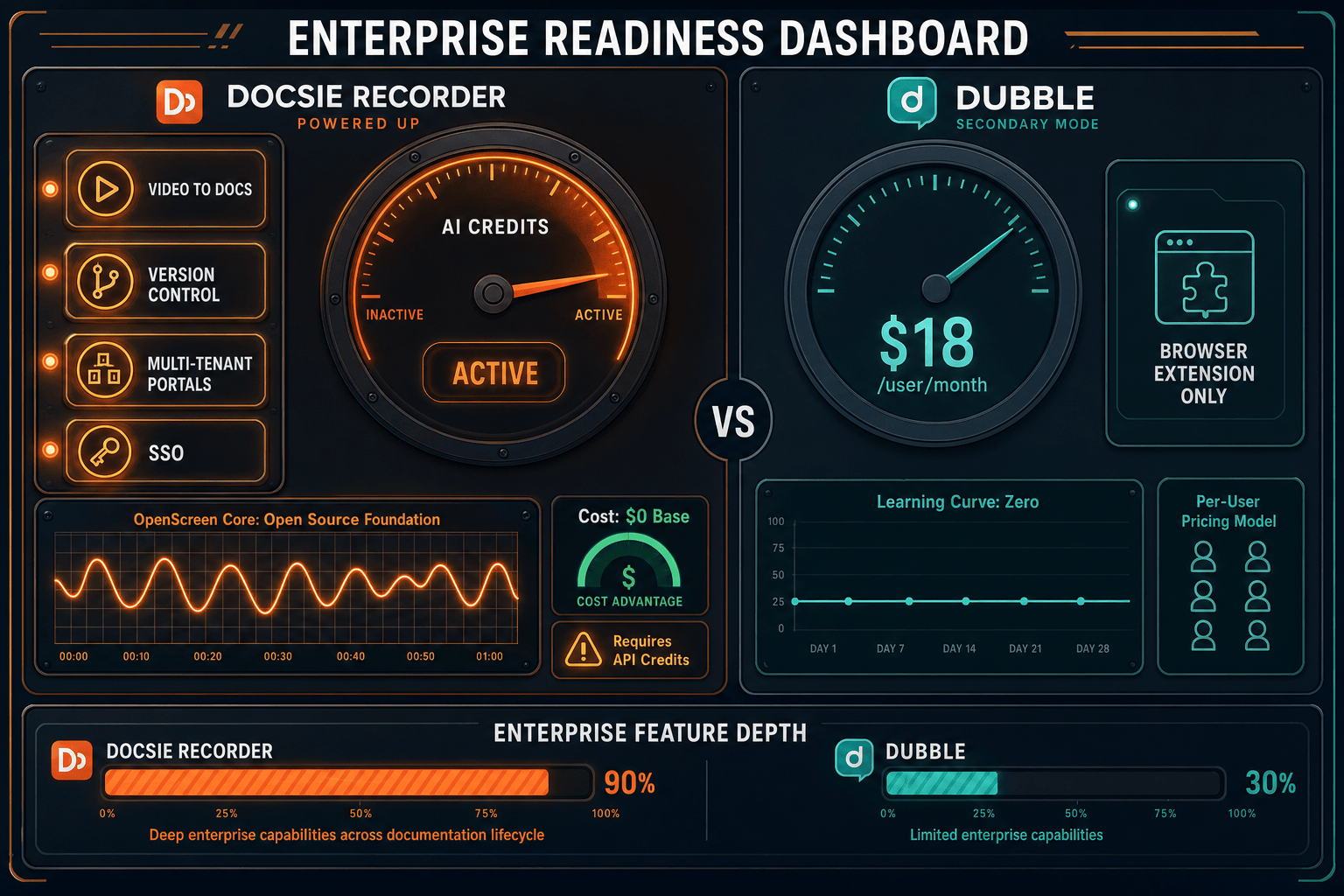
Winner: Docsie Recorder
Docsie Recorder is the clear enterprise-ready choice. Its open-source recorder core provides supply-chain auditability, its cross-platform desktop app removes browser-dependency risks, and its native connection to the Docsie platform delivers every enterprise control that procurement and security teams require — SSO, SOC 2, GDPR, HIPAA readiness, audit logs, RBAC, versioned knowledge bases, multi-tenant portals, API access, and a documented uptime SLA. Dubble meets none of these enterprise criteria and is better evaluated as a lightweight internal SOP tool rather than an enterprise documentation platform.
Decision Helper
A direct framework for picking between Docsie Recorder, Dubble, and Docsie based on your specific needs.
Docsie's free browser-based recorder that pipes captures straight into Docsie SOPs.
AI-assisted step-by-step guide capture for process documentation.

Convert real video into searchable docs, then deploy via multi-tenant portals.
Common Questions
Q: Does Dubble have SOC 2 compliance?
A: No. Dubble only acknowledges GDPR compliance on its public documentation. There is no published SOC 2 Type II certification, no HIPAA readiness statement, and no audit log functionality. Docsie's platform, which Docsie Recorder connects to for documentation publishing, holds SOC 2 Type II certification and supports GDPR and HIPAA-ready deployments with documented data residency options.
Q: Can Dubble support SSO for enterprise identity management?
A: No. Dubble does not offer SSO of any kind — no SAML, no OAuth, no OIDC, no Azure AD, and no Okta integration. Enterprise teams that require centralized identity management cannot use Dubble in a compliant configuration. Docsie Recorder's downstream Docsie platform supports all major SSO methods, making it compatible with enterprise identity providers.
Q: Is Docsie Recorder's source code auditable by enterprise security teams?
A: Yes. Docsie Recorder is built on an MIT-licensed open-source core available on GitHub, allowing enterprise security and legal teams to audit the recorder codebase directly before deployment. This is a meaningful differentiator for organizations with software supply chain policies or procurement requirements around open-source components. Dubble's Chrome extension code is not open-source.
Q: Does Dubble provide audit logs for documentation governance?
A: No. Dubble has no audit log functionality. Teams cannot track who created, edited, or shared a guide, which makes Dubble unsuitable for any compliance regime that requires documentation change history. Docsie's platform provides full audit logs covering content changes, user actions, and publishing events, supporting governance requirements for regulated industries.
Q: Can Dubble deliver documentation through multi-tenant portals for different departments or clients?
A: No. Dubble generates shareable guide links and basic shared collections but has no multi-tenant portal architecture. Each guide is a standalone output with no branded portal delivery, no custom domain support, and no per-tenant access control. Docsie Recorder connects to Docsie's multi-tenant platform, which allows a single workspace to power unlimited branded documentation portals for different clients, departments, or product lines.
Q: What happens to documentation governance when a Dubble account is cancelled?
A: Because Dubble lacks version control, audit logs, and a structured knowledge base, there is no portable documentation history to retrieve if the account is cancelled or the company pivots. Guides exist as discrete outputs without lineage or governance records. Docsie Recorder's output flows into Docsie's versioned knowledge base, where every document revision, approval event, and publishing action is retained and exportable, protecting institutional knowledge even through account or vendor transitions.
Download Docsie Recorder free — record on Mac, Windows, or Linux, then convert your recordings into structured, versioned documentation delivered through enterprise-grade portals with SSO, audit logs, and SOC 2 compliance.
Free to download. No account required to record and export video. Docsie AI credits used for Video-to-Docs conversion.