
4.8
on G2
 Docsie Recorder
 Cap
Cap
Both Docsie Recorder and Cap are open-source screen recorders positioned as Loom alternatives. But when enterprise teams ask about SSO, compliance, audit logs, scalability, and a downstream documentation pipeline, the two products diverge significantly. This page breaks down which tool is genuinely enterprise-ready and why.
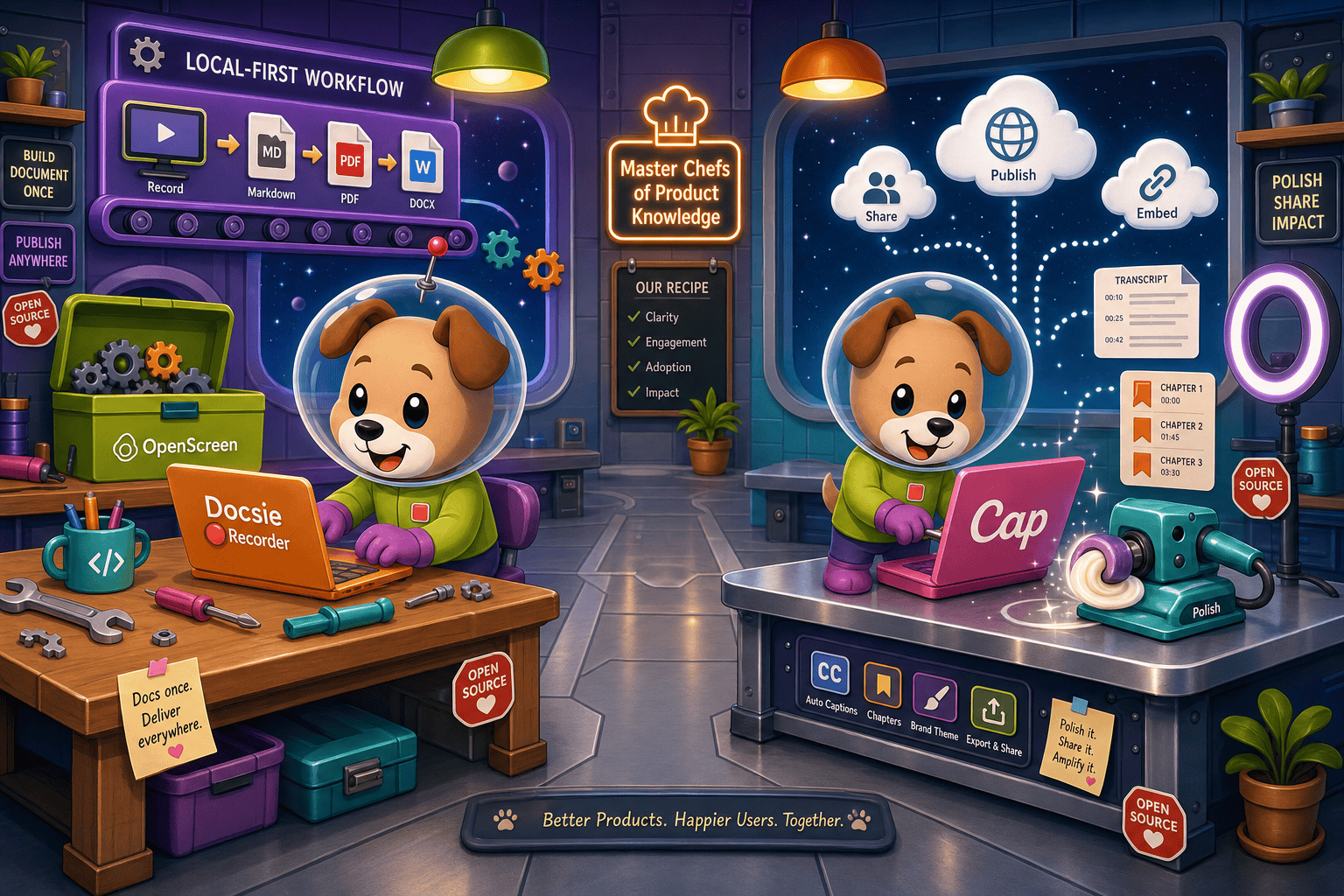
For enterprise buyers, Docsie Recorder and Cap cover narrow slices (mit-licensed recorder core gives legal and security teams a clean and genuine open-source product with self-hosting path) while Docsie adds SSO, audit trails, multi-tenant portals, and compliance monitoring in one platform.
Enterprise Feature Matrix
A focused comparison of the enterprise-grade capabilities that matter to IT, security, and operations teams evaluating an open-source screen recorder for org-wide deployment.
| Capability |
Docsie Recorder
Our Pick
|
Cap
|
|---|---|---|
| Free Desktop Recorder | ||
| Open-Source Recorder Core | MIT (OpenScreen base) | AGPLv3 / some MIT crates |
| Mac Support | ||
| Windows Support | ||
| Linux Support | Public build details available | |
| Self-Hostable | Recorder is local-first; Docsie platform self-host on request | |
| SSO (SAML / OAuth / OIDC) | Enterprise tier | |
| Role-Based Access Control | ||
| Audit Logs | ||
| SOC 2 / Compliance Certifications | Docsie platform; confirm current certs | Limited public detail |
| GDPR Compliance Controls | Limited public detail | |
| Data Residency Options | EU and custom on Docsie enterprise | Self-hosting available |
| Video-to-Docs Conversion | ||
| Markdown / DOCX / PDF Export | ||
| Knowledge Base Publishing | ||
| Versioned Documentation Management | ||
| Multi-Tenant Portal Delivery | ||
| API Access | ||
| Enterprise Deployment Path | Recorder (MIT) + Docsie platform enterprise tier | Custom enterprise plan |
| Dedicated Support / SLA | Available on Docsie enterprise | Enterprise plan SLA terms |
Data as of 2026. Features reflect publicly available information. Confirm enterprise-tier specifics with each vendor before procurement decisions.
Strengths & Weaknesses
Deep Dive
Enterprise readiness is more than a feature checklist. This section examines Security & Compliance, Scalability & Performance, Administration & Control, and Support & SLA — the four categories that procurement and IT teams weigh when approving a screen recorder for org-wide use.
Docsie Recorder's MIT-licensed core gives security teams a fully auditable codebase with no copyleft obligations, while the downstream Docsie platform adds SSO (SAML, OAuth, OIDC), RBAC, audit logs, EU data residency, and GDPR controls. Cap is open-source under AGPLv3, which is auditable but introduces copyleft terms that enterprise legal teams must review. Cap's compliance certifications and audit log support are unconfirmed at the time of writing. For regulated industries — healthcare, finance, government — Docsie's combination of permissive recorder license plus enterprise-grade platform controls is a materially stronger compliance posture than Cap's current offering.
Docsie Recorder captures and edits locally, so recording performance does not depend on cloud infrastructure or bandwidth. When teams scale to hundreds of users, the Docsie platform handles versioned documentation, multi-tenant portal delivery, and API-driven workflows without per-seat recording bottlenecks. Cap's cloud-sharing model is convenient for small teams but introduces cloud dependency for video storage and sharing at scale. Self-hosting Cap requires operational work that grows with team size. Docsie's architecture — local recorder feeding a managed documentation platform — scales more predictably for enterprise deployments than a cloud-sharing-first video tool.
Enterprise IT teams need to provision users, enforce policies, review access, and govern content. Docsie delivers this through the Docsie platform layer: SSO integration, role-based access controls, audit logs, workspace administration, and version-controlled documentation. Cap offers role-based access and collaboration features, but audit logs are not confirmed, and enterprise administration depth is unconfirmed. Critically, neither tool lets admins govern a recording after it has been shared as a video link — but Docsie's Video-to-Docs pipeline routes recordings into a governed knowledge base where admins can apply review workflows, access controls, and content lifecycle policies that a video share link simply cannot provide.
Docsie's enterprise tier includes dedicated support and uptime SLA coverage through the Docsie platform, backed by a commercially supported product with an established customer base. Cap's enterprise plan offers custom deployment and team administration, but specific SLA terms and dedicated support commitments require direct vendor confirmation. For enterprise procurement, verifiable SLA terms, named support contacts, and a clear escalation path are non-negotiable. Docsie's commercial enterprise boundary — separate from the MIT recorder core — provides the contractual support structure that IT and legal teams require, while Cap's enterprise offering is still maturing.
Our Recommendation
Both Docsie Recorder and Cap are genuine open-source screen recorders and credible Loom alternatives. For teams that primarily need async video sharing with a self-hosting option, Cap is a strong, fast-moving product. But for enterprise teams that need recordings to feed a governed documentation pipeline — with SSO, audit logs, versioned knowledge bases, API access, and compliance controls — Docsie Recorder is the more complete enterprise solution. The key difference is not just the recorder itself: it is what happens after the recording ends.
Choose Docsie Recorder if you need...
Choose Cap if you need...
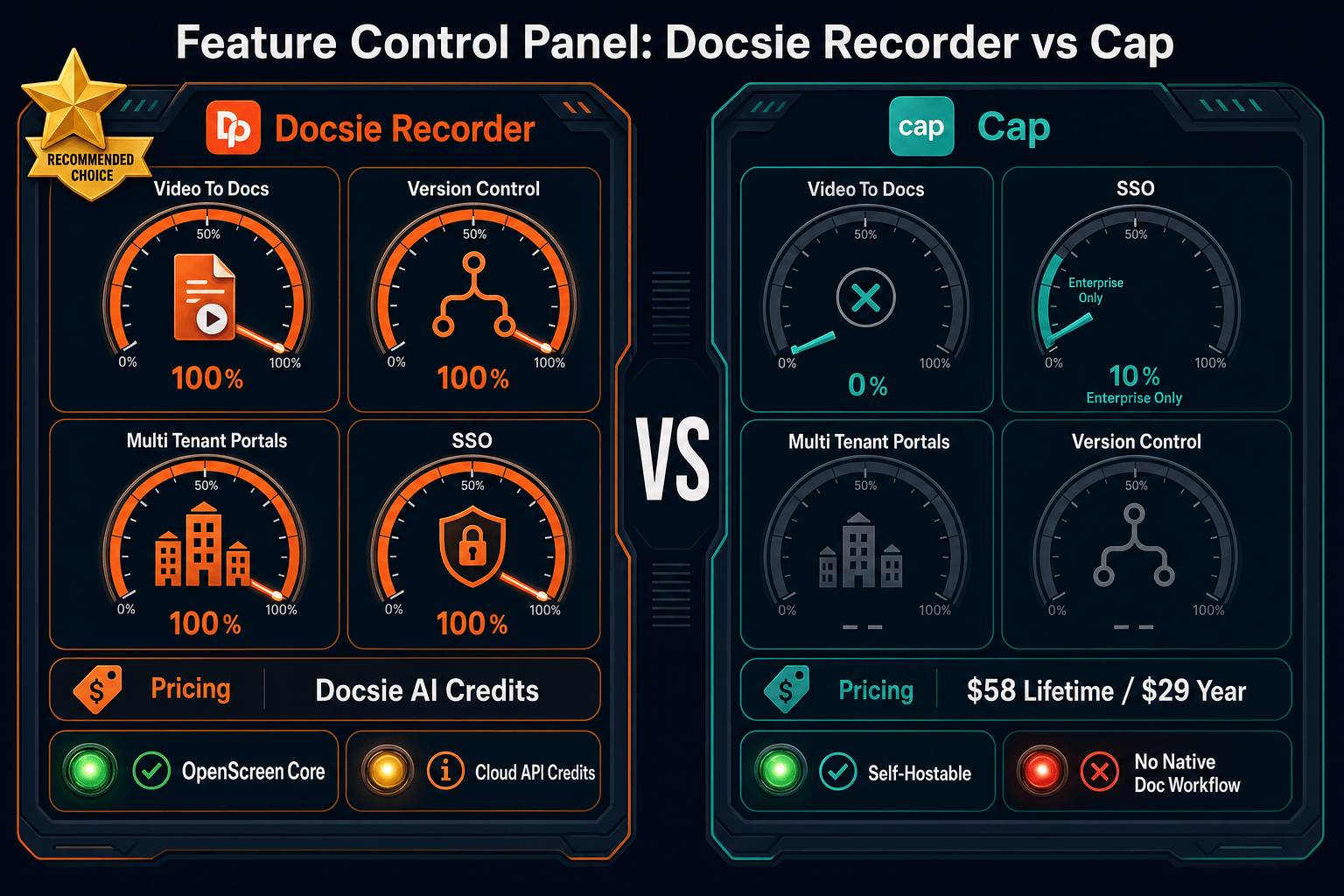
Winner: Docsie Recorder
Docsie Recorder wins the enterprise readiness comparison because it pairs a permissive MIT-licensed recorder with a commercially supported platform that delivers SSO, audit logs, RBAC, versioned documentation, multi-tenant portals, and API access. Cap is a strong video-first product, but it stops at the shareable video — it does not convert recordings into governed, searchable documentation. For enterprise teams, the ability to route a screen recording into a structured knowledge base with compliance controls is the capability that makes Docsie Recorder the more complete and enterprise-ready choice in 2026.
Decision Helper
A direct framework for picking between Docsie Recorder, Cap, and Docsie based on your specific needs.
Docsie's free browser-based recorder that pipes captures straight into Docsie SOPs.
Open-source screen recorder with team workspaces and instant share links.

Convert real video into searchable docs, then deploy via multi-tenant portals.
Common Questions
Q: Does Cap support SSO for enterprise teams?
A: Cap lists SSO as an enterprise-tier feature, but the specific protocols supported (SAML, OAuth, OIDC) and implementation maturity are unconfirmed at the time of writing. Docsie Recorder's downstream platform supports SAML, OAuth, and OIDC with established enterprise SSO integrations including Azure AD and Okta. Teams with hard SSO requirements should confirm Cap's current implementation directly with their sales team before committing.
Q: Which tool provides audit logs for compliance and security reviews?
A: Docsie's platform layer provides audit logs covering user actions, content changes, and access events — a standard requirement for SOC 2, HIPAA, and ISO 27001 audits. Cap does not have confirmed audit log support in its current feature set. For teams in regulated industries where audit trails are mandatory, this is a significant gap in Cap's current enterprise readiness.
Q: How does the open-source license difference between Docsie Recorder and Cap affect enterprise procurement?
A: Docsie Recorder's core is MIT-licensed, meaning enterprise legal and procurement teams can use, modify, and integrate it without copyleft obligations. Cap's main repository is AGPLv3, which requires that modifications or network-distributed versions of the software also be released under AGPL. Enterprise legal teams frequently flag AGPL as requiring additional review before approval, making Docsie Recorder's MIT core a simpler procurement path for many organizations.
Q: Can Cap's recordings be converted into structured documentation for a knowledge base?
A: Cap does not have a confirmed native video-to-docs or step-guide generation workflow. Its AI features produce transcripts, summaries, and chapter markers within the Cap video player, but these do not export as structured Markdown, DOCX, or PDF into a knowledge base. Docsie Recorder's Video-to-Docs pipeline converts recordings into structured documentation that publishes directly into versioned Docsie knowledge bases, closing the loop from recording to governed content.
Q: Is Docsie Recorder suitable for teams that want a fully local, air-gapped workflow?
A: Docsie Recorder captures and edits recordings entirely locally with no account required for MP4 and GIF export. The Video-to-Docs conversion step does use the Docsie cloud API, so a fully air-gapped AI conversion workflow is not available in the current release. Teams with strict air-gap requirements should note this and discuss enterprise deployment options directly with Docsie. Cap's self-hosting option gives more infrastructure control for video storage, but also lacks local AI processing.
Q: Which tool scales better for a large enterprise rolling out screen recording org-wide?
A: Docsie Recorder's architecture — local recorder with a managed documentation platform backend — scales without per-seat recording bottlenecks. IT can deploy the MIT-licensed recorder app across macOS, Windows, and Linux endpoints while the Docsie platform handles SSO provisioning, RBAC, versioned content governance, and API integrations centrally. Cap's self-hosting path requires ongoing infrastructure operations that grow with deployment size. For enterprise-wide rollout with centralized administration and compliance controls, Docsie Recorder's two-layer model is more operationally scalable.
Download Docsie Recorder free, capture your first walkthrough, and see how one recording becomes structured, governed documentation — published to a versioned knowledge base with SSO, audit logs, and API access ready when your enterprise needs them.
MIT-licensed recorder core. No account required to record and export MP4. Video-to-Docs conversion uses Docsie AI credits.