
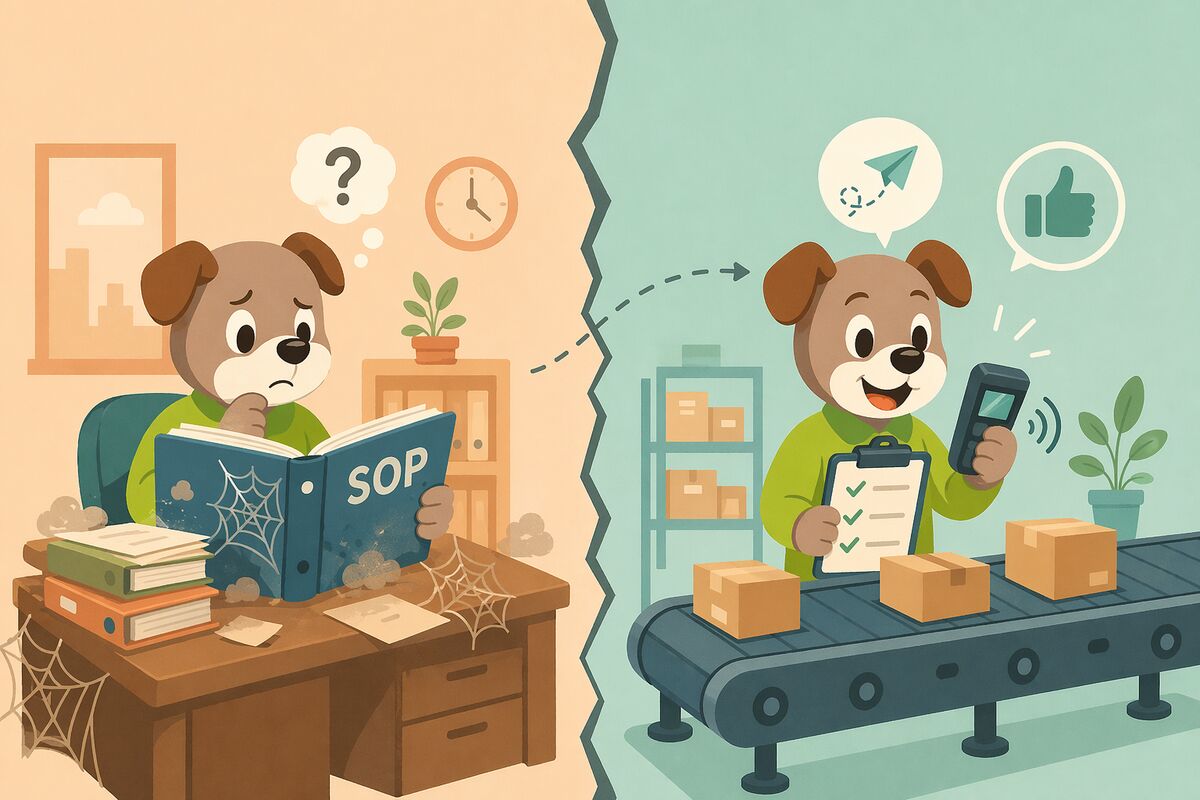
This is a hard thing to say, but most supply chain managers already know it is true: the SOPs in your document management system are not an accurate description of how work happens in your warehouse.
They are an accurate description of how someone believed work happened, at some point in the past, under the conditions that existed when the document was written.
That's not the same thing.
How SOPs get written
The traditional SOP creation process goes something like this. A process owner or technical writer sits with a subject matter expert — usually a senior operator or supervisor — and asks them to walk through the process. The expert describes it from memory, or demonstrates it once while the writer takes notes. The writer drafts a document. The document goes through review. Someone approves it. It gets filed.
This process has several structural problems.
Memory is reconstructive. When an expert describes a process from memory, they describe the idealized version — the way it's supposed to work, not the way it actually works under normal conditions, peak load, equipment issues, or staffing variations. The edge cases and workarounds that constitute real operational expertise don't make it into the document because they don't surface in a calm documentation session.
Observation is time-limited. Even when a writer observes the process being performed, they see one instance, performed by one person, under the conditions that existed at that moment. They miss the variation that exists across workers, shifts, and conditions.
Documentation ages. Processes change. Equipment changes. Systems change. Workarounds get developed and normalized. The document doesn't update automatically — someone has to notice that it's out of date, prioritize updating it, and go through the creation process again. This rarely happens on a meaningful schedule.
The consequence of the gap
When the documented process and the real process diverge, the consequences show up in several places.
Training fails to transfer. New hires are trained on the documented process and then discover, once on the floor, that experienced workers don't actually do it that way. They either adopt the undocumented real process (which may or may not be better) or they stick with the documented one and become outliers.
Audits become theater. Compliance audits measure conformance to documented procedures. If the documented procedures don't reflect actual practice, audits measure nothing operationally meaningful — they just confirm that the documentation exists.
Improvement initiatives stall. You can't systematically improve a process you can't accurately observe. Improvement projects built on inaccurate baseline documentation will optimize the wrong things.
Closing the gap with video
The only way to close the gap between documented and real processes is to observe work as it actually happens, at scale, across enough instances to see the real distribution of behavior.
Body cam footage, processed by AI, makes this possible for the first time at reasonable cost and effort. A warehouse that deploys wearable cameras on a sample of workers performing a target process can generate accurate, structured documentation of real practice within a shift.
That documentation becomes the new baseline — not what someone believed the process was, but what it actually is. From that accurate baseline, standardization, improvement, and compliance become achievable in ways they weren't before.
The goal is not to catch workers doing it wrong. The goal is to find out what right actually looks like in practice, and build systems that help everyone get there.
Docsie closes the gap between documented and real warehouse processes — with AI-powered video analysis that runs on your infrastructure. Book a demo.