
Send ten people through the same training. Give them the same SOP. Put them on the same shift, in the same warehouse, doing the same job.
Come back six months later and record them all doing it.
You will not get ten identical processes. You will get ten variations of a process — some better than the documented version, some worse, some just different in ways that are hard to categorize but easy to measure once you have the right tools.
This is not a training failure. It is how human work evolves. The question is whether you have visibility into it.
Why variation is invisible at scale
A warehouse floor supervisor can watch one worker at a time. A quality team can audit one process per quarter. A trainer can observe onboarding, but not what happens six months after onboarding when habits have settled in.
The result is that most supply chain operations teams have a high-confidence view of maybe five percent of what actually happens on their floor. The rest is assumption, anecdote, and hope.
Process variation compounds quietly. A small shortcut here, a workaround there, a step skipped during a busy shift — individually none of these are visible. Collectively they represent the difference between a process that runs at design efficiency and one that runs at something significantly less.
What a comparison matrix does
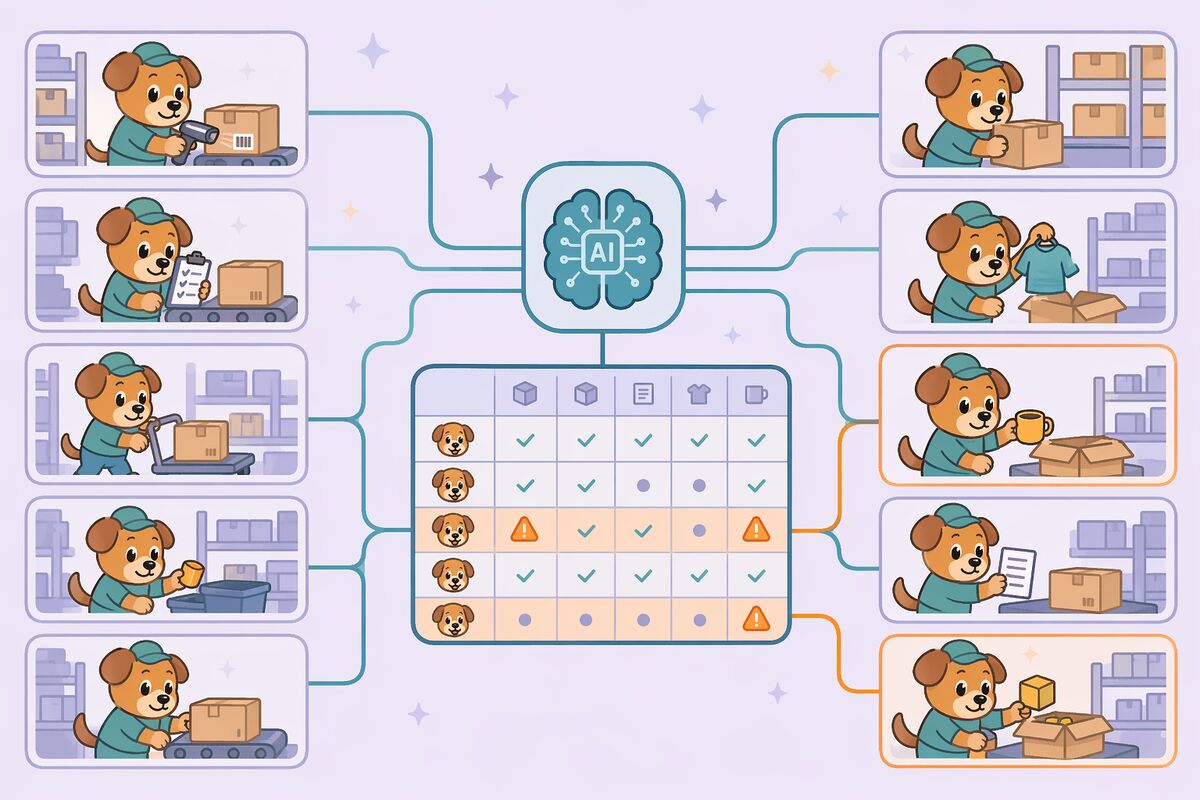
A comparison matrix is exactly what it sounds like: a structured side-by-side view of multiple instances of the same process, organized to surface differences automatically.
When AI processes ten body cam videos of the same warehouse task and generates an SOP from each one, the comparison matrix places those ten SOPs in a structured grid. It identifies:
- Steps that appear in all ten versions (the core process)
- Steps that appear in some versions but not others (variation points)
- Steps that appear in only one version (outliers — either expertise or deviation)
- Sequence differences (same steps, different order)
- Timing differences (same steps, different duration patterns)
This analysis would take a human analyst days to produce manually and would still be subject to the limits of observation and memory. AI produces it in minutes from the source footage.
What you do with what you find
The comparison matrix is not the end of the process. It's the beginning.
Once you can see where variation lives, you can ask better questions. Why does this step appear in seven versions but not three? Is the documented process actually inferior to what workers have figured out on their own? Which variation produces the best outcome — and how do you know?
This is where operations modernization actually happens. Not in a conference room reviewing a flowchart someone drew in Visio, but in the gap between what was designed and what is practiced.
AI can go further. Once you have a complete map of all process variations, you can ask the system to recommend a unified process that eliminates redundant steps, resolves conflicting approaches, and incorporates the best practices your most effective workers have developed organically. You can ask it to think outside the documented process entirely and suggest reimagined workflows that your existing documentation would never surface.
Making it multilingual
For warehouses with multilingual workforces — which is most large distribution operations — process standardization has an additional layer of complexity. The standardized SOP needs to be understood by everyone, in the language they work in.
AI-generated documentation can be published simultaneously in multiple languages from a single source. The same process, derived from the same footage, delivered to a Spanish-speaking picker and a French-speaking supervisor and an English-speaking quality manager — each reading a document that was generated from the same underlying analysis.
This isn't translation as an afterthought. It's multilingual delivery as a native output of the documentation process.
Docsie compares process variations across worker footage, recommends unified SOPs, and publishes multilingual documentation from one source. See it in action.